Geico DriveEasy Review: Is It Worth It for Safe Drivers?
GEICO DriveEasy makes sense only if you expect careful, mostly daytime driving and can live with price changes tied to your score; skip it if you drive late, share the car with risky drivers, or want a fixed premium. A weak score can push your renewal price up, not down. This guide explains what DriveEasy tracks, who should avoid it, and how it compares with other usage-based programs.
This guide is part of our Car laws and compliance guide series.
Geico DriveEasy review: is it worth it?
DriveEasy is a solid choice for a careful solo driver who keeps steady hours and wants a shot at a lower renewal price. It may be a poor fit for mixed-driver households, night-shift workers, or anyone who wants predictable pricing, since the score can affect the premium at renewal.
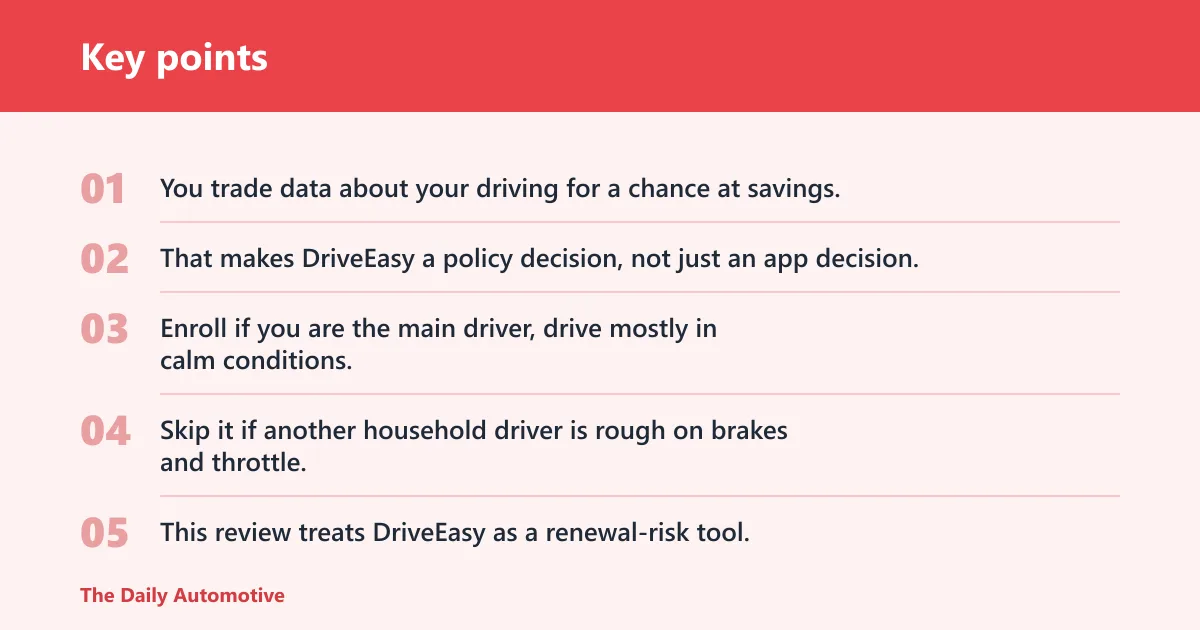
The tradeoff is plain. You trade data about your driving for a chance at savings, but GEICO suggests that poor driving habits can lead to a higher renewal rate. That makes DriveEasy a policy decision, not just an app decision.
Verdict first: who should enroll and who should skip
Enroll if you are the main driver, drive mostly in calm conditions, and can keep the app’s score signals clean. Skip it if another household driver is rough on brakes and throttle, if your schedule puts you on the road after dark, or if your policy already has a fixed rate you do not want to disturb.
What this review focuses on
This review treats DriveEasy as a renewal-risk tool. The main questions are not whether the app is simple or whether telematics can save money in theory. The real questions are who gets scored, which behaviors matter, and when a small discount is not worth the chance of a higher renewal price.
What is GEICO DriveEasy?
GEICO DriveEasy appears to be a usage-based telematics program offered through the GEICO mobile app. It watches driving behavior through the phone and turns those trips into a driving score that GEICO can use when pricing the policy at renewal.
How the telematics program works
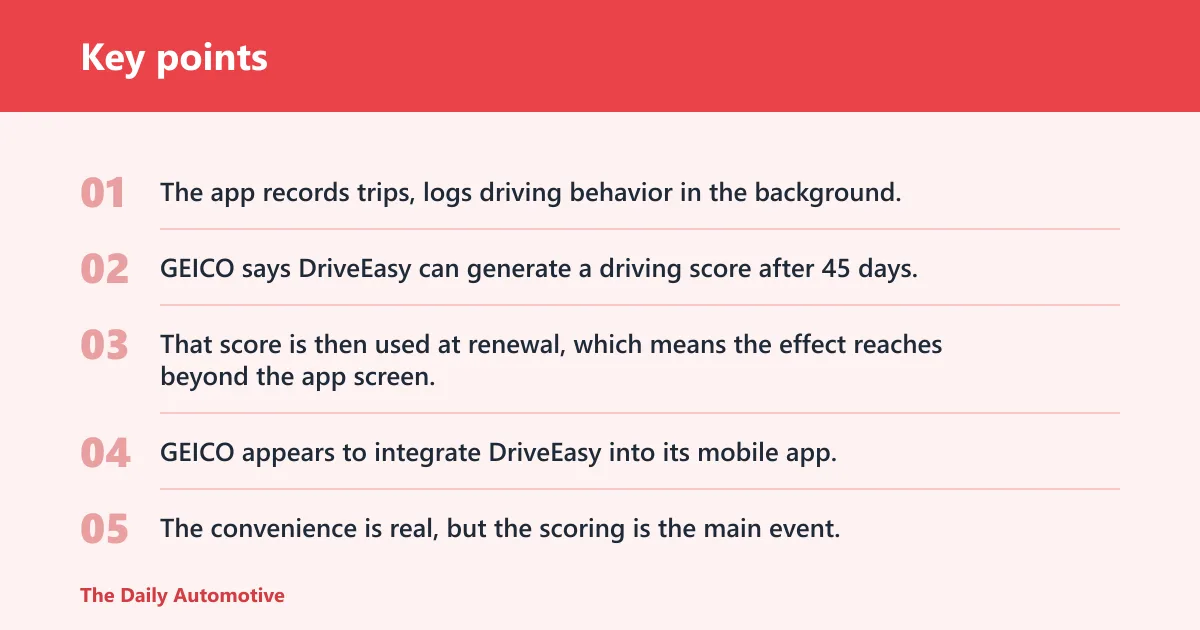
The app records trips, logs driving behavior in the background, and ties that data to the policy. GEICO says DriveEasy can generate a driving score after 45 days. That score is then used at renewal, which means the effect reaches beyond the app screen.
How the GEICO Mobile app fits in
GEICO appears to integrate DriveEasy into its mobile app, which can also handle trip tracking, policy management, and a virtual assistant. The convenience is real, but the scoring is the main event. The app is not just a dashboard; it is the measurement tool.
State availability and policy eligibility
GEICO says DriveEasy is not currently offered in CA, HI, or VT. Availability is state-specific, and pricing rules can also vary by state. Before enrolling, check whether your policy and location are actually eligible.

What does GEICO DriveEasy track?
DriveEasy tracks several driving signals, including distractions, braking and acceleration, cornering, smoothness, time of day, distance, and route regularity. AutoInsurance.com also describes braking and acceleration, plus late-night driving and route consistency, as part of the program’s scoring picture.
Driving score factors
Think of the score as a bundle of behaviors, not one single metric. Smooth, predictable trips help. Hard inputs, erratic timing, and distracting phone behavior work against you.
Phone use, including active use while driving
Active phone use while driving is a major risk signal. GEICO’s system can flag distractions, and that matters because phone handling suggests divided attention. If a passenger caused the reading, GEICO says trips can be corrected within 30 days.
Braking, acceleration, and time of day
Hard braking and rapid acceleration are read as rougher driving. Time of day also matters, so late-night trips can weigh on the score. A common first-timer mistake is assuming short trips do not count much; several short urban trips with stop-and-go traffic can still stack up poorly.
How does scoring affect your premium at renewal?
The score is policy-level, not just app-level. GEICO says DriveEasy can raise your rates if poor habits are detected, so the result is not limited to a one-time app penalty. The score can move renewal pricing up or down.
Why renewal pricing can move up or down
Usage-based pricing works by comparing your driving pattern to what the insurer expects. Careful driving may help at renewal. Poor driving can do the opposite. That is why DriveEasy matters most if you are already near a rate threshold where a small change changes the whole renewal picture.
Why short-trip and urban driving can matter
Short urban trips create frequent braking, more lane changes, and more chances for phone interaction at lights. Suppose a driver makes six five-mile trips across downtown streets each week. The app may see repeated stop-and-go patterns that look less smooth than a longer highway commute, even if the driver is alert.
Who should not enroll in DriveEasy?
Do not enroll if one person on the policy is likely to drag the household score down, if your schedule pushes you into late-night driving, or if passengers often hand a phone back and forth in the car. These cases can turn a possible discount into a renewal surcharge.
Mixed-driver households
All enrolled drivers on a policy need to participate. That household rule matters because one aggressive driver can affect everyone. If a spouse, roommate, or older teen drives hard, the policy’s overall result may reflect that behavior even if another driver is careful.
Night-shift and late-night drivers
Late-night driving is part of the score. That creates a built-in disadvantage for nurses, warehouse workers, delivery workers, and anyone else whose commute happens after dark. If the schedule cannot change, the score probably will not either.
Heavy phone-user passenger households
If passengers frequently handle the phone, correct navigation, or pass devices around, the trip data can get messy. GEICO does allow passenger-use corrections within 30 days, but that still requires attention and follow-through. If your household needs that fix often, DriveEasy may be more trouble than it is worth.
How much can GEICO DriveEasy save?

GEICO does not publish a savings figure for DriveEasy. That means there is no honest way to promise a specific discount. The better way to judge it is to weigh the size of any likely savings against the chance of a renewal increase.
Why exact savings varies by state and policy
Usage-based insurance pricing is state-dependent, policy-dependent, and driver-dependent. A clean commuter in one state may see a better result than a mixed household in another. The program is not priced like a fixed coupon.
A practical break-even view
The right question is whether the expected savings are larger than the downside risk. If the likely discount is small and the policy includes a late-night driver, a hard-braking commuter, or a teen with a phone habit, the renewal downside can erase the upside quickly.
When a small discount is not worth the risk
If you would only enroll for a modest savings edge, think carefully about the worst-case renewal result. A modest discount may not be compelling if a single poor scoring period could offset it by pushing the premium up later. That is especially true when every driver on the policy is swept into the same result.
DriveEasy decision matrix for five driver profiles
This matrix turns the policy tradeoff into a practical screen. The score is not about who is a “good person”; it is about whether the driving pattern fits a telematics program that can affect renewal pricing.
| Driver profile | Fit score | Enroll or skip | Why |
|---|---|---|---|
| Solo safe commuter | 5/5 | Enroll | Mostly steady daytime driving, fewer household variables, best chance that the score reflects one driver’s habits. |
| Mixed-driver household | 2/5 | Skip | All enrolled drivers must participate, so one aggressive driver can hurt the policy at renewal. |
| Night-shift driver | 2/5 | Skip | Late-night driving is part of scoring and can raise renewal pricing even if the driver is otherwise careful. |
| Heavy phone-user passenger household | 2/5 | Skip | Passenger phone use can be misread, and correction requires active cleanup within the 30-day window. |
| Teen-driver policy | 1/5 | Skip | Teens are more likely to trigger hard acceleration, abrupt braking, and distraction signals that can affect everyone on the policy. |
Pros and cons of GEICO DriveEasy
Pros
- Can reward careful, mostly daytime driving.
- Built into the GEICO Mobile app for trip tracking and policy management.
- Includes a correction path for misclassified passenger phone use within 30 days.
- May fit a solo policy better than a household with multiple driving styles.
Cons
- GEICO says poor habits can raise your rate at renewal.
- All enrolled drivers on the policy need to participate.
- Late-night driving and distraction can work against the score.
- GEICO does not publish a savings figure, so the payoff is hard to predict.
How to get the best DriveEasy score
The best score comes from predictable driving. Keep speed changes smooth, avoid hard braking, limit rapid acceleration, and reduce active phone handling while the car is moving. If a passenger causes a false reading, use the 30-day correction window.
Reduce hard braking and rapid acceleration
Leave more following distance and accelerate in a steady way. The goal is not perfection. It is to avoid the sharp inputs that telematics reads as risk.
Limit phone handling while driving
Do not use the phone for navigation changes, texts, or scrolling while the car is moving. If a passenger is the one touching the device, make sure the trip gets corrected. That small step can protect the score from a bad data point.
Use the correction window when needed
If the app misclassifies passenger use, act inside the 30-day trip correction window. That matters most in carpool situations, rides with teens, or shared devices where the app may not tell who touched the phone.
Frequently asked questions
is geico drive easy worth it
It is worth it mainly for a solo, careful driver who keeps mostly daytime hours and wants to gamble for a lower renewal price. It is not worth it for households with mixed driving styles, late-night commuters, or anyone who needs a fixed premium and minimal scoring risk.
how much does geico drive easy save
GEICO does not publish a savings figure for DriveEasy. That makes exact savings impossible to state in advance. The practical answer is to compare any likely discount against the chance of a higher renewal rate if the score flags risky habits.
can geico drive easy increase premium
Yes. GEICO says DriveEasy can raise your rates if poor habits are detected. That is why it should be treated as a policy-level risk, not just a discount app. A weak score can affect renewal pricing, especially when multiple drivers share one policy.
does everyone on my policy have to use driveeasy
Yes. GEICO says all enrolled drivers on a policy need to participate. That rule matters because one aggressive driver can influence the result for everyone. Mixed-driver households should be especially careful before enrolling.
what states is geico driveeasy available in
GEICO says DriveEasy is not currently offered in CA, HI, or VT. In other states, availability and pricing rules can still vary, so you should confirm eligibility for the specific policy and location before turning it on.
Products related to this article
Sponsored / affiliate links. As an Amazon Associate I earn from qualifying purchases. I may earn additional commission from eligible campaigns.