Best 5 Key Covers for Car Keys Review
This guide compares five common key covers for car keys and shows how to match a cover to your fob’s button layout, shell size, and battery-access design. Pick silicone for scratch protection, TPU for grip, and a hard shell only if the key blade and emergency release stay reachable. Buy the wrong one, and buttons can misfire, the cover can crack, or you may block the battery door.
Quick picks


| Best for | Cover type | Fit risk | Common use case |
|---|---|---|---|
| Everyday use | Silicone key cover | Low if the fob shape and button count match | Scratch and dust protection with easy button access |
| Pocket carry | TPU key cover | Moderate to low when model-specific | Lightweight protection with a tighter shell feel |
| Broken loops and worn shells | PU leather key sleeve | Moderate | Covers a damaged shell or worn edges without much bulk |
| Style-first buyers | ABS rhinestone key cover | Higher if the listing is not exact-model specific | Decorative cover for a matching fob shape and button layout |
| Irregular fobs on a budget | Universal-fit key fob case | Highest | Dimension-based buying when a model-specific cover is unavailable |
Key cover fit table
| Fob shape | Button count | Shell type | Common failure mode | Buy or no-buy verdict |
|---|---|---|---|---|
| Rounded oval | 2 or 3 | Silicone sleeve or soft shell | Buttons can feel mushy if the cutouts are shallow | Buy if the listing names the exact shape |
| Flat rectangle | 4 or 5 | TPU or silicone full shell | Loose edges can shift near the side buttons | Buy model-specific first; universal only after measuring |
| Large sculpted fob | 5+ | Hard shell or decorative cover | Bulk can block the battery door or the emergency blade release | No-buy unless the listing shows the exact fob and back side |
| Worn shell with intact electronics | Any matching layout | PU leather sleeve | Stitching or tight seams can interfere with button edges | Buy for cosmetic repair if the fob still closes cleanly |
| Irregular or very slim fob | Any | Universal-fit case | Gaps, loose closure, or a button press that feels uncertain | No-buy unless dimensions match within the listing’s stated range |
Silicone key cover
The silicone key cover is the simplest choice for scratch and dust protection, and it usually gives the easiest button access of the common shell styles. Its soft, flexible material also makes it a strong match for daily pocket carry, especially when the owner wants grip without much bulk.
What it protects well
Silicone works best against the small damage that shows up daily: key rubbing against coins, dust building around buttons, and light bumps in a pocket or bag.
Where button feel can suffer
The tradeoff is feel. If the button cutouts are too shallow or the silicone is too thick around the face, the button press can feel dull or inconsistent. That is why exact fob shape and button count matter more than color.
Who should buy it?
Choose silicone if you want a low-risk, low-fuss cover for commuting, grocery runs, and pocket carry. It is also a practical buy for drivers who want a simple replacement for a worn shell without adding much size.
How do you know if a TPU key cover fits?
A TPU key cover fits best when the listing matches the exact fob model, button count, and side profile of your remote. TPU is a flexible shell material often described as lightweight and waterproof, so it is a strong option when you want a tighter protective fit without a rigid, decorative shell.
Model-specific fit clues
Check for the exact vehicle family, not just a color or style name. A wrong match can still look close and still fail at the buttons.
Water and scratch protection
TPU usually gives better edge coverage than a loose sleeve, which helps with scratches and dust. The shell-like feel can also help when the fob rides in a pocket with keys or a flashlight. Some listings describe it as waterproof, but that does not mean the fob can survive submersion.
When TPU is the safer buy
Pick TPU when the listing shows your exact fob and you want more shape retention than silicone. It is a sensible middle ground for drivers who want daily protection without moving to a bulky decorative shell.
PU leather key sleeve
A PU leather key sleeve is a slim sleeve-style cover that works well when the fob shell is worn or broken and the main goal is to keep the remote usable.
Slim carry benefits
Leather-style sleeves usually slide into a pocket cleanly and can look more polished than silicone. They also work well when the key is carried with a bag clip or on a key ring, because the sleeve does not add much thickness.
Tradeoffs for worn or broken keys
The downside is that a sleeve may not protect the fob as completely as a full shell. If the edges are cracked badly, or if the buttons sit proud of the housing, stitching and seam placement can make the fit less predictable.
When a sleeve beats a shell
Choose a sleeve when the fob still functions, the battery door stays secure, and the owner wants a quick cosmetic repair. It can also make sense for broken-loop repairs where the aim is to keep the remote carried safely while avoiding a larger replacement shell.
ABS rhinestone key cover
An ABS rhinestone key cover is the style-first option in this group. The rigid shell construction gives it more shape than a soft sleeve, while the decorative surface is aimed at drivers who want the fob to look intentional rather than plain.
Rigid shell fit warnings
This is the style most likely to cause trouble if the fit is vague. If the listing is generic, treat that as a warning sign.
Decoration versus daily durability
Rhinestone surfaces can wear differently from plain silicone or TPU. The decorative finish may hold up fine in a purse, but it can also feel bulkier and can make a fob less comfortable in a tight pocket.
Best use case for this style
Buy ABS rhinestone only when the listing matches your exact fob and the main goal is appearance plus basic protection. It works best for light daily use, not for rough carry or frequent drops.
Which universal fit case works?
A universal-fit key fob case works only when the fob’s dimensions, shape, and button layout fall close to the listing’s stated range. It is the fallback choice, not the default choice. If the fob has odd corners, a thick back, or a protruding emergency blade, a universal case can feel loose or block access.
Measurement checklist
- Measure the fob’s total length, width, and thickness.
- Count the buttons, including trunk or remote-start buttons.
- Check whether the battery door opens from the back or the side.
- Look for an emergency key blade or release tab that must stay reachable.
- Compare the listing photos to your fob from the front and back.
Loose-fit risk signs
If the seller only lists “universal” without dimensions, that is a warning. So is a listing that shows a large family of fobs but not your exact shape. A universal case can also fit loosely when the button spacing is odd, even if the length looks close.
When to buy model-specific instead
Choose model-specific when the fob shape is unusual, the button layout is crowded, or the battery door is already hard to reach.
How should you choose one?
The right choice comes down to how you carry the key and what usually fails first. Daily commuters should lean toward silicone or TPU. Purse carry favors a slim sleeve or a softer shell. Broken-loop repairs need a cover that preserves access to the ring point without hiding the buttons.
Daily commute and pocket carry
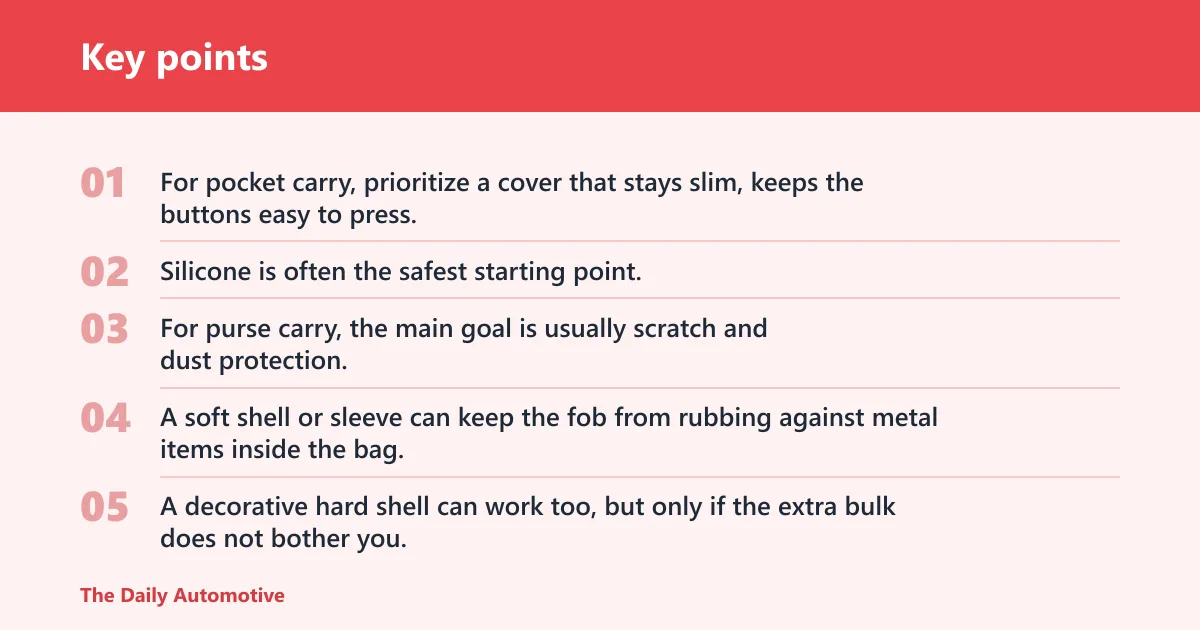
For pocket carry, prioritize a cover that stays slim, keeps the buttons easy to press, and does not snag on fabric. Silicone is often the safest starting point, and TPU is the next step up if you want a firmer shell.
Purse carry and scratch protection
For purse carry, the main goal is usually scratch and dust protection. A soft shell or sleeve can keep the fob from rubbing against metal items inside the bag. A decorative hard shell can work too, but only if the extra bulk does not bother you.
Broken-loop repair and worn-shell replacement
When the loop is cracked or the shell is worn, replace only the cover if the electronics still close cleanly and the battery door stays secure. A cracked cover can often be replaced without replacing the entire fob, but the new shell still needs the exact cutouts for the blade, buttons, and battery access.
Keychain and holder extras
Some listings add a separate keychain or holder accessory, including heart-shaped or decorative keychains. That can help with carrying and style, but it should not hide the main fit question: does the cover match the fob itself?
Say your fob slides around in your pocket and the buttons get pressed by accident. A silicone cover with clear button cutouts is the better answer than a rhinestone shell that looks good but feels bulky. The right style fixes the use problem first.
What is key cover?

A key cover is a protective shell, sleeve, or holder that wraps a car key fob to reduce scratches, dust exposure, and everyday wear. Common forms include full shell covers, sleeves, zippered holders, and key ring cases. The useful one is the one that matches your exact fob shape and button layout.
Frequently asked questions
Do silicone car key covers block signal?
Usually no. Silicone itself does not normally stop the signal from a key fob, and most issues come from a cover that is too tight, misaligned, or blocking the button from pressing fully. If the remote works before the cover goes on and not after, the fit is the first thing to check.
Are leather key covers better than silicone?
Not across the board. PU leather can look slimmer and more polished, while silicone usually gives easier grip and simpler button access. Leather-style sleeves can be better for worn keys or purse carry; silicone is often better for scratch protection and quick daily use.
Can I replace a cracked car key cover only?
Yes, if the electronics still function and the housing style allows a shell swap. That is often the right move when the outer case is cracked but the battery door, buttons, and blade release still work. If the internal clips are broken too, a full fob replacement may be the cleaner fix.
How do I know if a universal key cover will fit?
Measure the fob’s length, width, and thickness, then compare those numbers with the listing. The button count and layout matter just as much. If the seller gives only generic “universal” language and no dimensions, treat the fit as uncertain and choose a model-specific cover instead.
Where can I find a car key cover near me?
Local auto parts stores, locksmith shops, and some hardware retailers may carry basic silicone or sleeve-style covers. The drawback is selection. Local shelves often have fewer exact-model options than online listings, so a nearby store is best for simple universal styles when you can verify the size in person.
Are Amazon car key covers worth buying?
They can be, but only if you check the model match, button count, and battery access before ordering. Online listings usually offer more styles and more exact-model choices than a local store. The risk is also higher if the listing photos are vague or the dimensions are missing.
What material is best for a car key protector cover
Silicone is the best general choice for scratch protection and easy grip. TPU is a strong second choice when you want a firmer shell and a model-specific fit. PU leather fits better when appearance matters more, while ABS and metal styles are better reserved for exact-match, style-led purchases.
Products related to this article
Sponsored / affiliate links. As an Amazon Associate I earn from qualifying purchases. I may earn additional commission from eligible campaigns.