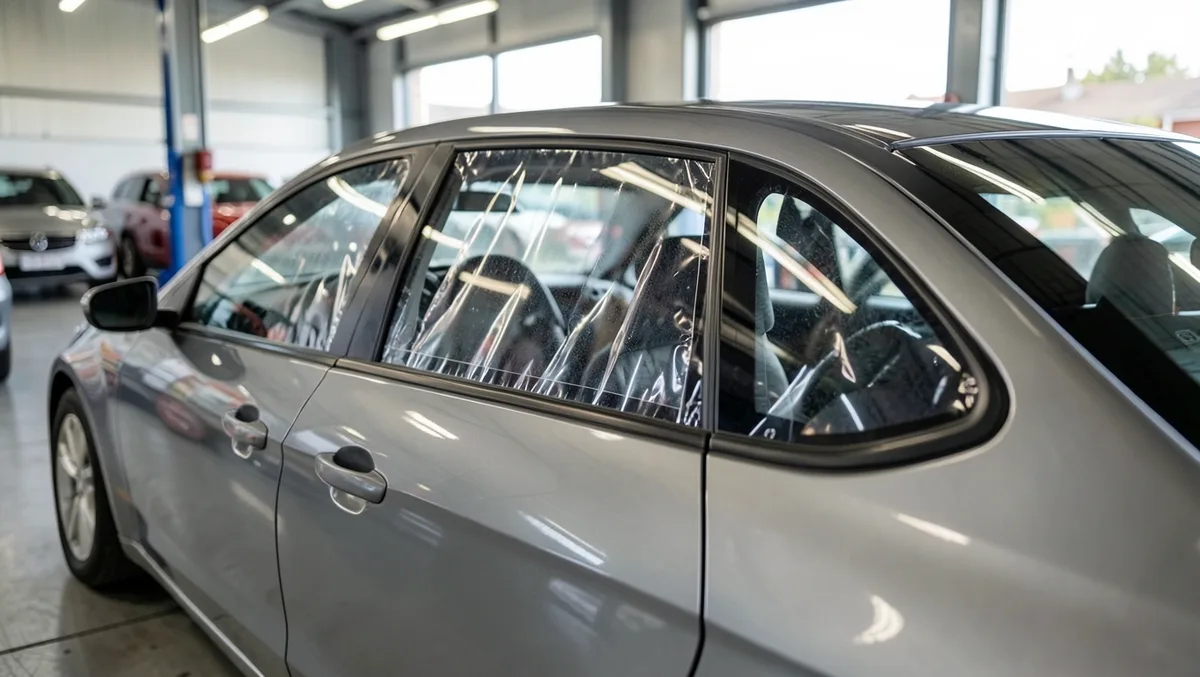
Lexan Glass for Cars: Legality, Uses and Best Cleaners
Lexan/polycarbonate is generally not road-legal for windshields or front side windows on street cars unless the part is certified to the applicable glazing standard; it is often used for race, off-road, and some rear or interior applications. Get it wrong, and you can end up with failed inspection, poor visibility, scratching, or permanent haze. This guide explains where Lexan is allowed, where it is not, and how to clean it without damage.
What is Lexan on a car?


Lexan is a trade name commonly used for polycarbonate glazing, which is a plastic material rather than glass. On a car, that matters because polycarbonate is lighter and more impact-resistant in some uses, but it is also more scratch-prone than automotive glass and needs different cleaners and softer tools.
That material change also changes the cleaning job. Automotive glass can handle standard glass cleaners and, in some cases, more aggressive polishing. Polycarbonate needs plastic-safe products, light pressure, and a towel that will not drag grit across the surface.
Polycarbonate vs. automotive glass
Poly(bisphenol A carbonate), the most common type of polycarbonate, is used where impact resistance and weight savings matter more than everyday abrasion resistance. Glass is harder. Polycarbonate is easier to mark. That is why a cleaner that works fine on a windshield can haze a Lexan panel if it carries the wrong solvent or abrasive.
Where Lexan is commonly used
Lexan windows are commonly used in motorsport, track, race, and off-road applications. Those uses often accept trade-offs that a street car cannot. Side windows, rear panels, and interior partitions are the most common places to see polycarbonate because the vehicle is being built for competition, weight reduction, or debris resistance rather than standard road compliance.
Why scratch resistance matters
Scratch resistance matters because dirt turns a wipe into abrasion. A dry towel can grind dust into the surface. A paper towel can leave fine marks. Once haze starts, it is harder to remove than ordinary film, and a strong polish can make the problem worse if the surface already carries micro-scratches.
Is Lexan legal for road cars?
Lexan is not universally road-legal. Whether it is allowed depends on your location, the vehicle application, and the glazing standard that applies to that part of the car. On street cars, windshields and front side windows face the strictest rules because they affect forward visibility and occupant protection.
Windshields and forward visibility rules
Front glass is where the legality question gets toughest. Many jurisdictions require certified safety glazing for windshields, and inspection schemes often also expect a reasonable level of optical clarity and abrasion resistance. Polycarbonate can be legal only when the exact part is approved for that use under the local rule set.
Side windows and rear glass rules
Side windows and rear glass are often treated differently from windshields. Some places allow polycarbonate in rear or non-driving-critical positions, while others limit it to competition vehicles or specific conversions. The answer is local, not universal, so the same panel can be compliant in one setting and rejected in another.
Track, race, and off-road use
Track, race, and off-road vehicles are the most common legal homes for Lexan. Those vehicles often operate under event rules, class rules, or off-road equipment rules rather than normal highway glazing rules. That does not remove the need for safety, but it does change what is allowed on the vehicle.
Can you use Lexan on a windshield or side windows?
You may be able to use Lexan on a windshield or side window only if your local rules, inspection standards, and the part certification all line up. On a road car, assume the answer is no until you confirm the exact glazing standard for that position and vehicle type.
What to check in local regulations
Check whether the rule applies to the vehicle class, the window position, and the glazing material itself. Some places allow polycarbonate only in motorsport or off-road use. Others permit it only for rearward positions or for modified vehicles with documentation. If a part lacks the right marking, it may still fail inspection.
Inspection and insurance concerns
Even if a window seems acceptable, inspection and insurance rules can still be stricter than the owner expects. A vehicle that passes one test may fail another if the examiner wants factory-style safety glass in a certain position. If the car has to be driven on public roads, check both compliance and coverage implications.
When glass is the safer choice
Glass is the safer choice when legal certainty matters more than weight savings. It is harder to scratch, easier to clean, and more predictable for daily driving. If the vehicle is a commuter, family car, or any road car that must pass routine inspections, glass usually avoids the compliance and care problems.
Lexan cleaner matrix
This table separates what is generally safe for polycarbonate from what needs caution and what should stay off Lexan. The key rule is simple: if the ingredient or tool can haze, soften, or abrade plastic, it does not belong on the panel unless the manufacturer explicitly approves it.
| Safe | Use with caution | Avoid |
|---|---|---|
| Dedicated plastic cleaner, made for polycarbonate and less likely to haze the surface. | — | — |
| pH-neutral cleaner, mild chemistry can work if it is plastic-safe and non-abrasive. | . | . |
| Microfiber, a soft, clean towel reduces scratching compared with rough fabrics. | . | . |
| . | Alcohol, some formulas may be tolerated, but check the listing and spot test first. | . |
| . | Glass polish, can help only if the product explicitly says it is safe for polycarbonate. | . |
| . | . | Ammonia, can damage or haze plastic and is not the default choice for Lexan. |
| . | . | Methanol, harsh on polycarbonate and not a safe default for Lexan cleaning. |
| . | . | Paper towels, can leave fine marks and lint on a scratch-prone surface. |
| . | . | Abrasive pads, too aggressive for polycarbonate and likely to create haze. |
How do you clean Lexan without scratching it?
Clean Lexan with a plastic-safe cleaner, a soft microfiber towel, and light hand pressure. Start by removing loose dust first, then spray lightly, then wipe gently in straight passes. The goal is to move dirt off the panel, not rub it back and forth across the surface.
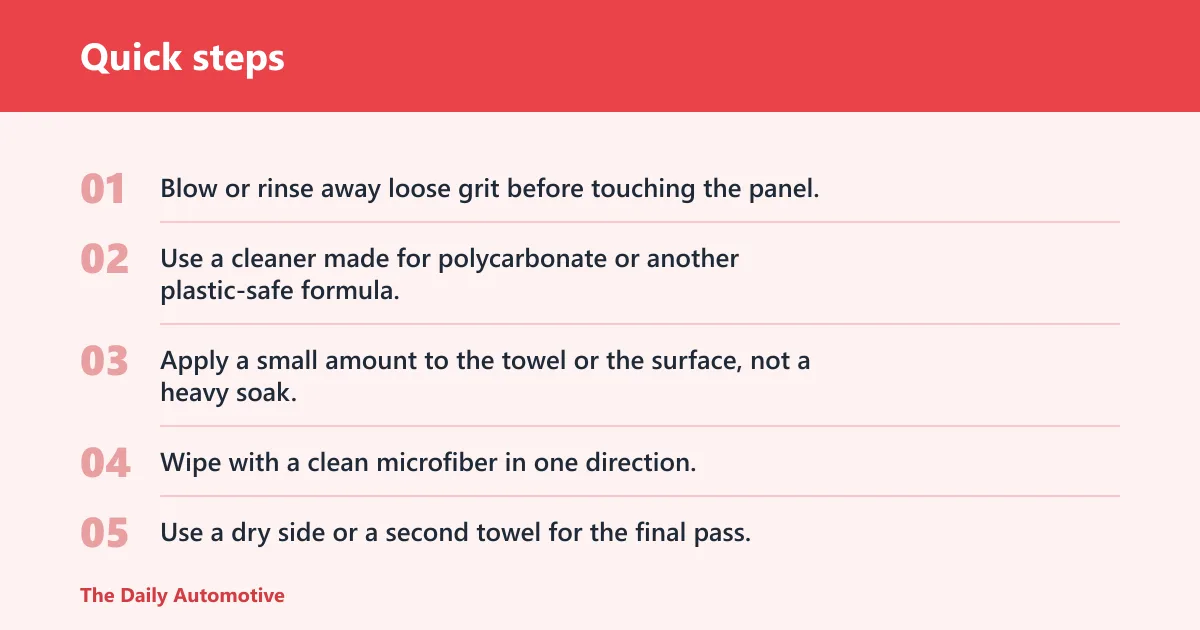
- Blow or rinse away loose grit before touching the panel.
- Use a cleaner made for polycarbonate or another plastic-safe formula.
- Apply a small amount to the towel or the surface, not a heavy soak.
- Wipe with a clean microfiber in one direction.
- Use a dry side or a second towel for the final pass.
- Stop if the surface already shows haze, because harder rubbing can make it worse.
A common first-timer mistake is to grab the same dusty towel used on painted panels. On Lexan, that turns dust into fine scratches fast. Suppose a rear race window has light road dust after transport. A dry wipe can leave a dull patch even though the panel looked only slightly dirty at first.
Remove loose dust first
Loose dust is the part you want gone before any towel touches the panel. A quick air blow, a gentle rinse, or a very light pre-wet step keeps abrasive grit from acting like sandpaper. That matters more on polycarbonate than on glass.
Use plastic-safe cleaner sparingly
More cleaner is not better. Too much liquid can leave residue, and stronger solvents can cloud the surface. A light spray is enough for most cleaning. If a spot does not lift easily, treat it gently instead of scrubbing harder.
Wipe with soft microfiber only
Microfiber is the right tool when it is clean and soft. That is true for Lexan and for tinted glass. For final buffing on automotive glass surfaces such as windshields, side windows, rear glass, mirrors, and glass roofs, a waffle weave microfiber towel is a strong choice because it helps reduce streaks and residue.
Stop if the surface is already hazing
If the panel is already hazy, the cleaning problem may have become a correction problem. At that point, more wiping may not fix it. A plastic-safe restorer or professional refinishing approach may be needed, and some hazing may not come out cleanly at all.
What should you use on tinted glass and mirrors?
For tinted glass and mirrors, use an ammonia-free, methanol-free tint-safe cleaner with a spray-and-wipe method. That keeps the film and the glass cleaner in the same lane. On tinted automotive glass, the point is a streak-free finish without stressing the tint layer.
Tint-safe, ammonia-free cleaner
A tint-safe formula is useful because it is designed to be kinder to window film and trim around the glass. Good Stuff says its glass cleaner is ammonia-free, methanol-free, suitable for tinted automotive glass, and works on windshields, side windows, rear glass, and mirrors. It is sold in three sizes.
Waffle weave microfiber for final buffing
Use a dedicated glass towel for the last pass. A waffle weave microfiber towel works well for glass, mirrors, and windows because it helps reduce streaks and residue during the final buff. Keep a separate towel for glass so trim dressing and interior dust do not contaminate it.
Interior windshield cleaning
Work on a cool windshield and use only a small amount of cleaner. Spray the cloth rather than soaking the glass, then wipe with a clean glass microfiber and finish with a dry side or a second towel. Consumer Reports recommends spraying glass cleaner on the cloth to avoid streaking, and that method is especially useful inside the cabin. (Consumerreports)
Say your windshield has a thin film on the inside after a rainy week and the cabin has been running the defroster. A light spray on the towel, not the glass, keeps drips off the dash and makes the last buff much easier. That is a cleaner method than flooding the surface and chasing streaks afterward.
Where do glass polish and screenwash fit?
Glass polish and screenwash are useful, but they are not the same as routine hand-cleaning products. Glass polish is for more stubborn contamination on glass. Screenwash belongs in the washer system. Neither one replaces a proper plastic-safe cleaner for Lexan or a careful towel method for interior glass.
When glass polish is appropriate
Glass polish is a cream polish used for cleaning and preserving glass. It is stronger than routine glass cleaner and better suited to stubborn contamination that normal spray cleaners will not lift. Autoglym includes a cream polish specifically for glass in its professional range, and it lists four glass-related products there overall.
That stronger action is exactly why it needs care. Glass polish may help on automotive glass surfaces, but it is not the first choice for polycarbonate unless the product explicitly states compatibility. On Lexan, a polish can create more harm than benefit if it contains the wrong abrasives or solvents.
Why screenwash is not a hand cleaner
Screenwash is for windscreen washer systems, not for wiping the outside or inside of the car by hand. It supports visibility and safe driving when mixed into the vehicle’s washer reservoir, but it is not a substitute for a cloth, a cleaner, or a dedicated plastic-safe formula on Lexan.
Autoglym describes one product as a rapid action window cleaner and offers a super concentrated all season screenwash. Those are different jobs. One is a hand-applied cleaner for glass surfaces. The other is a fluid for the vehicle’s washer system.
How visibility products differ from surface cleaners
Visibility products are about the system that clears the glass while driving. Surface cleaners are about what you use by hand. A good washer fluid helps keep the windscreen readable in use, while a cleaner and towel remove film, fingerprints, and road grime during detailing.
Frequently asked questions
Is Lexan glass legal for cars?
Usually, no, not by default. Lexan is a polycarbonate material, not ordinary glass, and legality depends on the exact vehicle use, location, and glazing position. It is commonly allowed in motorsport, track, race, and off-road setups, but road-car use depends on local rules and certification for that part.
Can I use Lexan on a road car?
You can only use Lexan on a road car if your local laws, inspection rules, and the part’s certification allow it. Windshields and front side windows are the most restricted positions. Rear or non-driving-critical areas may be treated differently, but you should confirm before fitting any polycarbonate panel.
What is the best cleaner for Lexan car windows?
The best cleaner is a dedicated plastic cleaner or another plastic-safe, pH-neutral formula that does not contain harsh solvents. Use it sparingly with a clean microfiber towel. If the product is not clearly labeled for polycarbonate, treat it cautiously and avoid anything with ammonia or methanol.
Is ammonia safe on Lexan or tinted windows?
Ammonia is not a safe default for Lexan, because polycarbonate can haze or suffer surface damage from harsher chemicals. For tinted windows, an ammonia-free, methanol-free tint-safe cleaner is the better choice. That keeps the film safer and reduces the risk of streaking or residue on the glass.
Should I use a microfiber towel on Lexan?
Yes. A soft microfiber towel is the right basic tool for Lexan because it is less likely to scratch than paper towels or rough cloth. Keep the towel clean, use it lightly, and reserve a separate waffle weave microfiber towel for the final buff on glass, mirrors, and windows.
Products related to this article
Sponsored / affiliate links. As an Amazon Associate I earn from qualifying purchases. I may earn additional commission from eligible campaigns.