Machine Polish for Cars: Best Cordless & Rotary Buffers
Choose a cordless dual-action polisher for light to moderate defects, beginners, and final finishing. Choose a rotary buffer for heavy defect removal, hardened paint, and experienced users who can control heat and edge burn. Pick the wrong tool, and you can waste hours, haze paint, or cut through clear coat. This guide matches paint condition, skill level, and correction goal to the right machine, pad, and use case.
Quick picks


- Best for swirl marks: Milwaukee M18 FUEL Random Orbital Polisher. Its 21 mm stroke, 360-2200 rpm range, and 8-position speed dial make it the strongest fit here for broad-panel swirl reduction.
- Best for tight spaces: Milwaukee M12 Sub Compact Polisher. Its compact form and detachable 2-position side handle can make it a good choice for mirrors, pillars, bumpers, and other hard-to-reach areas.
- Best for light correction on a budget: Batavia 12V Cordless Dual Action Polisher Ø150 mm. It is a simpler dual-action option with adjustable speed, a 150 mm working diameter, and soft-grip handling.
Which buffer should you buy?
Pick a cordless dual-action polisher for swirl marks, light scratches, and finishing work. Pick a rotary buffer when the paint needs faster defect removal and you already know how to control heat, pad angle, and edge pressure. For most owners, dual action is the safer first purchase.
Cordless dual action vs rotary
A cordless dual-action polisher uses random orbital motion, which helps reduce visible swirls and keeps heat from building in one spot. A rotary polisher spins on a single axis, cuts faster, and can remove defects more aggressively, but it also raises the risk of holograms and burn-through on thin clear coat.
That tradeoff matters on modern clear coat, which reacts quickly to heat. A rotary can be the right tool for heavy correction, but the learning curve is steeper. If you are unsure, start with dual action and a medium pad before moving to a rotary for targeted work.
Match the tool to paint condition
Light swirl marks, wash marring, and soft haze usually point to a dual-action machine with a finishing or light cutting pad. Deeper scratches, stubborn oxidation, and hard clear coat may justify more aggression, but only if the defect is truly in the clear coat and not through it. If you can catch a scratch with a fingernail, machine polishing may not be able to remove it.
Suppose a black sedan has fine swirls from towels and automatic washes. A dual-action polisher with a softer pad is the sensible starting point. Suppose the panel has deeper defects around a neglected trunk edge. That is where a rotary can help, but the edge area also has higher burn-through risk.
Match the tool to your skill level
Beginners should start with a dual-action polisher because the motion is more forgiving and the tool is easier to keep moving flat on the panel. A rotary buffer is better for experienced users who can read paint response, manage pad choice, and avoid dwelling on edges, body lines, and trim.
A common first-timer mistake is chasing one dull spot with too much pressure and too little pad movement. That can create haze or localized heat before the defect is gone. A dual-action tool gives more margin for error while you learn speed control and pad cleanliness.
How much power do you need?
For machine polishing, power is not only motor strength. Stroke, rpm control, pad diameter, and balance all affect how fast a machine corrects paint and how much heat it creates. For most car owners, controlled motion matters more than raw speed.
Stroke, speed, and pad diameter
The Milwaukee M18 FUEL Random Orbital Polisher uses a 21 mm stroke and variable speed from 360-2200 rpm, with support for accessories up to 180 mm. That combination points to broader panel coverage and stronger correction potential than a small trim tool. Its 8-position speed dial helps you step through tasks with more precision.
The Batavia cordless model is a 12V dual-action polisher with a 150 mm working diameter and up to 5000 rpm. Its job is lighter correction and swirl reduction, not maximum cut on neglected paint. The Milwaukee M12 Sub Compact Polisher is built for harder-to-reach areas, so its value is precision rather than large-panel speed.
When more aggression helps
More aggression helps when the clear coat has moderate oxidation, heavier swirls, or a correction goal that calls for faster defect removal. A rotary buffer can save time on that kind of job, especially on hard paint. It is less suitable when the panel only needs a clean-up pass before sealant or wax.
When lower heat matters more
Lower heat matters on thin clear coat, on edges, around emblems, and on repainted panels whose thickness is unknown. Dual action is the safer choice there because its combined rotation and oscillation spreads work across a wider pattern. That reduces the chance of holograms and localized burn-through.
What features matter most?
Start with the battery system, speed control, and how the machine feels in your hands. Then check pad fit and how quickly you can swap pads during a correction pass. Those features decide whether you can use the tool correctly panel by panel.
Battery system and tool-only vs kit
A shared battery platform can matter more than one extra feature because it lets you swap batteries between tools and keep working. Milwaukee says one M18 battery can polish one full-sized car, which is useful for planning a session. Tool-only versions cost less up front, but a kit may be better if you do not already own compatible batteries and a charger.
Fade-free battery performance is valuable because polisher speed should stay predictable as the charge drops. If you already own a matching battery system, tool-only often makes more sense. If not, count the charger and battery in the real purchase price.
Speed control and grip
Adjustable speed matters because the same pad can act very differently on a clean hood versus a curved bumper. The Milwaukee M18 FUEL Polisher’s 8-position speed dial gives finer control, while the Batavia adds adjustable speed in a simpler package. A soft grip or side handle helps keep the pad flat and stable.
The Milwaukee M12 Sub Compact Polisher adds a detachable 2-position side handle, which helps with precision work in tight areas. That is especially useful near mirrors, grilles, and spoiler edges where a larger tool can feel awkward.
Pad fit and changeover
Pad size should match the panel and the defect. Larger pads cover more area and suit doors, hoods, and roofs. Smaller pads are easier around curves and trim. Pad material also matters: foam is commonly used for finishing and moderate correction, while more aggressive pads are chosen when the paint needs stronger cut.
Change pads when they load up with spent polish, removed clear-coat residue, or loosened contamination. A contaminated pad can haze paint and reduce cutting ability. Match the polish type to the pad, and do not expect one pad to cover every paint condition well.
Milwaukee M18 FUEL random orbital polisher
This is the strongest fit for broad-panel correction, swirl reduction, and users who want a cordless dual-action machine with enough control for a full car. It suits owners who already work through paint correction steps and want a battery tool with enough range for larger jobs.
What the listing says
Milwaukee says it supports accessories up to 180 mm and includes an 8-position speed dial. The company also says one M18 battery can polish one full-sized car.
What to check before buying
Check whether you want the tool-only version or a kit with battery and charger. Confirm that your battery platform matches the rest of your tools. Also check backing plate and pad compatibility for the diameter you plan to use, since larger accessories change how the tool handles on curved panels.
Milwaukee M12 sub compact polisher
This is the better choice for detail work in confined areas, not the first pick for large hood or roof correction. It suits trim-heavy vehicles, touch-up work, and owners who need a small machine for tight spaces where a full-size polisher is awkward.
Batavia 12V cordless dual action polisher Ø150 mm
This is a sensible entry-level cordless dual-action option for light correction, swirl removal, and owners who want a simpler machine with a 150 mm working diameter. It is a better fit for lighter jobs than for heavy defect removal on neglected paint.
Machine polish decision table
| Paint condition | User skill | Correction goal | Recommended buffer type | Pad aggressiveness | Risk level | Expected outcome |
|---|---|---|---|---|---|---|
| Fine swirls and wash marring | Beginner | Improve gloss and reduce visible marks | Cordless dual action | Light foam pad | Low | Cleaner finish with less haze |
| Light scratches in clear coat | Beginner to intermediate | Remove or soften shallow defects | Cordless dual action | Light to medium cut | Low to moderate | Noticeable defect reduction |
| Moderate oxidation and stubborn defects | Intermediate | Faster correction on hard paint | Rotary buffer | Medium to aggressive | Moderate to high | Faster cut, more finish work needed |
| Edges, pillars, mirrors, and tight recesses | Any skill level with care | Precision polishing | Milwaukee M12 Sub Compact Polisher | Small foam pad | Moderate | Controlled work in narrow areas |
| Large panels with broad swirl coverage | Beginner to intermediate | Full-panel refinement | Milwaukee M18 FUEL Random Orbital Polisher | Medium foam pad | Low to moderate | Even correction across wider panels |
Starter cost estimate
| Starter item | Typical need | Budget note |
|---|---|---|
| Tool | Polisher body only | Choose tool-only if you already own the battery system |
| Battery | One compatible pack | Budget for at least one extra if you plan a longer session |
| Charger | Platform-specific charger | Needed if you do not already own the platform |
| Pads | At least one light-cut and one finishing pad | Plan on replacements as pads load up or wear |
| Polish | One polish matched to pad and paint | Choose by correction level, not by marketing claims |
Because pricing changes often, the most honest estimate is to treat the battery and charger as part of the real starter cost unless you already own the platform. A tool-only purchase can be the cheapest route, but it is not the cheapest complete setup if you need batteries, a charger, pads, and polish.
Pad and polish pairing notes
Use a smaller, softer pad when the goal is finishing or swirl reduction. Use a more aggressive pad only when the paint needs extra cut. Match the polish to the pad, and do a test section before committing to the whole panel so you can confirm cut, finish, and heat behavior.
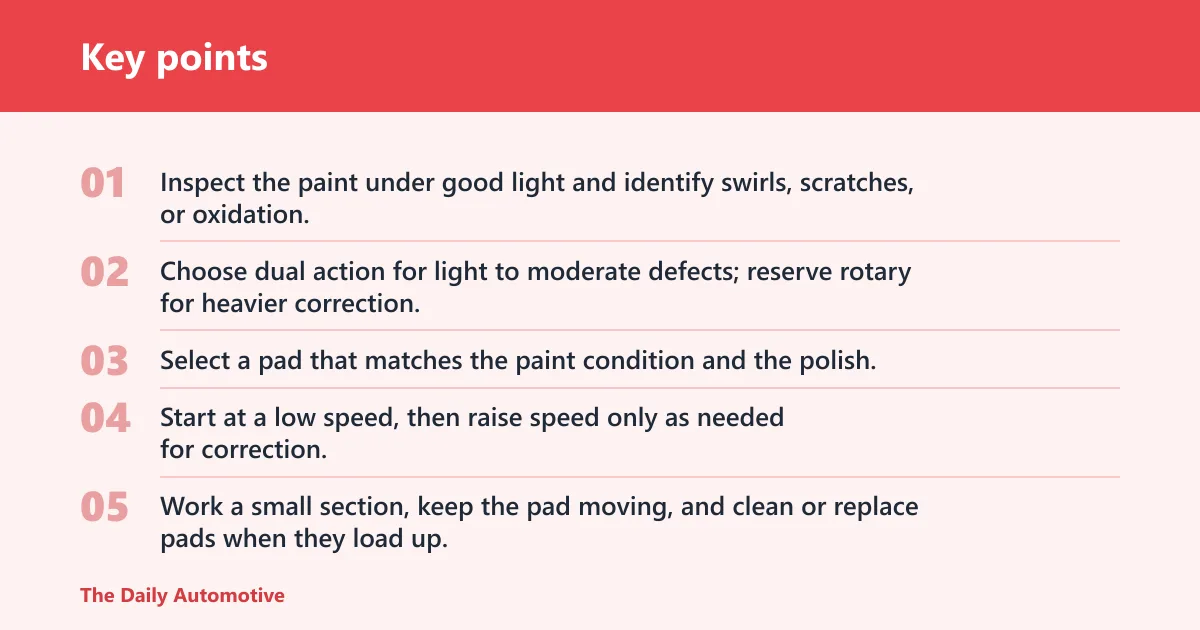
- Inspect the paint under good light and identify swirls, scratches, or oxidation.
- Choose dual action for light to moderate defects; reserve rotary for heavier correction.
- Select a pad that matches the paint condition and the polish.
- Start at a low speed, then raise speed only as needed for correction.
- Work a small section, keep the pad moving, and clean or replace pads when they load up.
Frequently asked questions
What is the best cordless car polisher for swirl marks?
A cordless dual-action polisher is the best starting point for swirl marks because it reduces visible marring while staying more forgiving on clear coat. Among the models here, the Milwaukee M18 FUEL Random Orbital Polisher is the strongest fit for broader correction, while the Batavia is a simpler entry-level option for light swirl removal.
Should I buy a rotary buffer or a dual action polisher?
Buy a dual-action polisher unless you already know you need faster, more aggressive correction and can control heat well. Rotary buffers remove defects faster, but they also carry more risk of holograms and burn-through. For most owners, dual action is the safer and more versatile first choice.
How much power do I need for machine polishing a car?
You need enough power to keep speed and pad movement stable under light pressure, not maximum motor output on paper.
Can a cordless polisher remove light scratches?
Yes, a cordless polisher can reduce or remove light scratches if they are in the clear coat and not too deep. A dual-action machine with the right pad and polish is usually the best starting point. Deeper scratches may only improve, not disappear, and some cannot be polished out safely.
What size polishing pad is best for car paint?
Use the pad size that matches the panel and the defect. Larger pads suit wide, flat body panels. Smaller pads are better for curves, bumpers, and tight areas.
How long does a cordless car polisher battery last?
Battery life depends on battery size, paint condition, pad choice, and how hard you lean on the tool. Milwaukee says one M18 battery can polish one full-sized car, which gives a practical planning point. Heavy correction and aggressive pads shorten usable time, so a spare battery helps.
Can I polish chrome, fiberglass, or motorcycles with the same buffer?
Yes, many cordless polishers can be used on chrome, fiberglass, motorcycles, boats, or caravans if the pad and polish are appropriate. Batavia lists motorcycles, boats, and caravans as use cases. The key is to reduce pad aggressiveness and control heat, especially on curved or thinner surfaces.
What features matter most in a cordless polisher?
Speed control, battery compatibility, grip comfort, and pad fit matter most. Adjustable speed helps you match the job, a shared battery platform cuts ownership cost, and a stable grip helps keep the pad flat. If you work in tight spaces, a compact body and side handle matter as well.
Products related to this article
Sponsored / affiliate links. As an Amazon Associate I earn from qualifying purchases. I may earn additional commission from eligible campaigns.