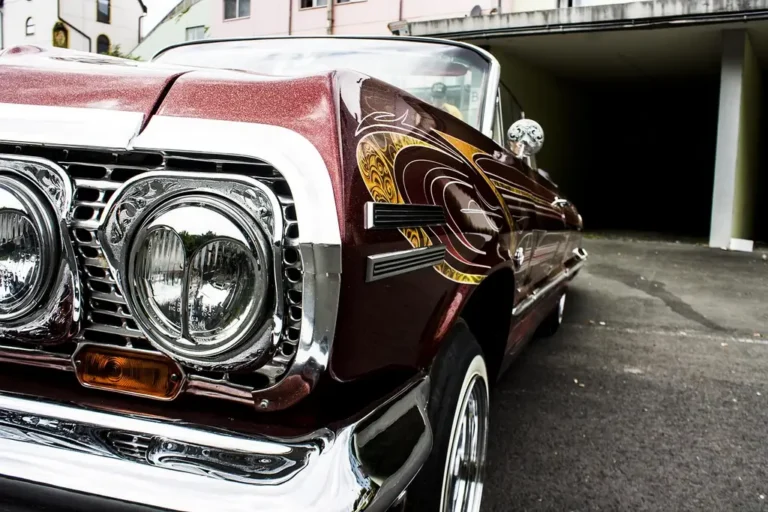
Best Cordless Car Buffer for Effortless Detailing and Polishing
The best cordless car buffer is a variable-speed dual-action polisher with 8 mm to 15 mm orbit, 5-inch pads, and a battery platform you already own. Choose 8–10 mm for wax and light polishing, 12–15 mm for swirl removal. Pick the wrong tool and you waste time, leave haze, or burn through paint edges. This guide matches buffer specs to waxing, polishing, swirl removal, and light correction so you can buy by job, paint condition, and battery ecosystem.
Quick comparison
| Product | Badge | Best for | Price | ||
|---|---|---|---|---|---|
 |
BATOCA 2026 S3 Cordless Car Buffer Dual Action Polisher,BATOCA | Our pick | Camouflage · 6 Speed · 2×2.0Ah Battery | $65.99
Price as of 31 Oct 2026
|
View |
 |
cotaros Cordless Car Buffer Polisher, 8-Speed, 2*21Vcotaros | Budget pick | 5-Inch · 8-Speed · 2x21V Battery | $51.29
Price as of 31 Oct 2026
|
View |
 |
Rotvik Cordless Car Buffer Polisher Kit, 2x4000mAh 21VRotvik | Also great | 6-Inch · 8-Speed · 2x4000mAh Battery | $56.84
Price as of 31 Oct 2026
|
View |
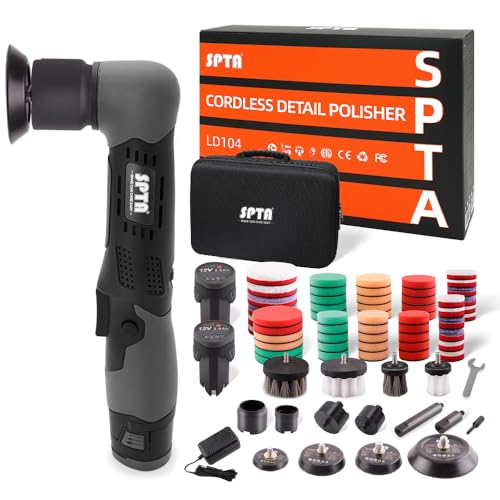 |
SPTA Cordless Mini Polisher, 12V Cordless Multi Polisher,SPTA | Upgrade pick | 12V Mini · RO/DA · Micro Polisher | $107.99
Price as of 31 Oct 2026
|
View |
Use the comparison table to match orbit, speed control, battery setup, and pad size to the work you actually do. The right cordless buffer should fit the panel size, not the marketing copy.
How we chose
We compared manufacturer specs, listing details, and published buyer feedback, then filtered for the details that matter most in cordless detailing: orbit type, speed range, pad size, battery setup, motor type, and included accessories.
We also looked for practical fit. That means beginner-safe dual-action motion, a useful accessory kit, a fast charger or dual-battery workflow, and clear listing details about weight and compatibility.
Finally, we favored products that make task matching easier. A buffer for wax is not the same as a buffer for swirl removal, and a 1-inch mini pad tool is not a 6-inch panel machine.
Cordless buffer selector table
| Detailing task | Recommended orbit / plate size | Speed range | Battery setup | Notes on overheating and pressure limits |
|---|---|---|---|---|
| Waxing | 8 mm to 9 mm orbit, 5-inch pad | Low speed, about 2800 to 3500 RPM | 18V, 20V, or 21V platform; one 2000mAh to 3000mAh battery is usually enough for small jobs | Light pressure only. Stop if the pad starts dragging or the housing gets warm. |
| Swirl removal | 8 mm to 15 mm orbit, 5-inch pad | Mid to higher band, about 3500 to 5000 RPM | Dual-battery swap workflow helps keep correction moving; fast charger helps between panels | Use moderate pressure, not force. Too much pressure stalls the pad and raises heat fast. |
| Tight-area detailing | 1-inch mini pads or small backing plate | Lower to mid speed, about 2800 to 4000 RPM | Compact 18V to 21V battery packs; light tool weight matters more than long runtime here | Watch edges, badges, and trim. Short passes prevent overheating on thin paint near body lines. |
| Heavier correction | 5-inch pad with firmer pad material | Upper range, about 4500 to 6000 RPM | Higher-capacity 21V or 20V batteries, ideally 3000mAh to 4000mAh with spare pack ready | Limit pressure and keep passes moving. Heat builds quickly on flat panels and even faster on corners. |
BATOCA S3: best for beginners and light detailing
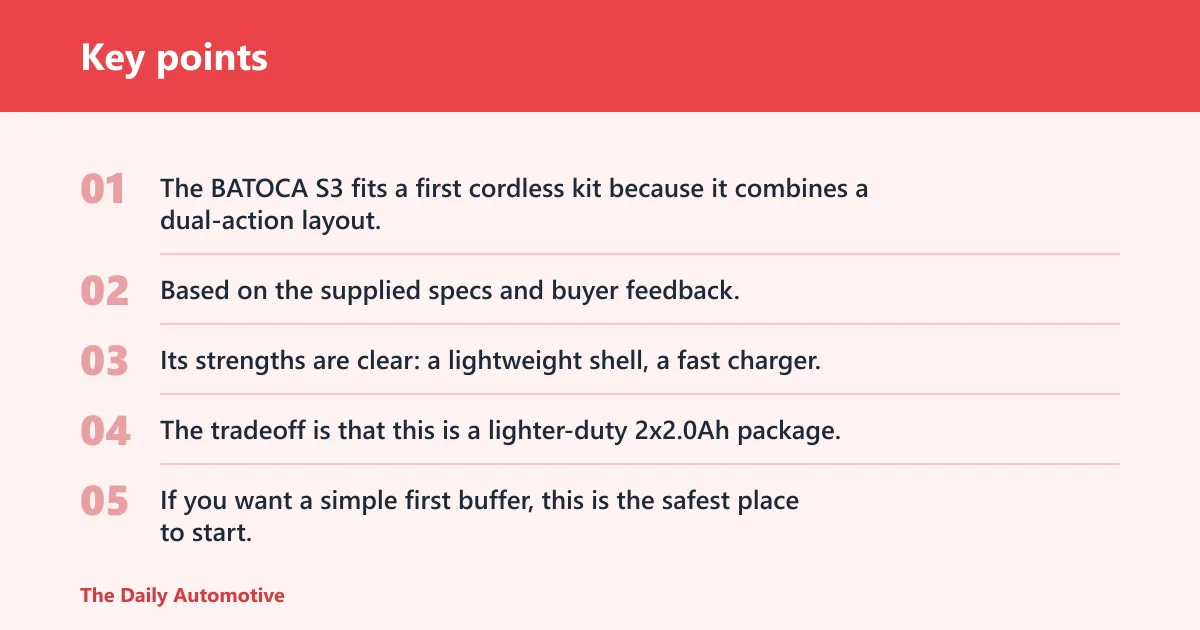
The BATOCA S3 fits a first cordless kit because it combines a dual-action layout, six speeds, two batteries, and a listed 3-pound weight. Based on the supplied specs and buyer feedback, that makes it a practical choice for waxing, finishing polish, and light correction on smaller panels.
Its strengths are clear: a lightweight shell, a fast charger, and a cordless setup that helps cut fatigue during short detailing sessions. The tradeoff is that this is a lighter-duty 2×2.0Ah package, so it is better matched to wax and touch-up work than to long correction sessions on neglected paint.
If you want a simple first buffer, this is the safest place to start. Dual-action motion is beginner-friendly because it is designed for a swirl-free finish, and the listed six-speed control gives you enough range to stay low for wax and move up only when the panel needs more correction.
Cotaros 8-speed: best for battery-platform buyers
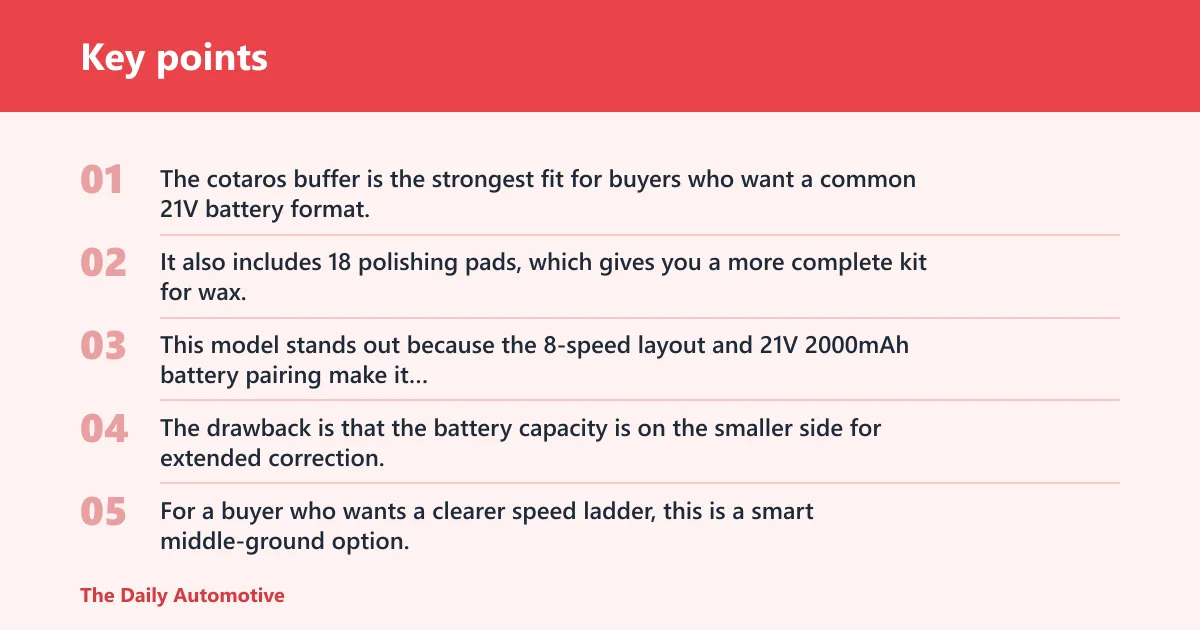
The cotaros buffer is the strongest fit for buyers who want a common 21V battery format, a 5-inch back plate, and an LED display that makes speed selection easier. It also includes 18 polishing pads, which gives you a more complete kit for wax, polishing, and scratch repair.
This model stands out because the 8-speed layout and 21V 2000mAh battery pairing make it easier to match pad action to the job. The drawback is that the battery capacity is on the smaller side for extended correction, so a dual-battery swap workflow matters more if you are polishing several panels in one session.
For a buyer who wants a clearer speed ladder, this is a smart middle-ground option. An 8-speed dial helps you stay in the low band for wax and move into the correction band without guessing, which matters when you are working around clear coat edges or freshly washed paint.
Rotvik 6-inch: best for larger panels and heavier correction
The Rotvik is the right shape for bigger panels because it uses a 6-inch orbital setup, two 4000mAh 21V batteries, and eight variable speeds. That combination points to longer working time and broader coverage, which helps on hoods, doors, and other flat surfaces.
The upside is obvious: more battery capacity and a larger pad setup make it better suited to extended polishing than a mini tool. The compromise is maneuverability, since a 6-inch machine is less convenient around mirrors, grilles, and tight body lines than a smaller buffer.
This is the pick for a user who wants to move faster over large body panels and keep working without a constant battery change. A 6-inch pad covers more surface, but it also makes pressure control more important because excessive force will slow the pad and add heat.
SPTA Mini Polisher: best for tight areas and trim work
The SPTA mini polisher is built for tight spaces, and its RO/DA layout makes it more forgiving than a rotary-only mini tool. It is the best fit when you need access around emblems, spoilers, door handles, and other places where a full-size buffer cannot move cleanly.
The main advantage is control. Mini pads reach places a 5-inch machine cannot, and the double-action free spinning motion is a better fit for swirl-free finishing on small sections. The drawback is obvious too: this is not the tool for wide-panel correction, and it will be slower on doors, hoods, and roofs.
For trim work, the smaller machine is worth it because it reduces the risk of catching edges. Picture a hatchback with a badge recess and a sharp character line; a 1-inch or mini-pad setup can clean the area without forcing the pad into the crease.
Which one should you buy?
Pick the buffer that matches the paint, the battery ecosystem, and the size of the work area. If you mainly want wax application and light polishing, start with the BATOCA S3. If you want more speed control and a fuller accessory kit, the cotaros is the better all-around choice.
If your vehicle has larger panels and you expect longer correction sessions, the Rotvik makes more sense because the 6-inch format and two 4000mAh batteries support broader coverage. If your work is mostly trim, emblems, and tight body details, the SPTA mini polisher is the cleaner fit.
Say your sedan has a few light swirls and you only want to refresh the finish before a weekend drive. A dual-action buffer with a 5-inch pad, low speed, and a foam finishing pad is the least risky setup. If the paint is harder and the defects are deeper, move up in orbit and speed carefully rather than forcing one heavy pass.
Battery ecosystem matters too. Buyers already invested in 21V packs should favor the cotaros or Rotvik. If you already own 20V tools, look for a tool-only listing that explicitly states compatibility; none of the four picks here is described that way in the supplied data.
Dual-action buffer: best for beginners
A dual-action buffer is the safer choice for most beginners because the pad does not spin in one fixed, aggressive path. That makes it easier to get a swirl-free finish and reduces the chance of overheating a single spot. For first-time users, 8 mm to 9 mm orbit is a sensible wax-and-polish range, while 12 mm to 15 mm is better suited to swirl removal.
Why dual-action motion is safer
Random orbital and dual-action motion are both designed to be more forgiving than rotary-only machines. The pad moves in a pattern that is less likely to carve a visible trail, which matters when you are learning how much pressure the machine tolerates before it slows down.
What orbit size to look
Look for 8 mm or 9 mm if your main goal is wax or finishing polish. Step into 12 mm to 15 mm when the paint needs more defect removal. The larger orbit increases correction potential, but it also demands cleaner technique and more attention to heat.
Where it fits in a first kit
A first kit should include foam pads, at least one microfiber pad, a charger, and a carrying bag. Wool pads are more aggressive, so they are useful for stronger correction but not necessary for a beginner who mainly wants safe wax and polish work.
DeWalt 20V buffer: best for battery owners
If you already own a DeWalt 20V battery platform, compatibility should drive the purchase more than any brand badge. The right choice is a tool-only model only when the listing explicitly says it accepts your batteries; otherwise, you may end up buying extra packs you do not need.
Tool-only versus battery-included kits
Tool-only kits are cheaper up front when you already have batteries and a fast charger. Battery-included kits make more sense for a first-time buyer who does not already own a matching platform, especially when the kit includes two batteries for swap-and-go use.
When compatibility matters most
Compatibility matters most when you already own several tools on the same platform. That lets you share batteries across drills, lights, and the buffer, which cuts downtime. It also keeps you from mixing voltage families that do not belong together.
What to confirm in the listing
Check whether the kit includes batteries or is tool only, then confirm the platform voltage, charger type, and whether the speed display or dial is part of the package. If the listing does not say it works with your pack, do not assume it does.
Mini-pad buffer: best for tight spots
A mini-pad buffer is the right tool when the bodywork gets narrow. Emblems, spoilers, vents, and trim strips need a smaller pad because a 5-inch plate can contact surrounding paint or plastic too easily. A 1-inch pad is slower, but it gives you control where large pads cannot fit.
1-inch pads for emblems and trim
Use 1-inch mini pads for tight recesses and edge work. They are better for precision than coverage, and they help you avoid over-polishing around badges, grilles, and sharp transitions where paint is often thinner.
When a small plate is worth it
A small plate is worth it when access is the problem, not panel size. If the machine cannot seat flat on the surface, a bigger pad only creates drag and heat. A mini polisher makes the machine work with the car instead of against it.
Limits on body-panel coverage
Mini pads are not efficient for hoods, doors, or roofs. They can finish those areas, but slowly. For broad coverage, a 5-inch pad or 6-inch backing plate is the more practical choice because it covers more paint with each pass.
Heavy-cut buffer: best for stronger correction
A heavy-cut cordless buffer is the better match when you need to push farther into oxidation, deeper swirl marks, or long correction work. Higher speed helps, but only if the pad stays moving and the pressure stays controlled. For this job, brushless motors are usually the better pick because they manage heat and efficiency more effectively than a basic brushed motor.
When higher speed and firmer pads help
Use the upper speed band for correction, not for wax. A firmer foam pad or wool pad can cut faster, but it also raises the risk of haze if you stay on one area too long. Keep passes moving and finish back down at lower speed.
Heat and pressure limits to watch
Too much pressure causes stalling, and stalling causes heat. That matters more on edges, bumper curves, and high spots where paint runs thinner. If the housing feels hot or the pad stops free-spinning, back off immediately.
Why it is not the first choice for new users
Heavy correction rewards control. A new user is more likely to overload the pad, overheat a corner, or chase defects with too much pressure. A dual-action buffer with moderate orbit is usually the safer first step before moving to stronger correction setups.
How to choose
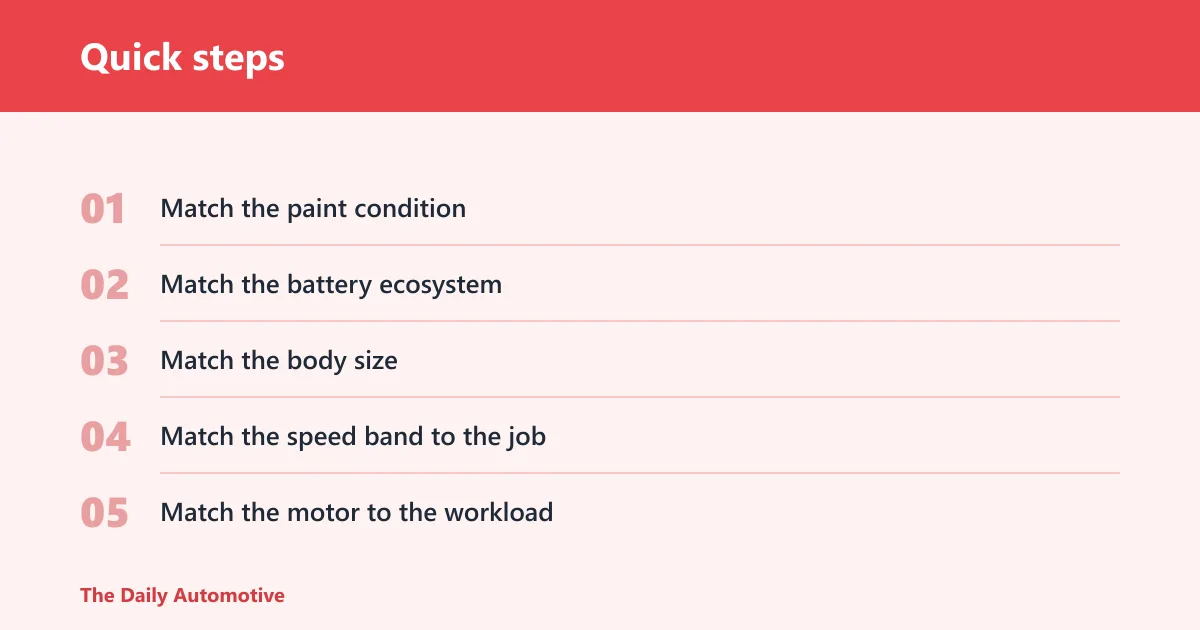
- Match the paint condition. Wax and light polish need low speed and a 5-inch pad. Swirl removal needs more orbit and more patience. If the paint is only dusty or freshly sealed, do not buy a heavy-cut setup just because it looks stronger.
- Match the battery ecosystem. If you already own 18V, 20V, or 21V batteries, buy into that platform when possible. Dual batteries and a fast charger matter most for longer sessions, but they do not fix a mismatched battery family.
- Match the body size. Large panels favor 5-inch or 6-inch coverage. Tight spaces need a mini pad and a smaller backing plate. A 1-inch setup is for access, not speed.
- Match the speed band to the job. Low speed for pad priming and wax. Mid speed for finishing polish. Higher speed for defect removal, with careful pressure control.
- Match the motor to the workload. Brushless motors are usually the better long-run choice for noise, heat, and durability. Pure copper brushed motors can still work, but they are typically less efficient under repeated load.
A common first-timer mistake is grabbing a heavy corded-style setup in a cordless buffer and cranking the speed right away because it seems like the fastest way to remove swirls. On soft clear coat, that can create haze quickly. On harder paint, it may still waste battery life without improving correction.
Suppose a hatchback has light wash marring on the doors and a few tighter spots around the rear badge. A 5-inch dual-action buffer handles the doors, then a mini polisher finishes the badge area. That split setup is often more efficient than forcing one large tool everywhere.
Frequently asked questions
What is the best cordless car buffer for beginners?
A beginner should start with a variable-speed dual-action buffer, ideally one with a 5-inch pad, a low starting speed, and at least one foam finishing pad. That setup is safer for swirl-free work and is easier to control on curved body panels than a rotary-only machine.
Is a cordless car buffer powerful enough for paint correction?
Yes, for light to moderate correction it can be enough, especially with a brushless motor, a proper pad, and a higher speed band. It is not the best answer for severe defects or very large correction jobs, where corded machines or more aggressive setups can be more efficient.
What speed should I use on a cordless car buffer?
Use low speed for wax and pad priming, mid speed for finishing polish, and higher speed for swirl removal or correction. A 6-speed or 8-speed dial gives you better control, and the listing’s RPM range should guide the job rather than a single “best” setting.
How long does a cordless car buffer battery last?
Runtime depends on battery capacity, pad size, pressure, and the job itself. A 2000mAh pack is fine for short waxing work, while 3000mAh to 4000mAh batteries are better for longer correction sessions. For practical use, a dual-battery swap workflow and a fast charger matter more than a single runtime claim.
Should I get a dual-action or rotary cordless buffer?
Choose dual-action if you want the safer, swirl-free option for waxing, polishing, and light scratch removal. Choose rotary only if you already know how to manage heat and edge control, because rotary motion is less forgiving and is easier to misuse on clear coat.
What accessories should come with a cordless car buffer kit?
A useful kit should include foam pads, at least one microfiber pad, a charger, and a carrying bag. Wool pads and sandpapers can be helpful for more aggressive work, but they should be treated as job-specific tools rather than filler. The kit should also tell you what pad sizes fit the plate.
What size backing plate is best for a cordless car buffer?
For most body panels, a 5-inch pad and backing plate offer the best mix of coverage and control. Use a 1-inch mini pad for emblems, trim, and other tight areas. A 6-inch backing plate is better when broad coverage matters more than precision.
Are brushless cordless car buffers worth it?
Usually yes, especially if you want better heat management, improved efficiency, and a longer service life under repeated use. A pure copper brushed motor can still be acceptable for light occasional work, but brushless models are generally the better fit for frequent detailing.
Can a cordless buffer remove swirl marks and scratches?
It can remove or reduce swirl marks and some light scratches when paired with the right pad, polish, and speed band. It will not fix every defect. Deep scratches that catch a fingernail usually need paint-level repair rather than more buffer pressure.
Which cordless buffer works with DeWalt 20V batteries?
Look only at listings that explicitly state DeWalt 20V compatibility and whether the unit is tool only or battery included. If the listing does not confirm that match, do not assume the battery will fit. The safest route is to verify the model page before buying.
Products related to this article
Sponsored / affiliate links. As an Amazon Associate I earn from qualifying purchases. I may earn additional commission from eligible campaigns.