Best Mud Flaps for Cars: Universal Fit vs Custom Fit
Universal-fit mud flaps suit stock cars with mild tire changes. Custom-fit flaps are the safer pick for OEM appearance, pronounced wheel poke, or lowered and lifted suspensions. Poor fit can send spray onto paint, cause tire rub, crack liners or paint, and waste money fast. This guide compares fitment by body style, wheel offset, and install risk so you can choose the right flap type quickly.
| Factor | Universal Fit | Custom Fit | Winner |
|---|---|---|---|
| Fitment on stock bodywork | Wide compatibility, but flat or semi-rigid blanks can leave gaps on curved arches. | Vehicle-specific contouring follows the fender and liner shape more closely. | Custom Fit |
| Install method | Often trim-and-drill, with screws, clips, washers, or brackets chosen to suit the vehicle. | Often uses factory holes or no-drill hardware on matched kits. | Custom Fit |
| Coverage for modified tires | Better when you need wider coverage or a set-back flap on poke-heavy builds. | Best when the vehicle stays close to stock wheel and tire geometry. | Universal Fit |
| Appearance | Can look functional first, especially if trimming is visible. | Usually gives a cleaner OEM-like result. | Custom Fit |
| Total installed cost | Lower entry price, but cutting tools, hardware upgrades, or labor can narrow the gap. | Higher purchase price, though easier fitment can reduce labor and rework. | Universal Fit |
| Clearance risk at full steering lock | Higher if the flap hangs too low or sits too close to the tire. | Lower when the kit is matched to the exact model year and mounting points. | Custom Fit |
Quick comparison
| Product | Badge | Best for | Price | ||
|---|---|---|---|---|---|
 |
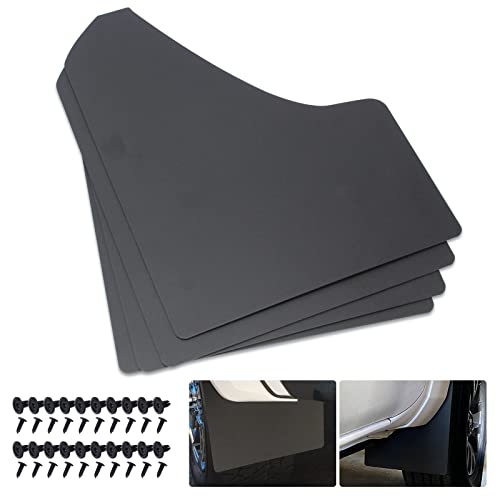
EPJHKBE Mud Flaps Compatible with Cadillac Optiq 2025 2026EPJHKBE | Our pick | Cadillac Optiq 2025-2026 · custom fit · 4-piece set | $24.31
Price as of 31 Oct 2026
|
View |
 |
RokBlokz Rally Mud Flaps Compatible with 2022+ VolkswagenRokBlokz | Pair with it | Custom Fit · Volkswagen Golf MK8 · custom cut · short | $129.99
Price as of 31 Oct 2026
|
View |
The core trade-off is simple: custom-fit flaps are the safer default for stock vehicles that want clean coverage and less install guesswork. Universal fit makes more sense when wheel poke, lift height, or unusual body shape pushes you beyond a stock-pattern kit.
If you are choosing between them for appearance alone, custom-fit usually wins. If you need extra width, deeper drop length, or a flap you can trim around a modified setup, universal fit earns its keep.
How we chose
The comparison below is based on manufacturer specs, listing details, and published buyer feedback. Fitment, mounting method, material, and vehicle application carried the most weight.
The main filters were body style, wheel-arch coverage, install risk, and whether the kit depends on factory mounting points or drilling. Cost mattered, but only after fit and clearance were checked.
| Vehicle scenario | Recommended flap type | Install method | Clearance risk | Expected tradeoffs |
|---|---|---|---|---|
| Stock sedan | Custom Fit | No-drill or factory-hole install | Low if the kit matches the exact body and wheel size | Best OEM look; less freedom if you want extra poke coverage |
| SUV | Custom Fit | Factory holes or liner attachment points | Low to moderate, depending on tire size and ride height | Cleaner fit, but some taller tires may need a longer flap |
| Lifted truck | Universal Fit | Trim-and-drill with brackets or wider hardware | Moderate to high at full lock and under compression | More coverage possible; more tuning and more chance of rework |
| Performance car | Custom Fit | OEM mounting points, often no-drill | Moderate if the car sits low or has aggressive wheel offset | Cleaner look; less tolerance for oversized tires |
| EV | Custom Fit | No-drill preferred when the listing matches the exact model | Low if the flap clears aero trim and front bumper contours | Good for spray control, but some aero shapes limit flap length |
| Winter commuter | Custom Fit | Factory holes or no-drill hardware | Low to moderate from packed snow and slush build-up | Strong salt and spray protection; cold-weather material choice matters |
| Fleet or work vehicle | Universal Fit | Drill-and-bolt with replaceable hardware | Moderate, especially if trucks are loaded or upfitted | Cheaper to replace; appearance usually matters less than coverage |
| Off-road build | Universal Fit | Set-back mounting, brackets, or wider blanks | High because of tire travel, rocks, and suspension articulation | Best chance of fitting oversized tires; least OEM-like finish |
Custom-fit no-drill kits: best for OEM look
- Made for Cadillac Optiq 2025-2026
- No-drill install using factory holes
- Front and rear coverage included
This EPJHKBE set is for a Cadillac Optiq 2025 to 2026 owner who wants front and rear coverage without drilling. The listing says it uses factory holes, which makes it a strong fit for a stock vehicle where the goal is a clean exterior and a lower install-risk path.
The main advantage is fit discipline: a custom-fit kit is engineered for specific model years, so it is more likely to follow the wheel arch and liner attachment points closely. That matters when you want the flap to clear the tire at full steering lock while still keeping spray off the rocker panels.
The drawback is the narrow application. If your Optiq has changed wheel offset, tire size, or suspension height, even a no-drill kit still needs a careful clearance check before you call it done.
Factory mounting points and liner attachment points
Custom-fit mud flaps often use factory holes, pre-drilled holes, or liner attachment points that already exist on the vehicle. That reduces the chance of misalignment and can avoid the messy look that comes from drilling visible outer panels.
Some kits bolt on without wheel removal, but that depends on the vehicle and the exact mounting locations. Always follow the vehicle and product manual.
Why these suit stock wheel and tire setups
Stock wheel and tire combinations give custom-fit kits their best chance of working as intended. The flap’s shape, drop length, and offset are chosen around standard body clearance, so the odds of tire rub are lower than with a universal blank cut to guesswork.
Say your sedan has stock tires and no spacer. A matched kit usually gives you the cleanest fit, while still protecting paint from water spray, salt, and stones.
RokBlokz Rally mud flaps: best for modified Golfs
- Custom fit for 2022+ Golf GTI and Golf R
- Includes mounting hardware and instructions
- No-drill install using OEM mounting points
This RokBlokz set is aimed at 2022 and newer Volkswagen Golf GTI and Golf R models that need a custom-cut fit with mounting hardware included. The no-drill claim and OEM mounting-point approach make it a practical pick when you want coverage that follows the car closely.
The advantage here is application-specific design. Custom-fit flaps like this are usually easier to align on a stock-geometry hatchback than a universal blank, and that can matter when you want the rear quarters protected from wet road grit and winter salt.
The drawback is that the short version may not be enough for more aggressive wheel poke or lower-than-stock ride height. If the car has wider tires, check the manufacturer’s listing for your exact setup before buying.
Universal rubber flaps: best for budget coverage
Universal mud flaps are flat or semi-rigid blanks designed to fit a wide range of vehicles. They usually cost less, but they often need trimming and drilling, and they can leave gaps on curved arches if the body shape is not friendly to a generic panel.
Trim-and-drill installation
Universal kits usually depend on screws, clips, push pins, brackets, and washers chosen to fit the vehicle. That flexibility is useful, but it also creates more chances to mismeasure the drop or drill where a liner flexes too much.
Do universal mud flaps need drilling? Often yes. If the kit does not use existing holes, expect trim-and-drill work and a final check at full steering lock.
When flat blanks work better than shaped kits
Flat blanks make sense when the vehicle has odd wheel-arch geometry, extra tire poke, or a suspension change that pushes the wheel outside the original contour. In those cases, a universal flap can be cut wider or mounted farther back to cover more spray.
Picture a lifted pickup with larger tires. A stock-pattern kit may sit too close to the tread, while a universal blank can be placed wider or lower if you are willing to spend the time on layout and drilling.
Heavy-duty polymer and ABS flaps: best for harsher weather
Material choice matters as much as fit. Rubber, ABS plastic, polyurethane, and polymer each behave differently in cold weather, with polyurethane and some polymer blends offering better flexibility, while stiffer ABS can hold shape and resist impacts well.
Cold-weather flexibility
In cold weather, a flap that becomes too stiff can crack or pull away from its mount. Rubber and polyurethane usually tolerate temperature swings better than brittle plastic when slush and packed snow load the back edge.
That is one reason winter commuters often need a material that stays flexible when temperatures drop, not just one that looks good in the driveway.
Impact resistance versus stiffness
ABS plastic can keep a crisp shape, which helps with OEM-like appearance, but it may be less forgiving if a flap gets hit by ice chunks or rocks. Rubber and polyurethane can absorb impacts better, though they may flex more at speed.
A common failure mode is flap oscillation after installation. If the hardware is too light or the flap is too long for the mount, it can flap against the body and wear the liner edge.
Fitment and wheel-arch coverage
Fitment is the real decision filter. Wheel-arch curvature, tire poke, drop length, and steering-lock clearance decide whether the flap protects the body or rubs the tire and shreds the liner.
- Measure the tire’s outer edge relative to the fender line.
- Check how far the arch curves inward near the front and rear wheels.
- Turn the steering wheel to full lock and inspect front clearance.
- Look for liner attachment points or factory holes before drilling anything.
- Confirm the flap will not hang low enough to scrape on driveways or curbs.
Do custom fit mud flaps use factory mounting points? Often yes. That is one reason they are usually easier to install on stock vehicles than a universal blank that needs fresh holes and more trimming.
Will mud flaps rub my tires? They can, especially if the flap sits too close to a wider tire, or if the suspension compresses more than the kit assumes. Check the front wheels at full steering lock and inspect rear clearance after loading the vehicle.
Road debris protection and legal checks
Mud flaps are there to reduce mud, water spray, stones, and salt reaching paint, rocker panels, and the undercarriage. That protection matters most on roads with loose aggregate, winter slush, or dirt shoulders.
Check local rules and the owner’s manual for tire coverage and splash-guard requirements. Some areas care about how much tread is exposed; some inspections also care about whether the flap still covers the spray line after a lift or wheel change.
Which one should you buy?
Choose custom-fit if your vehicle is stock, you want the cleanest OEM look, and you want the lowest install risk. Choose universal if you need wider coverage, have oversized tires, or want to adapt the flap to a lift or unusual offset.
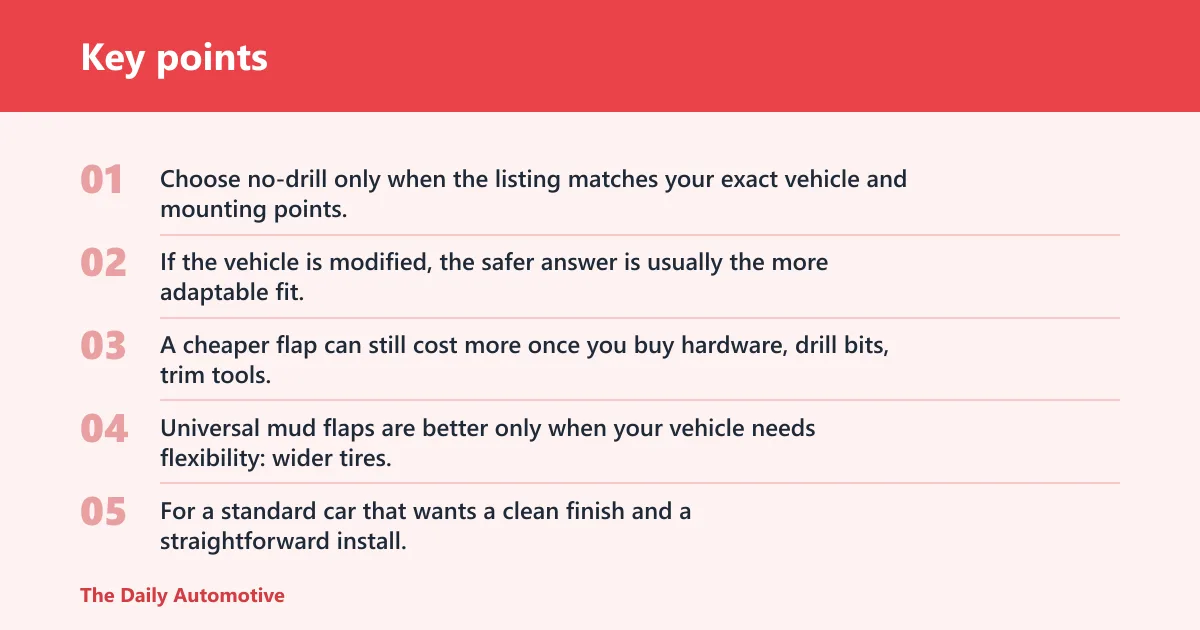
Choose no-drill only when the listing matches your exact vehicle and mounting points. If the vehicle is modified, the safer answer is usually the more adaptable fit, even if it takes longer to install.
Total installed cost also matters. A cheaper flap can still cost more once you buy hardware, drill bits, trim tools, or labor to fix a poor first fit.
Are universal mud flaps better than custom fit mud flaps?
Universal mud flaps are better only when your vehicle needs flexibility: wider tires, altered suspension, or coverage beyond stock contours. For a standard car that wants a clean finish and a straightforward install, custom-fit is usually the better choice because it follows the body and mounting points more closely.
Do universal mud flaps need drilling?
Often yes. Universal mud flaps are made for a broad range of vehicles, so they frequently need trimming and drilling to fit your arch, liner, and mount locations. Some can be attached with brackets or existing holes, but you should expect more layout work than with a matched kit.
Do custom fit mud flaps use factory mounting points?
Usually yes, though not every kit is the same. Many custom-fit mud flaps are shaped for specific model years and use factory holes or liner attachment points, which helps the flap sit square and reduces the risk of visible misalignment or extra drilling.
Which mud flaps are best for a car with oversized tires?
Universal fit is usually the safer bet when tire poke has increased or the suspension has been changed. The extra adjustability lets you widen the coverage or move the flap farther back, which helps protect the body and reduces the chance of a tire rubbing the flap at full lock.
What material is best for mud flaps in cold weather?
Rubber and polyurethane are usually the best cold-weather choices because they stay more flexible when temperatures fall. ABS plastic can hold shape well, but it may be less forgiving if ice, slush, or impact loads hit the flap in freezing conditions.
Are no-drill mud flaps worth the extra cost?
They can be, if you want a stock-like appearance and the kit is made for your exact vehicle. No-drill options often save time, reduce the chance of cracked liners or crooked holes, and make the install cleaner. If the vehicle is modified, though, the extra cost may not solve fitment problems.
Verdict: Universal Fit or Custom Fit?
Choose Universal Fit if you have a lifted truck or an off-road build with oversized tires, wheel poke, or extra coverage needs that call for trim-and-drill mounting and wider blanks.
Choose Custom Fit if you drive a stock sedan, SUV, EV, or Volkswagen Golf and want a clean OEM-like look with factory holes or no-drill hardware and lower install risk.
Frequently asked questions
How do I measure wheel arches for mud flaps?
Measure from the tire’s outer edge to the fender line, then compare that space with the flap’s width and drop length. Also check the arch curvature and turn the steering wheel to full lock, because a flap that clears at center can still rub when the tires are turned or the suspension compresses.
Will mud flaps rub my tires?
They can if the flap sits too close, hangs too low, or is mounted without checking lock-to-lock clearance. Oversized tires, spacers, and lowered or lifted suspensions raise the risk. The safest check is a full steering-lock inspection before you tighten the hardware fully.
Products related to this article
Sponsored / affiliate links. As an Amazon Associate I earn from qualifying purchases. I may earn additional commission from eligible campaigns.