Can You Negotiate Car Repair Costs?
Yes, you can often negotiate car repair costs, especially on labor, parts markup, and shop fees; ask for a written estimate that lists labor, parts, fees, and scope before you agree to anything. If you skip the breakdown, you may overpay for hidden markups, duplicate labor, or work you do not need. This guide explains how to question each line item, use timing to your advantage, and ask for a lower price without weakening the repair.
What moves in an estimate: labor, parts, and fees
Yes, but the parts of the estimate that move most are usually labor rate, parts choice, and some fees, not the actual need for the repair itself. A shop may also adjust scope, timing, or diagnostics. The key is knowing what state law requires, what is shop policy, and what is just a negotiation point.
When the car is unsafe to drive, your bargaining power shrinks because timing pressure works in the shop’s favor. That does not mean you should accept the first number. It means you should focus on scope, parts, and written approval limits instead of trying to force a blanket discount.
Dealer service departments versus independent shops
Dealership service departments often price labor closer to manufacturer standards and may use original equipment parts by default. Independent shops can have more room to adjust labor rate, source parts from more than one supplier, or offer remanufactured options. Neither type is automatically cheaper.
The difference matters because the quote structure changes. A dealer may be less flexible on parts brand but more precise about factory procedures. An independent shop may be more open to aftermarket parts, but it still needs written approval for any change in scope.
What parts of an estimate can you push on?
The most negotiable items are usually the ones a shop can vary without changing the repair’s safety or basic outcome. Labor rate, parts selection, and add-on fees are the first places to ask questions. Book time and required parts are less flexible, but they still deserve a review line by line.
Labor rate versus book time
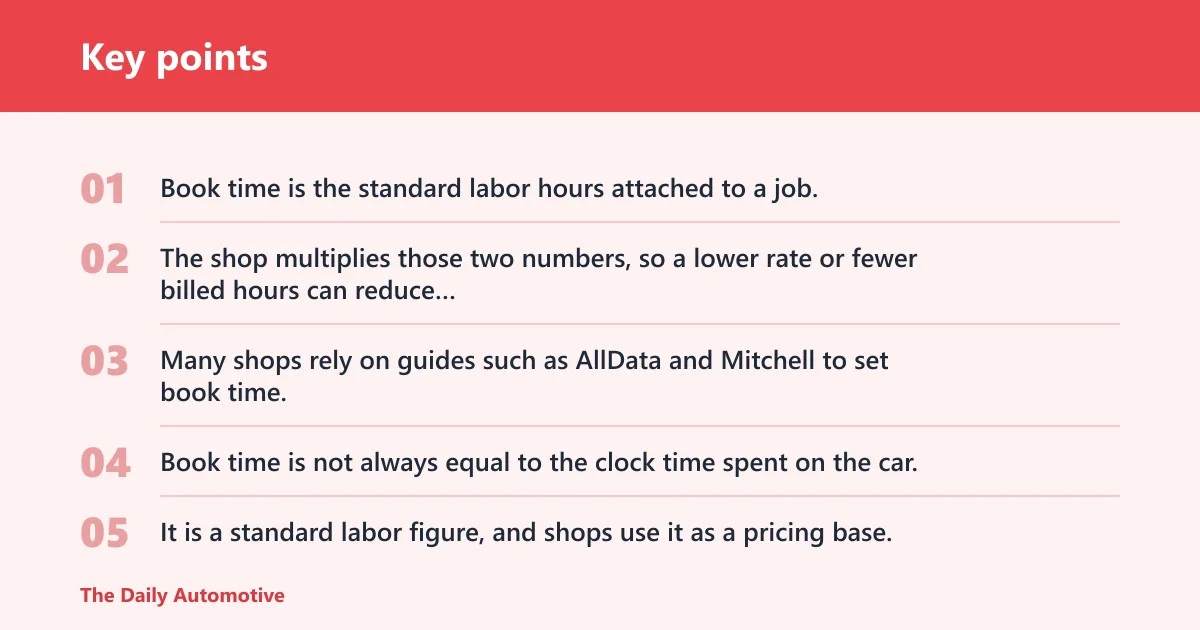
Labor rate is the hourly charge. Book time is the standard labor hours attached to a job. The shop multiplies those two numbers, so a lower rate or fewer billed hours can reduce the total. Many shops rely on guides such as AllData and Mitchell to set book time.
Book time is not always equal to the clock time spent on the car. It is a standard labor figure, and shops use it as a pricing base. If a quote looks high, ask whether the billed time follows the guide for your exact vehicle and repair code.
Parts choice and markup
Parts pricing can vary a lot. OEM parts are original-equipment components. Aftermarket parts come from other manufacturers. Remanufactured parts are rebuilt from used cores. A shop may mark up any of them, so ask for the part number and the supplier category on the written estimate.
Suppose a water pump line looks expensive. Ask whether the quote assumes OEM, aftermarket, or remanufactured parts, and whether a warranty changes that choice. If the repair is routine and the vehicle is older, a cheaper part may be a reasonable tradeoff. If the part affects safety, the cheapest option is not always the right one.
Diagnostic fee, shop supplies, and other add-ons
A diagnostic fee is common, especially when the problem is not obvious. Some shops credit that fee toward the repair if you authorize the work. Confirm that upfront. If the estimate says the diagnosis is separate, ask whether any later repair will reduce or remove that charge.
Shop supplies fees usually cover consumables such as cleaners, fasteners, and similar small items. Some shops calculate them as a percentage of labor. Others list a flat amount. Ask whether the fee is itemized and whether it applies to every job or only certain repairs.
Labor rate, book time, and shop fees
Labor rates vary by shop type, zip code, and business overhead. A city-center dealership may charge more than a neighborhood independent shop because rent, staffing, and brand-specific training are different. That does not automatically make the higher rate unfair, but it does make comparison useful.
RepairPal and AutoMD can help you check whether a quote is far outside a vehicle-specific range. RepairPal can provide price ranges by zip code and vehicle. AutoMD offers repair cost estimates, DIY guides, and a comparison tool. Use them as a benchmark, not as a guarantee.
| Estimate line item | Typical move | Best negotiation move | Push, accept, or walk away? |
|---|---|---|---|
| Labor rate | Flexible by shop type and location | Ask for the lowest posted rate, or compare nearby shops | Push |
| Book time | Usually fixed by labor guide | Ask which AllData or Mitchell labor entry was used | Accept unless it conflicts with the vehicle and job |
| OEM parts | Often flexible if safety allows other options | Ask for aftermarket or remanufactured pricing | Push on non-safety parts |
| Diagnostic fee | Sometimes credited to the repair | Confirm crediting before work starts | Push if not disclosed upfront |
| Shop supplies | Usually small and policy-based | Ask how it is calculated and whether it is capped | Accept if disclosed clearly |
| Scope changes | Must be approved before extra work | Require a new written estimate | Walk away if work starts without approval |
| Payment timing | Sometimes negotiable | Ask about deposit, split payment, or pickup timing | Push if cash flow is the only obstacle |
How do you negotiate car repair costs with a mechanic?
Keep the conversation narrow and specific. Ask what is needed, what is optional, and what can be changed without affecting safety. Do not open with blame. Start with questions about the line items, then ask whether the estimate can be revised.
A simple script helps: “Can you walk me through the labor hours, part choice, and fees on this estimate? If there is a lower-cost part or a smaller scope that still fixes the problem, I’d like to compare those options before I approve anything.”
That tone matters because it keeps the shop focused on solving the problem, not defending the price. It also gives the service writer a reason to offer a different parts tier, trim a fee, or revise the repair plan.
- Ask for a written estimate with labor, parts, fees, and scope listed separately.
- Check whether the labor rate and book time match the vehicle and repair.
- Ask which parts are OEM, aftermarket, or remanufactured.
- Confirm whether the diagnostic fee is credited if you authorize the repair.
- Ask whether shop supplies are a percentage, a flat fee, or itemized.
- Compare the quote with RepairPal or AutoMD using your zip code and vehicle.
- Request written approval before any extra work begins.
What parts of a repair estimate are negotiable?
Labor rate, parts selection, some fees, scope, and timing are the main pressure points. The repair itself may be fixed if the car needs a specific component. Even then, the shop may still have room to change the part brand, adjust the schedule, or remove nonessential add-ons.
State estimate laws matter here. In many states, shops need written approval before exceeding an estimate or doing extra work. Some states also set rules on overage limits and consumer rights. Ask for the shop’s policy in writing before you sign.
When to get a second opinion
Get a second opinion for large repairs, safety-related work, or any quote that seems far above the benchmark. The second estimate is useful even if you stay with the first shop, because it tells you whether the repair scope is broad, incomplete, or priced unusually high.
Compare the same items. If one shop quotes only a brake inspection and another quotes pads, rotors, hardware, and fluid flush, those are not comparable. Make sure the labor hours, part quality, and fees match before you judge the price.
Repair quote checklist
This checklist helps you decide whether to push, accept, or walk away on each line item. Use it before authorizing work, especially if the car is still drivable and you have time to compare.
| Line item | What to ask | Likely move | Decision |
|---|---|---|---|
| Labor rate | “What is your hourly charge, and is there a different rate for this job?” | Comparable rates can vary by zip code and shop type | Push |
| Book time | “Which labor guide did you use for this vehicle?” | Usually set by AllData or Mitchell | Accept unless the hours look mismatched |
| OEM parts | “Can you quote aftermarket or remanufactured options?” | Often flexible on non-safety parts | Push |
| Diagnostic fee | “Is this credited if I approve the repair?” | Often credited, but not always | Push if unclear |
| Shop supplies | “How is this fee calculated?” | May be a percentage of labor or a flat fee | Accept if disclosed |
| Scope changes | “Will you call me before adding anything?” | Must be approved in writing in many states | Push |
| Pickup timing | “Can the work wait if I need to compare one more quote?” | Useful when the car is safe to park | Push or accept based on urgency |
How to compare estimates fairly
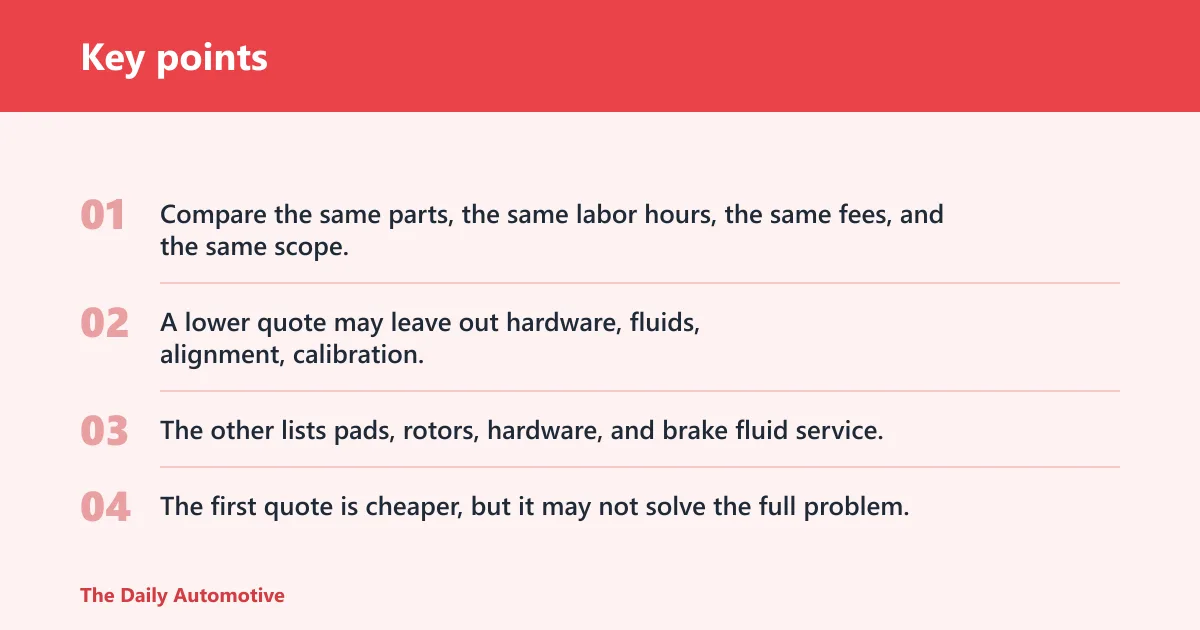
Do not compare totals alone. Compare the same parts, the same labor hours, the same fees, and the same scope. A lower quote may leave out hardware, fluids, alignment, calibration, or another step that the more complete quote already includes.
Picture two quotes for brakes. One lists pads only. The other lists pads, rotors, hardware, and brake fluid service. The first quote is cheaper, but it may not solve the full problem. That is why scope matters as much as price.
When should you accept, re-scope, or walk away?
Accept the quote when the parts match the problem, the labor hours make sense, and the fees are clear. Re-scope the job when the shop has quoted more than you need or bundled extra work into the estimate. Walk away when the shop refuses written approval, refuses to explain the line items, or pushes work that does not fit the symptom.
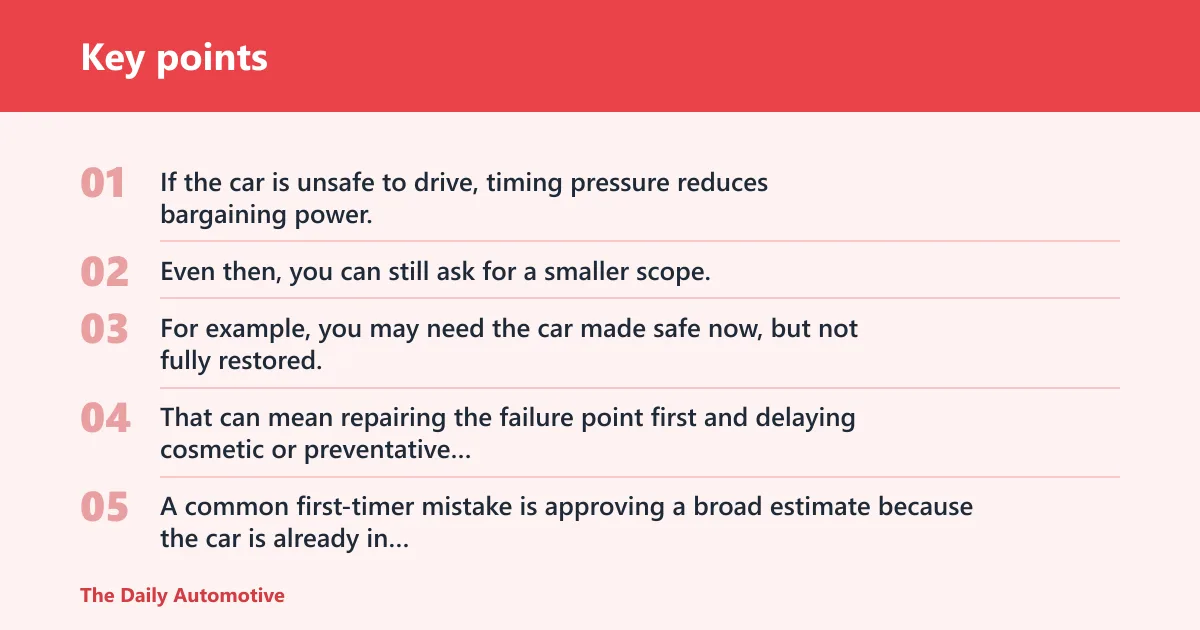
If the car is unsafe to drive, timing pressure reduces bargaining power. Even then, you can still ask for a smaller scope. For example, you may need the car made safe now, but not fully restored. That can mean repairing the failure point first and delaying cosmetic or preventative work.
A common first-timer mistake is approving a broad estimate because the car is already in the bay. If the vehicle needs a wheel bearing, that does not automatically mean it also needs every related add-on on the first pass. Ask which items are essential for safety and which can wait.
If you cannot afford the estimate, ask the shop whether the job can be split into stages. You may be able to handle the safety-critical repair now and defer the rest. If the vehicle is only worth a small amount, compare the repair bill to the car’s market value before committing to major work.
For small routine jobs, the dollar room is often limited. For larger repairs, the spread can be meaningful. FixMyCar says the average brake repair is £440.93, the average car battery replacement is £137, and the average windscreen repair is £272.60. Those figures are not a quote for your car, but they show why line-item comparison matters.
Frequently asked questions
Can you negotiate car repair costs?
Yes. The most flexible items are usually labor rate, parts choice, and some fees. The actual repair need is less flexible. Ask for a written estimate first, then compare the quote line by line before you agree to anything.
Can you negotiate labor rates for auto repairs?
Often, yes. The same source rates vary by location, shop type, and overhead. Dealership service departments may have less room to move than independent shops, but it is still reasonable to ask whether there is a lower rate or a different billing method for the job.
Can you ask a shop to use aftermarket parts to lower the price?
Yes, if the repair allows it. Aftermarket and remanufactured parts can lower the total, especially on non-safety repairs. Ask whether the part carries the same warranty coverage and whether the shop recommends a specific brand or supplier.
Should you get multiple quotes before agreeing to a repair?
Yes, especially for large or unclear repairs. Multiple quotes help you see whether one shop is pricing higher, quoting a broader scope, or including items another shop left out. Make sure you compare the same parts, labor, and fees before deciding.
What can I do if I can’t afford the repair estimate?
Ask whether the repair can be split into stages, whether a less expensive part is safe, or whether a smaller scope will get the car roadworthy. If the vehicle is old or low-value, compare the bill with the car’s worth before authorizing major work.
Products related to this article
Sponsored / affiliate links. As an Amazon Associate I earn from qualifying purchases. I may earn additional commission from eligible campaigns.