Car Title Transfer Cost: What You’ll Actually Pay
A car title transfer usually costs around $15 to $100 in state fees, but sales tax, registration, lien releases, and duplicate paperwork can increase the total. Miss a required form or fee, and you can face delays, rejected paperwork, or a second DMV trip that adds more cost. This guide breaks down government charges, tax, document fees, and the mistakes that most often raise the total.
What title transfer cost includes
The title transfer bill usually has several layers, and they do not always appear on the same line at the DMV. In many states, the title fee is separate from the title application fee, and both are separate from sales tax and registration. County or local processing charges can also appear.
Title transfer fee versus title application fee
The title transfer fee is the government charge for moving ownership on the record. The title application fee is the filing charge for the new title document itself, and some states bill that separately. Duplicate title requests and corrections are often priced differently from a standard transfer.
Sales tax, registration, and local processing fees
Sales tax on a vehicle transfer is often based on the purchase price or fair market value, depending on the state. Registration is a separate charge tied to plates, weight, or vehicle class, and it is not the same thing as a title transfer. Some counties add local processing fees on top.
Which costs are separate from the transfer itself?
Registration renewal is the most common line item people confuse with a title transfer. Renewal keeps the plates current; the transfer changes ownership records. Notary fees, lien release paperwork, inspection charges, and duplicate title corrections can all add cost without changing the core transfer fee.
How much does title transfer cost?
Title transfer cost changes by state, vehicle type, and transaction type, so there is no single nationwide price. A private-party sale can have a different tax result from a dealer sale, and out-of-state transfers can trigger extra steps. To estimate the total, add the title fee, tax, registration, and any document charges your DMV requires.
How to estimate the out-the-door total before you visit the DMV
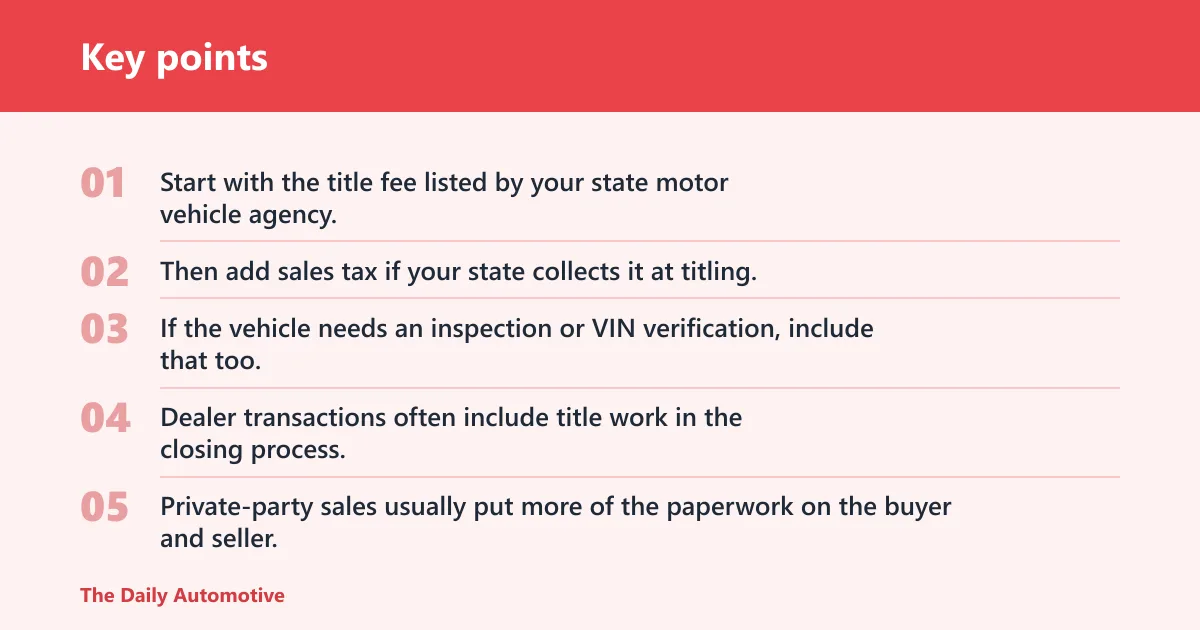
Start with the title fee listed by your state motor vehicle agency. Then add sales tax if your state collects it at titling, add the registration fee if you are also plating the vehicle, and add document costs such as notarization or a lien release. If the vehicle needs an inspection or VIN verification, include that too.
When a private-party sale and a dealer sale differ
Dealer transactions often include title work in the closing process, but that does not mean the buyer avoids tax or registration. Private-party sales usually put more of the paperwork on the buyer and seller, so the chance of a missed signature or missing odometer disclosure is higher. Those mistakes can create a second filing fee.
Say your state charges a flat title fee, but the county also collects a processing charge and the car still needs registration. The title line may be small, while the DMV visit costs more because tax and plate fees are added at the same window.
What fees are included?
Most title transfer bills include a title fee, but the full total often includes more than that. Registration, tax, county processing, and document fees can all appear in the same transaction. The exact mix depends on buying, selling, gifting, or moving an out-of-state title.
Title fee and application fee
The title fee is the ownership-record charge. The title application fee covers the new document request in many states. If the old title is lost or the information is wrong, the state may treat the filing as a duplicate or correction instead of a simple transfer.
Registration fee and plate-related charges
Registration is separate from title transfer, even when the DMV collects both at once. Plate transfers, weight fees, specialty plate charges, and renewal fees can all be attached to the same visit. Do not count a renewal estimate as your transfer estimate unless the DMV says they are billed together.
Tax, county fees, and document fees
Tax may be collected at titling, and county or local fees may be added to the filing. Notarization, inspection, VIN verification, and duplicate correction charges are common extras. They are conditional costs, which means they matter only if your state or transaction requires them.
Sales tax and other taxes
Sales tax often matters more than the title fee itself. In many states, tax is based on the purchase price or fair market value, then collected when the title is processed. Trade-ins, gifts, and inheritance transfers can change the tax result, so do not assume every transfer is taxed the same way.
Purchase price versus fair market value basis
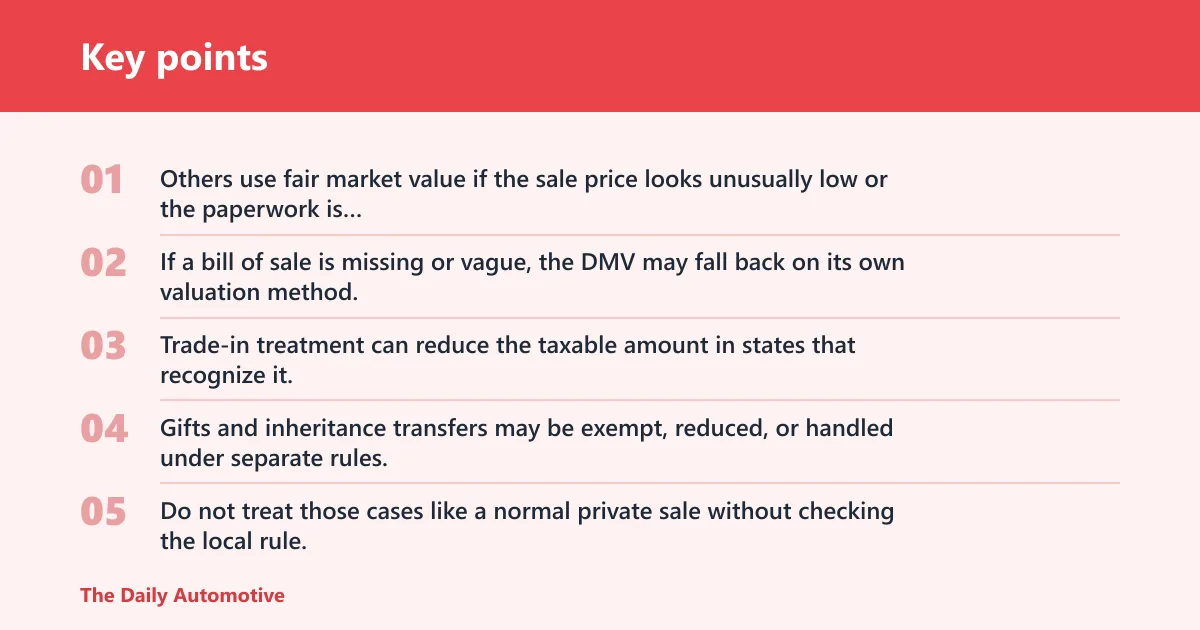
Some states tax the actual sale price. Others use fair market value if the sale price looks unusually low or the paperwork is incomplete. If a bill of sale is missing or vague, the DMV may fall back on its own valuation method.
Trade-in treatment, gifts, and inheritance cases
Trade-in treatment can reduce the taxable amount in states that recognize it. Gifts and inheritance transfers may be exempt, reduced, or handled under separate rules, depending on the state and the relationship between the parties. Do not treat those cases like a normal private sale without checking the local rule.
When tax is collected at titling
Some states collect tax when the title is filed, not when the car is handed over. That means the buyer may need to bring payment to the DMV instead of paying it only at the point of sale. If the transfer is out of state, tax treatment can change again.
Suppose a buyer and seller agree on a low private-party price, but the DMV wants tax based on fair market value because the bill of sale is incomplete. The transfer still goes through, but the tax line can jump if the paperwork does not support the stated price.
Car title cost worksheet
This worksheet helps you estimate the all-in transfer cost without treating the title fee as the whole bill. Use your state DMV schedule for the actual numbers, then fill in the items that apply to your transfer. If a line does not apply, leave it at zero.
| Line item | When it applies | Worksheet amount | Note |
|---|---|---|---|
| State fee | Every title transfer, though the amount varies by state, vehicle type, and transaction type | Enter your DMV title transfer fee | May include county or local processing charges |
| Sales tax basis | When your state collects tax at titling | Purchase price or fair market value | Use the amount your state uses to calculate tax |
| Registration fee | When you also register or plate the vehicle | Enter plate or registration amount | Separate from title transfer and separate from renewal |
| Lien release fee | When a lender had a security interest and paperwork is needed to clear it | Enter lender or filing cost, if any | Missing release can delay approval |
| Notary fee | When your state or document requires notarization | Enter notary charge, if required | Often avoidable if your state does not require notarization |
| Duplicate or correction fee | When the title is lost, damaged, or needs correction | Enter duplicate or correction charge | Common after name, VIN, or assignment errors |
| Expected total | All applicable lines combined | State fee + tax + registration + document fees | Use your DMV’s exact schedule before you pay |
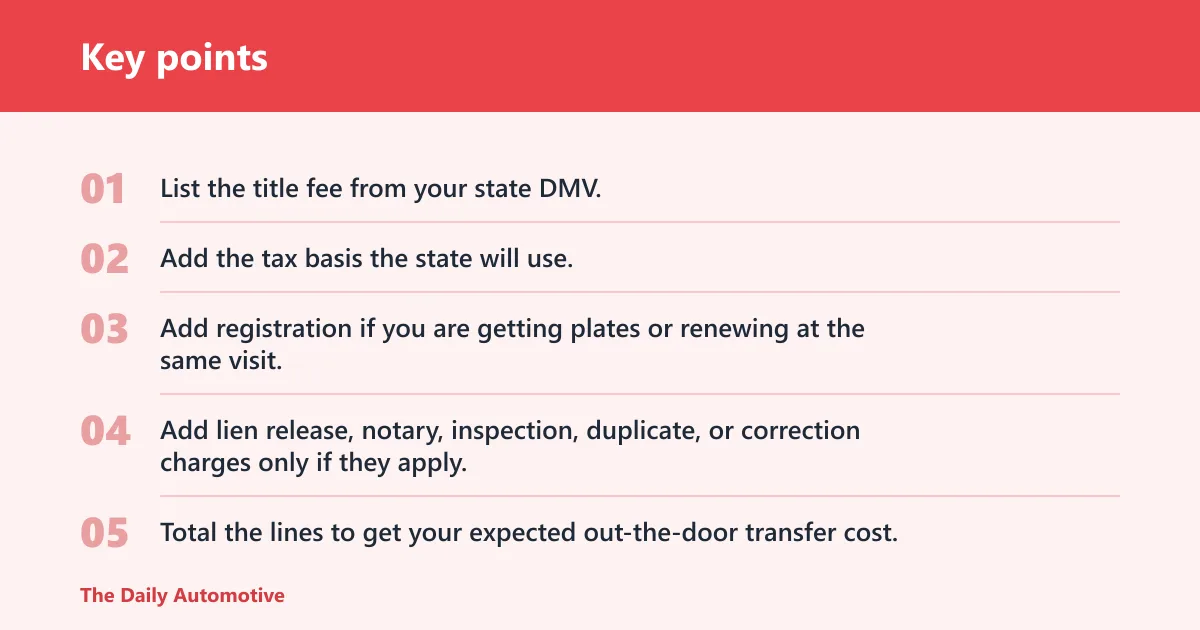
- List the title fee from your state DMV.
- Add the tax basis the state will use.
- Add registration if you are getting plates or renewing at the same visit.
- Add lien release, notary, inspection, duplicate, or correction charges only if they apply.
- Total the lines to get your expected out-the-door transfer cost.
Paperwork that can add cost
Paperwork mistakes are a common reason a transfer costs more than expected. A missing signature, a blank odometer field, or a mismatched VIN can force a correction fee or a second trip. If the title is financed, the lien has to be cleared before or during the transfer.
Signed title and title assignment section
The seller usually has to sign the title exactly as named on the document. Many states also require the sale date and mileage in the assignment area. An unsigned or altered assignment section can void the filing or send it back for correction.
Bill of sale, ID, and odometer disclosure
A bill of sale may be required, and it should list the buyer, seller, VIN, price, and date. ID proves who is filing, and the odometer disclosure must match the title paperwork for many vehicles under federal rules. If the numbers do not match, the agency can reject the transfer.
Lien release, notary, duplicate title, and correction fees
A lien release is required if a lender still has a security interest. Notarization is conditional, not universal. If the title is lost, damaged, or filled out incorrectly, the state may require a duplicate title or correction filing, which adds time and cost.
Do you pay sales tax when transferring a car title?
Often, yes, but not always in the same way or amount. Many states collect sales tax at titling, and the tax may be based on the sale price or fair market value. Gift, inheritance, and some trade-in situations can reduce or remove tax, so the DMV rule matters more than the label on the transfer.
Why transfer and registration can trigger different charges
Title transfer changes the ownership record. Registration lets the car legally operate on public roads. Because those are different transactions, the DMV can charge for both, and one charge does not replace the other. That is why a transfer estimate should never stop at the title fee alone.
What to verify with your state DMV
Check whether your state taxes the purchase price, the market value, or a different base. Confirm whether local or county surcharges apply, and ask whether gifts or inheritance transfers need special forms. If the agency lists separate transfer, application, and registration fees, add all of them before you pay.
What happens with an out-of-state title?
Out-of-state title transfers usually take more work than an in-state filing. Many states want extra verification, and some require an inspection before they will issue a local title. Fee schedules and tax treatment can also change, so the total may be higher than a standard transfer.
Extra inspection or verification steps
The DMV may ask for a VIN inspection, a safety inspection, or proof that the title is authentic. Those steps can add a fee or force another appointment. If the title information does not match the car, the transfer can stop until it is corrected.
Different fee schedules and tax rules
An out-of-state transfer may fall under a different filing category than a local sale. That can affect the title fee, the tax basis, and whether the state wants separate proof of ownership. Do not assume the paperwork you used in the seller’s state will work unchanged in your state.
Documents to gather before you start
Bring the signed title, bill of sale, ID, odometer disclosure, and lien release if one exists. Add any inspection form, VIN verification, or customs paperwork your state requires. Having the full packet ready is the easiest way to avoid a rejected filing.
How long does a title transfer take?
Most transfers are processed faster when the paperwork is complete, but timing varies by state and by whether the vehicle needs extra checks. A clean in-state transfer may move in one visit, while an out-of-state title, lien issue, or correction can take longer. Missing forms are the biggest cause of delay.
Common delay points
An active lien, a missing lien release, an incorrect seller signature, a missing odometer disclosure, a salvage brand, or a mismatched VIN can all stop processing. If the DMV has to correct one of those problems, you may pay again for a duplicate or correction filing.
How to avoid paying twice
Match the VIN on the title to the vehicle before you visit. Check that the seller signs exactly as printed on the title. Confirm the odometer line, sale date, and buyer information before you hand over the paperwork. Those small checks are cheaper than a second filing.
Frequently asked questions
How much is it to transfer title?
It is usually the DMV title fee plus any tax or registration that applies to your transaction. If the vehicle needs a lien release, notarization, or correction, those charges are added separately. The best estimate comes from your state’s current fee chart, not from a national average.
What fees are included in a car title transfer?
Common fees include the title transfer fee, the title application fee, sales tax, registration, county processing, notary, inspection, and duplicate or correction charges. Not every transfer includes all of them. The mix changes by state, by vehicle type, and by whether the car is being titled, registered, or both.
What happens if the title is in another state?
Expect extra verification, possibly an inspection, and a different fee schedule. Some states also apply different tax rules to out-of-state titles. Bring the signed title, bill of sale, ID, odometer disclosure, and lien release so the DMV can process the file without sending you back for missing paperwork.
Products related to this article
Sponsored / affiliate links. As an Amazon Associate I earn from qualifying purchases. I may earn additional commission from eligible campaigns.