3 Best Onoff Switches for a Car (2026): We Compared
The best on/off switch for a car depends on use: a manual battery disconnect for a stored classic, a keyed or hidden kill switch for theft deterrence, and a high-current switch for trucks or RVs. Pick the wrong type, and you can create parasitic drain, nuisance no-starts, or a switch that overheats under load. This guide compares the best picks by job, with the right fit for daily drivers, long-term storage, and high-demand electrical systems.
Quick comparison
| Product | Badge | Best for | Price | ||
|---|---|---|---|---|---|
 |
POWBAY Battery Disconnect Switch, Pure Copper, 12V-48V, 2PowBay | Our pick | 12V-48V · pure copper · 2 pack | $14.99
Price as of 25 Oct 2026
|
View |
 |
250A Smart Remote Battery Disconnect Switch 12V 24V – KillPonzkoe | Also great | 12V/24V · remote kill switch · LED display | $29.99
Price as of 25 Oct 2026
|
View |
 |
DIHOOL Heavy Duty Battery Disconnect Switch, 300 Amp DCDIHOOL | Also great | $55.88
Price as of 25 Oct 2026
|
View | |
 |
Spurtar Battery Disconnect Switch 12V 24V 48V Heavy DutySpurtar | Also great | 12V-48V · 200A · heavy duty | $15.99
Price as of 25 Oct 2026
|
View |
The real choice is not “best switch” in the abstract. It is “best switch for this vehicle, this terminal layout, and this load.” A commuter that only needs a simple top-post cutoff has very different needs from a diesel truck or RV with more wiring space and heavier electrical demand.
How we chose
We compared each option on fitment, electrical rating, install burden, and maintenance risk. We also separated true battery disconnect switches from accessory rockers, because those are not the same product. Finally, we gave extra weight to voltage compatibility, corrosion resistance, and how well each style fits common use cases.
- Terminal fitment: top-post, negative-terminal, or panel-mount.
- Load handling: continuous current and, where listed, cranking current.
- Install complexity: wiring, mounting, and hardware needs.
- Maintenance: corrosion checks, loose lugs, vibration, and storage concerns.
- Use case: daily driver, stored classic, truck, RV, or outdoor install.
Top-post disconnect switch: best for daily drivers
The PowBay Battery Disconnect Switch is the best fit for standard top-post batteries and is the cleanest pick for a commuter or garage-kept car that needs a simple cutoff. It works on 12V-48V systems, uses pure copper conductive parts, and is built around manual rotary disconnect use.
This style fits the common top-post battery terminal setup, so it makes sense when you want a direct-mount disconnect without adding a separate panel or extra wiring. WirthCo Battery Doctor 20092 is described as the best overall pick for standard top-post batteries, and it is presented as a five-minute anti-theft install with no wiring required; that is the same basic appeal here.
The drawback is fitment discipline. Top-post disconnects depend on terminal compatibility, tight lugs, and clean contact surfaces. If the clamp is loose or corroded, you can get voltage drop, intermittent starting, or heat at the connection.
Why this style works for commuters
A battery disconnect switch interrupts battery power flow, which can reduce parasitic drain when a car sits for days and can slow unauthorized use by cutting power. For a daily driver, the attraction is simple, less wiring, fewer panel changes, and a cutoff point near the battery.
That simplicity comes with a tradeoff. Disconnecting battery power can reset alarms, radios, and memory modules, so the driver has to decide whether convenience or preservation of stored settings matters more.
Panel-mount disconnect switch: best for trucks and RVs
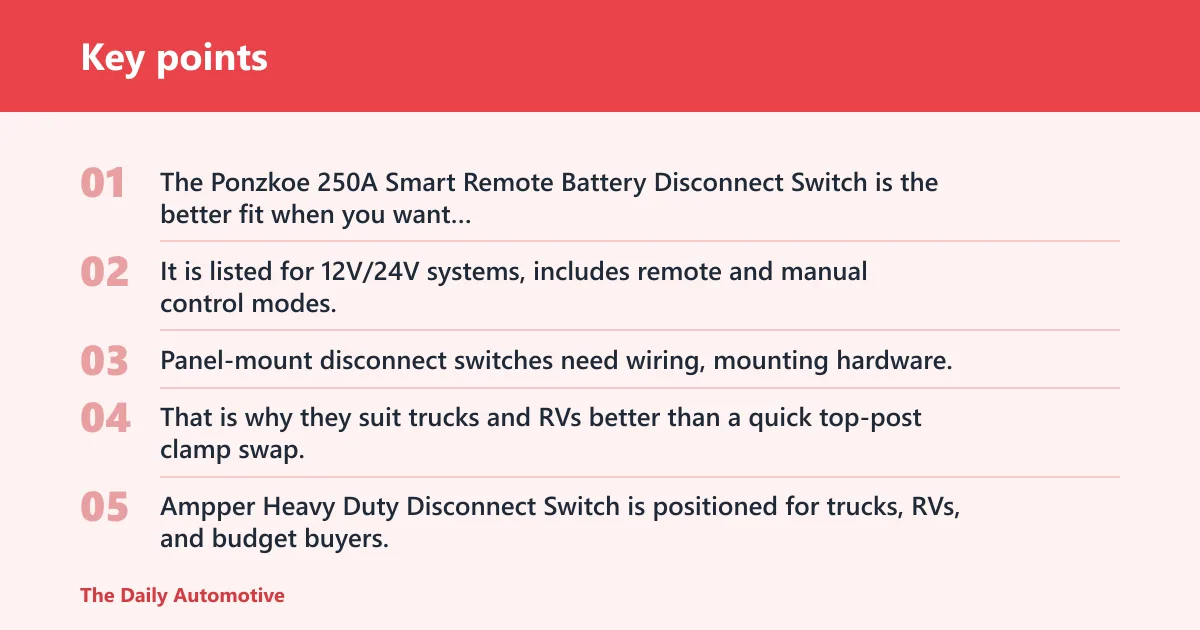
The Ponzkoe 250A Smart Remote Battery Disconnect Switch is the better fit when you want a panel-mount-style solution for a truck, RV, boat, or other custom install. It is listed for 12V/24V systems, includes remote and manual control modes, and adds an LED voltage display with low standby current.
Panel-mount disconnect switches need wiring, mounting hardware, and a place to live on the dash, bulkhead, or service panel. That is why they suit trucks and RVs better than a quick top-post clamp swap. Ampper Heavy Duty Disconnect Switch is positioned for trucks, RVs, and budget buyers, and it is described as a universal panel-mount switch for 12V or 24V systems.
The drawback is install burden. You need panel space, correct wire sizing, and careful mounting so vibration does not loosen the hardware. It is also easier to make a mistake with routing, especially in a cab or coach where other circuits already crowd the panel.
Why panel space matters
Panel-mount designs are useful when the battery is not easy to reach or when you want a controlled disconnect point in the cabin or service area. They are common on trucks and RVs because the owner may want quick access without opening a battery box every time.
For wet or exposed installs, look for a waterproof or weatherproof option. General Auto Pro includes a waterproof option with an LED voltage display, and IP66 waterproof rating is the clue to look for when dust and water exposure are part of the job.
Heavy-duty knob disconnect: best for stored classics
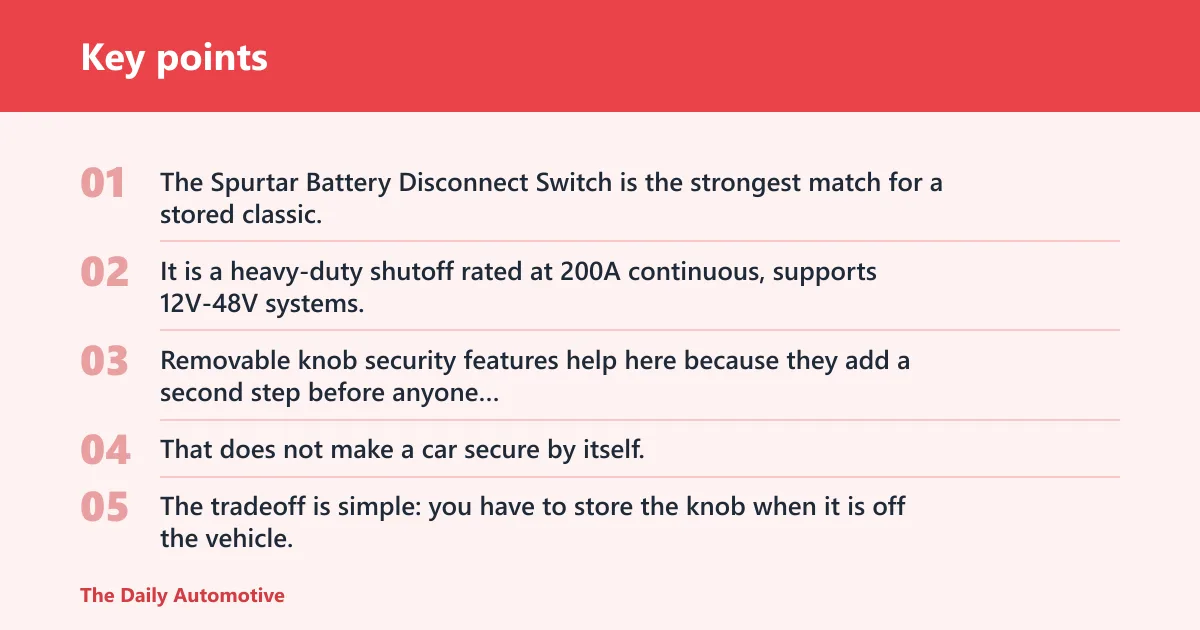
The Spurtar Battery Disconnect Switch is the strongest match for a stored classic, a weekend car, or a utility vehicle that sits for long stretches. It is a heavy-duty shutoff rated at 200A continuous, supports 12V-48V systems, and includes lugs and terminal insulators.
Removable knob security features help here because they add a second step before anyone can reconnect power. That does not make a car secure by itself, but it can deter casual tampering and slow unauthorized use. The tradeoff is simple: you have to store the knob when it is off the vehicle, and the knob itself becomes a part you can misplace.
The drawback is maintenance. Knob-style disconnects need periodic retightening, especially on vehicles with road vibration. Corrosion at the terminal faces can also cause trouble, and a knob that is forced or cross-threaded can strip over time.
Where stored vehicles benefit most
Stored classics often need battery isolation more than daily commuters do. That is because long idle periods invite parasitic drain from clocks, modules, and alarms. A disconnect switch can stop that drain, but it can also reset memory systems, so owners should expect to reset presets after reconnecting power.
Picture a 1970s coupe that sits in a covered garage for six weeks. If the battery keeps going flat, a manual cutoff near the battery can solve the drain problem cleanly. The owner still needs clean terminals and a snug clamp, or the switch becomes another source of resistance.
High-current disconnect: best for heavier electrical systems
The DIHOOL Heavy Duty Battery Disconnect Switch is the highest-capacity option in this group and is the one to watch when current demand is the main concern. It is listed as a 300 Amp DC circuit breaker for power station and solar use, which makes it a different kind of choice from the basic automotive top-post cutoff.
This is where continuous current rating matters most. A 250A class switch can suit lighter-duty vehicle service, a 300A class rating gives more headroom, and a 350A class rating gives even more margin for demanding setups. Blue Sea Systems 6006 m-Series Switch is listed with a 300A continuous rating, and Blue Sea Systems 9001E e-Series Switch is listed with a 350A continuous rating.
The drawback is complexity and cost. A higher-rated disconnect usually asks for better wiring, more careful installation, and more attention to mounting and heat management. If your vehicle does not need that level of capacity, you pay for headroom you will never use.
When higher ratings matter
High-load trucks and RVs may run winches, inverters, auxiliary batteries, or heavy accessory circuits. In those cases, current rating is not a marketing line; it is the line between a switch that runs cool and one that becomes a weak point.
General Auto Pro lists one battery switch model at 300A continuous and 900A crank, and that kind of split shows why both ratings matter. Continuous rating covers sustained load. Cranking current is the short-duration startup capacity, which becomes important when a vehicle asks a lot from the battery during starting.
Battery switch decision matrix
The fastest way to choose is to match vehicle type, terminal style, and load to the switch style that actually fits the job. This matrix is a practical shortcut for top-post, panel-mount, and high-current setups.
| Vehicle type | Terminal style | Electrical load | Best switch type | Why |
|---|---|---|---|---|
| Daily commuter | Top-post battery terminal | Moderate accessories, occasional storage | Top-post battery disconnect | Quick install, low wiring burden, easy cutoff for drain control |
| Stored classic | Top-post battery terminal | Low to moderate, long idle periods | Manual rotary or removable-knob disconnect | Simple isolation, better tamper resistance, good for storage |
| Truck or RV | Panel space available | Heavy accessories, auxiliary systems | Panel-mount disconnect | Better access, better load handling, easier service access |
| Wet or exposed install | Either panel or battery mount | Outdoor or marine-style exposure | Weatherproof or IP66-rated disconnect | Better dust and water resistance for exposed locations |
Onoff switch table
Switch price is only part of ownership cost. Replacement hardware, dielectric grease, and ring terminals add up, especially if the install needs cleanup after corrosion or a re-run of the cable ends.
| Cost item | Typical range | What it covers |
|---|---|---|
| Switch price | $15.99 to $55.88 | Listed product price for the options compared here |
| Dielectric grease | Low-cost maintenance item | Helps limit corrosion at terminals and contact surfaces |
| Ring terminals | Low-cost hardware item | Needed for some panel-mount or rewired installs |
| Replacement hardware | Low to moderate | Nuts, bolts, washers, and insulators lost or replaced during service |
Onoff switch checklist
- Confirm whether the battery uses a top-post clamp or a panel-mounted disconnect point.
- Check whether the vehicle is 12V or 24V before buying any switch.
- Match continuous current rating to the vehicle’s real load, not the smallest label on the box.
- Check whether cranking current is listed if the vehicle has a heavy startup draw.
- Decide whether a removable knob, remote control, or plain rotary cutoff fits the security goal.
- Inspect available space for wiring, hardware, and future retightening access.
Choose PowBay if… / Choose Ponzkoe if…
Choose PowBay if you have a standard top-post battery, want a simple manual cutoff, and prefer the least complicated install path for a daily driver or a car that sits in storage between trips.
Choose Ponzkoe if you want a panel-mounted solution, need 12V/24V compatibility, want voltage display and remote control, or are fitting a truck or RV where panel space is available and the wiring can be managed cleanly.
Which one should you buy?
If your car has a standard top-post battery and you want the easiest install, start with the PowBay option. If your vehicle is a truck or RV with room for a mounted control point, the Ponzkoe style fits better. If the vehicle sits for long periods and theft deterrence matters, a removable-knob design is the smarter direction.
Choose by load before you choose by price. A commuter with modest electrical demand can live with a simpler top-post disconnect, but a high-load setup should move toward a higher continuous rating such as 300A or 350A class hardware. General Auto Pro’s 12V to 48V picks show how broad the category is, but voltage and current still have to match the vehicle.
For harsh weather, exposed mounting, or off-road use, prioritize weather resistance. IP66 waterproof rating is the useful clue, and waterproof or weatherproof housing matters more than a low sticker price when the switch lives in dust, spray, or road grime.
A common first-timer mistake is buying a small accessory rocker when the goal is battery isolation. A rocker can control an accessory circuit, but it is not the same as a true battery disconnect switch that interrupts battery power flow for drain prevention or theft deterrence.
Frequently asked questions
What is the best on/off switch for a car battery?
The best choice depends on the vehicle. For a standard commuter with a top-post battery, a direct-mount disconnect is the simplest answer. For a stored classic, a removable-knob or rotary cutoff makes more sense. For trucks and RVs, a panel-mount disconnect gives better access and load handling.
Do I need a top-post or panel-mount disconnect switch?
Use top-post if the battery terminals are exposed and you want a quick direct fit. Use panel-mount if the vehicle has room for wiring and a service panel, or if the battery is harder to reach. Top-post is usually easier. Panel-mount is usually more flexible.
What current rating do I need for a car battery disconnect switch?
Match the switch to the vehicle’s electrical load, not just the battery size. If startup load is high, also check cranking current, such as 900A or 1000A claims.
Is a removable knob better for anti-theft protection?
It can help, but it is not a guarantee. A removable knob adds tamper resistance because the switch cannot be flipped instantly. That said, it also adds a storage step, and if the knob is left nearby or the installer chooses a poor location, the security value drops fast.
Can I use a battery disconnect switch on a 12V or 24V system?
Yes, if the switch is rated for that voltage. The voltage match matters for safety and function. Some switches support both 12V and 24V systems, which is useful for mixed automotive and RV use, but the label should always match the vehicle before installation.
Will an on/off switch stop parasitic battery drain?
Yes, a true battery disconnect switch can stop parasitic drain by cutting battery power flow. That makes it useful for storage or long parking periods. The tradeoff is that alarms, radios, and memory modules may reset, so it solves one problem while creating another.
What is the difference between a rocker switch and a battery disconnect switch?
A rocker switch is often an accessory control for a single circuit, while a battery disconnect switch isolates the battery itself. They are not interchangeable. If the goal is to stop drain or cut all power for theft deterrence, you want a true disconnect, not a small accessory rocker.
Which switch is easiest to install in a car?
A top-post battery disconnect is usually easiest because it can be a direct fit with little or no wiring. The WirthCo Battery Doctor 20092 is described as a five-minute anti-theft install with no wiring required, which is exactly why this style is so common for simple setups.
Products related to this article
Sponsored / affiliate links. As an Amazon Associate I earn from qualifying purchases. I may earn additional commission from eligible campaigns.