Best Paddle Tires for RC Cars (2026): We Compared
For beach bashing, pick wide, low-pitch paddle tires. For sand drag, use taller, more aggressive paddles. For snow-only driving, choose softer, narrower paddles with low fitment risk. The wrong choice hurts acceleration, heats drivetrains, and can rub suspension or bodywork. This guide sorts the best fit by terrain intensity and points you to the first options to buy.
Quick comparison
| Product | Badge | Best for | Price | ||
|---|---|---|---|---|---|
 |
AMORIL RC Paddle Tires, 4PCS Off Road Snow Sand RubberAMORIL | Our pick | 110 mm · 4-pack · rubber | $35.99
Price as of 28 Oct 2026
|
View |
 |
ProLine 1010110 Sling Shot 2.2 Sand Tires Mounted OnPROLINE | Also great | 2.2" · 12-paddle · mounted | View | |
 |
Pro-Line Racing Dumont Sand/Snow Tires Mounted on RaidPro-Line | Upgrade pick | Mounted · 17mm hex · sand/snow | $44.99
Price as of 28 Oct 2026
|
View |
 |
HIRCQOO 1/8 RC Off Road Buggy Snow Sand Paddle TiresHIRCQOO | Also great | 123 mm · 17mm hex · unglued | $27.59
Price as of 28 Oct 2026
|
View |
The top pick for hard sand driving is the Pro-Line Sand Paw HP Belted 2.8, as belt support can help the tire hold shape under load. For fast installs, a pre-glued paddle wheel set is the simplest route, while multi-hex sets reduce fitment risk when you are unsure about 12 mm, 14 mm, or 17 mm hardware.
How we chose
This selection uses manufacturer specs, listing details that affect fitment, and published buyer feedback for caution points such as ballooning, clearance, and install hassle.
Only products with clear paddle use for sand or snow made the list. Fitment mattered as much as tread design.
We also weighed whether a tire was pre-glued or glue-on, whether it was belted, and whether the listing gave enough detail to check hex compatibility before you buy.
Paddle tire decision matrix
This table turns the buying choice into terrain, scale, hex size, build type, and risk notes. It is the fastest way to avoid the common mistake of choosing the right tread for the wrong truck.
| Use case | Terrain | Scale | Hex size | Pre-glued or glue-on | Belted or no-belt | Risk notes |
|---|---|---|---|---|---|---|
| Beach bashing | Loose sand with some turn-in abuse | 1/10 | 12 mm, sometimes 14 mm | Pre-glued if you want less setup time | Belted preferred | Watch heat, ballooning, and sidewall rub at speed |
| Sand drag | Deep sand, short straight pulls | 1/10 or larger | 14 mm or 17 mm on some setups | Either, but mounted sets help when you want quick swaps | Belted strongly favored | Higher paddle bite can load the drivetrain and expose clearance issues |
| Snow-only use | Packed or powder snow | 1/16 or 1/10 | 12 mm on many smaller trucks | Pre-glued is usually easier | Non-belted can work if speeds stay modest | Check body clearance, steering range, and wheel well space |
| Mixed sand and snow | Both surfaces, same day | 1/10 mostly | 12 mm or multi-hex | Pre-glued with spare planning | Belted if you expect speed | No single paddle layout is ideal for both surfaces; expect compromise |
Pro-Line Sand Paw HP Belted 2.8: best for sand racing
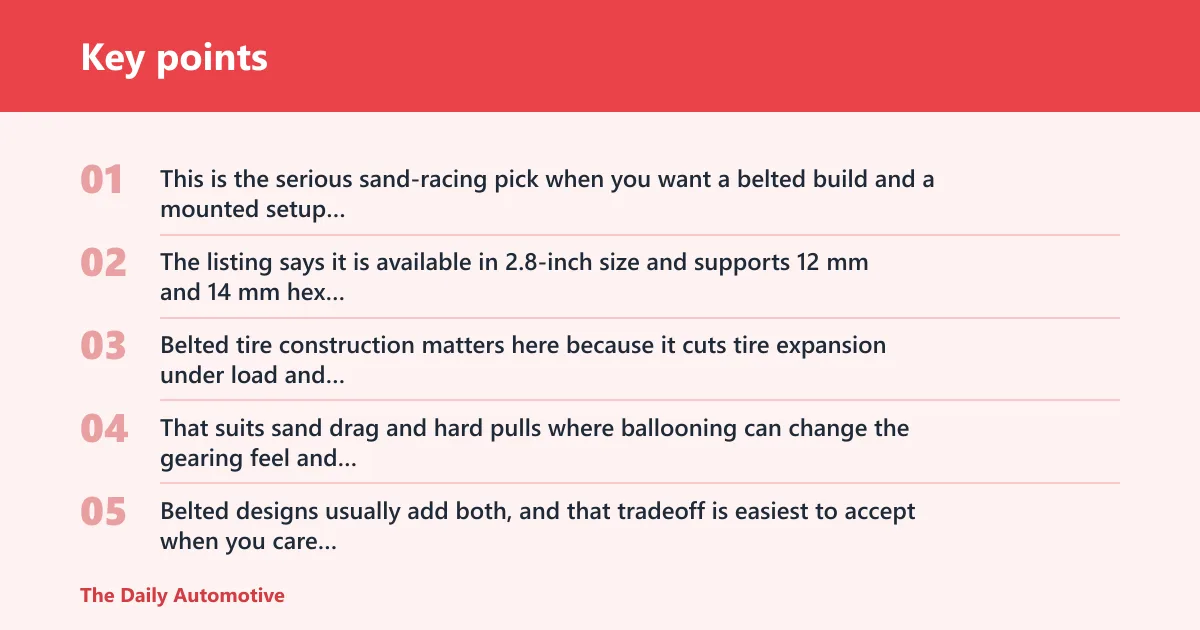
This is the serious sand-racing pick when you want a belted build and a mounted setup based around 17 mm hex wheels. The listing says it is available in 2.8-inch size and supports 12 mm and 14 mm hex options, so it reaches beyond a single truck family.
Belted tire construction matters here because it cuts tire expansion under load and helps consistency at higher speed. That suits sand drag and hard pulls where ballooning can change the gearing feel and make the truck harder to track.
The drawback is cost and weight. Belted designs usually add both, and that tradeoff is easiest to accept when you care more about straight-line stability than light steering feel.
If your truck already runs 17 mm hardware, this style can fit larger RC setups well. If you are on a smaller platform, verify wheel offset, body clearance, and suspension travel before buying.
Pre-glued paddle wheel set: best for quick installs
Pre-glued paddle wheel sets are the easiest choice when you want less setup time and fewer steps before a run. DUSTAIL’s set supports 12 mm, 14 mm, and 17 mm hex options, and the tire size is about 117 mm outer diameter.
The big advantage is convenience. A pre-glued set cuts out wheel assembly and glue work, which matters if you swap tires often or want a faster turnaround between sand and snow sessions.
The drawback is maintenance planning. When tread starts to lift or wear unevenly, you are dealing with a mounted assembly, so inspection, re-gluing, or replacement can take more care than a simple loose tire and rim setup.
Because this style is often sold in 4-piece packs, it is easier to keep a full matched set ready. That helps if you expect one wheel to take damage or if you want a spare set already broken in visually to match the car.
AMORIL RC paddle tires: best for 1/10 snow and sand
This 4-piece AMORIL set is built for 1/10 scale trucks and uses 12 mm hex hubs. The outer diameter is 110 mm, which puts it squarely in the compact 1/10 paddle category.
That size makes sense for beach bashing and snow use where you want a lighter paddle than a full-size sand drag tire. It is also a practical choice when your truck manual calls for 12 mm hex wheels and you want a replacement set that stays close to common 1/10 proportions.
The drawback is that compact 1/10 paddles can run out of clearance on bodies with tight wheel arches. Always check the manual for hex size, then confirm offset and suspension travel before ordering.
For snow-only runs, this style keeps fitment risk lower than bigger drag-oriented tires. For deep sand and high-speed use, the shorter body can give up some bite compared with more aggressive paddle layouts.
HIRCQOO 1/8 paddle tires: best for larger 17 mm setups
This is the 1/8-scale option in the list, and it uses 17 mm hex wheel rims. The listing reports a 123 mm outer diameter and says it includes soft rubber tires with foam inserts, which suggests it is suited to larger trucks that already run 17 mm hardware.
It is the clearest answer when your truck is in the bigger RC class and you want sand paddle wheels that match a wider stance. The included rims cut assembly work, and the 17 mm hex format is common on larger trucks and bashers.
The drawback is fitment risk on narrower bodies and smaller suspension envelopes. Bigger paddle tires can contact the body at full compression or full steering lock, especially if the wheel offset is wrong.
If you are comparing 1/10 and 1/8 choices, remember that the larger diameter and wider footprint can change gearing load and steering feel. That can be useful in sand, but it is not free.
Which one should you buy?
If your goal is sand racing and you care most about stability, start with the Pro-Line Sand Paw HP Belted 2.8. If you want the fastest install and a multi-hex safety net, the pre-glued paddle wheel set is the easier first buy.
If you run a 1/10 truck with 12 mm hex hubs, the AMORIL set is the cleaner compact choice. If your truck is larger and already on 17 mm wheels, the HIRCQOO set is the better match among the options here.
For budget planning, buy for fitment first and tread second. A paddle tire that rubs the body or loads the drivetrain too hard is the wrong buy, even if the tread looks aggressive.
A common first-timer mistake is choosing a big sand paddle for a truck with limited wheel well space. The truck may launch harder in a straight line, then start rubbing the body at speed or bottoming out the tire under compression.
Paddle tread geometry matters more than it looks
Paddle tread geometry changes how the tire moves sand or snow. Taller paddles can dig and throw material harder, while denser or wider layouts can change how the truck hooks up and how much drag the drivetrain sees.
For beach bashing, a lower-pitch layout usually feels easier to control. For sand drag, a more aggressive layout can help the truck dig in, but the extra bite also raises the chance of ballooning and heat buildup if the truck is overgeared.
How to choose by fitment risk
Start with the vehicle manual and verify the hex size before anything else. Then check wheel offset, body clearance, and suspension travel so the tire can move without hitting the shell or the chassis.
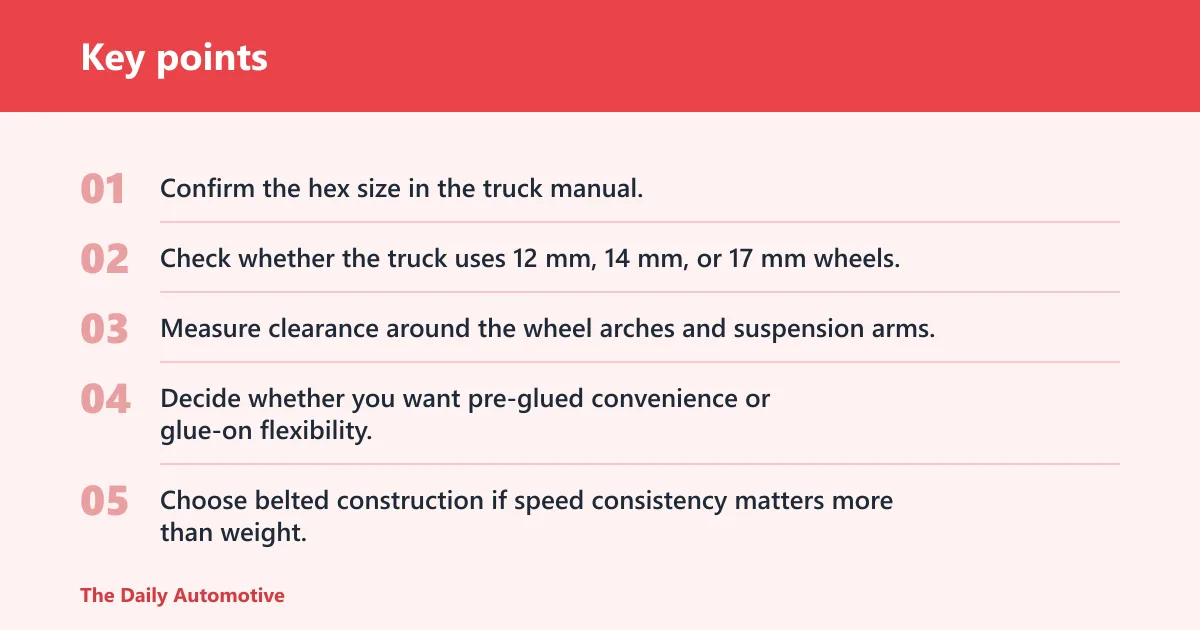
- Confirm the hex size in the truck manual.
- Check whether the truck uses 12 mm, 14 mm, or 17 mm wheels.
- Measure clearance around the wheel arches and suspension arms.
- Decide whether you want pre-glued convenience or glue-on flexibility.
- Choose belted construction if speed consistency matters more than weight.
- Plan for spares if you expect heavy sand use or repeated snow runs.
What 1/10 and 1/16 trucks usually need
1/10 scale RC trucks are the most common target for paddle tires, and many use 12 mm hex wheels. That makes them the easiest place to start if you are shopping for sand and snow use.
1/16 scale RC trucks often need lighter, compact paddle tires. GOUPRC is designed for 1/14 and 1/16 RC cars, uses 12 mm hex compatibility, and lists dimensions of 85.6 x 42.4 mm, which fits the smaller-platform idea well.
Say your 1/16 truck has a 12 mm hex and tight wheel wells. A compact pre-glued paddle set is the safer starting point than a larger drag-style tire that could overload steering or rub the body on compression.
Pre-glued versus glue-on maintenance
Pre-glued paddle tires save time, but they still need inspection. Look for lifted bead edges, torn paddles, and uneven wear after hard runs, especially if you drive on mixed surfaces or carry extra speed.
Glue-on tires give you more control over wheel and tire pairing, but they ask for more assembly care and more planning if you want a backup set ready. If you run often, keep a spare set on hand before the current set is worn down.
What are the best paddle tires for RC cars on sand and snow?
The best paddle tires depend on how hard you drive and how much fitment risk you can accept. For serious sand racing, a belted option like the Pro-Line Sand Paw HP Belted 2.8 is the strongest fit among the listed choices. For easy installation, a pre-glued multi-hex set is the safer convenience play.
Will 12mm hex paddle tires fit my RC truck?
They will fit many 1/10, 1/14, and 1/16 paddle setups, but only if your manual says your truck uses 12 mm hex wheels. Do not assume fit from scale alone. Check offset, body clearance, and suspension travel before you order.
Are pre-glued paddle tires better than glue-on tires?
Pre-glued tires are better if you want speed and simplicity at install time. Glue-on tires are better if you want more control over mounting and bead work. For most hobbyists, pre-glued sets are easier to manage, but glue-on setups can make sense if you swap wheels often.
What scale paddle tires do I need for a 1/10 RC car?
For a 1/10 RC car, start with 1/10 paddle tires and 12 mm hex compatibility unless your manual says otherwise. That is the most common target segment, and it keeps the chance of mismatch lower. If the truck is larger or adapted, check whether 14 mm or 17 mm hardware is listed.
Do belted paddle tires work better for sand racing?
Belted paddle tires are often the better call for sand racing because they resist expansion under load and stay more consistent at speed. The tradeoff is extra weight and cost. If your truck is geared hard or sees long straight pulls, that stability usually matters.
Can one paddle tire set work on both sand and snow?
One set can work on both, but it is usually a compromise. Sand often rewards taller, more aggressive paddles, while snow can like narrower layouts with less drag. If you split time between both surfaces, a pre-glued multi-hex set is a practical middle ground.
How do I check RC tire hex compatibility before buying?
Check the vehicle manual first, then match the hex size on the listing. Confirm whether your truck uses 12 mm, 14 mm, or 17 mm hubs, and look at wheel offset before buying. If the listing mentions adapters, verify that they match your vehicle and wheel carrier.
Which paddle tires are best for 1/16 RC trucks?
For 1/16 trucks, compact and lighter paddle tires are the better fit. GOUPRC is built for 1/14 and 1/16 RC cars with 12 mm hex compatibility, which makes it a sensible place to start. Smaller trucks need less rotating mass and less body clearance risk.
Do paddle tires wear out faster on hard surfaces?
Yes, they usually do. Paddle tires are built for loose surfaces like sand and snow, not pavement. Hard ground raises heat, scrubs the paddles, and can shorten service life fast, so keep pavement runs brief and check the tread after each session.
Products related to this article
Sponsored / affiliate links. As an Amazon Associate I earn from qualifying purchases. I may earn additional commission from eligible campaigns.