Personal Finance Tips for Car Enthusiasts That Work
Use a car-only cash-flow cap: keep total vehicle spending at or below about 15% of take-home pay, then split that cap into insurance, maintenance, and mod buckets before you buy parts. Skip that system, and the hobby starts pulling from emergency savings, debt payoff, and every other goal. This guide lays out the spending cap, the three-bucket setup, and the order to fund daily driving, repairs, and upgrades without wrecking your long-term finances.
How should car enthusiasts budget without killing the hobby?
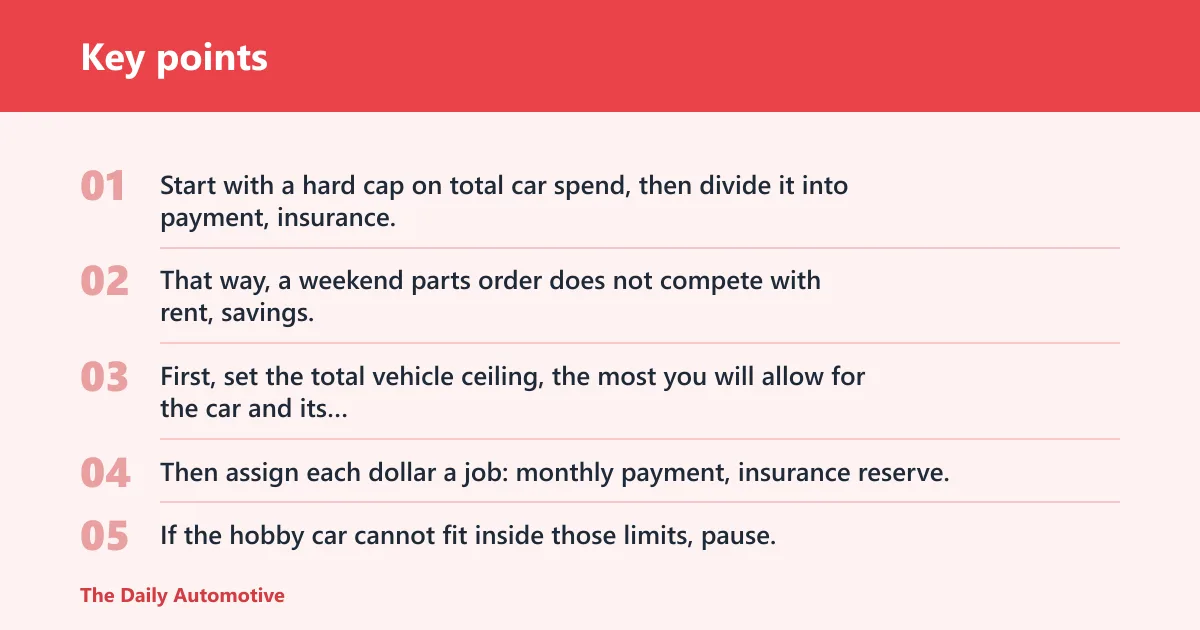


Start with a hard cap on total car spend, then divide it into payment, insurance, maintenance, and modification buckets. Keep emergency savings outside the car fund. That way, a weekend parts order does not compete with rent, savings, or the cash needed to fix a broken water pump.
Build the budget in the right order
First, set the total vehicle ceiling, the most you will allow for the car and its related costs. Then assign each dollar a job: monthly payment, insurance reserve, maintenance sinking fund, and mod fund. If the hobby car cannot fit inside those limits, pause. Do not stretch the loan or raid the emergency fund.
A common first-timer mistake is treating the payment as the whole story. A $350 note can sometimes feel like roughly a $700 monthly burden once insurance rises, tires wear out faster, and a few “small” upgrades land on the card.
Keep emergency savings separate
Keep emergency savings separate for job loss, medical bills, and surprise household repairs. Car money should not fill that role. If the repair reserve is empty, delay the purchase or choose a cheaper platform with lower insurance and parts costs.
📊 The guide says enthusiasts should keep total vehicle spending under roughly 10% of annual income. Source: Personal Finance Tips for Car Enthusiasts.
What is the one-tenth rule for car spending?
The one-tenth rule limits total vehicle spending to roughly 10% of annual income. For enthusiasts, it works best as a ceiling, not a target. It helps prevent the common mistake of buying too much car and then cutting into long-term savings to keep it on the road.
Use income as the first filter
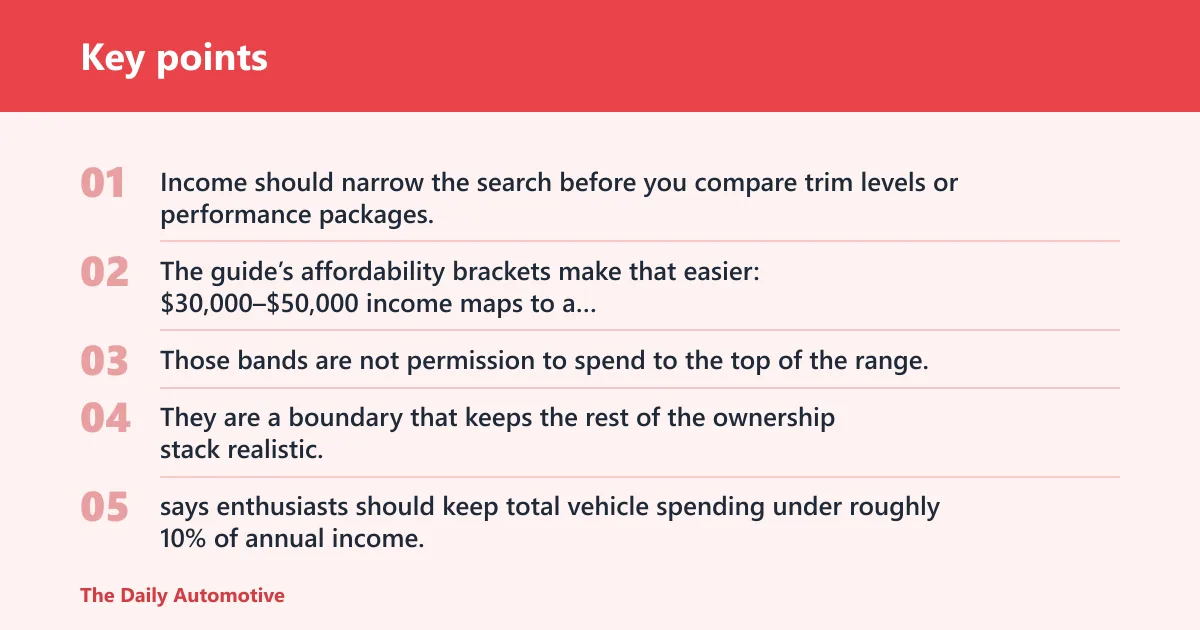
Income should narrow the search before you compare trim levels or performance packages. The guide’s affordability brackets make that easier: $30,000–$50,000 income maps to a $15,000–$25,000 car; $50,000–$80,000 maps to $25,000–$40,000; $80,000–$120,000 maps to $40,000–$60,000.
Those bands are not permission to spend to the top of the range. They are a boundary that keeps the rest of the ownership stack realistic.
Use the rule as a ceiling
says enthusiasts should keep total vehicle spending under roughly 10% of annual income. adds that overspending on a car is a common way enthusiasts hurt long-term savings. That is why the rule works better as a guardrail than as a shopping goal.
| Annual income | Car cost ceiling | Monthly budget target | Red flag |
|---|---|---|---|
| $30,000–$50,000 | $15,000–$25,000 | About 15% of take-home pay or less | Any plan that leaves no room for insurance or repairs |
| $50,000–$80,000 | $25,000–$40,000 | Separate payment, insurance, maintenance, and mods | Loan term stretched only to force a better badge |
| $80,000–$120,000 | $40,000–$60,000 | Keep ownership costs inside the full vehicle cap | Upgrades that cut into emergency cash |

How do you build an enthusiast car budget worksheet?
Set annual limits for payment, insurance, maintenance, and modifications, then convert those limits into monthly buckets. Add red-flag thresholds that stop spending early. A worksheet keeps the car hobby visible, measurable, and easier to control before a loan or parts order gets approved.
Use this annual worksheet
Start with a simple structure. The payment bucket covers the loan or cash set-aside. Insurance covers premium and deductible exposure. Maintenance covers routine service and wear items. Mods cover discretionary upgrades only after the first three buckets are funded.
| Bucket | Annual amount | Monthly amount | Red-flag threshold |
|---|---|---|---|
| Payment | Car-specific amount tied to income cap | Annual amount ÷ 12 | Payment plus insurance exceeds 10% of annual income on its own |
| Insurance reserve | Full yearly premium plus deductible cash | Annual amount ÷ 12 | Policy requires a deductible larger than cash reserves |
| Maintenance sinking fund | Routine service, tires, brakes, fluids, and surprise wear items | Annual amount ÷ 12 | No cushion for the next scheduled service |
| Modification fund | Only what remains after core costs | Annual amount ÷ 12 | Any mod purchase pulls from emergency savings |
Put the monthly template into practice
Example template: if your annual car budget is around $6,000, you could split it into roughly $2,400 for payment, about $1,200 for insurance reserve, around $1,800 for maintenance, and about $600 for mods. That works out to roughly $200, $100, $150, and $50 a month. The exact mix will vary, but the sequence should not: protect the core costs first.
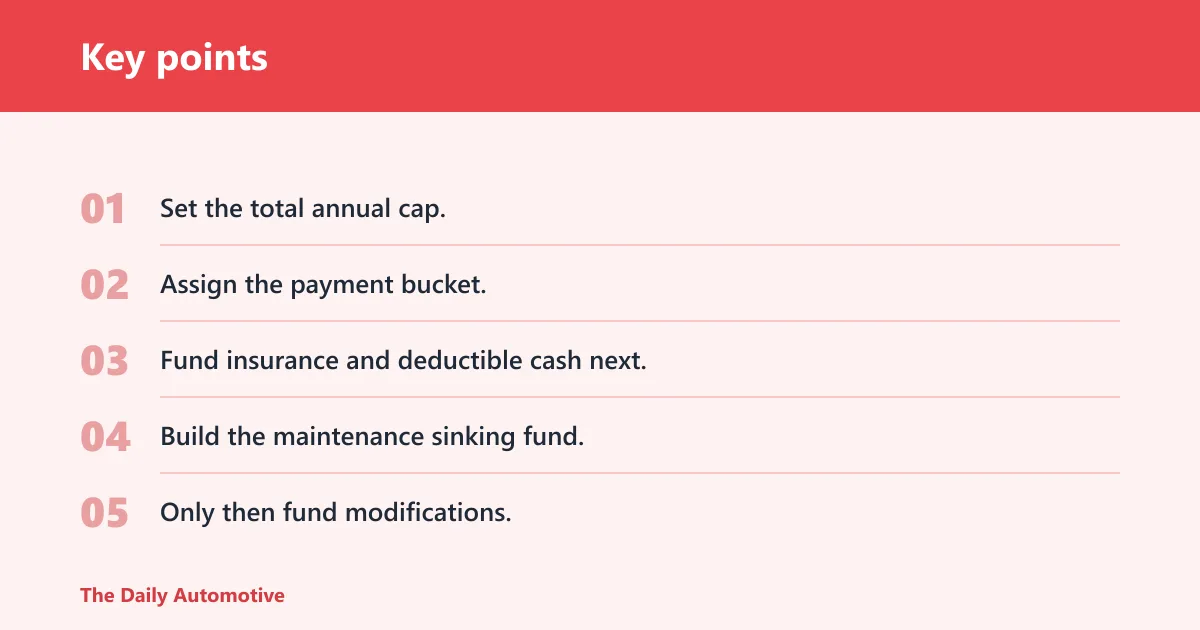
- Set the total annual cap.
- Assign the payment bucket.
- Fund insurance and deductible cash next.
- Build the maintenance sinking fund.
- Only then fund modifications.
- Stop when a purchase would cut emergency savings.
How do you work out car finance before you buy?
Compare cash purchase, loan, and dealer financing before you commit. Stress-test APR, term length, and total interest. Shop rates first and keep negotiation separate from financing, because a low monthly payment can hide a bad deal if fees, rate, or term stretch the total cost.
Cash versus finance
Cash avoids interest and simplifies ownership, but it should never drain the emergency fund. Finance can preserve liquidity, which matters if the car is also a daily driver or the buyer needs cash reserves for repairs and life expenses. The right choice depends on APR, fees, and how tight the rest of the budget is.
recommends considering financing options and interest rates when shopping. That matters because the same car can be affordable at one rate and out of reach at another. A short term with a fair APR often costs less than a long term with a tempting payment.
Rate shopping and APR sensitivity
Get preapproved before entering the dealership. Compare at least two or three offers, then test how the payment changes if the APR rises. If a one-point rate increase breaks the budget, the car is too expensive for the current cash flow.
Keep negotiation focused on the vehicle price. Then compare the final out-the-door number, the loan term, and the total interest. If the dealer reshapes the monthly payment by extending the term, the buyer may be paying more for the same car.
What matters more than the sticker price: new or used?
Used cars are often the lower-cost choice, but only when the total cost of ownership still fits the plan. Compare maintenance, insurance, fuel, and likely repairs before you decide. A cheaper sticker price can still turn into a costly ownership trap if history, condition, or running costs are poor.
Look at total cost of ownership first
says total cost of ownership should include maintenance and insurance. Add fuel, taxes, and mod spillover as well. That broader view prevents buyers from choosing a car that leaves no room for upkeep or the next set of tires.
Say your budget can handle a used coupe around $22,000, but the insurance premium and larger-tire costs leave little or nothing for repairs. The car is not affordable just because the sale price fits the loan. The monthly stack needs room to breathe.
Use used cars as a money-saving tool
Used purchases can free up cash for maintenance, insurance, or a future upgrade fund. They are especially useful when records are complete and the platform is known for parts availability. Still, the lower price should never override condition, mileage, or the cost of known wear items.
Negotiate and walk away
Research the car’s value before discussing price. Know the market, the trim, the mileage band, and the repair history. If the seller will not meet the budget or the numbers force cuts elsewhere, walk away. That discipline matters more than winning the deal.
How do maintenance and insurance protect your car budget?
Follow the owner’s manual and the maintenance schedule so upkeep happens at manufacturer-recommended intervals instead of guesswork. Build a maintenance sinking fund for wear items and surprises. Choose insurance coverage, deductibles, and discounts that fit the car and the cash reserve, not just the monthly premium.
Use the owner’s manual and schedule
The owner’s manual is the starting point for service intervals, fluid changes, tire rotation, and other routine items. Skipping scheduled maintenance to save cash usually creates larger repair bills later. That is especially true on enthusiast cars, where neglected fluids or worn brakes can become expensive fast.
Picture a turbo daily driver that runs fine at first, then starts asking for brakes, tires, and a transmission service in the same quarter. Without a maintenance fund, the owner starts choosing between service and mods. That is how the budget breaks.
Know the insurance basics
says liability insurance is mandatory. names collision, comprehensive, and uninsured motorist coverage as additional options. The right mix depends on the car’s value, where it is parked, and how much cash is available to absorb a loss.
notes that higher deductibles can reduce premiums. That only works if the driver can cover the out-of-pocket hit. A low premium with an unaffordable deductible is not a bargain.
Use discount levers that usually matter
Bundling policies can lower premiums. A defensive driving course may qualify for discounts. Anti-theft devices and secure parking can help as well. recommends defensive driving courses to qualify for discounts, which makes sense when the car is driven regularly or parked in an exposed area.
How do mods, track days, and classic cars fit the plan?
Set a separate modification fund before buying parts, and keep track use and classic ownership costs out of the daily-driver budget. If upgrades threaten emergency savings or repair money, delay them. Enthusiast spending should be discretionary after the car’s core duties are covered.
Daily drivers need the strongest guardrails
A daily driver must stay reliable, insured, and serviceable. That means maintenance and insurance come before cosmetic changes, wheel upgrades, or performance parts. If the car is needed for work, the mod fund should be the first bucket to pause when money gets tight.
Track days need their own reserve
Track use increases wear on brakes, tires, fluids, and sometimes alignment parts. Those costs belong in a separate bucket, not the commute budget. If there is no room for consumables, the car is not ready for track duty.
Classic cars need a larger maintenance margin
Older cars often need more frequent parts replacement, and some components can be harder to source. That does not make them bad purchases. It does mean the maintenance bucket should be larger, and the owner should be ready for downtime, not just monthly payments.
Suppose a classic coupe is cheap enough to buy outright, but the restoration list includes tires, hoses, seals, and a carburetor rebuild. The sticker price is only the beginning. The real question is whether the car can stay funded after the purchase.
Frequently asked questions
How should i finance a car
Finance a car only after you know the total cost of ownership, the APR, the fees, and the term. Start with a preapproval, compare offers, and make sure the payment, insurance, maintenance, and emergency savings all still fit. A low monthly payment is not enough on its own.
How to properly finance a car
Proper financing means setting a budget first, shopping rates, and avoiding a loan term that hides the real cost. Compare the out-the-door price, APR, and total interest. If the financed amount forces you to skip maintenance or drain reserves, the structure is wrong.
How to work out car finance
Work out car finance by calculating the full monthly burden, not only the note. Include payment, insurance, fuel, maintenance, and any planned upgrades. Then test the budget against a higher APR or shorter term. If the numbers fail under stress, choose a cheaper car.
Which finance is best for personal car
The best personal-car finance is usually the one with the lowest total cost after APR, fees, and term are counted. For some buyers that is cash, for others it is a short loan with a fair rate. The right answer depends on liquidity and reserve strength.
How to finance a car
Get preapproved, compare lenders, and separate the financing step from price negotiation. Focus on APR, term, and total interest before signing anything. If the deal only works by stretching the term or skipping insurance and maintenance, do not sign it.
Buy car on finance or outright tips
Buy outright if the purchase would not weaken emergency savings and you want to avoid interest. Finance if keeping cash available is more valuable and the rate is reasonable. In both cases, check maintenance, insurance, and repair costs before you commit.
How to get a car on finance
To get a car on finance, check your budget, review your credit, get preapproved, and compare lender offers before visiting the dealer. Use the approval as a ceiling, not a target. If the car still strains the budget, ask for a cheaper one.
Products related to this article
Sponsored / affiliate links. As an Amazon Associate I earn from qualifying purchases. I may earn additional commission from eligible campaigns.