Can You Pay Cash at a Car Dealership?
Yes, many dealerships accept physical cash, but a cashier’s check or wire transfer is often the cleaner choice, especially for large amounts. Walking in with a stack of bills can slow paperwork, bring extra ID checks, or get turned away. This guide explains what dealers take, why dealer policy changes from store to store, and which payment method avoids delays on pickup day.
Physical cash may be legal but impractical on delivery day
Often, yes, if the store allows physical cash and the amount stays within its limit. In dealer terms, “cash” usually means physical bills and coins. Other payment methods, such as a cashier’s check, a wire transfer, or sometimes a debit card, are not the same thing.
What dealers usually mean by cash
Physical cash is the hardest version for a dealership to accept. Experian says dealerships may allow physical cash, but cashier’s checks, personal checks, or wire transfers are safer and more convenient. Many buyers use “cash” loosely, then find out the store wants bank-backed funds instead of bills.
Why acceptance depends on dealer policy
Dealer cash policy can vary by store, and some dealers may set low internal limits for physical cash or decline it altogether. A franchised dealer may use tighter controls than an independent used-car lot, and some stores may refuse physical cash even when the sale is legal. Call first, then plan the payment.
When cash is possible but not practical
Physical cash can be legal and still be a bad fit on delivery day. Large piles of bills slow counting, raise fraud checks, and can trigger identity review under money-laundering rules. For a large payment, a cashier’s check or wire transfer usually avoids the worst delays.
Why dealers may say no to cash
Dealers reject physical cash for practical reasons, not just preference. Counterfeit risk, money-laundering checks, and handling limits all matter. The store may also need to document the transaction more carefully if the payment is large or split across more than one method.
Fraud and counterfeit risk
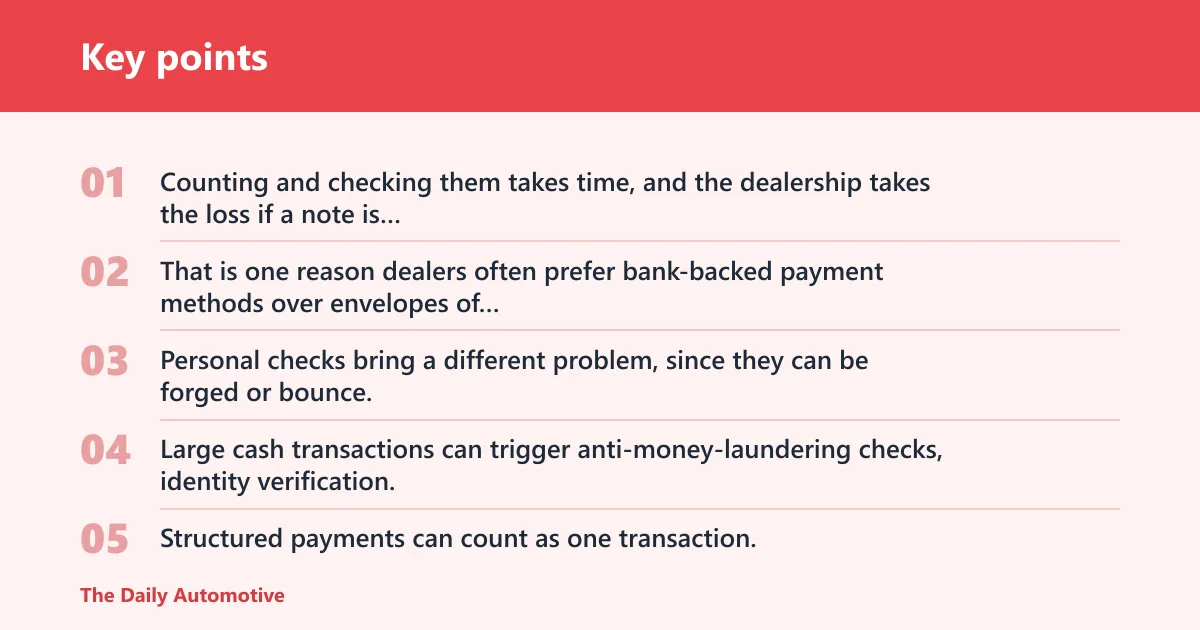
Paper bills can be fake. Counting and checking them takes time, and the dealership takes the loss if a note is counterfeit. That is one reason dealers often prefer bank-backed payment methods over envelopes of bills. Personal checks bring a different problem, since they can be forged or bounce.
Money-laundering checks and reporting
Large cash transactions can trigger anti-money-laundering checks, identity verification, and reporting obligations. Structured payments can count as one transaction, so splitting a large amount into several smaller handoffs does not remove the dealer’s duty to ask questions or file reports when required.
Cash handling limits at the store
The Car Expert says cash payments are unpopular because of money-laundering concerns. In practice, some dealers are reluctant to take large amounts of physical cash. That does not mean every store uses the same cap, only that many dealers set low internal limits for handling bills.
Pay cash at car table
| Scenario | Safest payment method | Likely dealer reaction | Documents to bring |
|---|---|---|---|
| Under £1,000 in physical cash | Physical cash if the dealer agrees; cashier’s check if you want fewer delays | Often accepted, but the dealer may still count every note and ask for ID | Photo ID, purchase agreement, proof of funds if asked |
| £1,000+ in physical cash | Cashier’s check or wire transfer | More likely to ask for advance notice, extra ID checks, or a switch away from bills | Photo ID, bank contact info, signed buyer’s order, receipt request |
| Used-car lot | Cashier’s check or debit card if the lot allows it | More flexible than some franchised stores, but policies still vary | ID, bill of sale, payment confirmation, any deposit receipt |
| Franchised dealer | Wire transfer or cashier’s check | Often prefers bank-backed payment and may route you to finance or accounting | ID, purchase order, financing waiver if relevant, wire instructions |
| Dealer refusal | Wire transfer, cashier’s check, or debit card if accepted | May hold the car until cleared funds arrive; may not negotiate on payment method | ID, written payment instructions, proof of available funds, dealer contact name |
What is the safest way to pay?
For most buyers, a cashier’s check or wire transfer is a practical alternative to physical cash. A cashier’s check is issued by a bank, which can make it easier for the dealership to process than cash. Wires are common for larger purchases because they move fast and are hard to reverse.
Cashier’s check versus physical cash
A cashier’s check cuts theft risk and can speed dealer verification. You are not carrying a large stack of notes, and the dealership can usually confirm the amount more easily. If the dealer wants bank-backed funds, this is often the simplest paper option.
Personal checks are different. Many car dealers no longer accept personal checks or bank drafts, and that fits the dealer’s concern about slow clearing and forgery. If a store does accept a personal check, expect extra verification or a delay before pickup.
When a wire transfer makes more sense
A wire transfer can be the cleanest answer when the amount is large or the dealer wants cleared funds before delivery. It is important to verify wire instructions carefully before sending money. (Wikihow)
If your dealer will not hold the vehicle without same-day cleared funds, a wire sent before pickup is often better than walking in with bills. The accounting desk can confirm payment without counting cash at the counter.
Where debit cards and personal checks fit
F2 says dealers usually prefer a debit card on the day or an electronic transfer before pickup. Debit cards may work for some dealers, but your bank may require advance notice for a high-value charge, and some stores still cap card payments. Personal checks sit at the bottom of the list.
Picture a buyer trying to put the whole purchase on a debit card with no bank notice. The charge can decline at the register, and the sale stalls while the store waits for another payment method. A quick call to the bank before delivery avoids that problem.
Will cash get you a better deal?
No, cash does not guarantee a lower price. Auto Credit Express says dealers usually do not give a better deal just because a buyer pays cash, and cash, check, or pre-approval usually does not hold more negotiating power. Dealer pricing often follows inventory, incentives, and financing targets instead.
Why cash does not guarantee a discount
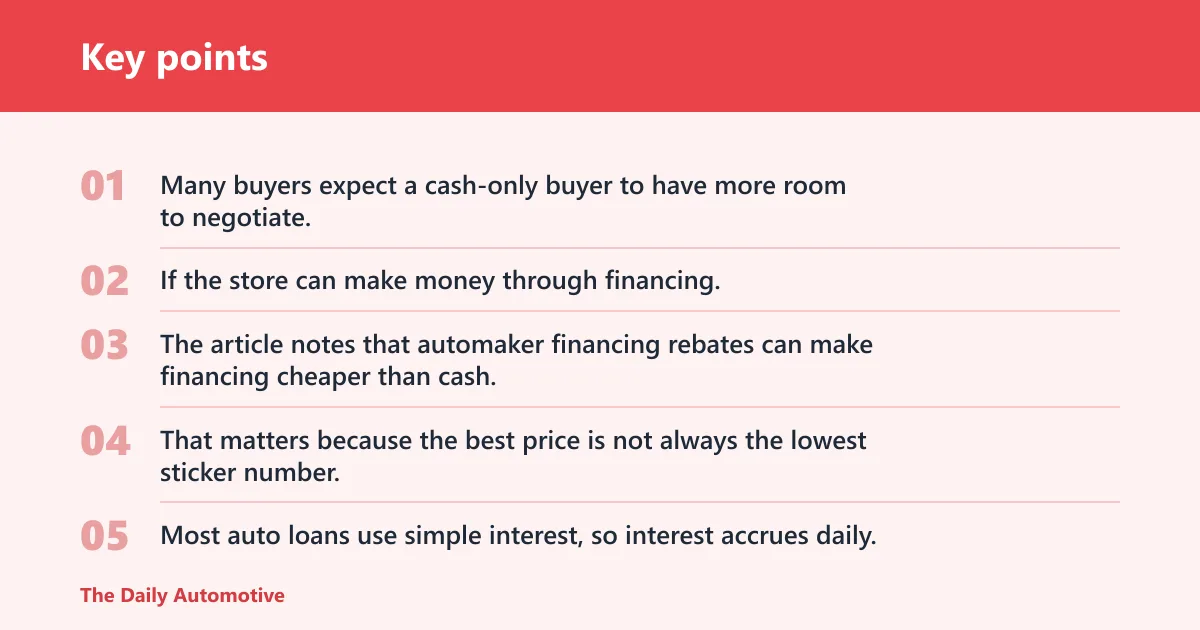
Many buyers expect a cash-only buyer to have more room to negotiate, but dealers often care more about total profit than the payment source. If the store can make money through financing, it may not move much on price simply because you are paying without a loan.
How financing rebates can beat cash savings
The article notes that automaker financing rebates can make financing cheaper than cash. That matters because the best price is not always the lowest sticker number; it is the lowest total cost after rebates, fees, and loan terms are compared.
Most auto loans use simple interest, so interest accrues daily. If you finance and pay off early, the math can still favor the rebate in some cases. That is why you should ask for both numbers before you decide.
When to keep financing on the table
Keep financing in the conversation if the dealer offers a rebate or a rate tied to a captive lender. Some buyers plan to finance, capture the incentive, then pay off quickly if the loan terms allow it. The key is to compare the full out-the-door price, not just the payment label.
How to prepare before you go
Preparation matters because the payment method can stall the sale even after the car is picked. Call the dealer, notify your bank, and bring the right paperwork. That keeps accounting, sales, and delivery from waiting on one missing approval or one unanswered phone call.
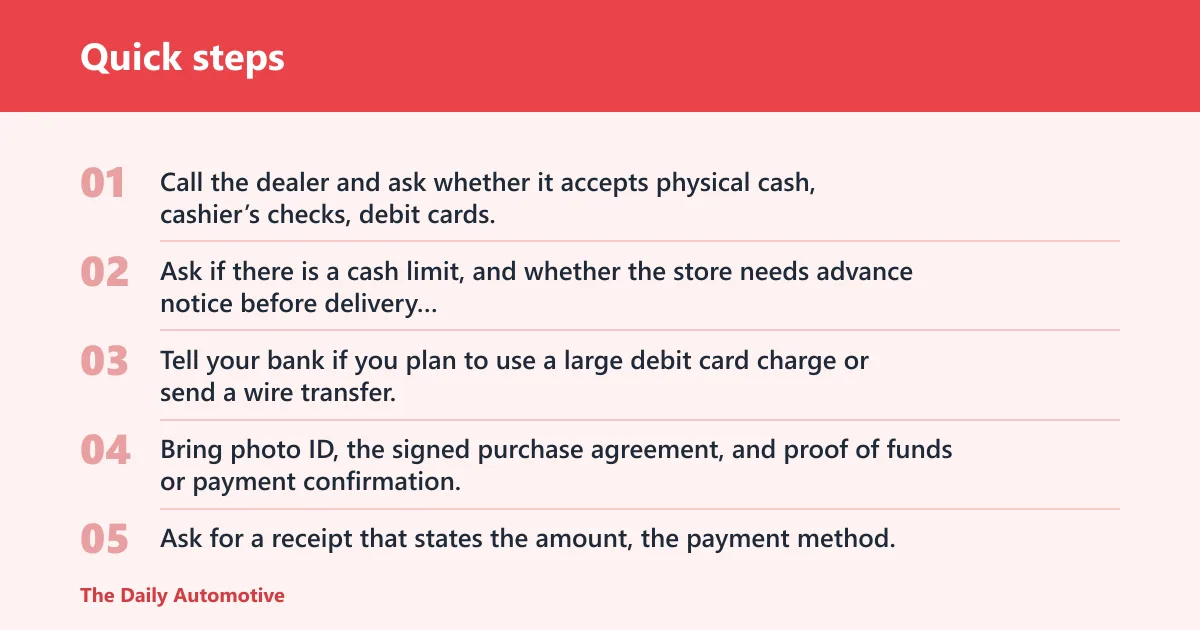
- Call the dealer and ask whether it accepts physical cash, cashier’s checks, debit cards, or wire transfers.
- Ask if there is a cash limit, and whether the store needs advance notice before delivery day.
- Tell your bank if you plan to use a large debit card charge or send a wire transfer.
- Bring photo ID, the signed purchase agreement, and proof of funds or payment confirmation.
- Ask for a receipt that states the amount, the payment method, the vehicle identification number, and the remaining balance, if any.
What to ask the dealer
Get the payment policy in writing if possible. Ask whether the store will accept a split payment, whether cashier’s checks must be made payable to the dealer or a specific entity, and whether the vehicle will be released the same day funds clear. That keeps surprises off the desk.
What to ask your bank
If you are using a cashier’s check, confirm the exact payee name and amount before the check is printed. If you are using a wire, confirm the routing instructions with the dealer by a known phone number, not just by email. Wire fraud often starts with altered payment instructions.
What fees still apply
Cash does not erase the tax bill. The same source says buyers should budget for sales tax and vehicle registration on top of the sales price. Dealer fees, documentation fees, and title charges can still apply whether you pay with bills, a check, or a wire.
Sales tax
Sales tax is still due unless your state provides an exemption. The dealer normally collects it at sale and includes it in the paperwork, so the out-the-door amount is the number that matters, not the sticker price alone.
Registration and title fees
Registration and title work can add to the total even when the car is paid in full. These charges are part of making the vehicle legal to drive and legally transferred to you, so they should be budgeted before you negotiate payment terms.
Dealer and doc fees
Dealer fees and documentation fees may still appear on the buyer’s order. A cash purchase does not cancel them by itself. Ask for the full out-the-door figure early so you do not arrive with the wrong amount or the wrong payment type.
Frequently asked questions
Can you pay cash at a car dealership?
Yes, many dealerships will accept cash, but the limit depends on store policy and the amount involved. Physical cash is often less convenient than a cashier’s check or wire transfer, and large amounts can trigger extra ID checks or reporting. Confirm the dealer’s rules before delivery day.
Can you use cash at a car dealership?
You can use physical cash at some dealerships, but not every store wants it. Many dealers prefer bank-backed funds, and some set low internal caps on bills. If the dealer accepts cash, expect counting, receipts, and possible paperwork checks before the keys are released.
Can you pay cash for a used car at a dealership?
Used-car lots are often more flexible than franchised dealers, but policy can still vary. The safest route is still a cashier’s check or wire transfer if the amount is large. Ask in advance whether the lot will accept physical cash or wants cleared funds first.
Can you pay cash for a new car at a dealership?
Yes, but new-car dealers often prefer financing, cashier’s checks, or wires over physical cash. That is partly because dealer cash policy may be strict and because financing incentives can change the best deal. If you want to pay in full, confirm the acceptable method before signing.
How do you pay cash at a car dealership?
Start by calling the dealer to confirm the accepted payment method and any limit on physical cash. Bring ID, proof of funds, and the correct payee information if you are using a cashier’s check or wire. Ask for a receipt that shows the vehicle, amount, and balance due.
Will a dealership give you a better deal if you pay cash?
Usually not. The same source says dealers usually do not give a better deal just because a buyer pays cash, and cash, check, or pre-approval usually does not change negotiating power. Financing rebates can even make a financed deal cheaper than a cash deal.
Should you tell a dealership you are paying cash before negotiating?
Usually, it is better to negotiate the out-the-door price first, then decide whether cash, a cashier’s check, or a wire transfer is the cleanest way to pay. If the dealer asks about payment early, answer honestly, but keep the focus on the vehicle price and any dealer policy that affects payment or proof of funds.
Products related to this article
Sponsored / affiliate links. As an Amazon Associate I earn from qualifying purchases. I may earn additional commission from eligible campaigns.
 Maxlaxer El Wire Blue Interior Car LED Strip Lights, 5M Neon Wire USB 5V with Fuse Protection for Automotive Interior Decoration, with 6mm Sewing Edge
 Maxlaxer El Wire Ice Blue Interior Car LED Strip Lights, 5M Neon Wire USB 5V with Fuse Protection for Automotive Interior Decoration, with 6mm Sewing Edge