How Much Does 1% Higher APR Cost You on a Car Loan?
A 1% higher APR is commonly shown as adding about $16 a month and nearly $1,000 in total interest on a $30,000, 60-month car loan. Miss that gap, and you can pay hundreds more for the same vehicle without getting anything extra. This guide shows exact payment and interest differences for common loan amounts and terms, plus when a small APR gap is worth fighting.
1% APR cost calculator
The table below compares a base APR with a loan that is exactly 1.00 percentage point higher. It uses the same amount financed in each row, so you can see the payment change and the lifetime interest change side by side. The figures are rounded to the nearest dollar.
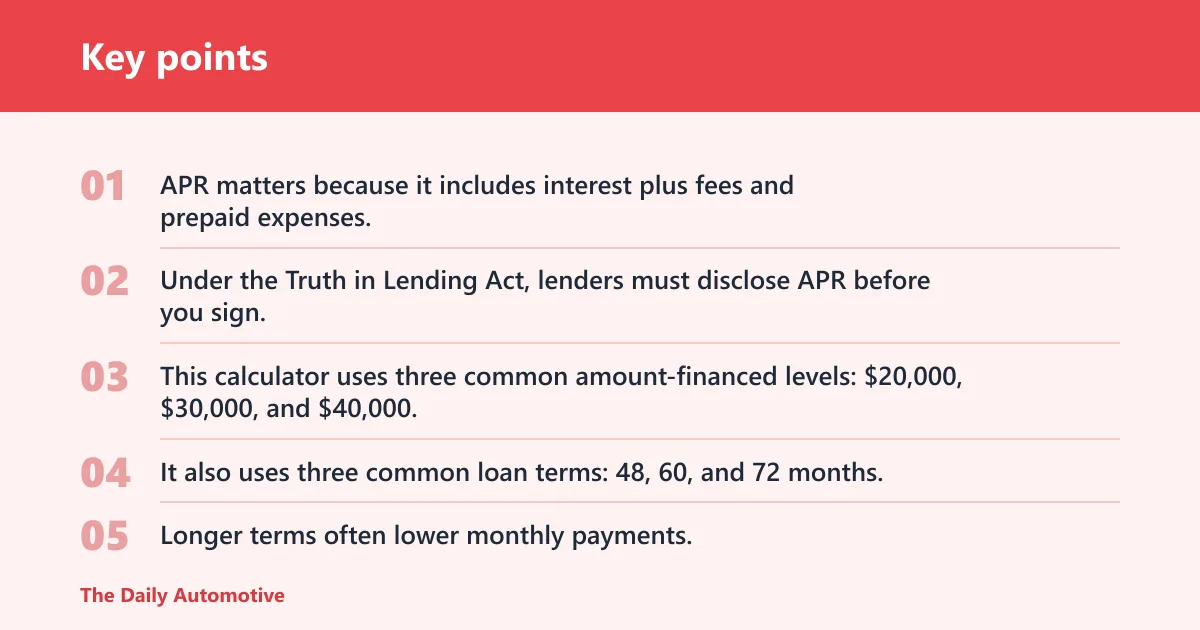
APR matters because it includes interest plus fees and prepaid expenses. Under the Truth in Lending Act, lenders must disclose APR before you sign, which lets you compare offers on the same basis instead of guessing from the monthly payment alone.
Loan sizes and terms used
This calculator uses three common amount-financed levels: $20,000, $30,000, and $40,000. It also uses three common loan terms: 48, 60, and 72 months. Longer terms often lower monthly payments, but they also usually bring higher interest rates and more total interest over time.
Amount financed matters more than sticker price for this math. A larger down payment reduces the amount financed, which shrinks the dollar cost of any APR increase. Fees added to the loan do the opposite.
| Amount financed | Term | Base APR payment | Payment at +1.00% APR | Monthly delta | Base total interest | Total interest at +1.00% APR | Lifetime interest delta |
|---|---|---|---|---|---|---|---|
| $20,000 | 48 months | $478 | $490 | $12 | $2,944 | $3,510 | $566 |
| $20,000 | 60 months | $396 | $406 | $10 | $3,760 | $4,336 | $576 |
| $20,000 | 72 months | $340 | $348 | $8 | $4,480 | $5,042 | $562 |
| $30,000 | 48 months | $718 | $736 | $18 | $4,416 | $5,266 | $850 |
| $30,000 | 60 months | $594 | $608 | $14 | $5,640 | $6,504 | $864 |
| $30,000 | 72 months | $510 | $522 | $12 | $6,720 | $7,562 | $842 |
| $40,000 | 48 months | $958 | $981 | $24 | $5,888 | $7,021 | $1,133 |
| $40,000 | 60 months | $792 | $811 | $19 | $7,520 | $8,672 | $1,152 |
| $40,000 | 72 months | $680 | $696 | $16 | $8,960 | $10,083 | $1,123 |
How to read payment and interest deltas
The monthly delta tells you what the higher APR does to your budget right now. The total-interest delta tells you what that same offer costs you across the full loan term. Both matter, but they answer different questions.
Suppose you are choosing between two 60-month offers on a $30,000 amount financed. One APR is 7.00%; the other is 8.00%. The second offer costs about $14 more each month and about $864 more in total interest. That is a real price increase, even if the payment still looks manageable.
What APR includes
APR includes interest plus fees and prepaid expenses. Interest rate and APR both indicate borrowing cost, but APR is the broader number because it folds in certain finance charges. That is why two offers with the same stated rate can still have different APRs.
APR vs. interest rate
The interest rate is the core borrowing charge. It is usually the biggest part of APR, but it is not the whole number. APR gives you the all-in finance cost that matters for comparison shopping.
Your credit score can change the interest rate a lender offers. New vehicles tend to have lower interest rates than used vehicles. Longer loan terms tend to have higher interest rates than short-term loans. Those factors can move both the stated rate and the APR.
Fees that can lift APR
An origination fee is a good example of an upfront finance charge that can raise APR without changing the stated interest rate. Other prepaid expenses can do the same. If those costs are rolled into the loan or treated as finance charges, APR moves up.
That is why a lender quote with a slightly lower stated rate can still be worse overall. The rate on paper is not enough. The amount financed and the fee structure both matter.
Why disclosure matters under TILA
The Truth in Lending Act requires lenders to disclose APR before signing. That rule exists so you can compare auto loan offers before you commit, not after the paperwork is done. It also makes it easier to check whether a dealer quote matches the lender’s written terms.
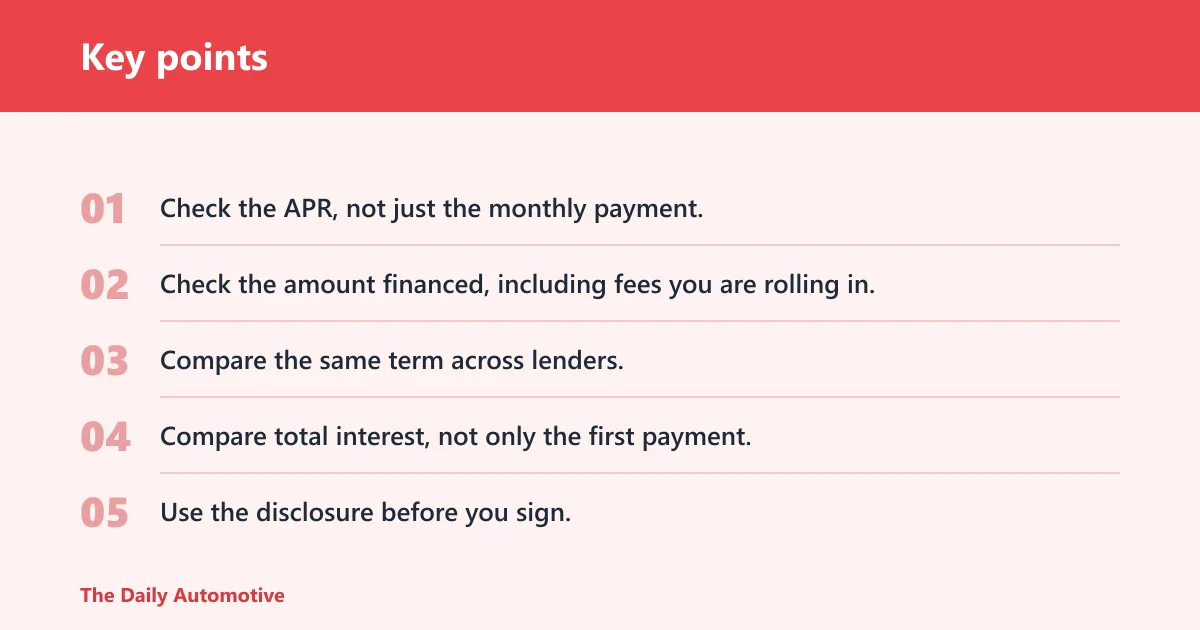
- Check the APR, not just the monthly payment.
- Check the amount financed, including fees you are rolling in.
- Compare the same term across lenders.
- Compare total interest, not only the first payment.
- Use the disclosure before you sign.
How much does 1% higher APR add?
A 1% higher APR usually adds a modest amount to the monthly payment, but the full cost becomes clearer over 48, 60, or 72 months. The bigger the loan and the longer the term, the more that extra point of APR costs in total interest.
48-month loan examples
On a 48-month loan, the monthly bump is usually noticeable but still smaller than on a longer term. The total-interest hit is also smaller than it would be on a 60- or 72-month loan, because you are paying the loan off faster.
60-month loan examples
At 60 months, the payment increase is often easy to miss if you only look at the sticker monthly figure. On a $30,000 loan, the extra 1% is shown as adding about $14 a month and roughly $860 more in total interest. That is enough to matter in a deal comparison.
72-month loan examples
At 72 months, the monthly difference can still look small, but the balance stays outstanding longer, so more interest accrues. On a $40,000 loan, a 1% APR increase is shown as adding about $16 a month and roughly $1,100 in total interest.
A common first-timer mistake is fixing only on the payment. Say your payment drops by $25 because the term stretches from 60 to 72 months, but the APR also rises by 1%. The payment feels easier, yet the loan can still cost more overall because the interest runs longer.
Why the term changes the damage
The same APR increase does not hit every loan the same way. Shorter terms limit the time interest has to build. Longer terms give interest more time to compound, so the dollar cost of a 1% APR bump grows with the loan length.
Shorter terms
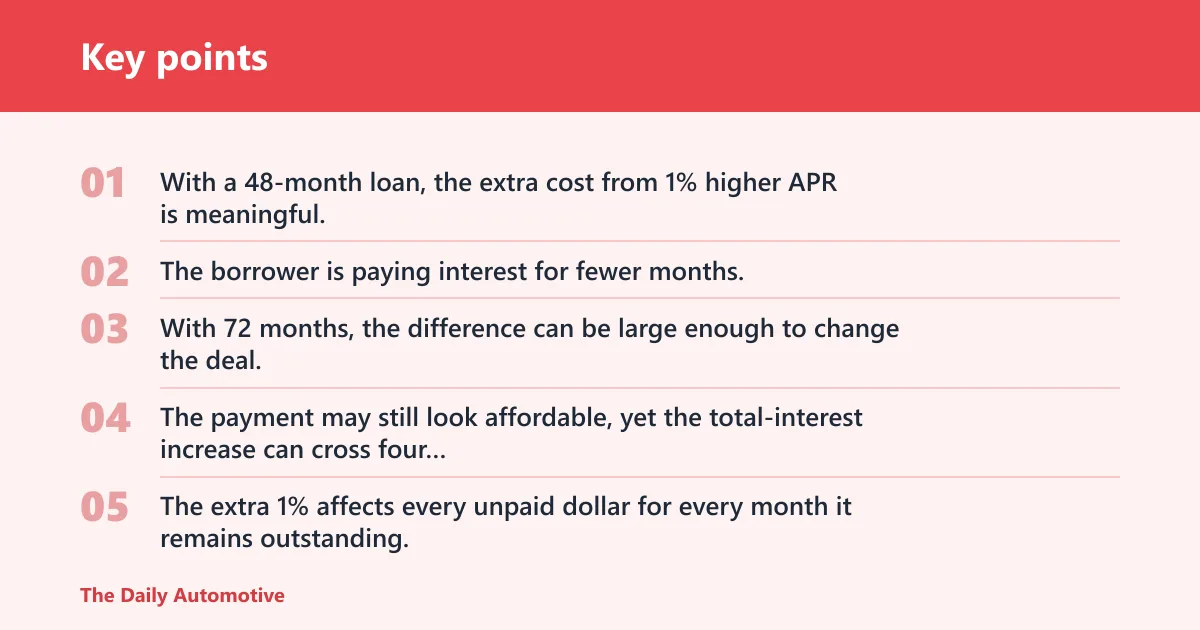
With a 48-month loan, the extra cost from 1% higher APR is meaningful, but it is contained. The borrower is paying interest for fewer months, which keeps both the payment delta and the lifetime delta lower than they would be on a longer term.
Longer terms
With 72 months, the difference can be large enough to change the deal. The payment may still look affordable, yet the total-interest increase can cross four figures on a larger amount financed. That is where APR deserves more attention.
Why the same APR bump costs more over time
The extra 1% affects every unpaid dollar for every month it remains outstanding. The longer the term, the more months that higher charge applies. That is the simple reason a small rate gap becomes a larger lifetime gap on longer loans.
When does 1% matter enough?
One extra percentage point matters most when the loan is large, the term is long, or both. If the monthly change is tiny but the total-interest change is close to or above a thousand dollars, the offer deserves a second look. If the payment is already tight, even a smaller delta may be enough to walk away.
When the payment delta is small
If the monthly change is only $8 to $16, some buyers ignore it. That can be a mistake if the loan is 60 or 72 months long, because the total-interest difference still adds up. Small monthly changes can hide larger lifetime costs.
When the total-interest delta is large
When a 1% APR bump adds roughly $850 to $1,150 in interest, the cost is no longer minor. That amount can cover registration, a set of tires, or several months of fuel. It is enough to justify lender shopping or a tougher negotiation.
When to renegotiate or walk
Renegotiate if the higher APR comes with no offsetting benefit, such as a shorter term, lower amount financed, or a needed fee concession. Walk away if the lender will not explain the charge, the APR is materially worse than another offer, or the payment only looks affordable because the term is stretched too far.
Picture a $40,000 loan where the dealer offer is 8.00% for 72 months and a bank preapproval is 7.00% for the same term. The dealer payment is only about $16 higher, but the extra interest is about $1,123. That is the kind of gap that should trigger a direct counteroffer.
How down payment and amount financed change the cost
The amount financed is the net loan amount after fees and down payment. It is not always the same as the vehicle price. Because APR costs are charged on the financed balance, anything that reduces that balance also reduces the dollar hit from a higher APR.
Amount financed vs. vehicle price
Two shoppers can buy the same vehicle and end up with different loan costs. One may roll in fees and taxes. The other may put cash down and borrow less. The APR difference can be identical, while the dollar impact is very different.
Down payment effects
A larger down payment can help reduce the total amount financed. That lowers both the monthly payment and the lifetime interest cost. It also shrinks the extra cost from a 1% APR increase because there is less principal for that rate to act on.
Fees and negative equity
Fees can make a car loan APR higher even if the stated interest rate stays the same. Negative equity does something similar on the borrower side: it raises the amount financed by adding old debt into the new loan. Both move the payment in the wrong direction.
Suppose you are financing $28,000 after a $2,000 down payment. A 1% APR gap will cost less than it would on a $30,000 loan, because the financed balance is smaller. The loan structure itself has already lowered the damage.
Is APR more important than the monthly payment on a car loan?
APR should usually carry more weight than the monthly payment when you are comparing financing offers, because APR captures the broader borrowing cost. The payment still matters for cash flow, but a lower payment can hide a longer term, higher fees, or more total interest.
When payment alone misleads
A lower monthly payment can come from stretching the term, not from a cheaper loan. That can make a deal look easier while raising the total cost. If the APR is higher and the term is longer, the payment may be lower but the loan can still be worse.
When APR should drive the decision
APR should drive the decision when two offers have similar terms and similar fees. In that case, the lower APR is usually the better loan because it cuts the all-in financing cost. It is also the better number when you are comparing dealer financing with a preapproval.
When a lower payment hides higher total cost
The lower payment is not a win if it comes with a much longer term and a larger interest bill. A payment that feels easier today can cost more across the life of the loan. That is why you should compare payment, term, APR, and total interest together.
What is a good APR for a car loan right now?
There is no single good APR number that fits every borrower, vehicle, and term. A good rate is the one that is competitive for your credit profile, the vehicle type, and the loan length you actually need. Lower is better, but only when the full offer is otherwise comparable.
For many shoppers, the practical target is simple: compare several lenders, compare the same term, and compare the amount financed after fees and down payment. If one offer is 1% higher and brings no other advantage, the math above shows why that gap deserves scrutiny.
Frequently asked questions
How much does a 1% higher APR increase a car payment?
On the examples in this guide, a 1% higher APR usually adds about $8 to $24 a month, depending on loan size and term. The $30,000, 60-month example comes out to about $14 more per month. Larger loans and shorter terms produce larger payment changes.
How much more interest will I pay over the life of a car loan with 1% higher APR?
It depends on the amount financed and the term. In the table above, the lifetime interest delta runs from about $562 on a $20,000, 72-month loan to about $1,152 on a $40,000, 60-month loan. The longer and larger the loan, the more the extra point costs.
What APR difference is meaningful on a 60-month car loan?
On a 60-month loan, even a 1% gap can matter. If the loan is larger, the dollar gap becomes more serious and may justify renegotiation or walking away.
How do interest rate and APR differ on auto loans?
The interest rate is the core charge for borrowing the money. APR includes that charge plus certain fees and prepaid expenses. Because APR is broader, it is the better number for comparing loan offers that may have different fee structures.
What fees can make a car loan APR higher even if the rate stays the same?
An origination fee is one common example. Other prepaid expenses can also raise APR without changing the stated interest rate. If those charges are included in the finance cost, the APR rises even when the headline rate looks unchanged.
Products related to this article
Sponsored / affiliate links. As an Amazon Associate I earn from qualifying purchases. I may earn additional commission from eligible campaigns.