3 Best Primer Paints for Cars (2026): Based on Specs and Reviews
The best primer paint for car work depends on the job: epoxy for bare metal and rust defense, high-build primer for scratch filling and sanding, and adhesion promoter for plastic panels. Pick the wrong one, and you risk rust bleed-through, filler marks, peeling, or paint that lifts off trim. This guide compares those three primer types by outcome, so you can buy the right chemistry for bare metal, plastic, and bodywork repairs.
Quick comparison
| Product | Badge | Best for | Price | ||
|---|---|---|---|---|---|
 |
Corroseal-82320 Water-Based Rust Converter Metal Primer,Corroseal | Our pick | 1 qt · water-based · rust converter | $30.25
Price as of 24 Oct 2026
|
View |
 |
Krylon K05582007 COLORmaxx Primer Spray Paint forKrylon | Budget pick | 12 oz can (pack of 2) · gray · spray primer | $8.96
Price as of 24 Oct 2026
|
View |
 |
Bartoline Plastic Primer Spray, Gray, 13.5 oz –Bartoline | Also great | 13.5 oz / 400 ml · gray · plastic primer spray | $12.99
Price as of 24 Oct 2026
|
View |
Use this as a job-first filter, not a brand race. The wrong primer usually fails at adhesion, corrosion control, or build thickness. Match the chemistry to the surface first, and those failure points are far easier to avoid.
How we chose
This comparison centers on four things: substrate match, defect depth, application method, and what happens if you pick the wrong chemistry. Coverage and dry time matter too, because aerosol convenience can be a poor fit for a full-panel repair.
The list also reflects the reality of mixed-material repair. Bare steel, aluminum, galvanized panels, and plastic parts do not need the same primer. A product that works well on one can fail badly on another.
Where the product data gave hard specs, those numbers are used exactly as published. Where the chemistry matters more than the label, the guidance focuses on the job outcome: rust defense, scratch filling, or plastic adhesion.
Corroseal: best for rusted steel prep
Corroseal is the best fit here if your panel already has rust and you need a primer that also converts it. Based on the manufacturer’s specs and buyer feedback, it is the most practical pick in this list for treated rust on automotive or marine metal, especially when the goal is to stabilize the surface before topcoat.
Its main advantage is that it paints, primes, and converts rust in one step. That helps on a small rust patch when you do not want to chase every trace of oxidation back to bare, bright metal.
The drawback is just as important: a rust converter is not the same thing as a bare-metal epoxy primer or a high-build surfacer. It is a prep product for corrosion, not the right answer for deep scratches, plastic trim, or a panel that needs serious leveling.
If the rust is flaky, scaled, or has spread under seams, stop treating this like a normal primer job. That is a repair-stage problem first, not a spray-can fix.
Krylon COLORmaxx primer spray: best for small touch-ups
Krylon COLORmaxx is the best convenience pick in this list for small DIY repairs where you want an aerosol and quick turnaround. It increases paint adhesion on metal and wood, and the two-pack format makes sense for spot repairs, brackets, and other small panels rather than full-car work.
The upside is obvious: an aerosol is simple, fast, and easy to control on a short repair. The tradeoff is film build and reach. Aerosol primers generally lay down less material than gallon kits, so they are weaker as a substitute for bodywork primer on larger repairs.
Its biggest drawback is not chemistry so much as scale. If you are trying to prime an entire hood or multiple panels, you will run through cans fast and pay more per usable square foot than with a kit. That is why aerosol primer is usually a spot-repair choice.
Say your door handle bezel has scuffed paint but the plastic is intact. A small aerosol primer is sensible there. If the bumper cover has deep gouges and filler work, switch to a primer that can build and sand, not just fog on color.
Bartoline Plastic Primer Spray: best for plastic parts
Bartoline is the clearest pick here for plastic automotive parts such as bumpers, trim pieces, and similar rigid plastic components. The manufacturer describes it as a high-adhesion matte-finish plastic primer, and that is the right category when the panel needs help getting paint to stick.
Its strength is substrate fit. Plastic parts often need an adhesion-friendly primer or a dedicated promoter, especially after cleaning and scuffing. This type of product is built for that job, not for rust defense or heavy scratch fill.
The drawback is that plastic primer is not a universal car primer. It will not solve corrosion on steel, and it will not level medium or deep sanding marks the way a high-build urethane surfacer can. For that, you need different chemistry.
Suppose the bumper has been repaired and sanded, but the surface still looks slick after cleaning. A plastic primer is the correct next step. If you instead spray a general metal primer there, the finish can peel at the edges or lift when the topcoat cures.
Self-etching primer: best for bare metal
Self-etching primer is the best match for bare steel and aluminum when the panel has been cleaned and lightly scuffed but not yet topcoated. Its acid-based etching chemistry helps bite into non-ferrous and ferrous metal, which is why it is often sold in aerosol form for fast bare-metal prep.
This is the right chemistry when you have fresh sanded metal and need quick adhesion plus corrosion protection. It is also a common answer for galvanized panels, but only if the label explicitly allows that substrate and the panel is fully cleaned first.
The limits matter. Self-etching primer is not ideal for plastic, and it is a poor choice for heavy rust. It also is not the best option when you need to fill scratches or level bodywork; for that, you want a surfacer or epoxy system.
Epoxy primer: best for corrosion resistance
Epoxy primer is the strongest all-around bare-metal sealer in this group. As a 2K two-component system, it matters that you mix the ratio correctly and respect pot life, because once the components are combined, the usable working time is limited.
For steel, aluminum, fiberglass, and some plastics, epoxy is the most defensible choice when corrosion resistance is the priority. It is also the better answer when you want a sealed base before filler, surfacer, or topcoat, especially on panels that need longer-term protection than an etch coat can provide.
The drawback is convenience. A 2K epoxy is less forgiving than a simple aerosol, and the mix ratio matters. SprayMax 2K Epoxy Primer, for example, dust-dries in 15 minutes and comes in a 13.5 oz aerosol, but even aerosol 2K products still demand careful timing and proper prep.
Is epoxy primer better than self-etching primer? For long-term corrosion resistance and bare-metal sealing, yes, usually. Self-etching is quicker and useful on clean metal, but epoxy is the better choice when you want a sealed base and can handle the mix-and-spray workflow.
High-build urethane primer: best for scratch filling
High-build urethane primer is the right choice when the panel already has filler work, sanding marks, or medium-to-deep scratches that need to be leveled before topcoat. It is a sandable surfacer, commonly 2K, and it is built to build film thickness rather than just promote adhesion.
This is the primer that helps when you can still see the repair after sanding. Speedokote SS-2790G uses a 4:1 mix ratio and hardener, and it is sandable in 2 to 3 hours. Restoration Shop’s 4:1 kits are also aimed at sprayable 2K primer use, including a gallon kit that mixes 4:1 to yield 1.25 gallons of sprayable primer.
The drawback is setup. High-build urethane is usually a spray-gun product, not a casual aerosol. That means compressor, spray equipment, mixing, and cleanup. If the panel only needs a quick spot prime, this is more tool than you need.
Can you use a sandable primer over scratches and body filler? Yes, that is exactly where high-build urethane belongs. The key is not to treat it like a rust fix or a plastic adhesion aid. It is for leveling, sanding, and getting the surface straight before color.
Primer decision matrix
This matrix ties the primer type to the job outcome, not just the label. It also calls out what fails when the wrong product is used, because that is where most paint jobs go sideways.
| Primer type | Best substrate | Defect depth | Application method | Dry / sand time | Topcoat fit | Failure case if you choose wrong |
|---|---|---|---|---|---|---|
| Self-etching primer | Bare steel, aluminum, some galvanized metal | Very light scuffs only | Often aerosol; also sold for gun use | SEM 39683 Grey Self Etching Primer has a 3-hour dry time | Good under paint after proper flash and prep | If used on plastic or heavy rust, adhesion suffers and the coating can peel or fail around the edges |
| Epoxy primer | Steel, aluminum, fiberglass, some plastics | Light imperfections; not a filler | 2K mix; aerosol or spray gun | SprayMax 2K Epoxy Primer dust-dries in 15 minutes | Strong base for sealer, filler work, and topcoat | If the mix ratio is off or pot life is ignored, curing suffers and the film can stay soft or lose adhesion |
| High-build urethane primer | Body filler, repaired panels, sanded primer surfaces | Medium to deep scratches | Commonly 2K; usually spray gun and compressor | Speedokote SS-2790G is sandable in 2 to 3 hours | Best before basecoat and clear on repaired panels | If sprayed over rust or bare plastic without the right prep, it can shrink, map scratches, or lose adhesion |
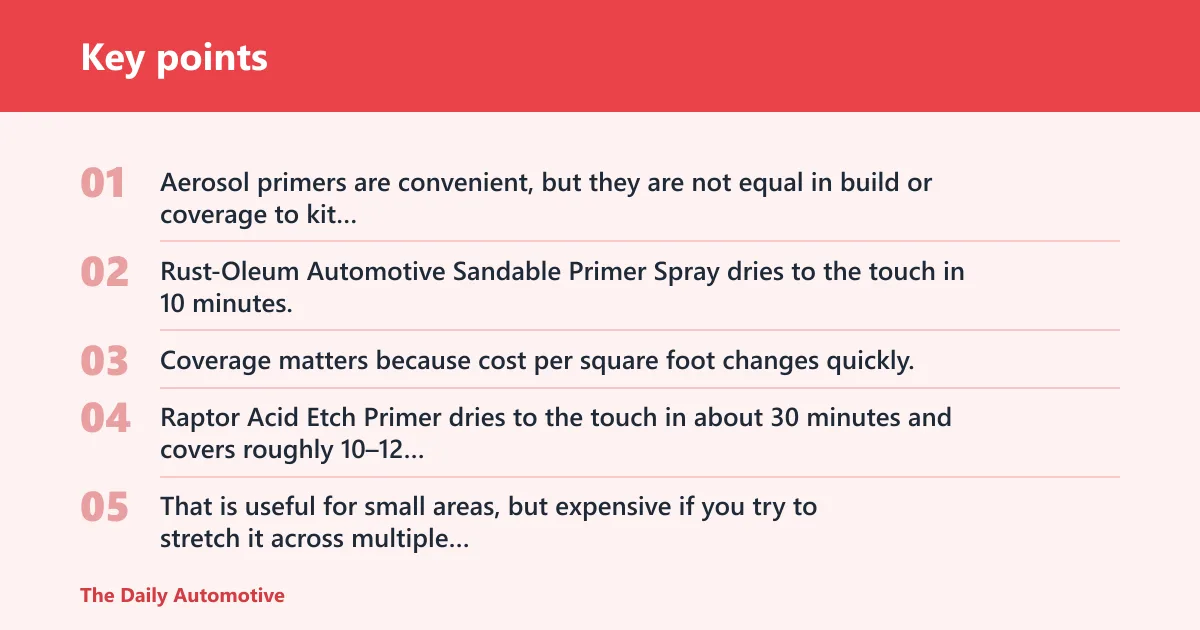
Aerosol primers are convenient, but they are not equal in build or coverage to kit products. Rust-Oleum Automotive Sandable Primer Spray dries to the touch in 10 minutes, yet it covers only about 12 square feet, which is why it fits spot repairs better than a full panel.
Coverage matters because cost per square foot changes quickly. Raptor Acid Etch Primer dries to the touch in about 30 minutes and covers roughly 10–12 sq ft per coat. That is useful for small areas, but expensive if you try to stretch it across multiple panels.
For a bigger repair, the gallon format can make more sense. Restoration Shop’s gallon kit mixes 4:1 to yield 1.25 gallons of sprayable primer, which is a much better scale for repeated panel work than a single aerosol can.
A common first-timer mistake is using a filler-style primer on bare steel because it “looks thicker.” Thickness does not equal corrosion control. If the metal is exposed, the chemistry has to protect it first, or rust can come back under the finish.
Which one should you buy?
If your panel is bare steel or aluminum and you want corrosion protection first, buy epoxy primer. If the panel is a small repair and you need fast convenience, an aerosol primer is the easiest route. If you are dealing with bumper covers or other plastic parts, use a plastic primer or an adhesion promoter made for that substrate.
If the repair has visible sanding marks, body filler edges, or panel waves, choose high-build urethane primer. That is the one that sands back into shape. If the panel is rusty and you cannot fully strip it, a rust converter like Corroseal is more appropriate than a normal primer, because it addresses the rust before topcoat.
Do you need 2K primer for a car repaint? For anything beyond a very small cosmetic patch, 2K is usually the better bet because mix ratio, curing, and durability matter. One-part aerosol primer can work for spot work, but it is not the same category as a mixed urethane or epoxy system.
Which primer works best for aluminum or galvanized panels? Epoxy is the safest all-around choice when you want sealing and corrosion resistance. Self-etching primer can also work on bare aluminum or certain galvanized panels, but only when the product label says so and the metal is properly scuffed and cleaned first.
What is the best spray paint primer for cars? For quick touch-ups, an aerosol like Krylon COLORmaxx is convenient. For a better repair on bare metal or repaired panels, a 2K aerosol epoxy or a gun-sprayed epoxy or urethane primer is usually the smarter buy because coverage, build, and cure are more predictable.
Frequently asked questions
What is the best automotive paint primer?
The best automotive paint primer depends on the surface and the damage. Epoxy is best for bare metal and corrosion resistance, high-build urethane is best for scratches and body filler, and plastic primer is the right call for trim and bumper covers. There is no single best can for every panel.
What is the best automotive paint primer for bare metal?
For bare steel or aluminum, epoxy primer is the strongest all-around choice because it seals the metal and resists corrosion. Self-etching primer is also common on clean, scuffed bare metal, especially for fast aerosol work, but it is not the better option for long-term sealing.
What primer should I use on plastic car parts?
Use a plastic-specific primer or adhesion promoter for plastic car parts, especially bumpers and trim. Plastic often needs a chemistry made to grab the substrate after cleaning and scuffing. A metal primer can fail there, leading to peeling around edges or poor topcoat hold.
Is epoxy primer better than self-etching primer?
Usually yes, if the goal is sealing and corrosion resistance. Epoxy is a 2K system and is better suited to bare metal that needs longer-term protection. Self-etching primer is useful for clean metal and quick adhesion, but it is not the stronger corrosion barrier.
Can I use a sandable primer over scratches and body filler?
Yes. High-build urethane primer is made for that job. It fills medium-to-deep scratches, sands well, and helps level repaired panels before topcoat. It is not the right fix for rust or plastic adhesion, so pair it with the right prep on the substrate.
How long should car primer dry before sanding?
Follow the label, because dry times vary by chemistry and film build. As examples, Rust-Oleum Automotive Sandable Primer Spray dries to the touch in 10 minutes, SEM 39683 Grey Self Etching Primer has a 3-hour dry time, and Speedokote SS-2790G is sandable in 2 to 3 hours.
Can I prime rusted metal before painting a car?
Yes, but only if the rust is addressed correctly first. A rust converter such as Corroseal is meant for rusted metal, while normal primers are better on cleaned, stable surfaces. If the rust is heavy or flaky, strip or repair the metal before you think about topcoat.
Products related to this article
Sponsored / affiliate links. As an Amazon Associate I earn from qualifying purchases. I may earn additional commission from eligible campaigns.