Rack for Car Top: How to Choose the Right Setup
The best roof storage system starts with roof type: bare roof, raised rails, flush rails, or factory tracks. Then match the carrier to the cargo, with a cargo box for weather-resistant luggage, a basket for bulky gear, and a platform or bars for mixed loads. Pick the wrong setup, and you can waste money, add wind noise, or risk poor fit and damaged trim. This guide compares roof storage options by roof setup, cargo type, and mounting fit.
Top pick for your roof type
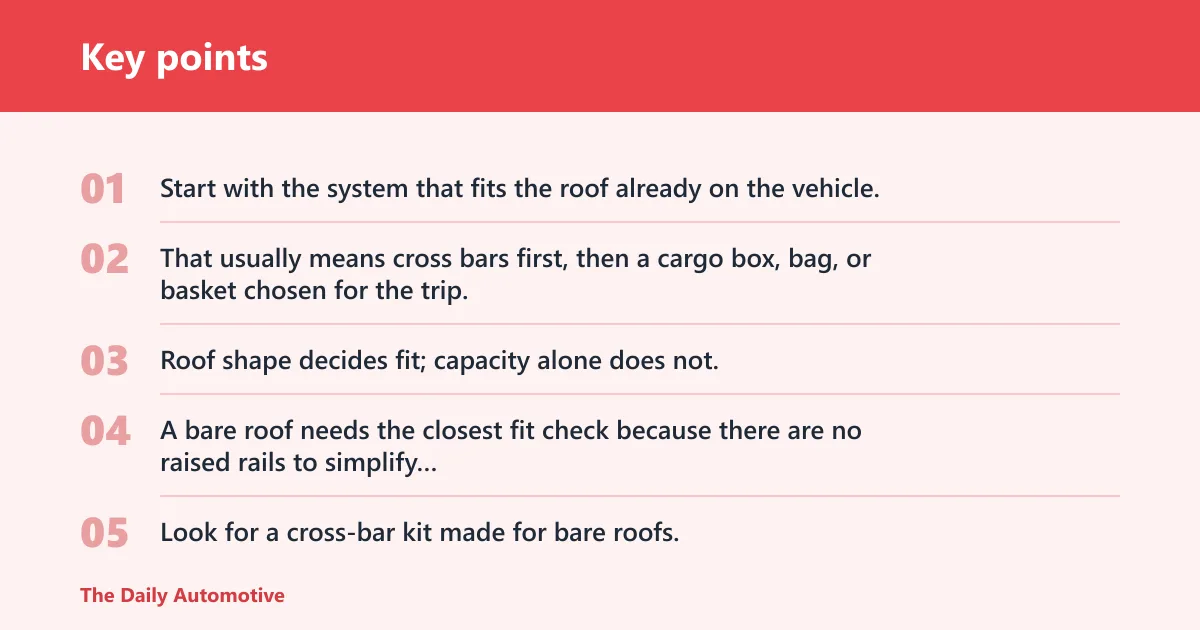


Start with the system that fits the roof already on the vehicle. That usually means cross bars first, then a cargo box, bag, or basket chosen for the trip. Roof shape decides fit; capacity alone does not.
Best choice for bare roofs
A bare roof needs the closest fit check because there are no raised rails to simplify mounting. Look for a cross-bar kit made for bare roofs, then add a bag or box that works with those bars. Bags with door-hook mounting can fit some vehicles, but they need careful strap routing and a stable surface.
Best choice for raised rails
Raised rails are the easiest roof type for cross bars and rooftop carriers. They usually support clamp-on bars with less fuss, and that opens the door to boxes, baskets, bikes, kayaks, and cargo bags. For frequent use, this is often the least frustrating setup.
Best choice for flush rails
Flush rails need bars designed for that rail profile, not a universal guess. Once the bars are correct, a box is the cleanest choice for dry luggage, while a basket works better for tall or awkward cargo that does not pack neatly into a shell.
📊 Car and Driver named the Thule Force 3 its best overall pick. Source: Best Rooftop Cargo Carriers of 2026, Tested.
Quick picks by need
Choose by use pattern, not by cubic feet alone. A 30 cubic-foot bag can still be the wrong answer if you use it once a year, while a smaller box may be the better long-term fit for frequent highway trips and wet weather.
- Frequent road trips: cargo box with locking hardware and side-opening access.
- Sports gear and wet cargo: roof rack basket with cargo net compatibility.
- Bulky luggage and occasional use: roof cargo bag with anti-slip mounting and strong straps.
- Mixed loads on SUVs and crossovers: cross bars plus a basket or box, depending on weather exposure.
Roof storage decision matrix
This matrix ties roof type to use case. It also flags the most common failure mode so you can check the weak point before you leave. The right answer is usually the one that stays secure at highway speed, clears the garage, and matches how often you will load it.
| Vehicle roof type | Recommended carrier | Why it fits | Common failure mode | What to check before driving |
|---|---|---|---|---|
| Bare roof | Cross bars plus cargo bag or box | Gives a stable mounting base and keeps load off the painted roof panel | Door-hook movement, strap stretch, trim scuffing | Confirm bar fit, door seal clearance, strap tension, and roof load limit |
| Raised side rails | Clamp-on cross bars plus cargo box | Simple bar mounting and good support for repeated use | Loose clamps or over-tightened hardware | Check clamp bite, bar lock, and box latch engagement |
| Flush rails | Rail-specific cross bars plus cargo box or basket | Best for steady, repeatable mounting on newer SUVs and crossovers | Wrong bar kit or incorrect rail spacing | Verify vehicle fit chart, clamp position, and torque settings |
| Factory tracks | Track-mounted cross bars plus basket or box | Flexible fore-aft positioning for mixed cargo | Bars mounted too far apart or too close together | Check track adapter lock, bar spacing, and carrier overhang |
| No side rails | Door-hook bag or bare-roof bar kit | Works when the vehicle has no permanent rail structure | Bag sag, paint abrasion, door seal pinch | Confirm door-hook layout, anti-slip mat placement, and strap routing |
What is the best rack for car top storage?
The best rack for car top storage is the one that matches your roof and your cargo. A cargo box is usually best for weather protection and clean packing. A basket suits awkward loads and gear that can be strapped down. A bag fits occasional luggage runs when you need a softer, lower-cost option.
When a roof cargo bag makes sense
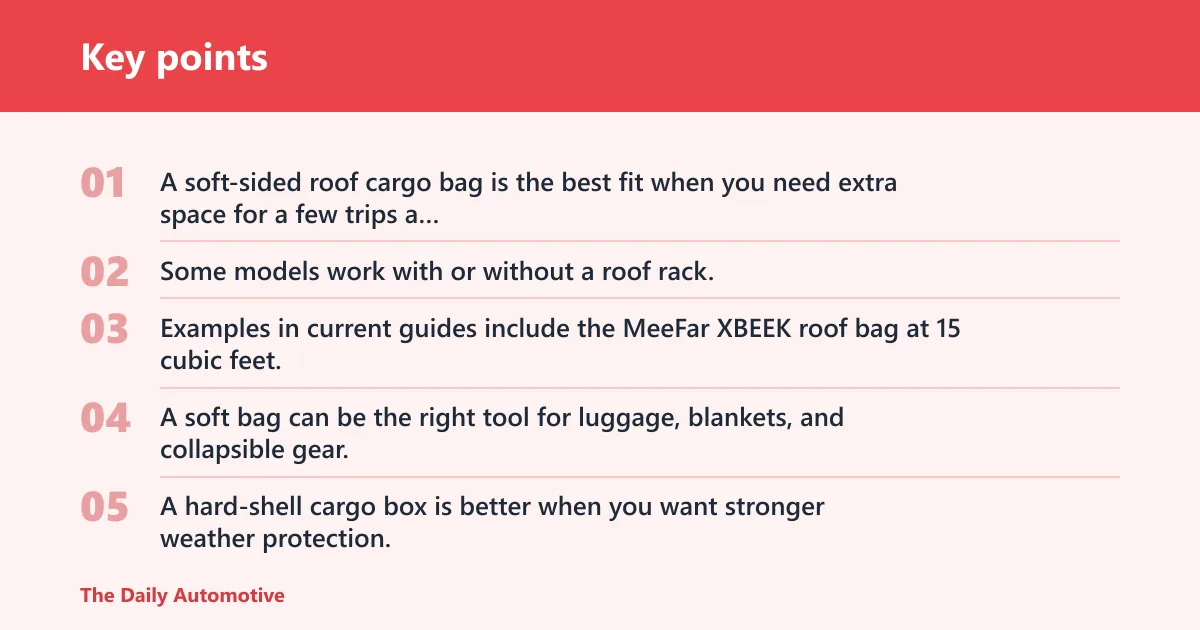
A soft-sided roof cargo bag is the best fit when you need extra space for a few trips a year and want something that stores easily when not in use. Some models work with or without a roof rack, but the mounting method matters more than the label on the package.
Examples in current guides include the MeeFar XBEEK roof bag at 15 cubic feet, the FIVKLEMNZ rooftop carrier at 21 cubic feet, and a larger FIVKLEMNZ bag listed at 30 cubic feet. A soft bag can be the right tool for luggage, blankets, and collapsible gear, but it is still only as stable as its straps and mounting points.
When a cargo box is the better fit
A hard-shell cargo box is better when you want stronger weather protection, lockable storage, and cleaner packing for repeat road trips. One reviewed box offers 14 cubic feet, the Thule 614 Pulse Cargo Box is described as medium and black, and the SportRack Vista XL cargo box is listed at 18 cubic feet.
Boxes keep shape under load and usually shed wind better than soft bags, though they add fixed height and can be more awkward to store. A side-opening or rear-opening lid also changes access, so pick the opening direction that fits your parking space and loading style.
When a roof rack basket is the right middle ground
A roof rack basket is the best compromise for bulky cargo that does not pack neatly and for gear that can tolerate some weather exposure. It is an open steel or aluminum tray, often with a wind shield or fairing up front, and it works well with cargo nets.
That openness helps with coolers, camping bins, and wet sports gear. It also means more drag and more exposure, so a basket is a practical answer, not a weatherproof one.
Do you need cross bars before installing a roof bag?
Often, yes. Many roof bags are meant to sit on cross bars because bars spread the load and reduce movement, but some bags are built with door hooks, anti-slip mats, and strap systems that can work without a rack on certain vehicles. The bag’s instructions and your roof type decide whether that is safe.
Cross bars on raised rails, flush rails, and bare roofs
Raised rails usually accept cross bars most easily. Flush rails need a fit-specific bar kit. Bare roofs need a system that clamps to the door openings or designated mounting points, because there is no rail structure to carry the load on its own.
Door hooks and anti-slip mounting on bags
Some soft carriers use door hooks, ratchet straps, and an anti-slip mat to keep the bag from sliding. Those parts matter on bare roofs because the roof panel itself is not a mounting platform. A mat helps protect paint and reduce movement, but it does not replace a proper fit.
When a bag should not be used without bars
Do not use a bag without bars if the maker says cross bars are required, if the roof is highly curved, or if the load will sit too far forward or rearward to stay balanced. A bag that sags can shift in crosswind, flap at speed, and rub the roof finish.
Are roof bags better than cargo boxes?
Neither is always better. Roof bags usually win on cost, storage, and flexibility. Cargo boxes usually win on weather protection, security, and cleaner highway manners. The right answer depends on how often you travel, how wet the cargo may get, and whether you want a lockable shell.
Capacity in cubic feet versus usable space
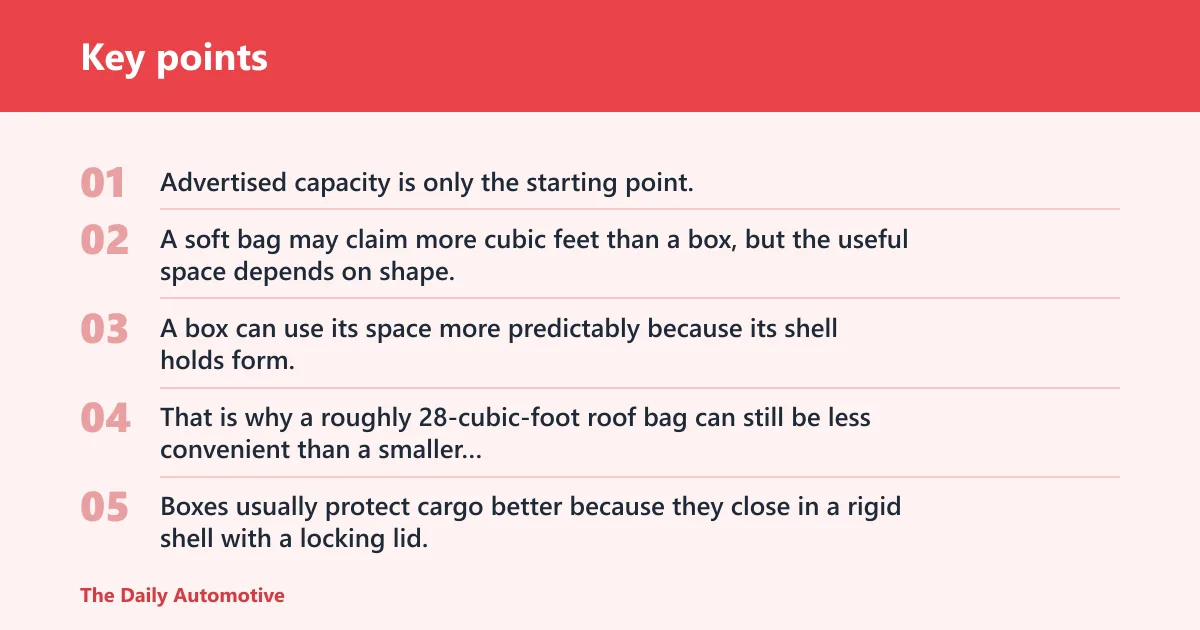
Advertised capacity is only the starting point. A soft bag may claim more cubic feet than a box, but the useful space depends on shape, stiffness, and how evenly you can pack the load. A box can use its space more predictably because its shell holds form.
That is why a roughly 28-cubic-foot roof bag can still be less convenient than a smaller hard box for rigid luggage or stacked gear. The number matters, but only after fit.
Weather protection and leak points
Boxes usually protect cargo better because they close in a rigid shell with a locking lid. Bags rely on waterproof material, zippers, seams, and flap overlap. Those are the common leak points, especially if the zipper path faces forward or the load pushes against the closure.
Water resistance is not the same as guaranteed dryness. A bag can still let in spray at the zipper or around strap openings, and pooled water can find its way through stitching if the bag is overloaded or poorly tensioned.
Security, access, and added height
A lockable cargo box is harder to open casually, and that matters in hotel lots or trailhead parking. A bag often depends on a combination lock and careful strap routing, but soft material is easier to cut than a molded shell. Boxes also add more fixed height, so garage clearance matters.
How much weight can your roof carry?
Your roof can carry only as much as the lowest limit among the vehicle manufacturer roof load limit, the bar limit, and the carrier limit. That is the number that counts. Also separate static loading from dynamic loading while driving, because movement, braking, and crosswinds change the real stress on the system.
Manufacturer roof load limit
Start with the vehicle owner’s manual. That roof load limit is the base line for the whole system, including bars and carrier. If the manual says 150 pounds, the roof system should stay under that combined figure even if the carrier itself is rated higher.
Bar and carrier load limits
Cross bars have their own rating, and carriers do too. One cross-bar guide lists YHAAVALE bars with up to 300 pounds capacity, while several bars in that guide are rated at up to 165 pounds. The actual safe limit is the lowest rating in the stack, not the highest one.
Dynamic load and load distribution
Dynamic load is what the roof sees while the vehicle is moving. The load shifts with bumps, braking, and cornering, so cargo should be centered and evenly distributed. Heavy items go low and near the middle. Light, bulky items can go around them if the carrier shape allows it.
Say your crossover has a 150-pound roof load limit, but your bars and box together also add weight before you pack them. That leaves less room for luggage than many buyers expect. The roof can still be overloaded even when the bag or box is not full.
How do you keep rooftop cargo from flapping or leaking?
Keep rooftop cargo tight, centered, and covered by the right format. Flapping usually comes from loose straps, soft-sided bags that are not fully tensioned, or cargo that is too tall for the carrier. Leaks usually come from zipper lines, seams, or a bag that is compressed unevenly in rain.
- Set the carrier on a clean roof or basket.
- Center the load left to right and front to back.
- Tighten straps or clamps until the carrier does not shift by hand.
- Use an anti-slip mat under soft bags when allowed by the maker.
- Close zippers fully and cover exposed seams where the design permits.
- Add a cargo net over open baskets and recheck tension after the first few miles.
A common first-timer mistake is loading a bag so full that the top bulges against the zipper path. The bag may still close, but the seam is now under stress and more likely to let in spray. Leaving a little space at the top reduces that risk.
How do you reduce wind noise from a roof rack?
Wind noise drops when the load sits lower, the bars are tightened correctly, and the front edge is shaped to cut air. A wind shield or fairing on a basket helps. So does removing unused cross bars when the carrier is off, because empty bars can whistle at highway speed.
What causes the noise
Noise comes from airflow around exposed bars, gaps between clamps and rails, and bulky carriers that catch air. A basket with no fairing usually makes more noise than a closed box. A soft bag can also whistle or flap if it is not pulled flat.
What to do about it
Check bar torque, strap tension, and the position of the carrier before each trip. If the setup is only used once in a while, remove it after the trip instead of leaving it on the roof. That reduces drag, keeps fuel use closer to normal, and restores garage clearance.
Start with roof type, then trip frequency, cargo shape, weather exposure, and security needs. If you travel often with dry luggage, a cargo box is usually the cleanest answer. If you haul odd-shaped gear or wet items, a basket works well. If you need temporary space and lighter storage, a roof bag can be enough.
What to check before you buy
- Your roof type: bare roof, raised rails, flush rails, or factory tracks.
- The vehicle roof load limit in the owner’s manual.
- The bar load rating and the carrier load rating.
- Whether the carrier needs cross bars or can use door hooks.
- The cargo shape: luggage, sports gear, coolers, or mixed loads.
- Whether weather protection or locking matters more than quick access.
- Added height for garages, parking decks, and low branches.
Suppose you drive an SUV with raised rails and take three family trips a year. A box is usually the safer long-term choice because it locks, sheds weather better, and keeps luggage stable. If the same vehicle only needs one summer trip, a bag may be enough if it matches the rack and stays within the roof limit.
Frequently asked questions
How much weight can a roof rack carry?
Use the lowest limit among the vehicle roof load rating, the cross-bar rating, and the carrier rating. That combined limit is the one that matters. Remember that moving the vehicle adds dynamic load, so you should leave a margin rather than packing right up to the limit.
Will a roof bag work without a roof rack?
Some will, but only if the manufacturer says so. Those models may use door hooks and anti-slip mounting on specific roof shapes. Others need cross bars for support. A roof bag without the right mounting method can sag, shift, or damage trim and paint.
Products related to this article
Sponsored / affiliate links. As an Amazon Associate I earn from qualifying purchases. I may earn additional commission from eligible campaigns.