Best Car Radiators: Top Picks by Vehicle Fitment
The best car radiator fits your vehicle exactly. Core size, hose location, and transmission-cooler layout need to match; use a 1-row unit for light-duty use, a 2-row unit for most street cars, and a thicker core only if your bay and fans can handle it. A poor match can leave ports out of place, remove the factory cooler, or cause overheating that ruins an engine or transmission. This guide maps radiator types, cooler integration, and core thickness to common vehicle setups so you can choose the right part before you order.
Quick comparison
| Product | Badge | Best for | Price | ||
|---|---|---|---|---|---|
 |
Denso 221-3236 Radiator | Replaces 19010-RBB-A51Denso | Our pick | Direct-fit OE replacement · radiator · OE-style fit | $130.30
Price as of 31 Oct 2026
|
View |
 |
Mishimoto MMRAD-RSX-02 Performance Aluminum Radiator,Mishimoto | Upgrade pick | 2-row aluminum · RSX fitment · performance build | $324.06
Price as of 31 Oct 2026
|
View |
 |
CSF 2 Row High Performance Aluminum Racing RadiatorCSF | Also great | 2-row aluminum · K-swap fitment · racing use | $499.00
Price as of 31 Oct 2026
|
View |
 |
Spectra Premium CU2423 Radiator With TOC, Without EOC –Spectra Premium | Budget pick | TOC radiator · Silverado fitment · direct replacement | $140.72
Price as of 31 Oct 2026
|
View |
 |
Maxcore 3-Row Copper/Brass Radiator 24" 289/302/351 ForGeneric | Pair with it | 3-row copper/brass · Mustang fitment · classic swap | $687.90
Price as of 31 Oct 2026
|
View |
This page is fitment-first, so read the table by vehicle need before brand name. Use the radiator section that matches your segment, then check hose orientation, cooler ports, and core dimensions against your vehicle data.
How we chose
These picks come from manufacturer listing details, fitment notes, and published buyer feedback. The comparison centers on direct-fit applications, cooler integration, core construction, and whether the listing makes the intended vehicle use clear.
We also separated OEM-style replacements from performance and classic-fit upgrades. That matters because a daily driver needs different packaging than a towing truck or a swapped compact car.
Denso 221-3236: best for Honda OE replacement
- Direct-fit replacement for listed Honda applications
- Matches OE replacement part numbers in the title
- Straightforward radiator swap for the specified fitment
This is the best fit if you want an OE-style replacement for the listed Honda applications and want to stay close to factory layout. The title calls out direct-fit replacement and cross-referenced OEM part numbers, which is what matters when you are matching a stock radiator.
It is the least adventurous choice here, and that is the point. The drawback is also its strength: it is a replacement part, not an upgrade part, so buyers looking for extra cooling margin should not expect a performance jump.
Mishimoto MMRAD-RSX-02: best for Acura RSX performance builds
- Compatible with 2002–2006 Acura RSX
- TIG-welded aluminum radiator construction
- Includes a high-pressure cap and magnetic drain plug
This suits 2002–2006 Acura RSX owners who want a 2-row aluminum radiator for a performance build rather than a plain replacement. The listing points to TIG-welded aluminum construction and includes a high-pressure cap and magnetic drain plug, which makes it more of an upgrade path.
The drawback is price. At $324.06, it sits above basic replacement territory, and buyers should confirm they actually need the added cooling and the more aggressive fitment approach before paying for it.
CSF CSF2850K: best for Civic K-swap cooling
- Compatible with 92–00 Honda Civic K-Swap applications
- All-aluminum tank and core construction
- Oil cooler not included for simpler layout
This is aimed at 92–00 Honda Civic K-swap applications where fitment and cooling demand both move away from stock. The listing describes all-aluminum tank and core construction, which appeals to buyers who want a performance-style setup for a swapped engine bay.
The drawback is cost and purpose. At $499.00, it belongs in a build that can use the extra capacity, and the listing also notes that oil cooler support is not included, so the rest of the cooling system needs to be planned carefully.
Spectra Premium CU2423: best for Silverado and GM tow use
- Direct replacement with OE fit, form and function
- High-density multi-louvered fins for heat transfer
- Drop-in fit design with included accessory pack
This is the strongest fit for Silverado, GMC, and Cadillac full-size truck and SUV applications that need a direct replacement with integrated transmission oil cooler support. The listing calls out OE fit, high-density multi-louvered fins, and a 34-1/16-inch core width, all of which matter for truck fitment.
The drawback is that you still need to check cooler-port layout and accessory pack contents against your exact vehicle. Truck radiators can look similar across trims while still differing in hose routing, TOC setup, or mounting details.
Maxcore 3-Row Copper/Brass Radiator: best for classic Mustang swaps
- Replacement for 1968–1969 Ford Mustang applications
- Copper/brass radiator construction
- Some applications may need a shorter fan spacer
This is a classic-fit option for 1968–1969 Ford Mustang applications where copper/brass construction and a 3-row layout are part of the appeal. It belongs in a restoration or period-correct build that needs a replacement with old-school materials and does not mind paying for that niche fitment.
The drawback is obvious from the listing price. At $687.90, it is the premium choice here, and the note that some applications may need a shorter fan spacer means the install may not be drop-in for every bay setup.
Which one should you buy?
If your vehicle is stock or near stock, buy the direct-fit replacement that matches your OEM part number and cooler setup first. If your build adds power, towing load, or a swap, move to the radiator that matches the cooling demand, then check core size and port layout before you spend more.
Budget buyers should stay in the $50–$150 range when the listing is a plain replacement and the factory cooler layout remains intact. Mid-range parts in the $150–$400 band make sense when you want better materials or a direct-fit upgrade. The $400+ range should be reserved for performance or classic applications where the layout, construction, or brand-specific fitment justifies it.
A common mistake is ordering by trim badge alone instead of matching the radiator to the exact year, make, and transmission setup. A Silverado owner can end up with the wrong cooler ports even when the radiator looks close in photos, and a Civic owner can order the wrong core width when the car has been swapped.
Truck and towing radiator picks
Full-size truck fitment
For full-size trucks, choose a radiator that matches the transmission-cooler setup first, then the core width and mounting tabs. A truck radiator can fit the opening and still fail if the cooler ports sit in the wrong place or the hose necks point in a different direction.
The Spectra Premium CU2423 belongs here because it is sold as a direct replacement for listed Silverado, GMC, and Cadillac full-size truck and SUV applications. The listing also points to high-density multi-louvered fins, which matters when the vehicle sees sustained load and heat soak.
Towing and heavy cooling demand
For towing or frequent load hauling, thicker cores and better fin density make more sense than a stock-style thin unit. Gardening Beyond notes that core thickness directly correlates with cooling capacity, and a 1.5-inch or thicker core is the kind of setup that usually belongs in heavier-duty use, not in a basic commuter.
That does not mean thicker is always better. A thicker radiator can create fitment trouble with fan clearance, shrouds, or hose routing, so the part still has to match the bay.
Daily-driver radiator picks
Compact and midsize sedans
For compact and midsize sedans, a stock-style radiator with a 1-inch core is usually the cleanest fit. The same source states that a 1-inch core is standard for most passenger vehicles, and that is the right starting point when the car is driven normally and the factory cooling system is intact.
The Denso 221-3236 fits the OE-replacement side of that decision. It is the right kind of part when your priority is restoring factory cooling without changing the car’s layout or adding hardware you do not need.
OEM-style replacement on a budget
If price matters most, stay in the budget band and keep the design close to stock. Expert Auto Guide places budget radiators at $50–$150, which is the range where you should expect a straightforward replacement part rather than a special material upgrade.
That budget approach works best when the vehicle does not need an integrated cooler change, the mounting points are standard, and the hose diameter matches the old unit. It is the wrong place to buy by brand name alone.
Classic and performance radiator picks
Classic GM and Mustang-style fitments
Classic cars often need more than a catalog match. They may need the right core width, the right hose orientation, and enough room for the fan spacer and shroud combination to work without contact.
That material choice is common in restorations where period-correct parts matter as much as cooling output.
Performance builds and thicker cores
Performance builds often justify a thicker core, but only when the bay can accept it. The same source states that thicker cores correlate with better cooling capacity, and full-aluminum construction is also noted there as better at resisting corrosion and handling higher pressures.
The Mishimoto RSX radiator and the CSF Civic K-swap radiator both sit in this lane. One is the better fit for a bolt-on RSX upgrade; the other is for a swapped Civic where the radiator choice needs to follow the conversion package, not the original engine.
Radiator fitment decision table
| Vehicle segment | Cooling demand | Recommended core construction | Transmission cooler requirement | Inspection checklist | Avoid-this-mistake notes |
|---|---|---|---|---|---|
| Compact sedan | Daily commuting, stock power | Plastic tank and aluminum core, 1-inch standard core | Manual-transmission-only unit if manual; integrated TOC if automatic | Confirm make/model/year, VIN, hose diameter, inlet/outlet location | Do not buy a thicker core just because it looks newer |
| Midsize sedan | Mixed city and highway use | Aluminum core or plastic tank and aluminum core | Check automatic compatibility and cooler port layout | Match core width and height to the old radiator | Wrong port angle can turn a simple swap into hose rework |
| Full-size truck | Towing, load hauling, heat soak | Full-aluminum construction or heavy-duty aluminum core | Integrated TOC if the truck is automatic | Check core thickness, mount style, and accessory pack | Do not assume the radiator for a different trim will fit |
| Full-size SUV | Passenger load plus trailer use | Heavy-duty aluminum or direct-fit OE-style aluminum core | Automatic units usually need a built-in cooler | Verify fan shroud clearance and cooler line fittings | Extra capacity means little if the cooler ports are wrong |
| Classic GM | Restoration or period-correct replacement | Copper and brass or full-aluminum based on restoration goals | Check whether the car uses an external or built-in cooler | Compare OEM part number, core width, and tank shape | Do not order by engine family only; bracket and tank shape matter |
| Classic Ford Mustang | Weekend driving, periodic spirited use | Copper and brass or upgraded aluminum core | Automatic transmission needs cooler provision | Check fan spacer needs and hose neck orientation | Do not ignore spacer clearance if the listing mentions it |
| Performance compact | Higher heat load from swaps or tuning | Full-aluminum construction, 2-row or thicker if space allows | Often manual-transmission-only if a separate cooler is used | Confirm core thickness and mount tab position | Do not choose by cooling hype alone; fitment is first |
| K-swap compact | Swap-driven heat load and custom bay packaging | All-aluminum core and tanks | Separate cooling package may be needed | Match core width, inlet/outlet, and fan room | Do not assume stock Civic dimensions still apply |
| Light-duty truck | Work use with occasional towing | Aluminum core with multi-louvered fins | Integrated TOC for automatics | Check transmission line fitting style and radiator height | Wrong cooler setup can create shifting trouble after install |
| Manual-transmission car | Moderate cooling load, no built-in trans cooler needed | 1-inch stock-style core or upgraded aluminum core | Manual-transmission-only unit is acceptable | Verify the listing excludes the cooler you do not need | Do not pay for integrated TOC hardware that your car will never use |
What fits your vehicle?
The correct radiator starts with make, model, and year, then moves to VIN verification, OEM part number cross-checking, and dimensional matching. Expert Auto Guide recommends using the VIN to confirm compatibility, and that is the safest way to avoid a part that looks close but is wrong in the details.
From there, check inlet and outlet diameter, core width, and core height against the old unit and the vehicle listing. If the car is automatic, confirm whether the replacement has an integrated transmission oil cooler. If it is manual, a manual-transmission-only unit can be the cleaner choice.
How to verify make, model, year, and VIN
Start with the exact vehicle configuration, not just the badge. Trim, engine, transmission, and cooling package can change the radiator enough to matter, especially in trucks and older platforms.
Use the VIN to narrow the listing, then compare the OEM part number in the old radiator or factory parts data. If the part number does not line up, keep looking.
How to cross-check dimensions and ports
Measure the core width and height, and check where the inlet and outlet sit on the tanks. That matters as much as the core itself because a correct-width radiator with the wrong neck angle still creates hose problems.
Also inspect mount style, transmission cooler fittings, and whether the shroud and fan clear the tanks. A mismatch here is one of the most common failure cases in online buying.
What to inspect when the radiator arrives
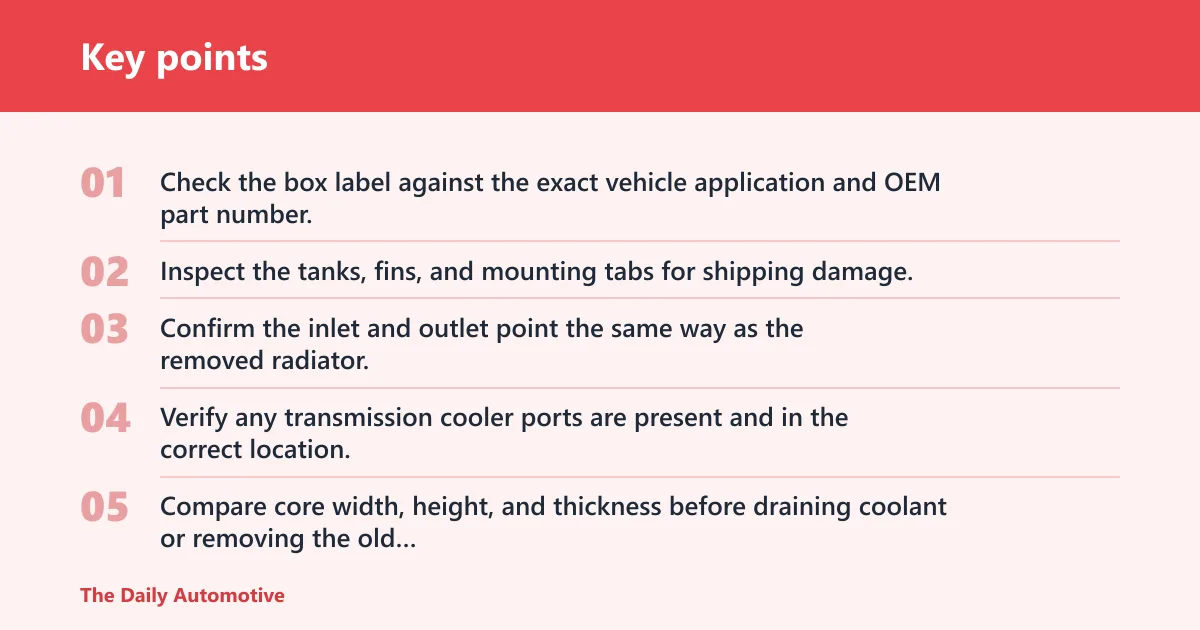
- Check the box label against the exact vehicle application and OEM part number.
- Inspect the tanks, fins, and mounting tabs for shipping damage.
- Confirm the inlet and outlet point the same way as the removed radiator.
- Verify any transmission cooler ports are present and in the correct location.
- Compare core width, height, and thickness before draining coolant or removing the old unit.
- Look for included hardware, caps, and drain plugs if the listing promised them.
Suppose a Silverado owner orders a radiator that looks right in the photo but the cooler ports sit on the opposite side. The part may still bolt in, yet the cooler lines will not reach cleanly, and the install stops before the old radiator is even out.
Should you choose an aluminum radiator or a plastic-tank radiator?
Choose aluminum when you want better heat handling, higher pressure tolerance, or a performance-oriented build. Choose plastic-tank and aluminum-core construction when you want an OE-style replacement that matches the factory design and keeps cost down. For many daily drivers, the stock-style version is the safer fit.
The same source notes that many aftermarket radiators use a plastic tank crimped to an aluminum core, while full-aluminum radiators resist corrosion better and handle higher pressures. That makes the material choice a fitment and durability choice, not just a style choice.
Durability and failure points
Plastic tank units are common because they are affordable and easy to package, but crimp-joint failure risk rises as the part ages and goes through thermal cycling. Full-aluminum units avoid that tank style, which is why they are often chosen for more demanding use.
A one- to two-year warranty is a useful baseline for many replacement radiators, but the warranty should never replace a careful fit check. A radiator that fails to match the vehicle is still the wrong purchase even if the warranty exists.
Does my vehicle need a transmission cooler in the radiator?
If the vehicle has an automatic transmission and the factory setup routes transmission fluid through the radiator, then yes, the replacement needs compatible cooler hardware. Gardening Beyond warns that automatic vehicles need a transmission oil cooler in the radiator. Manual-transmission cars may use a unit without it.
The key is not whether the radiator looks similar. It is whether the line fittings, cooler ports, and internal cooler are present in the correct configuration for that transmission.
Automatic versus manual compatibility
Automatic vehicles need the radiator and cooler system to match the original routing. That can mean an integrated TOC, the correct port spacing, and the right thread or quick-connect style on the lines.
Manual-transmission-only units are fine when the car does not use the radiator for transmission cooling. They are also a good way to avoid paying for unused hardware.
What core thickness is best for daily driving versus towing?
For daily driving, a 1-inch core is standard for most passenger vehicles, and it is usually enough when the engine, fan setup, and shrouding remain stock. For towing, hot climates, or performance use, a 1.5-inch or thicker core makes more sense if the bay can accept it and the fans can pull air through it.
Core thickness directly affects cooling capacity, but only within the limits of the vehicle package. A thicker radiator with poor airflow or wrong fitment can underperform a thinner direct-fit unit that matches the car correctly.
Cooling capacity versus packaging
More coolant capacity and denser fins can help pull heat out of the system, especially during sustained load. Still, the radiator must fit the shroud, support the fan clearance, and leave enough room for the hoses to route naturally.
That tradeoff is why the right answer depends on the segment. A sedan on a daily commute does not need the same core thickness as a truck pulling a trailer or a swapped compact with a higher heat load.
How much does a replacement car radiator cost?
Replacement radiator pricing usually falls into three bands: $50–$150 for budget replacements, $150–$400 for mid-range parts, and $400+ for premium or performance units. The right band depends on fitment complexity, construction, and whether the part includes a transmission cooler or hardware.
A basic OE-style part belongs in the lower band when the vehicle is common and the cooling package is simple. Truck, classic, and performance applications tend to climb quickly because the fitment is more specific and the materials are more specialized.
Price by fitment category
Budget pricing usually covers a direct replacement with standard materials and no extra cooling equipment. Mid-range pricing often brings better fin design, sturdier materials, or a more exact OE-style fit. Premium pricing is common for thicker aluminum units, classic copper/brass parts, or swap-specific radiators.
The product list here shows that spread clearly. The Denso replacement sits near the budget-to-mid boundary at $130.30, the Spectra Premium truck unit is $140.72, the Mishimoto RSX radiator is $324.06, the CSF K-swap unit is $499.00, and the classic Mustang copper/brass unit is $687.90.
Can I install a radiator myself or should I use a mechanic?
Many radiator swaps are DIY-friendly if the vehicle has clear access, standard hose routing, and no extra transmission-cooler complications. Choose a mechanic when the radiator sits tightly in the bay, the hoses are brittle, the cooling fan assembly is complex, or the transmission cooler lines need special handling.
DIY replacement still demands the right tools, a drain pan, hose-clamp pliers, and the vehicle manual’s procedure. Fuel, coolant, and electrical work need ventilation, no sparks, and the battery disconnected.
DIY steps in plain terms
- Let the engine cool completely.
- Disconnect the battery as the manual directs.
- Drain coolant into a safe container.
- Remove intake parts, fan shroud, or covers that block access.
- Disconnect upper and lower hoses and any transmission cooler lines.
- Swap the radiator, refill, bleed air, and check for leaks.
Never work under a vehicle supported only by a jack; use jack stands on level ground. If the vehicle has an integrated cooler or tight packaging, labor cost can climb because the job takes longer and there is more risk of broken clips, stripped fittings, or stuck hoses.
How to choose
Start with fitment, not brand. Match the vehicle’s make, model, year, and VIN, then verify the OEM part number, inlet and outlet diameter, and core width and height. After that, decide whether the car needs a plastic-tank OE-style replacement, a full-aluminum upgrade, or a heavier copper/brass unit for a classic build.
Then check whether the transmission setup needs an integrated cooler. That one detail can rule out otherwise good radiators, especially on automatics and trucks.
Finally, compare price to use case. If the car is a commuter, do not overpay for a thicker performance core. If the vehicle tows, swaps engines, or sees sustained heat, the extra cost of a better-suited radiator is easier to justify.
Say your midsize sedan only needs a stock replacement after a leak. A 1-inch OE-style radiator with the correct port layout is the sensible choice, and the lower price band usually makes sense. Suppose the same sedan gets a turbo setup later. The fitment conversation changes, and the original radiator may no longer be the right answer.
Frequently asked questions
What is the best car radiator for my make and model?
The best radiator is the one that matches your exact application, including VIN, OEM part number, hose orientation, and transmission-cooler setup. A direct-fit OE replacement is usually the safest choice for stock vehicles. Performance or swap builds need a radiator chosen for the altered cooling demand and bay packaging.
How do I check radiator fitment before buying?
Match the make, model, year, and VIN first. Then compare the OEM part number, inlet and outlet diameter, core width, core height, mount style, and cooler ports against the old radiator or factory listing. If any one of those items differs, keep checking before you order.
Products related to this article
Sponsored / affiliate links. As an Amazon Associate I earn from qualifying purchases. I may earn additional commission from eligible campaigns.