Best Car Jump Starters for Winter Starts: Research Shows
For winter starts, pick a jump starter with at least 1,000 peak amps, a lithium pack rated for cold-weather charging, and a boost or preheat mode. Below 0°F, that matters more than peak amps alone. A weak unit can leave you stranded with a battery that still has some charge but cannot deliver enough cranking power. This guide explains which specs matter in freezing weather, and which jump starters fit cars, SUVs, and trucks.
Quick comparison
| Product | Badge | Best for | Price | ||
|---|---|---|---|---|---|
 |
NOCO Boost GB40 12V 1000A UltraSafe Portable Lithium JumpNOCO | Our pick | 1000A · Portable · Lithium | $99.95
Price as of 20 Oct 2026
|
View |
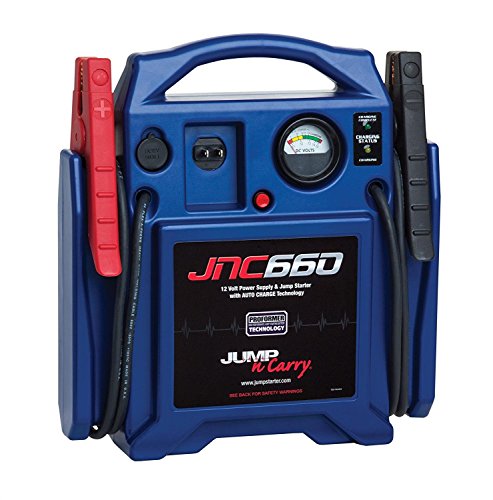 |
Clore Automotive Jump-N-Carry JNC660 1700 Peak Amp 12 VoltClore Automotive | Also great | 1700 Peak Amps · 12V · Heavy-Duty | $126.02
Price as of 20 Oct 2026
|
View |
Cold weather changes the choice fast. A compact lithium pack can suit a commuter sedan, while a heavier jump starter with long #2 AWG cables makes more sense for a pickup with a buried battery.
How we chose
We compared published peak-amp claims, engine-size ratings, low-temperature operating ranges, and safety protections. We also favored units with clamp quality, cable length, and winter-friendly extras such as an LED light, USB output, or a display that helps you verify charge status before you need it.
Two other filters mattered. First, storage readiness: a jump starter that sits in a trunk all season should publish a temperature range that fits that space. Second, fit for the vehicle segment: commuter sedan, SUV, diesel, or emergency-only kit.
NOCO Boost GB40: best for winter commuting
This is the clean fit for a daily driver that needs a compact backup more than brute force. Car and Driver lists the NOCO Boost Plus GB40 as Most Compact, and Sortra lists the NOCO Boost GB40 with 1000A and support up to 6.0L gas and 3.0L diesel, which makes it a sensible match for many cars and light-duty trucks.
The useful part is the size, plus the protection features. It includes spark-proof and reverse polarity protection, plus an integrated power bank for phone charging. That said, a 1000A unit is still a compact emergency tool, not the best answer for a heavy diesel in deep cold.
Clore Automotive JNC660: best for large engines
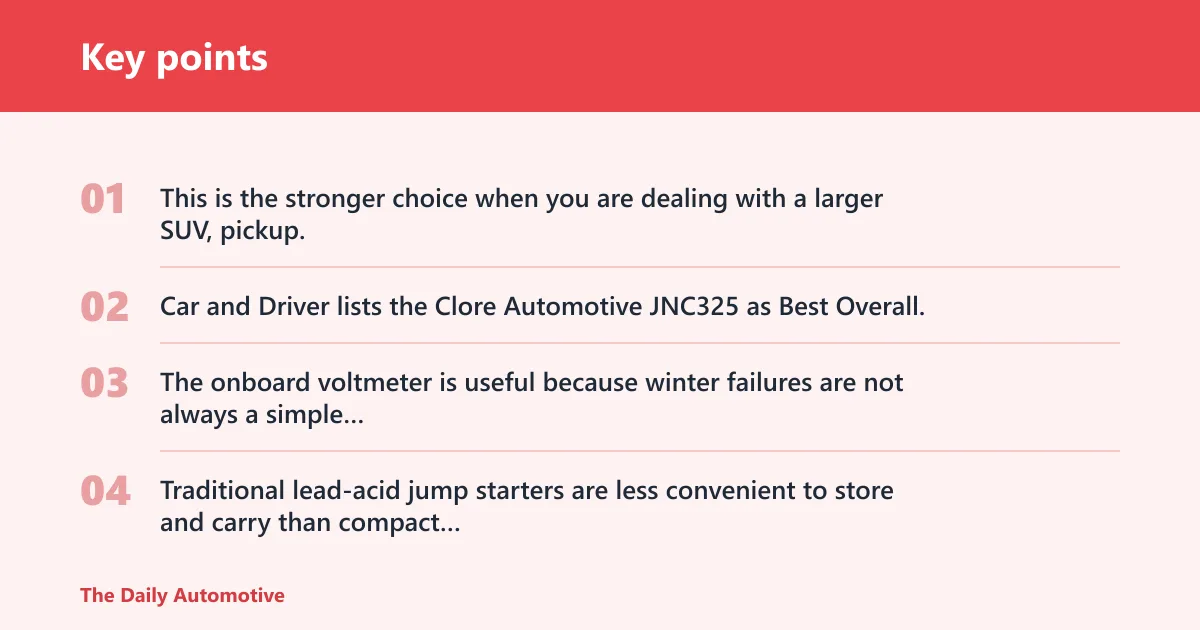
This is the stronger choice when you are dealing with a larger SUV, pickup, or a vehicle with awkward battery access. Car and Driver lists the Clore Automotive JNC325 as Best Overall, while Chevy Guide says the JNC660 has a 22Ah battery and 46-inch #2 AWG cables, both of which point to a traditional, heavy-duty layout that favors reach and cranking muscle.
The onboard voltmeter is useful because winter failures are not always a simple dead-battery case. The drawback is size and weight. Traditional lead-acid jump starters are less convenient to store and carry than compact lithium units, so this is better kept in a garage, cargo area, or tool compartment than in a glove box.
What is the best car jump starter for winter starts?
The best car jump starter for winter starts is the one that matches your engine size, storage space, and how often you need it. For most drivers, a compact lithium unit around the 1,000A class is enough for a commuter car, while bigger gasoline engines and diesel vehicles need more headroom and better cables.
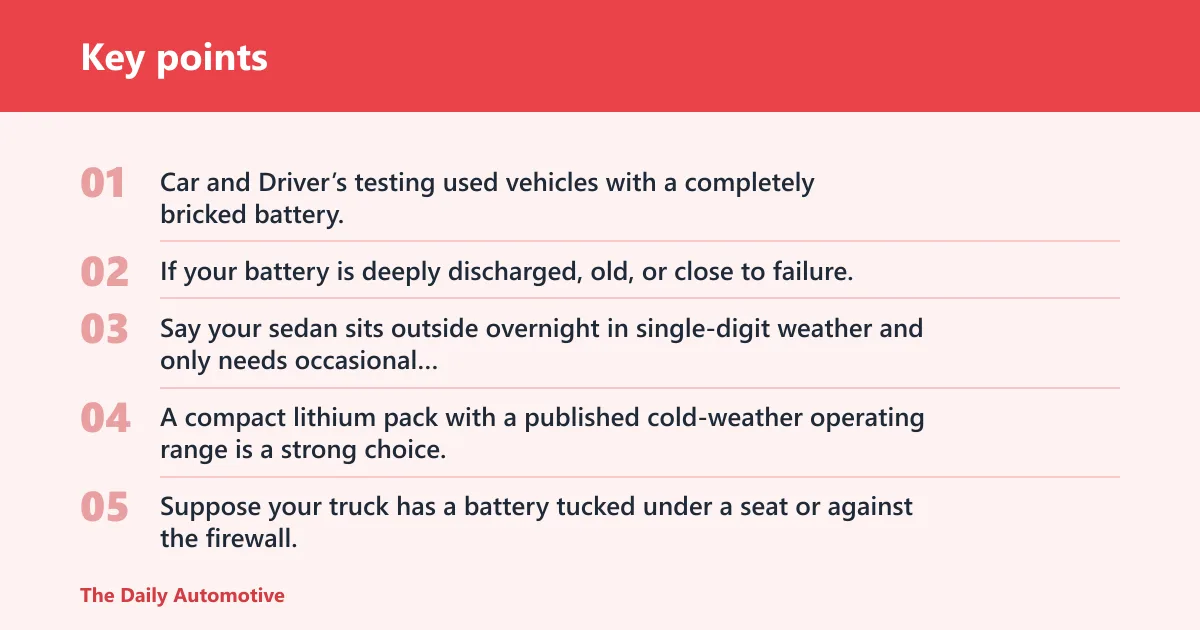
Car and Driver’s testing used vehicles with a completely bricked battery, which is a useful reminder that winter buyers should think beyond a weak battery. If your battery is deeply discharged, old, or close to failure, a jump starter may get you moving once, but it is not a substitute for replacement.
Say your sedan sits outside overnight in single-digit weather and only needs occasional rescue. A compact lithium pack with a published cold-weather operating range is a strong choice. Suppose your truck has a battery tucked under a seat or against the firewall. Long cables matter as much as amp claims.
How many amps do you need for a winter jump starter?
For winter use, peak amps are a starting point, not a guarantee. Competitor claims commonly span 1000A to 6000A, but those numbers are brand claims, so you should pair them with the engine-size rating and the unit’s cold-weather range instead of treating amps as a universal rule.
A practical guide is simple: commuter cars can often live in the lower end of the range, larger gasoline engines need more headroom, and diesel engines need the most margin. Sortra says the NOCO Boost GB40 supports up to 6.0L gas and 3.0L diesel, while higher-capacity listings often stretch to 10.0L gas or 12L diesel.
Extra headroom matters when temperature drops because the battery in the vehicle has less usable power and the starter has to work harder. It also matters if the vehicle has a long cable run, a stiff engine oil fill, or a battery that is only partially recovered.
Will a jump starter work in freezing weather?
Yes, but only if the unit itself is rated for the temperature it will see. A jump starter stored in a trunk at subfreezing temperatures can lose effectiveness if its chemistry, electronics, or protection circuitry are not built for cold use. Published low-temperature ranges are the part to check first.
Chevy Guide says the GOOLOO GP2000 works from -4°F to 140°F, and it says the WOLFBOX model operates down to -4°F. Those kinds of published ranges are what make a unit realistic for winter storage in a car, cargo area, or garage rather than just a warm shelf at home.
Storage matters. A glove box kit sees less temperature swing than a trunk in many cars, but both can get cold enough to affect performance. If the maker lists something like -20°C to 60°C or -4°F to 140°F, that range is more relevant than a marketing claim about raw amps alone.
Should you choose lithium or lead-acid for cold weather?
For most buyers, lithium is the better winter choice because it is lighter, more compact, and far more common in current listicles. AGM lead-acid still appears in rugged traditional models, and it can be a strong fit if you want heavier cables, a larger reserve, and a more garage-friendly unit.
Cold-weather behavior is the tradeoff. Lithium packs usually win on size and standby convenience. Lead-acid units usually win on durability feel and cable heft. That extra mass can be useful, but it is hard to ignore if the unit needs to live in a glove box.
Recharge timing also matters for seasonal kits. Some listings mention about 3 hours to recharge, while others advertise long standby periods such as 24-month standby. If the jump starter will sit untouched for months, a long storage-readiness claim is worth more than flashy accessory features.
Winter jump starter decision table
This table turns winter specs into a buying rule. Use it to match the unit to the vehicle, storage location, and how often you expect to need it.
| Scenario | Recommended minimum peak amps | Acceptable temperature range | Preferred battery chemistry | Must-have safety features | Air compressor combo worth it? |
|---|---|---|---|---|---|
| Daily commuter | 1000A | -4°F to 140°F, or better | Lithium | Spark-proof connections, reverse polarity protection, overload protection | No, unless you also want tire-top-off convenience |
| Large SUV or truck | 1700A or higher | -4°F to 140°F, or a published cold rating | Lithium or AGM lead-acid | Reverse polarity protection, short-circuit protection, sturdy clamps, long cables | Sometimes, if cargo space is not a problem |
| Diesel vehicle | High-capacity model with strong reserve | Cold-rated storage range with verified low-temp operation | Lithium with diesel support, or rugged AGM | Spark-proof connections, overload protection, low-temp protection | Usually no, because size and cold-use simplicity matter more |
| Emergency-only glove box kit | 1000A to 2000A | Compact storage range that fits the cabin or trunk | Lithium | Reverse polarity protection, spark-proof connections, clear charge display | No, the compressor makes it bulkier and slower to grab |
Which one should you buy?
If you drive a commuter sedan, start with the NOCO Boost GB40. It is the better answer when storage space, light weight, and fast access matter more than maximum output.
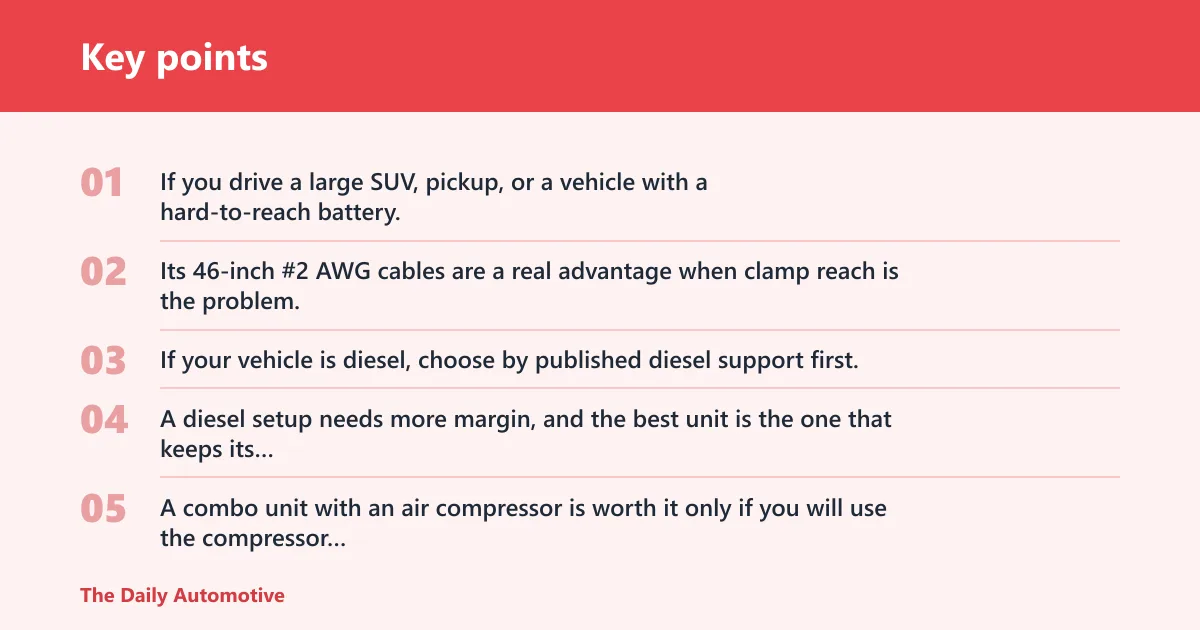
If you drive a large SUV, pickup, or a vehicle with a hard-to-reach battery, the Clore Automotive JNC660 is the stronger fit. Its 46-inch #2 AWG cables are a real advantage when clamp reach is the problem, not just cranking power.
If your vehicle is diesel, choose by published diesel support first, then by cold operating range. A diesel setup needs more margin, and the best unit is the one that keeps its performance in the temperature band where you actually park.
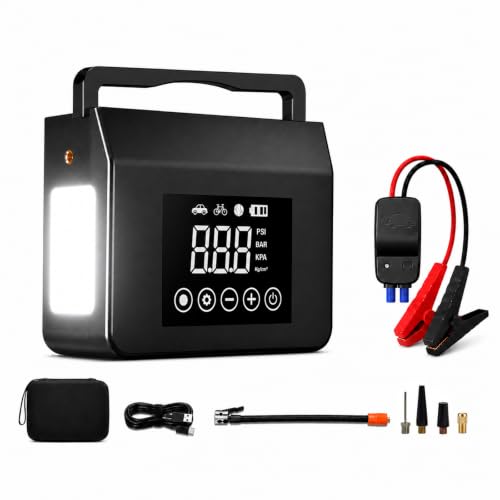
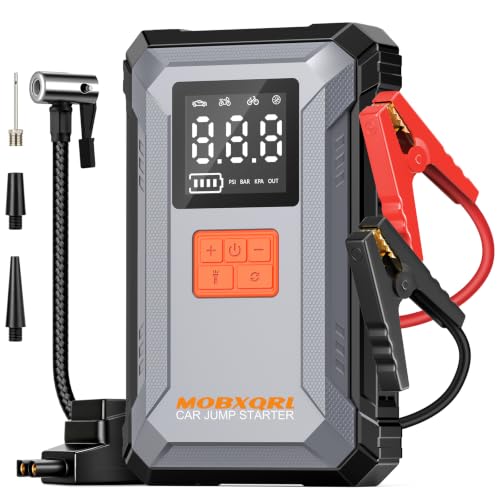
A combo unit with an air compressor is worth it only if you will use the compressor often enough to justify the added bulk. Those models are harder to stash, slower to charge, and less convenient for a true emergency kit.
Common winter accessories are worth a look, but they should stay secondary. An LED flashlight, SOS mode, USB charging, or an LCD display can help, yet none of them makes up for weak clamps or an inadequate cold-weather range.
What safety features should a winter jump starter have?
Look for spark-proof connections, reverse polarity protection, overload and short-circuit protection, and low-temperature protection. Those are the features that help prevent a bad hookup from turning into a blown fuse, a damaged unit, or a tense roadside mistake in freezing weather.
Clamp and cable design matters too. Heavy-duty #2 AWG cables show up on traditional units for a reason, and clamp quality becomes more important when gloves are on and the metal is cold. Longer cables also help when the battery is buried under a seat or in a crowded engine bay.
Can a jump starter also inflate tires or charge phones?
Yes. Many portable jump starters now include USB charging, power bank output, or an LED flashlight, and combo units can add an air compressor. The tradeoff is size and convenience: the more extras you add, the less likely the unit is to disappear into a glove box or small trunk cubby.
For a winter emergency kit, phone charging is usually the more useful extra because it helps you keep contact with roadside help. A built-in compressor is attractive if you regularly top off tires, but it is not essential if space and quick access are your priorities.
How long does a jump starter hold a charge in winter?
Published storage claims can stretch to 24-month standby on some models, while recharge times can be around 3 hours on others. In winter, the key question is not only how long the pack can sit charged, but whether it can still deliver power after months of cold storage.
That is why chemistry and storage range matter together. Lithium packs generally fit seasonal kits better, but you should still charge them on a schedule and keep them within the maker’s specified temperature range whenever possible.
How to use jump starter for car
Start by reading the manual for your exact unit. Then connect the clamps exactly as instructed, confirm the indicator shows a safe connection, start the vehicle, and disconnect in the reverse order the manual gives. Do not improvise with clamp placement if the maker specifies a direct battery connection.
If the engine still will not crank after a proper attempt, the battery may be too deeply discharged, damaged, or at the end of its life. At that point, a jump starter is a stopgap, not the fix. A battery replacement or a charging-system check may be the next step.
Frequently asked questions
How do I use a jump starter for a car?
Follow the manual for the exact model. Connect the clamps in the instructed order, verify the status lights or display, start the car, and disconnect as directed. If the battery is deeply discharged or the engine still will not crank after a proper try, the problem may be beyond a portable jump start.
Products related to this article
Sponsored / affiliate links. As an Amazon Associate I earn from qualifying purchases. I may earn additional commission from eligible campaigns.