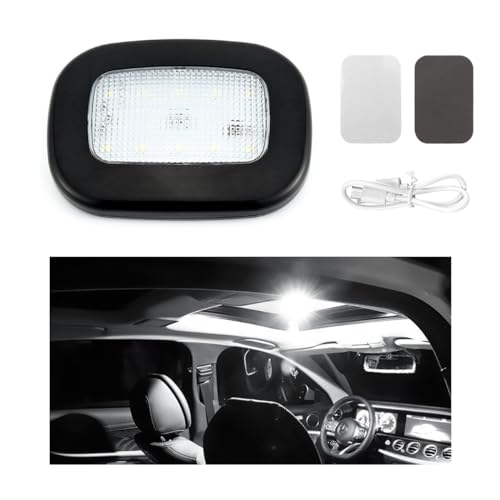
Map Light for Car: Best LED Picks and How to Install One
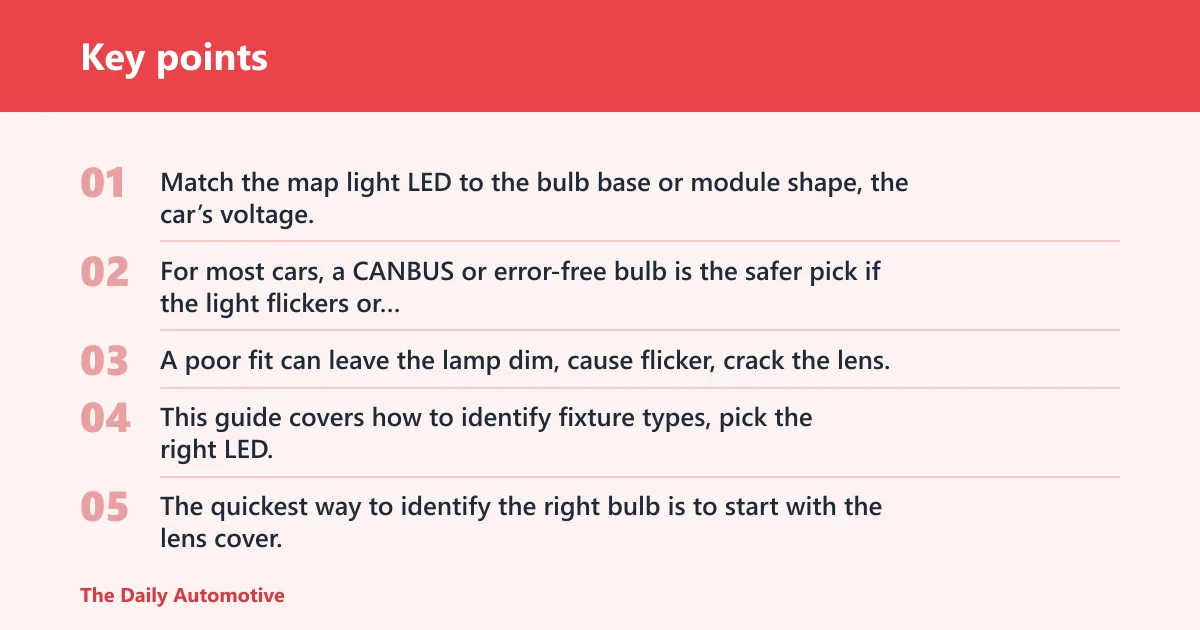
Match the map light LED to the bulb base or module shape, the car’s voltage, and the dimming style. For most cars, a CANBUS or error-free bulb is the safer pick if the light flickers or throws a warning. A poor fit can leave the lamp dim, cause flicker, crack the lens, or burn the driver board. This guide covers how to identify fixture types, pick the right LED, and install it without polarity, dimming, or fitment mistakes.
The quickest way to identify the right bulb is to start with the lens cover, then check the base shape and the owner’s manual. Map lights often use a T10/W5W wedge, a 194/168/2825 wedge family, or a festoon bulb, but the housing still decides which one fits.
What bulb size is my map light?


Pop the lens only after you confirm the fixture style. A flat-pin wedge has two contacts on the sides of the base. A festoon has metal caps on each end and spring clips in the housing. An integrated overhead module is different; the light board or full assembly may need replacement instead of a simple bulb swap.
Say your overhead console has a long capsule held by spring contacts. That points to a festoon fit, not a wedge. If the lens hides a small socket with side contacts, the bulb family is usually wedge-based, and the exact size still needs confirmation from the manual or a part number printed on the housing.
Read the socket from the lens and base
Remove the lens carefully and inspect the bulb base before ordering. A wedge bulb slides into a slot. A festoon bulb spans a gap between two spring ends. If the lens cover comes off but the light source is on a circuit board, you are not looking at a standard bulb replacement.
Look for part numbers on the back of the lens, on the bulb base, or in the vehicle manual. Many compact cars use small wedge bulbs. SUVs and trucks often use larger overhead housings, and cab lights can use different sizes than the front map lamps.
Spot integrated overhead modules
Integrated overhead modules are the biggest fitment trap. They may contain a fixed LED board, a diffuser, and the switch in one unit. If the manual lists the whole assembly instead of a bulb number, a replacement LED bulb will not fix the light.
In that case, match the assembly part number, not the bulb shape. Do not force a wedge or festoon into a sealed module. The wrong move can break the lens tabs or damage the board.
Which LED map light fits your socket?
Fitment comes first. T10/W5W wedge bulbs need a polarity check on many LED versions. 194, 168, and 2825 bulbs are often listed as interchangeable, but the vehicle manual should determine the final match. Festoon bulbs must match both length and spring-contact spacing, with 31mm, 36mm, and 41mm being common sizes.
T10 / W5W wedge fitment and polarity
T10 and W5W wedge bulbs are common interior sockets for map, dome, trunk, and glove box lights. Their flat-pin base slides into the socket, but many LED versions are polarity-sensitive. If the bulb does not light after installation, remove it and flip it 180 degrees.
That polarity check matters because the bulb may fit physically and still fail electrically. If the lamp flickers or stays dark, check the contacts in the socket for bent tabs before assuming the LED is bad.
194 / 168 / 2825 compatibility claims
The 194, 168, and 2825 wedge family shows up in listings as interchangeable-size compatible, but that claim is not a guarantee. Verify the exact socket in the vehicle manual before buying. A bulb can look close enough and still sit loosely, tilt in the housing, or miss the contact points.
AUXITO’s 194 LED bulb pack is a 10-pack with 6000K white light, and the AUXITO 194 bulb uses 14 SMD LEDs. Marsauto’s 194 bulbs are sold as a pack of 10, and Marsauto claims about 400 lumens per bulb at 2W. The first guide says its bulbs can last up to 50,000 hours.
Another listing describes 6000K xenon white, 24 3014 LED chips, and canbus error-free marketing. One kit includes 24 bulbs in three sizes for map, dome, license, and trunk use, and another kit highlights 24 bulbs and a pry bar in one kit. One kit also says it covers eight bulbs each for T10/194, DE3175, and 211-2/212-2/578 sockets.
Festoon fitment checks
Festoon bulbs use spring-contact fitment, so length matters as much as bulb family. The common lengths are 31mm, 36mm, and 41mm. A bulb that is too short will not touch both springs. A bulb that is too long can bow the clips or crack the lens when you close it.
Check the housing depth before ordering. If the overhead lamp uses a tight reflector, a festoon with the wrong ends or length can sit crooked and throw light unevenly.
What makes one LED work better than another?
The better choice is not only about brightness. For map lights, 360-degree emission helps fill a small housing, SMD chip layout affects heat and output, and an aluminum heat sink or cooling body points to better thermal control. CANBUS-compatible LEDs matter when the car monitors the interior circuit and throws bulb-out warnings.
360-degree emission in small housings
360-degree emission helps light spread across the lens instead of firing in one direction. That matters in small map housings, where a narrow beam can leave the passenger side or the center console in shadow. For wedge replacements, this is one of the more useful selling points.
It does not mean every 360-degree bulb is equal. Lens shape, socket depth, and reflector design still change the result.
SMD chip arrays and heat management
SMD LED chip arrays vary widely. Common listings often include 14-SMD, 18-SMD, 24x 3014, and 20×16 chipset designs. More chips do not automatically mean better light; the arrangement, heat path, and driver quality matter too.
An aluminum heat sink or cooling body is a good sign that the bulb is built to shed heat. That can help reduce flicker, slow color shift, and lower the chance of early failure in a closed overhead lens.
When CANBUS-compatible LEDs matter
CANBUS-compatible LED bulbs are relevant for monitored interior circuits, especially when the car checks current draw and reports a fault. They are often marketed as error-free. That claim is useful on some vehicles and unnecessary on others, so it should be treated as a compatibility feature, not an upgrade by default.
If the factory bulb monitoring is sensitive, a plain LED may work but still trigger a warning or pulse at a low level. In that case, a CANBUS-compatible version is the safer starting point.
Map light fitment checklist
Use this checklist before you buy or install anything. It separates fixture type from bulb family and shows the most common failure modes, so you can avoid polarity mistakes, loose fitment, and dimming problems.
| Fixture type | Bulb family | Common failure risks | Install tip | Warning signs |
|---|---|---|---|---|
| Map or dome lens with side contacts | T10 / W5W wedge | Polarity reversal, weak contact, flicker after install | Test the bulb before snapping the lens back on | No light, light only on one side, dim pulse |
| Small interior wedge socket | 194 / 168 / 2825 wedge | Loose fit, listing mismatch, uneven beam pattern | Verify the manual and compare the base shape | Bulb rocks in the socket, housing gets hot, warning light appears |
| Overhead lamp with spring clips | 31mm festoon | Short length, poor spring contact, no-light condition | Measure end-to-end length before ordering | Caps do not seat, bulb drops out, lens will not close cleanly |
| Longer dome or vanity housing | 36mm festoon | Bent clips, bowed lens, contact stress | Match spring spacing and avoid forcing the bulb | Lens bulges, bulb sits crooked, intermittent light |
| Large overhead or cargo lamp | 41mm festoon | Overlength fit, lens pressure, poor dimming response | Check the housing depth and clip spread first | Cracked lens tabs, hot spots, reduced dim range |
| Fixed overhead board or sealed console | Integrated overhead module | Wrong part type, damaged driver board, no bulb access | Replace the full unit if the manual calls for it | No removable bulb, board visible behind lens, wiring connector only |
Are LED map lights plug and play?
Sometimes, but not always. Plug and play means the bulb fits the socket and uses the car’s existing wiring without cutting or soldering. It does not guarantee correct polarity, proper dimming, or warning-free operation. You still need to confirm the bulb family, the depth of the housing, and the circuit behavior.
Polarity reversal and no-light fixes
If a wedge LED fits but does not turn on, polarity is the first thing to check. Remove it, flip it, and reinstall it. If it still fails, inspect the contacts in the socket and make sure the LED pins reach the terminals.
A common first-timer mistake is assuming a dead lamp means a bad bulb. In many wedge installations, the bulb is fine and the polarity is simply reversed.
Flicker and poor dimming problems
Flicker often comes from weak contact, a driver that does not like the car’s PWM dimming signal, or a bulb that runs too close to the limits of the socket. Poor dimming can also show up when a bright LED turns sharply on and off instead of fading smoothly with the switch.
If the circuit is monitored, a CANBUS-compatible bulb may reduce warning messages and unstable behavior. If the bulb still flickers, the fitment may be wrong or the housing contacts may need cleaning.
How do you install a map light LED safely?
Use a trim removal tool to remove the lens without marring plastic clips or headliners. Work slowly, keep pressure light, and do not pry against the glass or switch bezel. The safest install is a simple sequence: open the lens, swap the bulb, check polarity, and close the cover without forcing it.
- Turn the light off and let the housing cool.
- Use a trim removal tool or pry tool to release the lens.
- Remove the old bulb without bending the contacts.
- Insert the LED in the correct orientation.
- Test the light before snapping the lens back on.
- Flip the bulb if it does not light.
- Close the lens carefully and confirm there is no pinching or rattle.
Do not force a festoon bulb into a short housing. Do not bend the spring clips to make a loose bulb fit. If the lens resists closing, stop and recheck the length, base type, and seating depth.
How bright and white should the light be?
6000K white is a common interior target because it looks crisp and daylight-like. That color can improve visibility inside the cabin, but too much output in a small map housing can feel harsh at night. The right choice is bright enough to read without glare.
For map lights, aim for controlled output rather than the highest number on the box. A brighter bulb with 360-degree emission and good diffusion often works better than a raw, forward-firing LED in a tiny console.
Picture a compact car with a low roof and a shallow map lens. A 6000K wedge bulb may look clean and modern, but a very bright chip array can reflect off the windshield or make nighttime eye fatigue worse. In a truck cabin, a slightly wider spread may matter more than raw intensity.
How bright should a car map light be? Bright enough to read a map, phone screen, or receipt without washing out the cabin. If the bulb is so intense that it creates glare on the glass or distracts the driver, step down in output or choose a warmer, more diffused option.
Frequently asked questions
What bulb size is my car map light?
Check the lens shape, the bulb base, and the owner’s manual before buying. If the housing contains a fixed board instead of a removable bulb, you likely need an integrated module.
Do LED map lights cause bulb-out warnings?
They can on monitored circuits. Some cars check current draw closely and may report a warning when a low-draw LED replaces a halogen bulb. CANBUS-compatible or error-free bulbs are often used in those cases, but they are not necessary on every vehicle.
What color temperature is best for interior map lights?
6000K white is a common choice because it gives a clean, daylight-like look. That said, the best choice is the one that stays useful at night without harsh glare. In a small housing, a slightly softer output can be easier on the eyes than maximum brightness.
How do I install a map light LED without breaking the lens?
Use a trim removal tool, pry only at the designed release points, and avoid twisting the lens cover. Remove the old bulb gently, test the LED before final assembly, and close the lens without forcing the tabs. If the cover does not seat, recheck bulb length and orientation.
Can I use the same LED bulb for map, dome, and trunk lights?
Sometimes, but only if the socket family and length match. Many kits cover multiple interior locations, including map, dome, license, and trunk use, yet one bulb does not fit every housing. Separate the bulb type from the location before ordering.
Products related to this article
Sponsored / affiliate links. As an Amazon Associate I earn from qualifying purchases. I may earn additional commission from eligible campaigns.