Best Thermostats for Cars (2026): We Compared
The best thermostat for a car is the OEM-temperature unit specified by your engine, unless you need a colder or hotter calibration for towing, cold-weather driveability, or emissions compliance; for most DIY replacements, stick to the factory rating and the correct housing style. A wrong thermostat can cause overheating, poor heater output, long warm-up times, or a check-engine light, and the labor to redo it is often the expensive part. This guide compares four thermostat picks by failure mode, temperature rating, form factor, and use case so you can buy the right part the first time.
Quick comparison
| Product | Badge | Best for | Price | ||
|---|---|---|---|---|---|
 |
High-Flow 180 degree Thermostat for Pre-LT1 GM, Ford, AMC |JEGS | Our pick | 180 degree · Up to 50% more flow · High-flow | $22.67
Price as of 24 Oct 2026
|
View |
 |
AISIN GENUINE THT-023 Engine Coolant Thermostat And HousingAISIN | Also great | With housing · AISIN · OE matched temperature | $54.78
Price as of 24 Oct 2026
|
View |
 |
GM Genuine Parts 15-11006 (12620112) Engine CoolantGM GENUINE PARTS | Also great | With housing · GM OE spec · Genuine Parts | $55.23
Price as of 24 Oct 2026
|
View |
The big decision is temperature and fit style. Brand matters less than a thermostat that matches the engine’s opening spec and housing layout, because a “better” part can change warm-up behavior or create a sealing problem.
180°F and 195°F are the common alternates people compare. The lower number can add cooling margin in some use cases, while the higher number often fits factory calibration and cold-weather warm-up better.
How we chose
We compared the four picks on four practical points: opening temperature, direct-fit confidence, whether the part includes a housing or gasket, and whether the design fits a specific failure mode such as a warped plastic housing or a hot-running engine.
We also weighed the source of fitment confidence. OE-spec and OE-type parts matter more here than broad brand reputation because a thermostat only helps if it matches the engine code, housing style, and sealing surface.
Finally, we separated standalone thermostats from thermostat housing assemblies. That matters when the leak is not the valve at all, but the plastic housing or seal around it.
Thermostat choice matrix
| Vehicle use case | Target opening temp | Standalone or housing assembly | Fail-safe needed? | Fitment checks before purchase |
|---|---|---|---|---|
| Daily driver with factory cooling system | OE temperature, often 195°F | Standalone if the housing is sound | No, unless the engine runs hot | OEM part number, engine code, gasket shape, housing style |
| Hot-running V8 or towing duty | OE temp or 180°F if the application calls for it | Standalone if only the valve failed | Yes, useful as backup protection | Cross-reference supersessions, flow direction, seal type |
| Warped plastic housing or repeated coolant seepage | Factory spec for the engine | Housing assembly | Usually not the deciding factor | Housing design, integrated sensor ports, gasket inclusion |
| Import application with OE-style replacement needs | Match OE temp exactly | Either, based on the failed part | Not usually required | Vehicle trim, engine code, gasket included, OE supersession |
What temperature thermostat should you buy?
Buy the temperature your engine was calibrated for unless you have a clear reason to change it. For most cars, that means matching the OE spec, while 180°F and 195°F are the common alternates people compare when changing warm-up behavior or cooling margin.
180°F vs 195°F
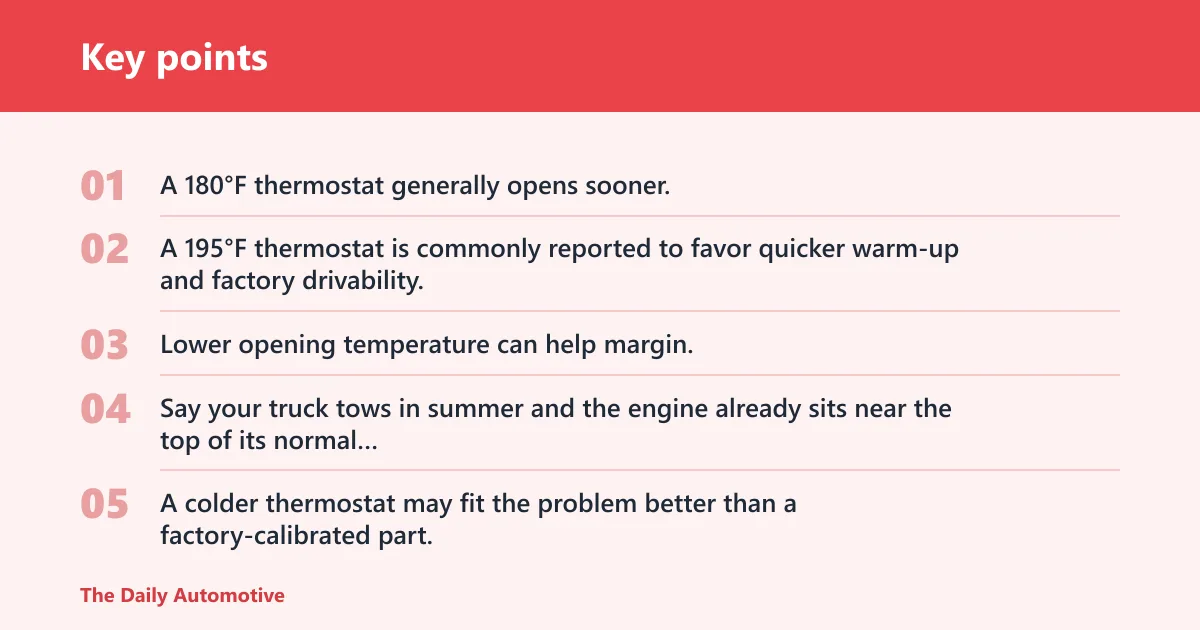
A 180°F thermostat generally opens sooner, which can help coolant circulate earlier under load and may provide more thermal headroom in some hot-running setups. A 195°F thermostat is commonly reported to favor quicker warm-up and factory drivability, especially in colder weather.
The trade-off is simple. Lower opening temperature can help margin, but it can also delay the engine reaching its intended operating temperature if the cooling system and calibration were designed around a hotter thermostat.
Say your truck tows in summer and the engine already sits near the top of its normal range on long grades. A colder thermostat may fit the problem better than a factory-calibrated part, but only if the cooling system itself is healthy.
When OE temperature is the safer call
OE temperature is usually the safer choice for a daily driver, especially when the vehicle still has the original cooling strategy, heater performance matters, or the engine management expects a certain warm-up curve. That is where OE-spec and OE-type thermostats earn their keep.
Gates is a good example of this fit-first approach. The brand’s OE-type and premium thermostat lines are aimed at direct replacement buyers who want factory-style fit confidence rather than a temperature experiment.
Hot climate, towing, and short-trip use
Hot climate and towing can justify a lower opening temperature if the vehicle is specified for it or the cooling system runs close to its limit. Short-trip commuting in winter points the other way, because a thermostat that opens too early can slow cabin heat and engine warm-up.
A common first-timer mistake is blaming the thermostat for every temperature spike. Low coolant, a weak radiator cap, a stuck fan, or bad sensor data can all produce the same dashboard warning.
Gates: best for OE-style replacement
Gates fits the buyer who wants a familiar aftermarket name and a direct-replacement path. Based on published product details and buyer feedback, its OE-type thermostat approach suits stock engines where the original opening temperature and fit style matter more than special performance claims.
The strongest case for Gates is confidence in factory-style replacement work. The downside is that a direct-fit thermostat assembly does not solve a warped housing or a bad coolant passage on its own, and you still need to match the exact engine and seal layout.
TheBatteryTips lists Gates 33009S and Gates 33008S as premium engine coolant thermostats, at 12.46 USD and 13.01 USD. That puts Gates in the middle of the pack on price for buyers comparing brand-name replacements.
MotoRad: best for fail-safe protection
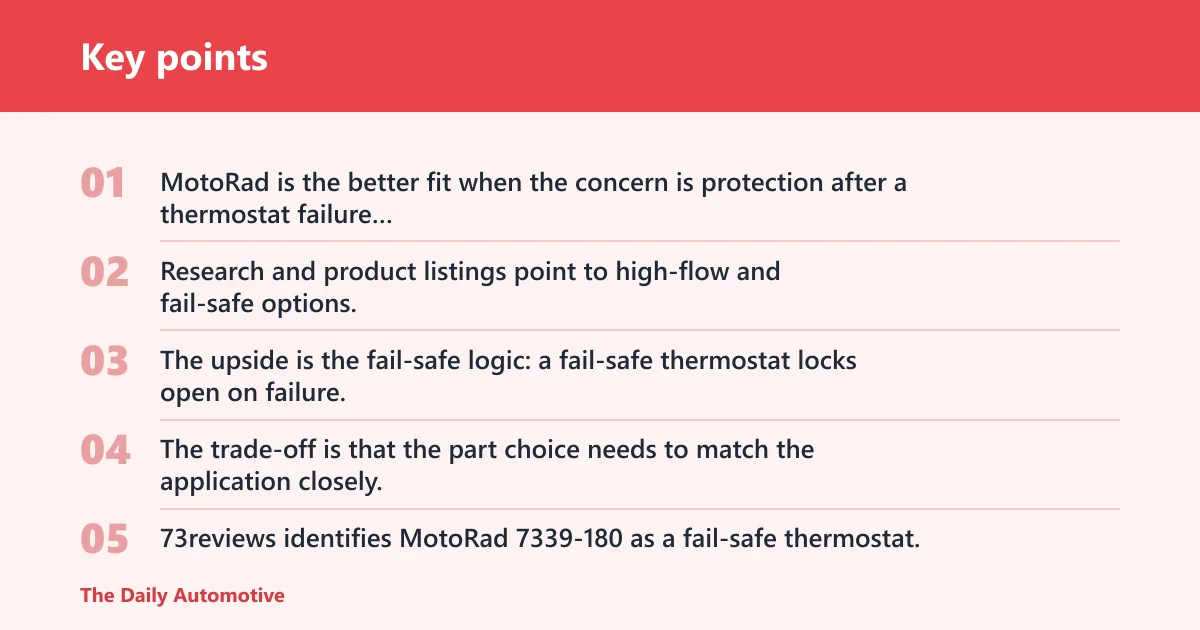
MotoRad is the better fit when the concern is protection after a thermostat failure rather than plain OE substitution. Research and product listings point to high-flow and fail-safe options, which matters on engines that run hot or see heavier load, including some V8 applications.
The upside is the fail-safe logic: a fail-safe thermostat locks open on failure, which can reduce the chance of a sudden overheat event. The trade-off is that the part choice needs to match the application closely, because a performance-oriented opening point is not right for every commuter car.
73reviews identifies MotoRad 7339-180 as a fail-safe thermostat, and MotoRad 2065-195 as a 195-degree high-flow thermostat. MotoRad 2000-195 is also positioned as a high-performance thermostat for Jeep, Ford, and Dodge applications, which helps explain its domestic-application focus.
AISIN: best for import fitment
AISIN is the strongest pick when you want an import-focused OE-style replacement with the gasket included. Its thermostat and housing assembly format is useful when the failed part is not just the valve, but the housing or seal surface around it.
The main advantage is fit confidence. Product details for AISIN THF-003 describe it as including a gasket and compatible with select Subaru and Saab models, which makes it a practical choice for owners who want the part to mirror OE expectations.
The drawback is the same one that comes with most housing assemblies: you may pay more for parts than a standalone thermostat, even when the thermostat itself is the only failed component.
Which one should you buy?
Choose the part that matches the failure mode first, then the temperature rating. If the old thermostat was in a healthy housing and the engine wants factory calibration, a direct-fit OE-type unit is the safest choice; if the housing is warped or leaking, buy the assembly instead.
For a direct replacement, Gates is the cleanest fit when you want OE-style replacement confidence and a known aftermarket brand. For hot-running engines or towing, MotoRad is the better match when you want fail-safe behavior or a high-flow option. For import applications with a leaking seal or brittle plastic housing, AISIN is the better buy because the gasket and housing approach addresses the real failure point.
If your car uses a thermostat housing assembly from the factory, do not force a standalone thermostat into a housing that is cracked, warped, or missing the right seal geometry. Suppose a Camry develops a coolant seep near the housing seam after years of heat cycling; replacing only the valve can leave the leak untouched.
When the model and engine family are unusual, OE part numbers matter more than the catalog title. Read the stamped or listed OEM number, check supersessions, and confirm whether the part is for the exact engine code, not just the same badge and model year.
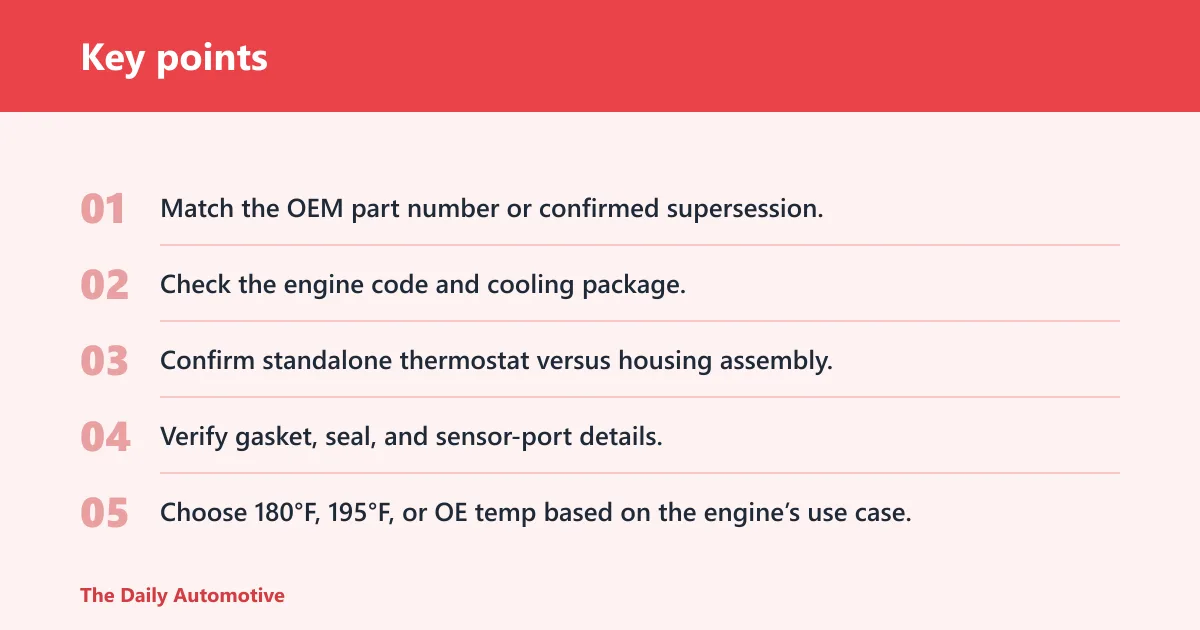
- Match the OEM part number or confirmed supersession.
- Check the engine code and cooling package.
- Confirm standalone thermostat versus housing assembly.
- Verify gasket, seal, and sensor-port details.
- Choose 180°F, 195°F, or OE temp based on the engine’s use case.
Frequently asked questions
What is the best thermostat for a car?
The best thermostat is the OE-temperature unit that matches your engine, housing style, and seal layout. For most replacements, that means a direct-fit OE-spec or OE-type part, unless you have a reason to choose a lower or higher opening temperature for towing, climate, or calibration.
How do I choose the right thermostat for my car?
Start with the OEM part number, then check the engine code, housing style, gasket shape, and any supersessions from the manufacturer. After that, choose the opening temperature that matches how the vehicle is used. That order matters more than choosing by brand first.
What is the difference between a 180 and 195 degree thermostat?
A 180°F thermostat opens sooner and can leave more cooling margin in some heavy-load situations. A 195°F thermostat usually supports faster warm-up and closer factory behavior. Neither is automatically better; the right choice depends on the engine’s original calibration and use case.
Should I choose a thermostat or a thermostat housing assembly?
Choose the housing assembly when the housing is warped, cracked, or leaking, or when the thermostat and housing are sold as one OE-style unit. Choose a standalone thermostat only if the housing is in good condition and the failure is clearly the valve, not the seal or plastic body.
How do I know if my thermostat fits my vehicle?
Check the OEM part number, engine code, and housing style first. Then confirm gasket inclusion, sensor ports, and any supersessions. “Fits the model” is not enough; the same model can use different thermostats across engines, trims, and cooling packages.
What are the signs a car thermostat is failing?
Common signs include overheating, long warm-up times, weak cabin heat, and temperature swings that do not make sense. But those symptoms can also come from low coolant, radiator problems, stuck fans, or faulty sensor data, so confirm the rest of the cooling system before replacing the thermostat.
Products related to this article
Sponsored / affiliate links. As an Amazon Associate I earn from qualifying purchases. I may earn additional commission from eligible campaigns.