5 Best Car Audio Systems for Sound Quality (2026): We Compared
The best car audio system for sound quality starts with the weakest link in the signal chain, usually source quality, tuning control, front speakers, and clean amplification before bass or convenience features. Skip that order and you often pay for louder sound, not clearer sound. This guide ranks the upgrade path, explains what each part changes, and shows where fidelity gains actually come from.
Quick comparison
| Product | Badge | Best for | Price | ||
|---|---|---|---|---|---|
 |
RECOIL REM65 Echo Series 6.5-Inch Car Audio ComponentRECOIL | Our pick | 6.5-inch · component · speaker system | $46.99
Price as of 30 Oct 2026
|
View |
 |
Alpine R-A90S R-Series 6/5/4/3 Channel Power Amplifier withAlpine | Upgrade pick | 6-channel · car amplifier · staggered power | $699.95
Price as of 30 Oct 2026
|
View |
 |
Sony XAV-AX3200 7-Inch Multimedia Receiver with AppleSony | Also great | 7-inch · multimedia receiver · CarPlay/Android Auto | $298.00
Price as of 30 Oct 2026
|
View |
 |
AudioControl DM-810 8×10 Channel Matrix DSP Car AudioAudioControl | Also great | 8×10 · matrix DSP · car audio processor | $699.00
Price as of 30 Oct 2026
|
View |
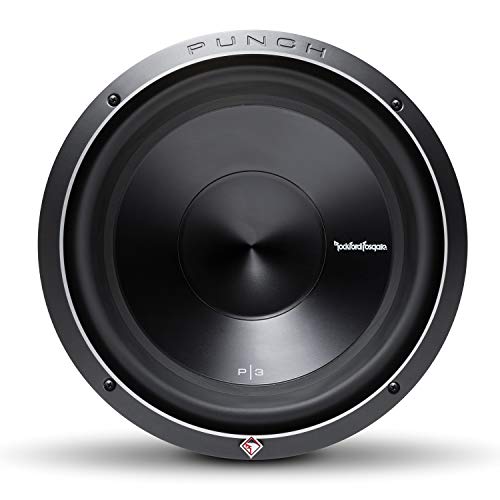 |
Rockford Fosgate P3D4-12 Punch P3 DVC 4-Ohm 12-InchRockford Fosgate | Pair with it | 12-inch · 4-ohm · DVC subwoofer | $259.99
Price as of 30 Oct 2026
|
View |
Use the comparison table to match your current setup to the next upgrade most likely to improve clarity. Convenience features matter, but they do not automatically improve fidelity.
How we chose
Selections here are based on manufacturer specs, listing details, and published buyer feedback. That keeps the focus on fit, signal control, and the parts that can actually change sound quality in a car cabin.
We also separated source features from audio performance, because CarPlay, Android Auto, and a larger screen are useful, but they are not the same thing as better sound. When specs were given, those details are used exactly as listed.
The list favors upgrade paths that solve common problems: muddy bass, harsh treble, road-noise masking, and weak amp-speaker matching. Installation complexity and dash compatibility also matter, because a great part that does not fit cleanly is a bad buy.
Head unit: best for source quality
A head unit changes sound quality most when your current source is weak, noisy, or short on EQ control. Single-DIN and double-DIN fit both matter, but so do FLAC playback, wired versus wireless connectivity, and whether you get 10-band or 13-band EQ control for final tuning.
Single-DIN units fit many older dashboards more easily, while double-DIN units usually give you a larger screen and a better interface. The screen size itself does not improve fidelity, but better access to EQ, balance, and fader settings can make setup much easier.
Wireless Apple CarPlay and Android Auto help convenience. Wired connections are still useful when you want the most stable phone link and the least chance of dropouts. If the goal is sound quality, look first for clean signal output, FLAC support, and enough EQ control to tune the cabin.
Why source quality matters first
Source quality sets the floor for everything downstream. If the head unit adds noise, limits EQ control, or forces awkward tuning, speakers and amplifiers can only do so much.
Music spans roughly 20 to 20,000 Hertz, so a system that gives you control across that range is easier to balance. CNET recommends keeping equalization flat for accurate sound, which is a useful starting point before you adjust bass, midrange, or treble.
DSP: best for tuning control
A DSP matters when your system needs time correction, crossover control, and multi-channel tuning that a basic stereo cannot provide. For sound quality, this is one of the biggest step-up parts because it shapes how the speaker system behaves in the cabin.
High-resolution processing also matters for modern builds. The Alpine PXE-C80-88 OPTIM8 is listed as a high-resolution DSP with 96kHz/24Bit processing, and the Alpine HDA-V90 supports high-resolution 192kHz/24Bit playback. Those are the kinds of details that matter when the rest of the chain is already solid.
Use DSP when the sound stage leans to one side, vocals sit in one door, or the factory system has built-in correction you need to bypass or refine. It is not a cure for bad speakers, but it can rescue a system that already has good hardware and poor integration.
What DSP changes in the car
Time correction helps align sound from left and right speakers so vocals do not pull to one side. Crossover control keeps bass out of small speakers and keeps upper frequencies away from the subwoofer.
Multi-channel tuning is especially useful in factory premium systems, where speaker placement and factory amp logic can be difficult to work around. If you are keeping OEM controls, a DSP can often do more for clarity than a simple head-unit swap.
Amplifier: best for clean power
An amplifier helps when speakers need cleaner power than the factory unit can provide, or when a subwoofer needs controlled output. For fidelity, the goal is not maximum volume. It is clean power that keeps speakers from strain and distortion.
Five-channel amps are common when you want front, rear, and sub duties in one unit. Multi-channel amps give more flexibility for front-stage builds and higher-control systems. The Alpine R-A90S is a 6-channel model with staggered power, which suits more complex layouts and a 3-way front stage.
Installation complexity rises with power demand, wiring load, and integration needs. Speaker-level turn-on can simplify some installs, but the wiring still has to be done correctly and matched to the rest of the system.
How amplifier choice affects sound
RMS power matching matters more than peak claims. If the amp cannot supply clean power where the speakers need it, you get harshness at higher volume and weak control in the bass.
A subwoofer and speaker array should be matched to the amp, not chosen separately. The wrong pairing can sound thin, boomy, or strained long before it reaches full volume.
Component speakers: best for front-stage clarity
Component speakers are the first speaker upgrade to consider when you want better detail in vocals and instruments. Separating the tweeter and midrange lets you place higher frequencies better and often reduces the smeared sound you hear from basic full-range door speakers.
The RECOIL REM65 Echo Series 6.5-Inch Car Audio Component Speaker System uses silk tweeters to keep highs smooth, with triple-level tweeter adjustment for placement. Focal’s ES 165 K2E is described with advanced aramid fiber cones, a material choice aimed at controlled, clear response.
Look at sensitivity, power handling, and the amp behind them. A speaker that looks good on paper can still sound weak if the amplifier cannot drive it properly. Beryllium tweeters, aramid fiber cones, and similar materials are about control and response, not decoration.
What to watch for with component sets
High sensitivity helps when the amplifier is modest. Lower sensitivity usually asks for more clean power to reach the same output without strain.
If the front stage is the priority, start here before adding a sub. A well-set front stage can sound more accurate than a bigger system with poor speaker placement and bad tuning.
What matters most for sound quality?
The most important part is fixing the weakest link in order: source, tuning, front speakers, amplifier, then bass. A subwoofer can add extension, but it will not fix muddy bass from bad crossovers or harsh treble from poor EQ.
Flat EQ should be the starting point, not the endpoint. From there, use bass, midrange, treble, balance, and fader to correct the cabin, then fine-tune with crossover settings and time alignment if your gear supports them.
Road noise and cabin size change what you hear more than many buyers expect. A compact cabin may need less bass boost, while a larger cabin can hide detail unless the front stage is set up carefully. Say your car has a loud tire hum at highway speed; boosting treble will not fix the masking, but better speaker placement and cleaner mids can help vocals stay present.
Is a premium factory audio system worth it?
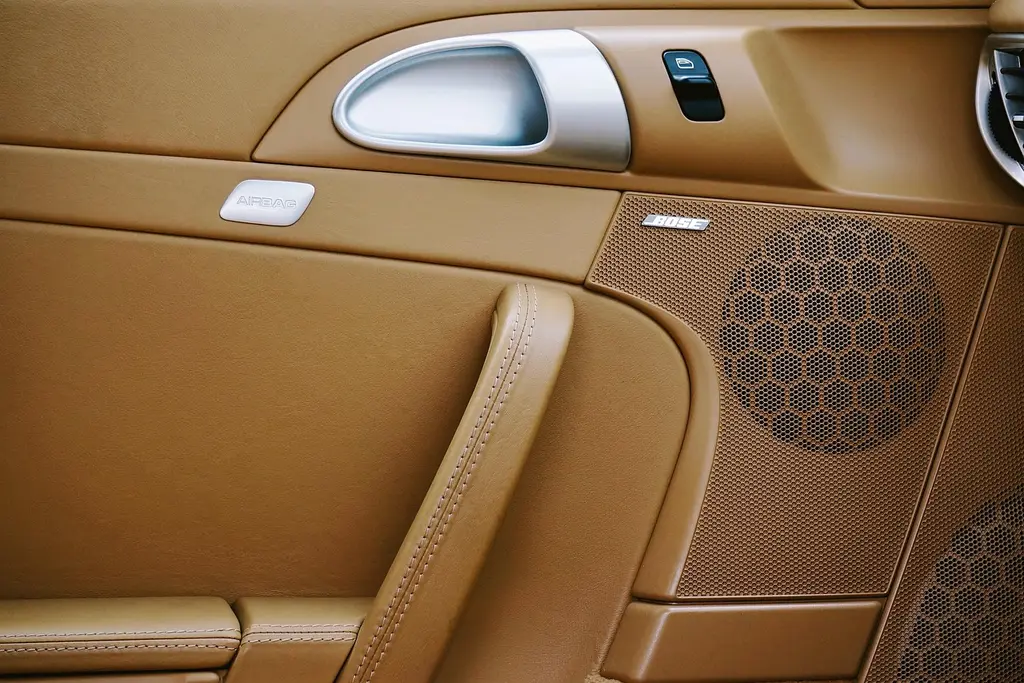
A premium factory audio system can be worth it when you want OEM-branded speakers, vehicle-specific tuning, and tight dash and control integration without redesigning the cabin. It is often the easiest way to get better sound in a new vehicle, especially if the factory system already includes more speakers and dedicated amplification.
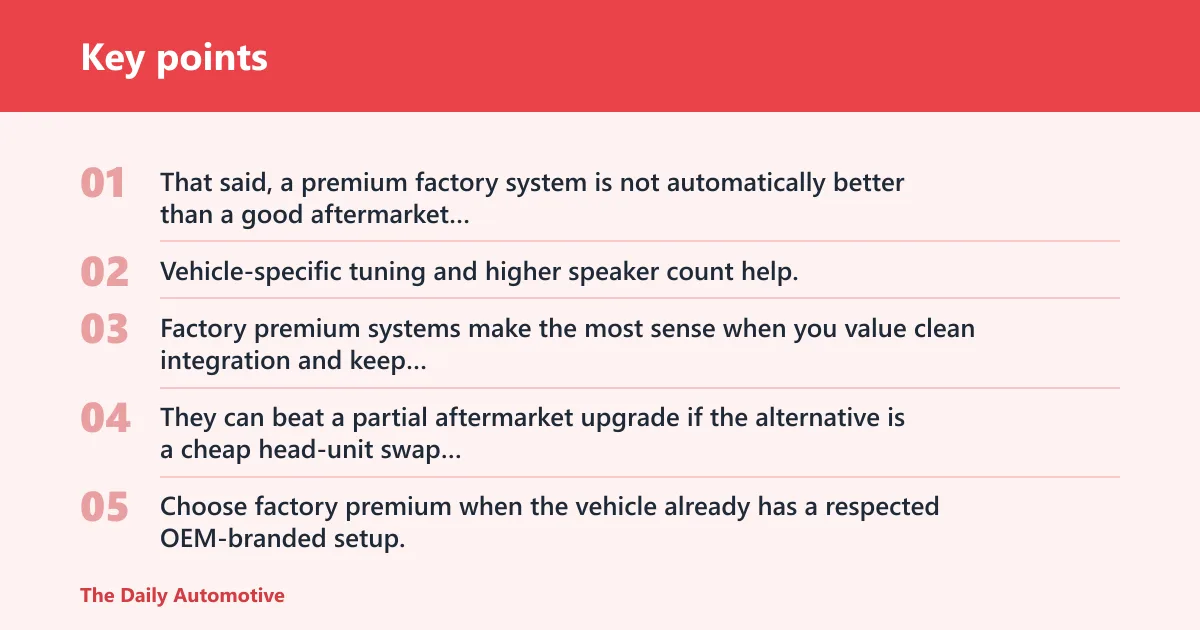
That said, a premium factory system is not automatically better than a good aftermarket chain. Vehicle-specific tuning and higher speaker count help, but some factory systems still sacrifice upgrade freedom and may limit how far you can tune the system later.
Factory premium systems make the most sense when you value clean integration and keep the vehicle close to stock. They can beat a partial aftermarket upgrade if the alternative is a cheap head-unit swap with no DSP and weak speaker matching.
When factory premium makes sense
Choose factory premium when the vehicle already has a respected OEM-branded setup, the dash integration matters, and you do not want to rework wiring or controls. If the system includes dedicated speakers, known wattage, and tuned amplification, it may be the most balanced path for that vehicle.
Suppose you drive a quiet sedan with a well-designed premium package. In that case, the gain from replacing only the head unit may be smaller than expected, because the factory amp and speaker tuning already do the hard work.
Car audio upgrade matrix
This matrix shows the best next move from six common starting points. It separates likely sound gain from fit risk and install complexity, so you can spend on the part of the chain that matters most first.
| Starting point | Best next upgrade | Expected sound-quality gain | Fit risk | Install complexity |
|---|---|---|---|---|
| Factory radio with weak EQ and basic speakers | Head unit with better EQ and FLAC support | Moderate | Medium | Medium |
| Factory premium audio with locked tuning | DSP with time correction and crossover control | High | Medium | High |
| New head unit, stock speakers | Front component speakers | High | Low to medium | Medium |
| Good front speakers, weak factory power | Amplifier matched to speaker load | Moderate to high | Medium | High |
| Clear mids but thin bottom end | Subwoofer with matched amp | Moderate | Medium to high | Medium to high |
| Already upgraded speakers and amp, but poor staging | DSP tuning and time alignment | High | Low | High |
The table is intentionally system-first, not product-first. A person chasing more bass may need a DSP and crossover fix before another subwoofer ever helps.
Tuning checklist
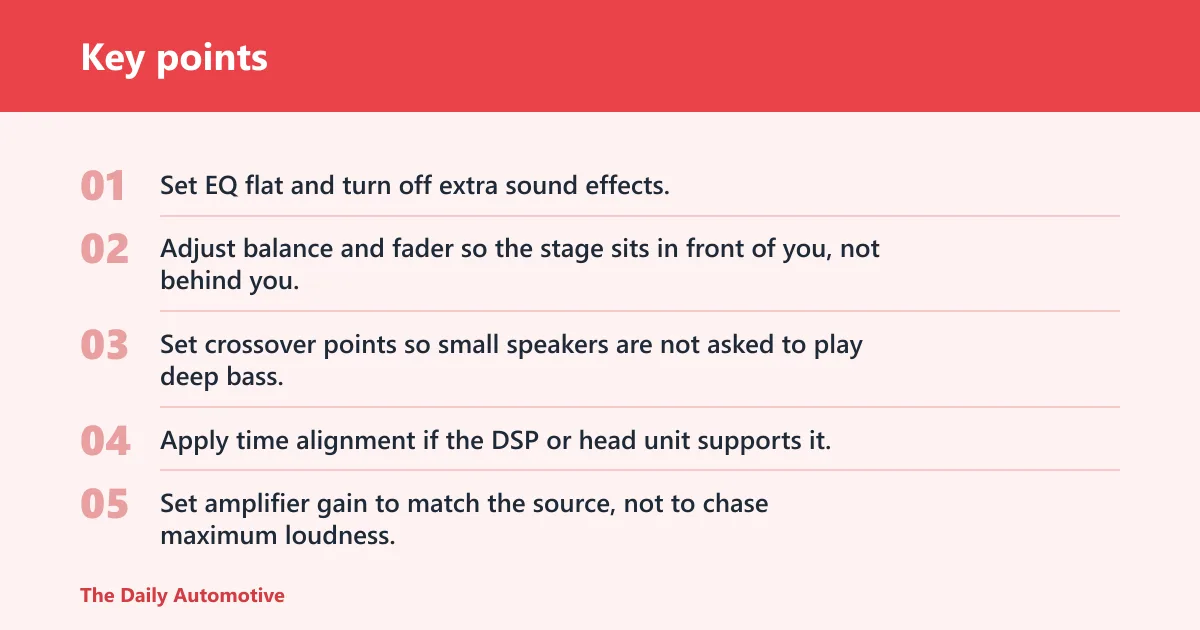
- Set EQ flat and turn off extra sound effects.
- Adjust balance and fader so the stage sits in front of you, not behind you.
- Set crossover points so small speakers are not asked to play deep bass.
- Apply time alignment if the DSP or head unit supports it.
- Set amplifier gain to match the source, not to chase maximum loudness.
- Recheck bass, midrange, and treble after a real drive, because road noise changes the result.
RECOIL REM65 Echo Series 6.5-Inch Car Audio Component Speaker System: best for front-stage clarity
This is a good fit when you want smoother highs and a cleaner front stage without moving into a full-system rebuild. The silk tweeters, triple-level tweeter adjustment, and ferrite motor point to a speaker set designed to help placement and keep the top end controlled.
The main drawback is that component speakers do not solve source problems by themselves. If the head unit or amp is weak, the result can still sound flat or strained, so check the amp match and the vehicle mounting depth for your model.
Alpine R-A90S R-Series 6/5/4/3 Channel Power Amplifier with staggered power: best for clean power
This amplifier suits a more serious upgrade path where the front stage, rear fill, and subwoofer all need clean power. Its 6-channel layout and staggered power make it useful for flexible system designs, including a 3-way front stage.
The drawback is installation complexity. More channels mean more wiring, more planning, and more chances to mismatch the amp if the rest of the system is not already sorted.
Sony XAV-AX3200 7-Inch Multimedia Receiver with Apple CarPlay/Android Auto: best for source quality
This is a practical source upgrade when you want CarPlay, Android Auto, backup camera input, and easier installation from a compact rear chassis. It also gives you 10-band EQ control, which is enough for basic tuning in many systems.
The drawback is that multimedia convenience does not equal the best possible audio path. If you need deeper tuning control, a dedicated DSP or a more advanced source unit may be a better fit for sound quality.
AudioControl DM-810 8×10 Channel Matrix DSP Car Audio Processor: best for tuning control
This is for the build that already has good hardware and needs real system correction. The 30-band EQ, AccuBass, and RTA support are aimed at precise tuning and integration with OEM or aftermarket setups.
The drawback is cost and complexity. A DSP this capable is only useful if you are ready to tune it carefully, and that takes more time than a simple speaker swap.
Rockford Fosgate P3D4-12 Punch P3 DVC 4-Ohm 12-Inch 600-Watt RMS 1200-Watt Peak Subwoofer: best for bass extension
This is a bass-focused upgrade when the system already has clarity up top but lacks low-end weight. The dual voice coils add wiring flexibility, and the vented motor design is aimed at cooling for subwoofer duty.
The drawback is obvious: a 12-inch sub takes space. Enclosure size can cut into trunk or cargo room, so check the vehicle fit and decide whether the bass gain is worth the tradeoff.
Which one should you buy?
Start with the part that solves the current problem. If the system sounds thin and muddy at once, the right answer is often a front-stage speaker upgrade plus tuning, not a bigger subwoofer. If the sound is already decent but poorly staged, a DSP usually gives the most meaningful improvement.
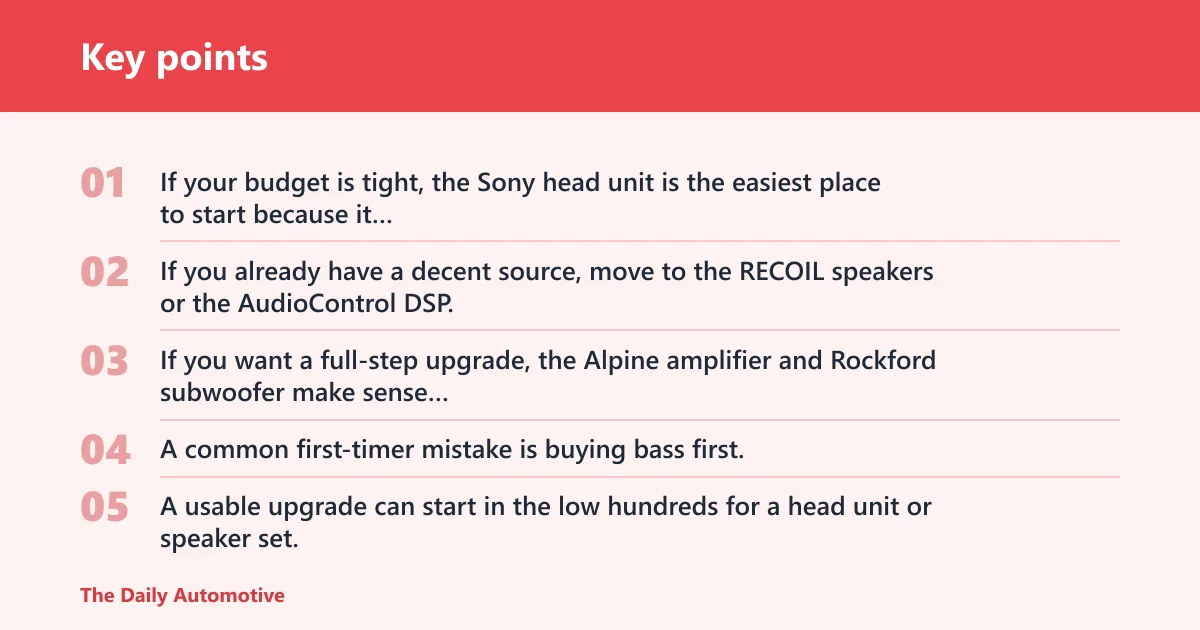
If your budget is tight, the Sony head unit is the easiest place to start because it brings modern connectivity and usable EQ control. If you already have a decent source, move to the RECOIL speakers or the AudioControl DSP, depending on whether your bigger issue is front-stage clarity or tuning control.
If you want a full-step upgrade, the Alpine amplifier and Rockford subwoofer make sense only after the front stage and source are in order. A common first-timer mistake is buying bass first, then discovering the mids are still buried and the whole system is harder to tune around the new low end.
How much does a good car audio system cost? A usable upgrade can start in the low hundreds for a head unit or speaker set, but a more complete chain with DSP, amp, speakers, and subwoofer will cost much more. Installation hardware and professional labor can add a noticeable amount, especially for dash work and steering-wheel controls.
What do you need for a good car sound system? At minimum, you need the right source, a front stage that matches the amp, and enough tuning control to correct the cabin. For many vehicles, that also means a dash kit, wiring kit, backup camera support, and a steering wheel control module.
Which car stereo gives the best sound quality? The one that fits your dash, supports the input path you need, and offers enough EQ and signal control for the rest of your system. Wireless Apple CarPlay and Android Auto are helpful, but FLAC playback, clean output, and solid tuning control matter more for audio.
Is a premium factory audio system worth it? Yes, if it is well tuned for the vehicle and you want simple integration with factory controls. No, if you plan to keep upgrading and need full control over the signal chain, because some factory systems are harder to work around than a clean aftermarket path.
Which vehicles have the best sound systems? The best factory sound systems are usually the ones with dedicated OEM tuning, more speakers, and stronger integration with the cabin. The specific answer depends on the vehicle package, not the badge alone, so check the exact trim and audio option before you buy.
Frequently asked questions
What is the best audio system for car?
The best system is the one that corrects the weakest link first: source, then tuning, then front speakers, then clean amplification, then subwoofer support. For most drivers, that means a well-fit head unit or DSP, followed by front components and proper tuning, rather than a bass-first build.
What is the best sound system for cars?
The best sound system for cars is not one single product. It is a balanced chain with a clean source, good front speakers, enough amplifier power, and tuning control. A premium factory system can be strong, but a carefully matched aftermarket setup often gives better control.
What are the best sound quality speakers?
For sound quality, component speakers are usually the first choice because they separate tweeter and midrange duties. Look for good sensitivity, sensible power handling, and materials that support controlled response, such as aramid fiber cones or silk tweeters, then match them to the amplifier.
How much does a good car audio system cost?
Cost depends on the path you take. A head unit or speaker upgrade can be relatively modest, while a system with DSP, amplifier, speakers, subwoofer, and installation hardware costs much more. Professional installation adds to the total, especially on vehicles with complex dash integration.
What do I need for a good car sound system?
You need a source with usable tuning control, speakers that suit the cabin, and amplification that matches the load. If you are replacing factory gear, you may also need a dash kit, wiring kit, steering wheel control module, and backup camera support for proper fit and function.
Which car stereo gives the best sound quality?
The best choice is the stereo that gives you the right fit and the right controls. CarPlay and Android Auto help with convenience, but sound quality comes from clean signal path, FLAC playback, and EQ depth. A 10-band or 13-band EQ is more useful than screen size alone.
Products related to this article
Sponsored / affiliate links. As an Amazon Associate I earn from qualifying purchases. I may earn additional commission from eligible campaigns.