Tow Truck Cost: How Much Does Towing Cost, Exactly?
A typical tow truck service call often costs about $75 to $150 for the hookup, plus roughly $2 to $4 per mile. After-hours service, winching, storage, or a flatbed for an AWD car can raise the bill fast. A wrong tow method can damage the vehicle, break roadside rules, or force extra recovery work. This guide breaks down towing prices, the factors that change them, and how to get a defensible quote before you call.
This guide is part of our Car laws and compliance guide series.
Tow truck cost at a glance
For a short private-caller tow, a common bill lands in the low hundreds. Final price still depends on distance, vehicle type, and whether the truck needs a flatbed or recovery gear. Hookup fees usually start before mileage, and heavy or hard-to-reach vehicles move the quote up quickly.
Typical price range for a short tow
For local work, Georgia local tows usually cost $75 to $250. BNT says a local tow covering 0–10 miles runs $75–$125, while TowingCosts.com puts a local tow at about $84 to $150. TowWithTheFlow says short local tows cost $75 to $150 without insurance.
What usually makes the bill rise first
The first jump is usually the tow hookup fee, sometimes called a dispatch fee or drop fee, followed by per-mile pricing. The same source lists a hookup fee of $50–$75 plus $2–$5 per mile. The same source says longer hauls add $3 to $7 per mile, and after-hours or flatbed service can push the bill toward $250 to $400+.
What drives towing charges?
Distance usually drives the total first, but it is not the whole bill. Tow companies also price the hookup, the vehicle’s weight and clearance, the recovery risk, and the time of day. A quote that skips one of those items can look cheaper than it is.
Hookup fee and per-mile rate
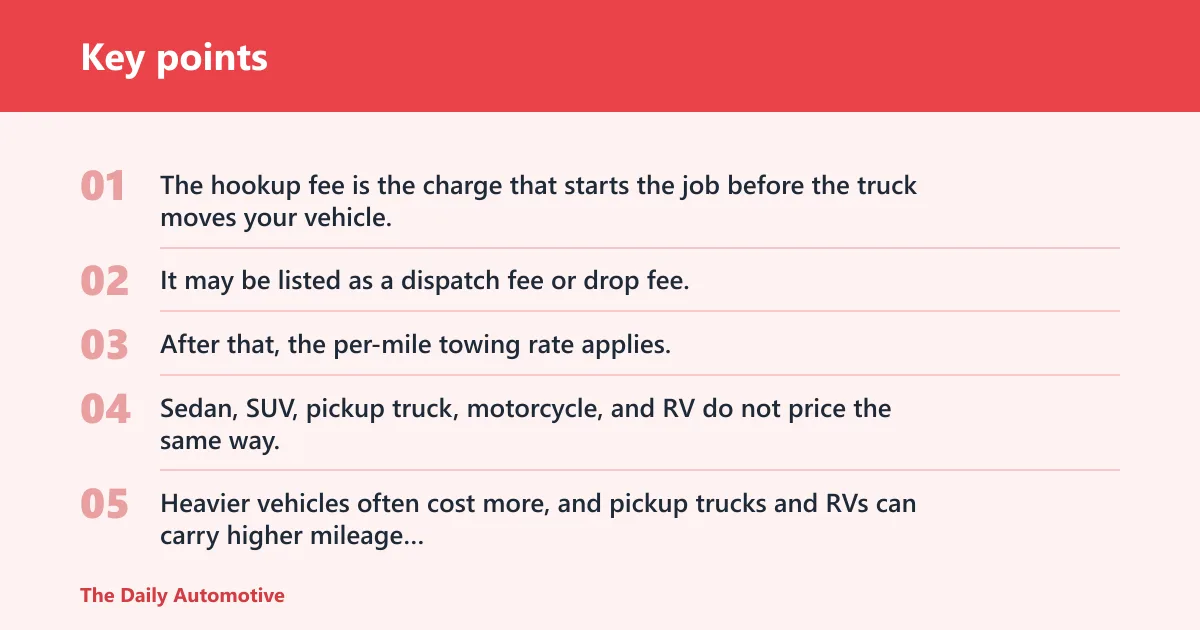
The hookup fee is the charge that starts the job before the truck moves your vehicle. It may be listed as a dispatch fee or drop fee. After that, the per-mile towing rate applies, and it usually rises with distance because the operator is tying up time, fuel, and equipment longer.
Vehicle type, weight, and access
Sedan, SUV, pickup truck, motorcycle, and RV do not price the same way. Heavier vehicles often cost more, and pickup trucks and RVs can carry higher mileage rates. A car that sits low, is hard to reach, or cannot roll freely may also need more labor.
Say your sedan breaks down on a surface street two miles from the shop. If the car rolls and the keys are available, a wheel-lift tow may be enough. Suppose the same car sits in a sloped driveway with a broken control arm. The crew may need extra rigging or a flatbed, which changes the quote.
After-hours and holiday premiums
Night, weekend, and holiday calls often add a surcharge. That surcharge can be a fixed add-on or a percentage-based charge, so the same tow can cost more simply because the call comes after business hours. Ask whether the quoted rate already includes the time-of-day fee.
Wheel-lift vs flatbed costs
A wheel-lift tow is usually the lower-cost modern option, while a flatbed usually costs more because it takes more equipment and loading time. The cheapest tow is not always the correct tow. AWD, low-clearance, luxury, damaged, and some EV vehicles often need the safer choice.
When a wheel-lift tow is the lower-cost option
Wheel-lift towing is common for standard front- or rear-wheel lifts and is often the least expensive way to move a straightforward roadside breakdown. It works best when the vehicle can roll normally, has no drivetrain restrictions, and can be loaded without scraping the body or driveline.
When a flatbed is safer or required
Flatbed towing is often the right call for AWD vehicles, low sports cars, luxury cars, damaged cars, and some EVs. If the drivetrain should not roll with two wheels on the ground, or the front splitter sits too low, the flatbed is the cleaner choice even if it costs more.
Why AWD, low-clearance, and damaged vehicles often change the quote
AWD sedans and many crossovers can be damaged by the wrong tow method. Low-clearance cars can scrape entering a standard tow setup. A damaged suspension, locked wheel, or crash-twisted body can force the operator into recovery work or a flatbed, both of which add time and cost.
Tow cost decision table
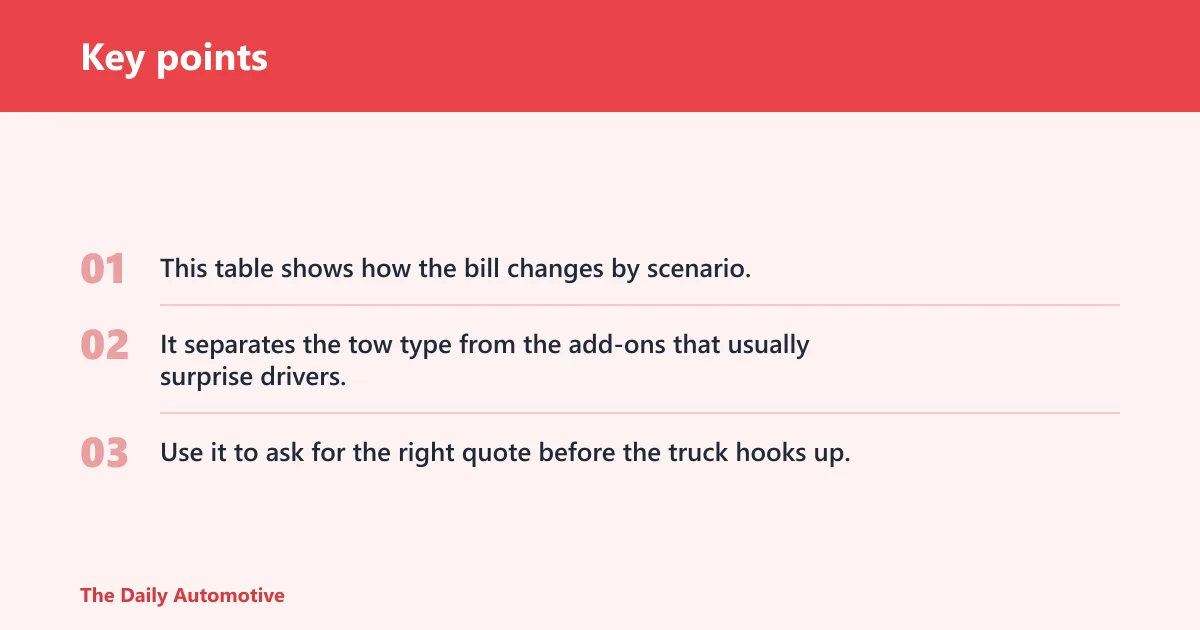
This table shows how the bill changes by scenario. It separates the tow type from the add-ons that usually surprise drivers. Use it to ask for the right quote before the truck hooks up.
| Scenario | Recommended tow type | Likely surcharge triggers | Hidden add-ons | What to ask before authorizing service |
|---|---|---|---|---|
| Short roadside breakdown | Wheel-lift | Hookup fee, mileage minimum | Gate fee, key return fee | Does the quote include the hookup, miles, and any minimum charge? |
| Interstate shoulder | Wheel-lift or flatbed | Highway access, safety escort, after-hours call | Traffic-control fee, storage if delay occurs | Is this a private-call tow or a highway-contracted dispatch, and what are the roadside rules? |
| AWD sedan | Flatbed | Drivetrain protection, loading time | Low-clearance ramping, dollies | Will all four wheels stay off the ground? |
| Lowered sports car | Flatbed | Scrape risk, extra loading labor | Soft straps, ramp boards | How will you load it without touching the splitter or exhaust? |
| Pickup truck | Heavy-duty wheel-lift or flatbed | Higher weight, stronger truck class | Extra axle handling, longer hookup time | What is the towing class and how does truck weight change the rate? |
| Motorcycle | Motorcycle carrier or flatbed | Special tie-down gear, balancing labor | Cradle, straps, small-load minimum | Is motorcycle tie-down included, or is that billed separately? |
| Ditch recovery | Winch-out plus tow | Mud, snow, steep angle, recovery labor | Stuck time, extra operator, cleanup | Does the quote cover winching and the tow, or only the pull-out? |
| After-hours call | Wheel-lift or flatbed | Night, weekend, holiday premium | Immediate response fee | Is the surcharge fixed or percentage-based, and does it apply to the whole bill? |
| Impound pickup | Any required release tow | Police hold, lot access rules, admin fees | Release fee, gate fee, paperwork fee | What is owed for release before the vehicle leaves the lot? |
| 25-mile shop tow | Wheel-lift or flatbed | Mid-range mileage pricing | Fuel surcharge, tolls | What is the per-mile rate after the hookup fee? |
| 100+ mile move | Flatbed or carrier quote | Long-distance mileage, driver time | Return trip, layover, tolls | At what distance does this stop being a tow and become a transport quote? |
| Unpaid storage | Impound lot hold | Daily lot charge, admin fee, release delay | Storage, paperwork, tow-out fee | What is the daily storage rate, and what must be paid before release? |
How much does towing a truck cost?
Pickup trucks and heavier vehicles often cost more because they need more towing capacity, more secure loading, and sometimes a different truck class. Motorcycles are different again, while SUVs and RVs can raise both the hookup fee and the per-mile rate. Long-distance moves can stop looking like a normal tow and start looking like transport.
Pickup trucks and heavier vehicles
For a pickup truck, expect the quote to move above the sedan baseline. Heavier vehicles can need a stronger wrecker or flatbed, and that usually raises both the base fee and the mileage charge. If the truck is 4WD, damaged, or loaded, the quote can climb again.
Motorcycles, SUVs, and RVs
Motorcycles often need special tie-down equipment, which is why a basic roadside rate may not apply. SUVs can fall between a sedan and a pickup on price, depending on weight and clearance. RV towing can be far more expensive because the equipment class is different and the vehicle is much heavier.
When long-distance moves stop being a normal tow
The same source lists long-distance tows at $185–$400+ for 30–100 miles, and TowWithTheFlow says longer hauls add $3 to $7 per mile. For 100+ miles, ask whether a carrier or shipping quote is cheaper. At that point, the math can favor transport over a standard tow bill.
Can insurance or roadside help pay less?
Insurance and roadside assistance can cut your out-of-pocket cost, but coverage is not unlimited. Some plans cap the tow distance, cap the dollar amount, or require you to use a specific network. For one tow, membership can be cheaper than paying cash, but only if the service fits the plan rules.
Roadside assistance limits and tow caps
Check whether the plan covers local towing only, whether it has a per-call limit, and whether a flatbed is included. A plan that pays for 5 or 10 miles may not help much on a 25-mile shop tow. If the truck is after-hours or a flatbed is required, ask whether the plan still applies.
Insurance claim basics for towing
Some policies reimburse towing after a covered loss, while others route the job through a network. That can change the price you pay up front and the amount later reimbursed. If the car is in an impound lot or requires storage, ask whether the policy pays only the tow or also release charges.
When paying out of pocket may be simpler
If the tow is short, private, and simple, paying cash can be easier than opening a claim. That is especially true when the claim would be small and the waiting time would be longer than the tow itself. For repeated use, though, roadside membership can pay for itself after a single call.
Storage and impound fees
Storage is where towing bills get expensive fast. Once the vehicle sits in a lot, daily charges can stack up, and impound releases can add admin and gate fees on top of the tow. In those cases, the tow is only part of the total you owe.
Daily storage charges
Storage fees are daily lot charges that continue until the vehicle leaves. If the car was impounded or left unpaid, each extra day can add a new charge. Ask for the daily rate and whether weekends or holidays count the same way as business days.
Release, admin, and gate fees
Impound pickup often includes a release fee, paperwork charge, and sometimes a gate fee. Those costs can be separate from the towing fee itself. Before you send someone to the lot, ask what must be paid, what ID or title paperwork is needed, and whether cash or card is accepted.
Why unpaid towing bills get expensive fast
Once a vehicle is in storage, the bill can grow even if the truck never moves again. If the owner waits, the eventual charge may include towing, release, storage, and administration. A quick pickup is usually cheaper than letting the vehicle sit.
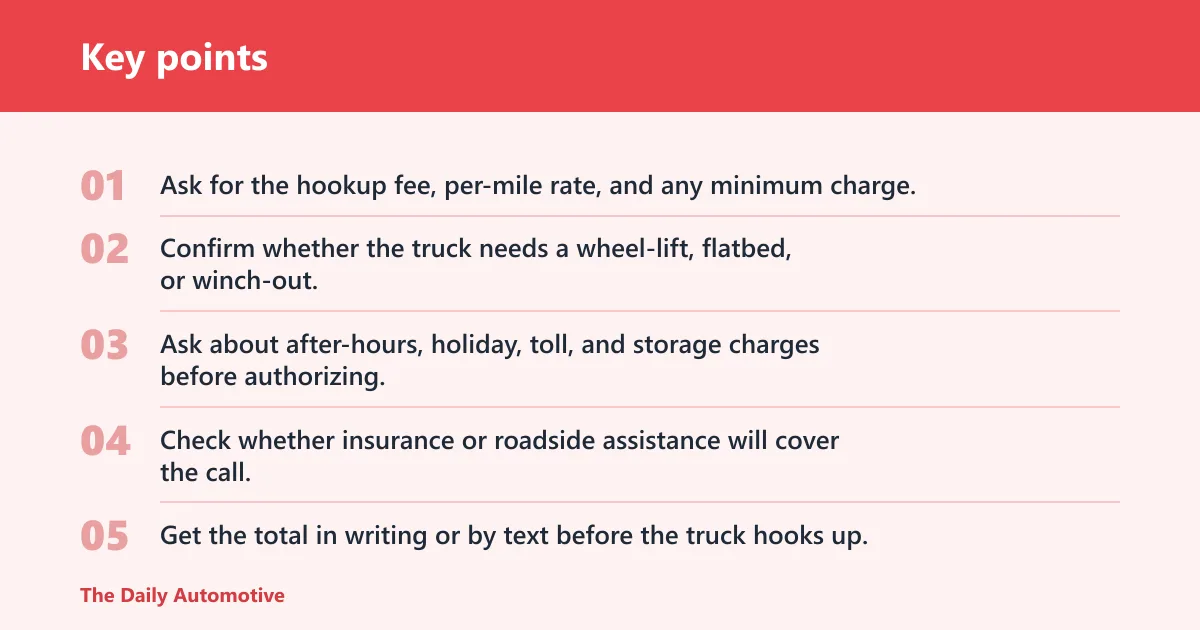
- Ask for the hookup fee, per-mile rate, and any minimum charge.
- Confirm whether the truck needs a wheel-lift, flatbed, or winch-out.
- Ask about after-hours, holiday, toll, and storage charges before authorizing.
- Check whether insurance or roadside assistance will cover the call.
- Get the total in writing or by text before the truck hooks up.
Frequently asked questions
How much do tow trucks charge?
Tow trucks usually charge a base hookup fee plus a per-mile rate. The same source lists $50–$75 for hookup and $2–$5 per mile, while TowWithTheFlow says longer hauls add $3 to $7 per mile. Night, weekend, and holiday service can add more on top of that.
How much is a tow truck?
If you mean a tow service, the answer is usually a short tow in the $75 to $250 range, depending on distance and vehicle type. If you mean buying the truck itself, a tow truck typically costs $35,000 to $500,000, with used rollbacks at $35,000–$75,000 and heavy-duty wreckers far higher.
How much does a tow truck charge?
A tow truck charge often starts with the hookup, then adds mileage, and the total changes with the job. After-hours and flatbed service can raise it quickly.
How much towing cost for a truck?
Towing a pickup truck usually costs more than towing a sedan because of weight and towing class. Heavier trucks can need a stronger wrecker or flatbed, and that can lift both the base fee and the mileage rate. If the truck is 4WD or disabled, the quote can rise again.
How much do tow trucks cost?
If you mean the vehicle itself, tow trucks typically cost $35,000 to $500,000, depending on class and setup. Used rollbacks run $35,000–$75,000, new rollbacks cost $110,000–$160,000, and heavy-duty wreckers cost $150,000–$500,000+. A 50-ton rotator can reach $750,000.
Products related to this article
Sponsored / affiliate links. As an Amazon Associate I earn from qualifying purchases. I may earn additional commission from eligible campaigns.