Should You Use the AC Button to Defog in Winter?
Yes, use the AC button in winter when windows fog from humid cabin air. For quick defogging, run AC with heat, front defrost, and fresh air. Ignore it and visibility can drop fast, turning a light haze into a real driving hazard. This guide explains when AC helps, when heat alone is enough, and what repeated fogging says about leaks, wet mats, or a failing cabin filter.
This guide is part of our Winter Car Care: The Complete Cold-Weather Guide series.
Winter defog basics
Windshield fog on the inside means water vapor in the cabin is condensing on colder glass. In very cold weather, that interior fog can freeze into frost, while exterior frost sits on the outside surface and needs a different fix. If visibility is too poor to read the road, pull over before you start changing settings.
What fog on the inside glass means
Inside fog forms when warm, moist air touches cold glass. The warmer side of the windshield is inside the car in winter, so condensation shows up there first. Heat alone can help, but dry air clears it faster.
When to stop and wait for visibility
If the windshield stays opaque after front defrost is on high, do not keep rolling and guessing. Pull into a safe spot, stop the car, and let the system work with fresh air and full blower speed. If the glass is iced over on the outside, scraping or a proper deicer is the right first move.
What you’ll need
- Heater control that can reach warm or maximum output
- Blower fan control with a high setting
- Front defrost mode
- AC button or automatic climate control that can engage AC
- Recirculation control
- Rear window defroster
- A clean windshield and dry cabin floor mats
Front defrost and rear defroster
Front defrost directs air at the windshield and usually raises fan speed. On many cars it also turns off recirculation automatically, and it may switch on AC and heat together. The rear window defroster uses heating elements embedded in the glass, so it works alongside the front system.
Fresh air instead of recirculation
Recirculation keeps cabin air moving in a closed loop. That can trap humidity and slow defogging. Fresh outside air is usually drier than trapped cabin air in winter, and a slightly open window can help move moist air out and draw drier air in.
Should you use the AC button to defog in winter?
Yes. Turn on the AC button when the fog is inside the cabin, because AC dehumidifies cabin air even in cold weather. That makes it useful with heat, not instead of heat. If the windshield is only lightly hazy, warm outside air alone may clear it without AC.
Why AC helps clear moisture
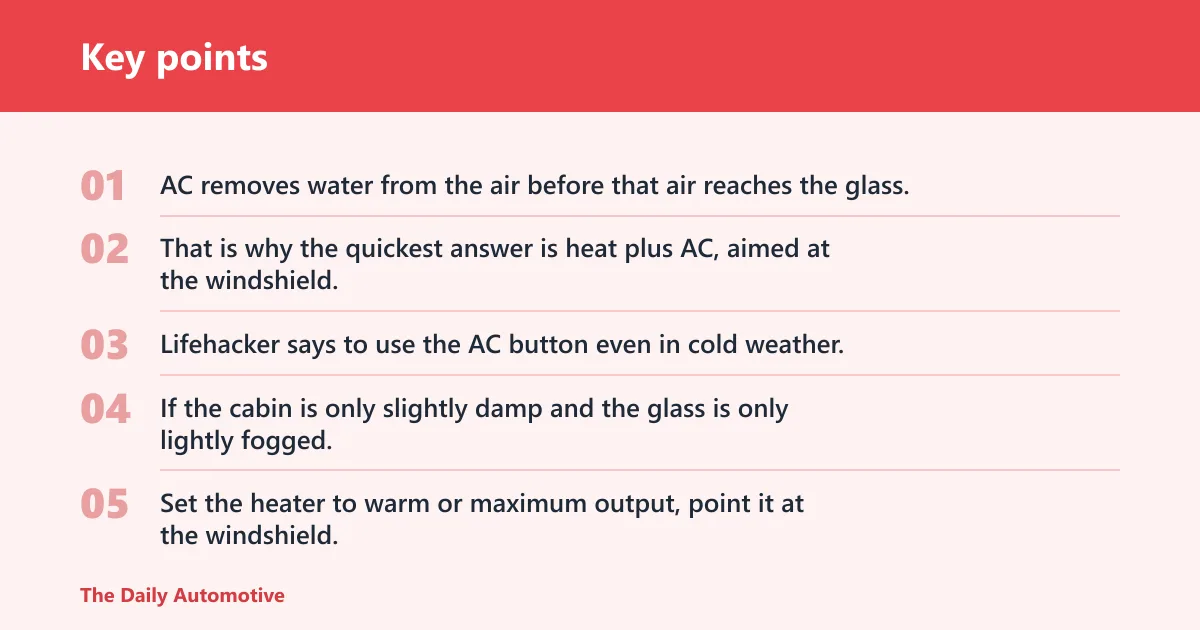
AC removes water from the air before that air reaches the glass. That is why the quickest answer is heat plus AC, aimed at the windshield, with recirculation off. Lifehacker says to use the AC button even in cold weather, and other winter-driving guidance gives the same basic direction.
When heat alone is enough
If the cabin is only slightly damp and the glass is only lightly fogged, warm air from the heater may be enough. Set the heater to warm or maximum output, point it at the windshield, and use the blower on high. If the air outside is already dry and the fog is mild, AC may not be needed.
When AC may be unnecessary or limited
AC helps with moisture, but it does not fix a badly iced exterior windshield. It also loses effectiveness if airflow is weak or the cabin is saturated with water. Some vehicles have temperature limits for compressor engagement, so automatic systems may manage the compressor differently than a manual HVAC panel.
How to clear the windshield fast
The fastest method is warm, dry air aimed directly at the glass. Use front defrost, set heat high, switch recirculation off, and run the fan on high. If the cabin is very humid, crack a window slightly so outside air can replace the damp air inside.
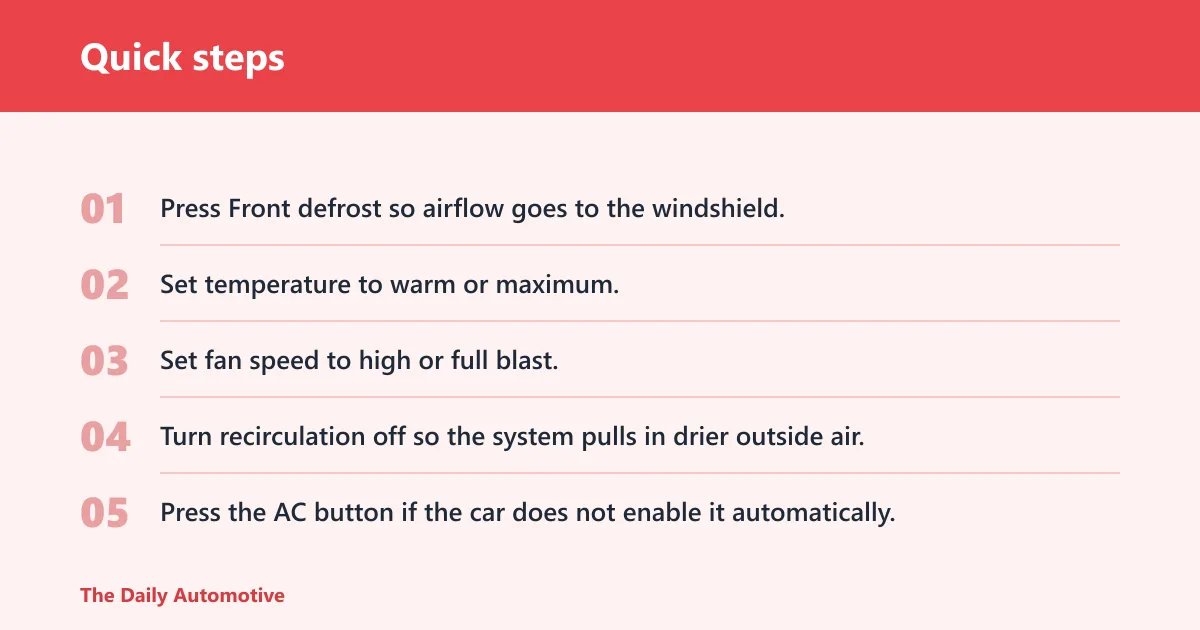
- Press Front defrost so airflow goes to the windshield.
- Set temperature to warm or maximum.
- Set fan speed to high or full blast.
- Turn recirculation off so the system pulls in drier outside air.
- Press the AC button if the car does not enable it automatically.
- Turn on the rear window defroster if the back glass is fogged or frosted.
- Crack a window slightly if the cabin still feels damp after a minute or two.
Say your windshield is fogged on a 20°F morning, the cabin smells damp, and the fan is already on low. Switching to front defrost, heat high, AC on, and recirculation off usually clears the glass far faster than heat alone.
Outside frost is a different problem
Exterior frost is frozen moisture on the outside of the glass. Interior defog settings do little for that layer. Use the proper defrost mode, scraper, or windshield deicer instead of assuming the AC button will melt outside ice.
Winter defog decision matrix
| Symptom | Likely cause | Best HVAC setting | What not to use | Likely fix |
|---|---|---|---|---|
| Inside fog on the windshield | Warm moist cabin air condensing on cold glass | Front defrost, heat high, AC on, recirculation off, fan high | Recirculation mode | Dry the cabin and keep fresh air flowing |
| Outside frost on the glass | Ice on the outer surface | Front defrost with heat; scrape if needed | Expecting AC to solve it alone | Remove exterior ice before driving |
| Repeated fogging after clearing | Cabin humidity staying high | Heat, AC, fresh air, fan high | Recirculation left on | Check for wet mats, leaks, or damp seals |
| Heavy cabin moisture | Wet clothes, shoes, mats, or standing water | Front defrost, AC on, outside air intake | Low fan speed | Remove wet items and dry the interior |
| Weak airflow or slow clearing | Clogged cabin filter, fan problem, or blocked vents | Front defrost with highest blower setting | Assuming more heat alone will fix it | Inspect filter, vents, and blower output |
Why does your car fog up again?

Fog returns when the cabin keeps sending moisture to the glass. Wet clothing, boots, and floor mats are common causes. Leaks around doors, sunroofs, or hatch seals can add more water, and a clogged cabin filter or weak blower can keep the system from drying the air fast enough.
Wet clothes, shoes, and mats
Snowmelt and rain tracked into the cabin raise humidity fast. A soaked carpet can keep releasing moisture for a long time. Pull out wet mats, shake them dry, and let the interior air out when parked.
Leaks and damp seals
Water under the carpet, a wet headliner, or damp door seals can keep fogging the windshield even after you clear it. That points to a moisture source, not a control problem. Look for stained trim, damp floor foam, or water pooling in the footwell.
Cabin filter restriction or low airflow
A clogged cabin filter can reduce airflow across the windshield. Weak airflow also slows drying even if the AC is on. If the fan sounds normal but little air reaches the glass, the filter or vent path deserves attention.
Suppose the windshield clears for five minutes, then mists again while the blower stays weak on the highest setting. That pattern points more toward airflow restriction than a simple wrong-mode setting.
If that didn’t work, try this next
- Open the glove box and inspect the cabin filter access point if your car uses one there or under the cowl.
- Replace a dirty filter with the correct part number for the vehicle.
- Check footwells and under mats for standing water.
- Look for blocked cowl vents or debris near the fresh-air intake.
- Have the blower motor, resistor, or HVAC door operation checked if airflow is still weak.
Common mistakes
Leaving recirculation on is the biggest one. It traps humidity inside the cabin and slows drying. Another mistake is using a low fan speed and expecting heat alone to clear the glass quickly. Air movement matters as much as temperature.
Do not point the vents away from the windshield. Do not ignore wet carpet, soaked mats, or a leak that keeps feeding moisture back into the cabin. If the rear glass is also fogged, use the rear window defroster rather than waiting for the front system to handle everything.
Prevention
Keep the windshield clean, remove wet items from the cabin, and dry the floor mats after snow or rain. Use fresh air mode in winter when the cabin starts to feel damp. A clean glass surface fogs less readily and clears faster.
Frequently asked questions
Should you turn on the AC button to defog windows in winter?
Yes, when the fog is inside the glass. The AC button dries cabin air, which helps clear condensation faster than heat alone in many cases. Use it with front defrost, warm heat, and recirculation off. If the problem is outside frost, AC is not the main fix.
Does AC dry out fog on the windshield faster than heat alone?
Usually, yes. Heat warms the glass and air, but AC removes moisture from the air first. That dry air reaches the windshield and clears condensation faster. For the quickest result, use front defrost, heat high, fan high, and AC on together.
Should recirculation be on or off when defogging in winter?
Off. Recirculation keeps humid cabin air in the loop, which slows drying and can make fog return. Fresh outside air is usually drier in winter and helps clear the glass. If the cabin is saturated, crack a window slightly to speed the exchange.
What is the fastest way to clear a fogged-up windshield?
Press front defrost, set the heater to warm or maximum, turn the blower up high, switch recirculation off, and use AC if available. That combination sends warm, dry air straight at the glass. If the rear window is also fogged, switch on the rear defroster at the same time.
Why does my windshield fog up inside when it’s cold outside?
Because warm, moist cabin air meets the colder windshield and condenses there. Wet clothing, shoes, mats, and leaks all raise cabin humidity. Cold weather makes the temperature difference bigger, so inside fog appears faster and can freeze if the temperature drops far enough.
Can you use the front defrost and AC at the same time?
Yes, and many cars do that automatically. Front defrost usually sends air to the windshield, raises fan speed, and may turn on AC and turn off recirculation at the same time. If your vehicle has manual controls, choose front defrost, AC on, heat high, and fresh air.
Why does my car fog up again after I clear it?
Repeat fogging usually means the cabin is still moist. Wet mats, damp seals, a cabin leak, or restricted airflow can keep feeding humidity into the air. Check for standing water, replace a dirty cabin filter, and keep the system on fresh air instead of recirculation.
Does opening a window help defog car windows in winter?
Yes, a slightly open window can help by swapping humid cabin air for drier outside air. That works best with front defrost, heat, and the blower on high. Open it just enough to help the exchange; you do not need a large opening.
What climate settings clear frost or fog on the inside of the windshield?
Use front defrost, warm or maximum heat, high blower speed, AC on if available, and recirculation off. Aim the airflow at the windshield. If the rear glass is fogged too, turn on the rear defroster. For light fog, heat and fresh air may be enough, but AC speeds drying.
Products related to this article
Sponsored / affiliate links. As an Amazon Associate I earn from qualifying purchases. I may earn additional commission from eligible campaigns.