Can You Use Plain Water Instead of Coolant in Winter?
Plain water is an emergency top-up in winter. Plain water can become risky around 32°F (0°C), because it may freeze and crack the radiator, heater core, hoses, or engine block. Ignore that risk and you can turn a small leak into a no-start or an expensive cooling-system repair. This guide tells you when water is acceptable, when it is not, and what to do after a winter top-up so the engine survives overnight.
This guide is part of our Winter Car Care: The Complete Cold-Weather Guide series.
Can you use plain water in winter?
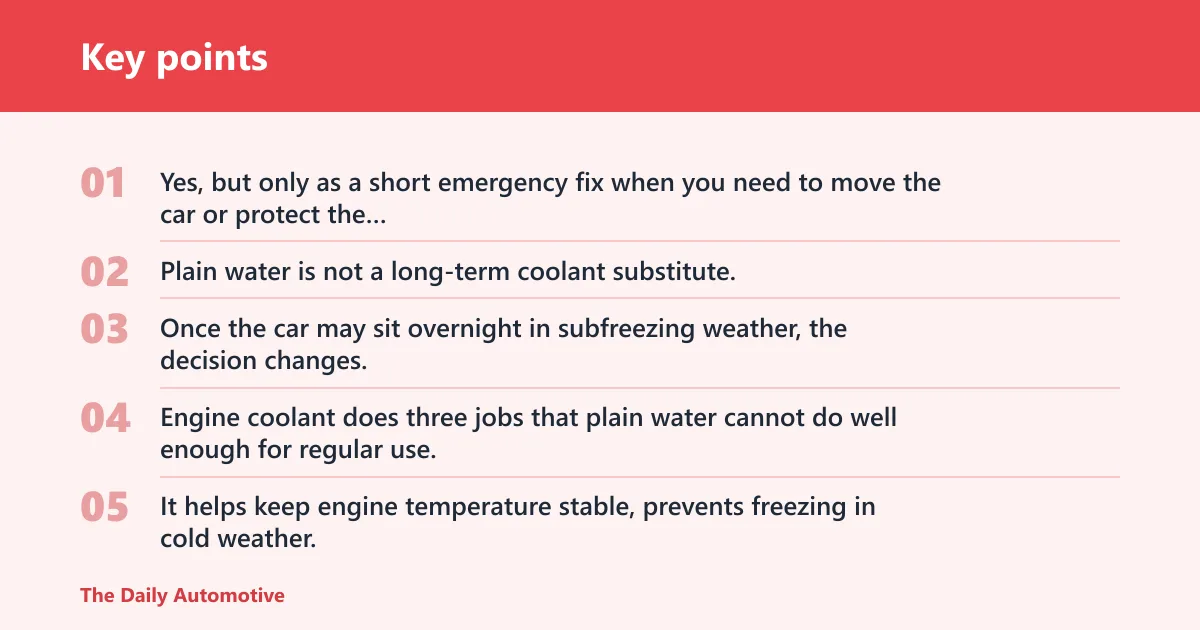


Yes, but only as a short emergency fix when you need to move the car or protect the engine long enough to reach safety. Plain water is not a long-term coolant substitute, and the risk rises fast as temperatures approach freezing. Once the car may sit overnight in subfreezing weather, the decision changes.
Engine coolant does three jobs that plain water cannot do well enough for regular use. It helps keep engine temperature stable, prevents freezing in cold weather, and contains corrosion inhibitors that protect the radiator, engine block passages, cylinder heads, heater core, and reservoir from rust and scale.
A 50/50 antifreeze-to-water mix is the usual service ratio in many road cars because it improves freeze protection and gives more boiling margin than plain water. The exact protection level still depends on the vehicle, the coolant type, and the system pressure, so the owner’s manual matters.
What coolant does in cold weather
Coolant circulates through the engine block and cylinder heads, then sheds heat in the radiator. That circulation keeps metal parts in a narrow safe range instead of letting them swing from very hot to very cold.
When the mix is correct, the fluid is far less likely to freeze in the passages that matter most. When the mix is diluted too far with water, freeze risk rises first in the smallest channels and low spots.
When is plain water acceptable?
Plain water is acceptable only for emergency situations, such as topping up a low system at the side of the road or making a short move to a safe place for repair. It is not a long-term answer, and it should not be treated as “good enough until spring.”
If the engine is already hot, do not rush the refill. Add coolant or water only after the engine has cooled enough for the specific reservoir or cap style on your vehicle, and follow the owner’s manual for where to add it.
Stranded roadside situations
Say your coolant warning light comes on during a 15-mile winter commute and the temperature is 28°F. Adding plain water to get the car off the shoulder and to a nearby shop is reasonable if that is the only fluid available. The goal is not to restore normal service; it is to avoid immediate overheating or complete stoppage.
Short-distance movement to safety
If you are close to home, a repair bay, or a heated garage, a small top-up with plain water or distilled water can be a temporary bridge. Keep the drive short, watch the engine coolant temperature sensor reading if the car displays one, and stop if the gauge climbs or a warning appears.
When to stop and tow instead
Stop and tow if the engine is overheating, the reservoir is empty again almost immediately, steam is visible, or the car will need to sit outside through a freezing night before it can be serviced. Water buys time only when the next step happens soon.
How cold is too cold?
Once temperatures drop below 32°F (0°C), plain water can freeze. That is the line where emergency use becomes much riskier, especially if the car is parked outside overnight or the system already contains a weak coolant mix.
How dangerous it is depends on three things: the outside temperature, how diluted the existing coolant already is, and whether the car will move again before the next freeze. A system that is mostly correct coolant may tolerate a small water top-up better than one that is already heavily diluted.
Winter decision table
| Outside temperature band | Plain water acceptable for a one-time emergency top-up? | Main risk to watch |
|---|---|---|
| Above 32°F / 0°C | Yes, for a short emergency move only | Overheating if the system is still too low; corrosion if water stays in the system |
| 32°F to 20°F / 0°C to -6°C | Yes, but only to reach safety or repair | Freeze risk if the car sits before proper coolant is restored |
| Below 20°F / -6°C | Use only if you must move the car a very short distance | Freeze risk becomes the priority, especially overnight |
| Below freezing and parked outdoors overnight | No, not if you can avoid it | Freeze expansion can crack the radiator, hoses, heater core, or engine block |
Picture a compact sedan with a weak radiator hose that leaks enough coolant to drop the reservoir level. If the owner adds plain water at 25°F and then leaves the car outside until morning, the water-coolant mix may freeze in the low points of the system. That is where the real damage chain begins.
What to do before overnight parking
If water was added and the car will sit overnight, the best move is to get the correct coolant mix restored before the temperature falls. If that is impossible, the next best step is to reduce freeze risk as much as you can and plan immediate service at first light.
Do not assume the system is safe just because the engine still runs. A diluted mix can look fine during a short drive and still freeze later, especially when the engine cools fully and the car is parked outside.
Before you leave the car
- Confirm the engine has cooled enough for the reservoir or fill point specified in the owner’s manual.
- Check whether the car has a pressurized cap on the reservoir or a separate overflow bottle, and follow the manual for the correct fill point.
- Top up with the correct manufacturer-specified coolant if it is available; if not, use distilled water only as a temporary emergency measure.
- Do not fill the reservoir to the top; coolant expands as it warms.
- Schedule a proper refill and leak check before the next cold soak.
Protect against freezing overnight
Get the vehicle into a garage if possible. If not, keep the next start as close as possible to the time you added the water so the system does not sit through a hard freeze. A short window is safer than an all-night exposure when the mix is weak.
What matters is not the water alone. It is the final mixture already in the system after the top-up. If you added one quart of water to a nearly full cooling system, the final concentration changes less than if you added the same amount to an already low system.
Is distilled water better than tap water?
Yes, for temporary emergency use. Distilled water has lower mineral content than tap water, so it is the better choice if you must top up in a hurry. It still is not a permanent coolant substitute, and it still freezes at 32°F (0°C).
Tap water can leave mineral deposits behind. Over time, those minerals can contribute to scale buildup in the radiator and narrow engine passages, which is why distilled water is preferred over impure water for mixing or temporary use.
Why minerals matter
In a cooling system, narrow channels matter. The radiator, heater core, and engine block passages rely on clean flow. Mineral-heavy water can leave deposits that reduce flow, encourage hot spots, and make corrosion worse when the corrosion inhibitors in coolant are absent or too diluted.
Distilled water is the safer temporary choice because it avoids adding as many minerals into an already stressed system. It is still only a bridge until the correct coolant is restored.
What happens if coolant freezes?
Frozen coolant can expand in the radiator, hoses, heater core, and engine block passages. That expansion can crack parts, split seals, or damage the cylinder head or head gasket if the engine is then started or forced to run while the system is blocked.
The failure chain is usually practical, not dramatic: water turns to ice, ice expands, flow stops, pressure rises in the wrong place, and the weakest component gives way. The radiator is a common first casualty, but the engine block and heater core can be damaged too.
Damage chain in plain order
- Freeze starts in diluted coolant or plain water left in the system.
- Expansion puts stress on the radiator and narrow water jackets in the block.
- Crack or split damage can form in the radiator, hoses, or heater core.
- Overheating follows if circulation is blocked or fluid leaks out.
- Head damage becomes possible if the engine continues to run hot.
Can water damage the engine or radiator?
Yes. Water can damage both, and the risk is different in winter than in summer. In cold weather, the biggest threat is freezing expansion. In warm weather or under load, the bigger threat is overheating because water boils at 212°F and has no coolant additives to help protect the system.
Coolant also helps prevent rust and corrosion inside the engine. Without those additives, a cooling system can start to rust internally, and that corrosion can spread to the radiator, the water pump passages, and the heater core.
Parts most likely to suffer
The radiator can crack if water freezes. The engine block can crack if ice expands in narrow water jackets. The cylinder head and head gasket can warp or fail if coolant is absent or badly diluted and the engine overheats. That is why a short emergency use and a full refill are not the same thing.
How long can you run water instead of coolant?
Only long enough to get to safety, a repair shop, or a place where the correct coolant can be added. Water should not be used for long-term driving. The safe window is measured in distance and conditions, not in days or weeks.
If the weather is above freezing and the drive is short, the risk is often overheating rather than freezing. If the weather is below freezing, the risk can flip quickly to freeze damage the moment the car sits.
What changes the time limit
The existing coolant concentration matters. A system that still contains mostly correct coolant has more freeze protection than one that has already been diluted by repeated water top-ups. Vehicle load, outside temperature, and idle time also matter, especially if the engine coolant temperature sensor is already showing a warmer-than-normal reading.
A common first-timer mistake is adding water on a mild afternoon, driving the car home, and assuming the problem is solved. If a freeze is due overnight, that same car can be in trouble by morning if the mix was too weak to begin with.
What should I do if my coolant is low and it’s freezing outside?
If coolant is low in freezing weather, use plain water only as a one-time emergency top-up when you must move the car. Then restore the correct manufacturer-specified coolant mix as soon as possible, because the real risk is not just the top-up itself; it is the diluted mixture left in the system overnight.
Start with the owner’s manual, use the correct reservoir or cap for your vehicle, and do not overfill. If the leak is active or the car needs to sit outside through a hard freeze, towing is safer than hoping the diluted mix will hold.
Best next steps
- Add only enough fluid to get the level back into the safe operating range.
- Use distilled water if coolant is unavailable and you need a temporary top-up.
- Drive only as far as needed for repair or safe parking.
- Restore the correct coolant mixture before the next overnight freeze.
- Have the leak checked and repaired, then refill with the manufacturer-specified coolant.
Frequently asked questions
Can you use plain water instead of coolant in winter?
Yes, but only as an emergency top-up and only for short-term use. Plain water is not a permanent coolant substitute, and it becomes risky fast once temperatures fall below freezing. The key question is whether the car will sit overnight before the correct coolant mix is restored.
Will plain water freeze in my car overnight?
It can. Plain water freezes at 32°F (0°C), so an outside overnight park in subfreezing weather is a real freeze risk. The exact danger depends on how much coolant was already in the system and how diluted the final mix became after the top-up.
Can I drive a car with water in the radiator in cold weather?
You can drive a short distance if the water is there only as an emergency fix and the engine is not overheating. Keep the trip to the minimum needed for safety or repair. If the car must sit through a freezing night, the safer answer is no.
Is distilled water better than tap water in a car cooling system?
Yes, for temporary emergency use. Distilled water has lower mineral content than tap water, so it is less likely to add scale and deposits to the cooling system. It still lacks corrosion protection and still freezes in winter, so it is not a permanent coolant substitute.
Products related to this article
Sponsored / affiliate links. As an Amazon Associate I earn from qualifying purchases. I may earn additional commission from eligible campaigns.