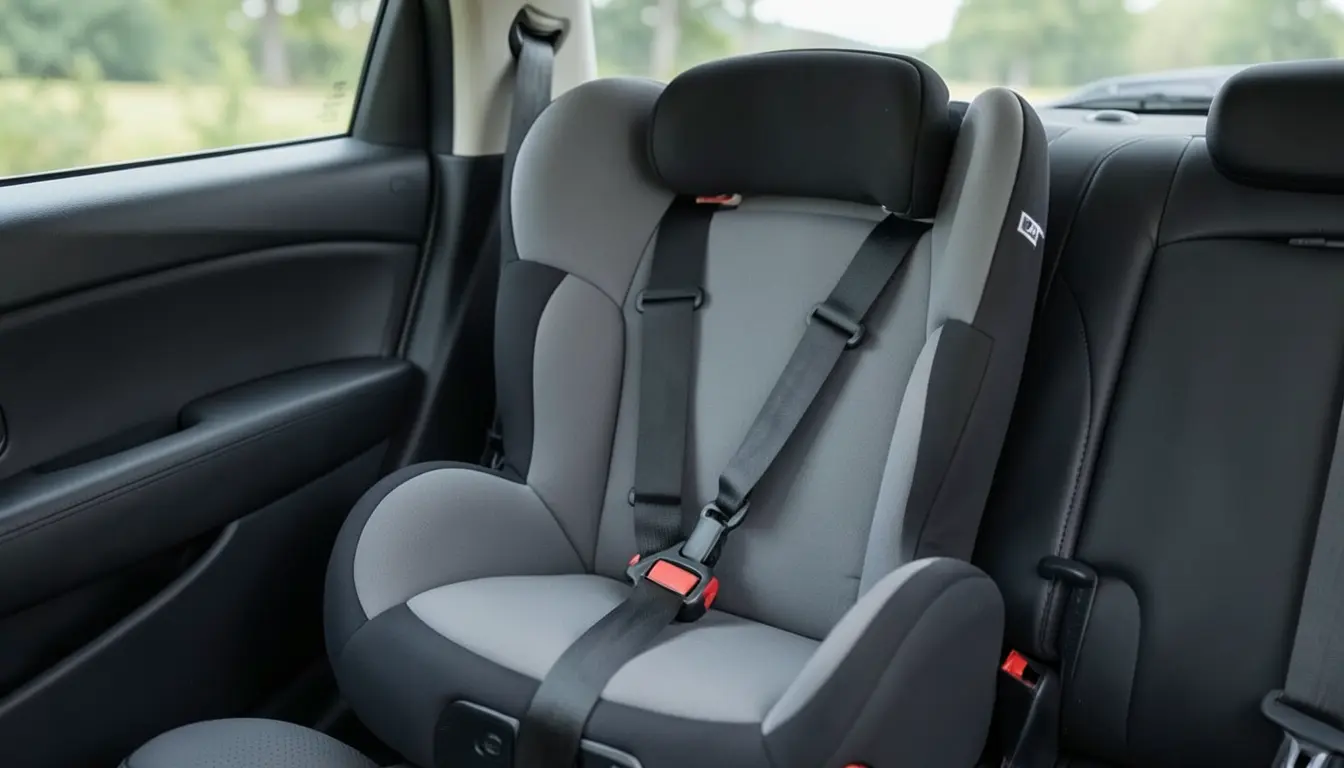
What Age for a Car Seat? NHTSA Stages by Age, Weight and Height
There is no single “right age” for a car seat. NHTSA and the American Academy of Pediatrics both base every car seat transition on your child’s current weight and height against the limits printed on the seat itself, not on a birthday.
The stakes are real: motor vehicle crashes remain a leading cause of death for children in the United States, and NHTSA estimates that a correctly used car seat cuts the risk of fatal injury by about 71 percent for infants and 54 percent for toddlers in passenger cars, compared with no restraint. The CDC puts the injury-reduction benefit of car seats at 71 to 82 percent versus seat belt use alone, and says a booster seat cuts serious injury risk by roughly 45 percent for kids ages 4 to 8.
This guide walks through NHTSA’s four car seat stages, rear-facing, forward-facing, booster, and seat belt only, with the actual weight and height ranges for each, how state law differs from the AAP’s safety recommendations, and the most common installation mistakes that quietly make a correctly chosen seat less safe.
Why “What Age” Isn’t the Right Question
Every car seat sold in the US is designed around a weight and height range, printed on a label on the seat itself, not a calendar age. Two 18-month-olds can legitimately need different seats: one might still fit comfortably rear-facing, while a bigger toddler may have already reached that seat’s rear-facing weight limit and need a larger convertible seat.
That is why NHTSA and the AAP frame car seat guidance around four size-based stages instead of ages. Age ranges below are typical, real-world averages, not hard cutoffs, always defer to the specific height and weight limits printed on your seat’s label over any general age range, including the ones in this article.
GROWS WITH YOUR CHILD THROUGH 3 STAGES
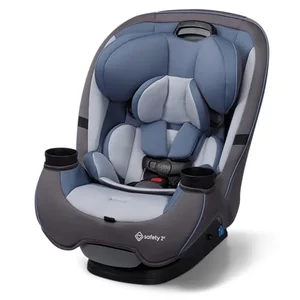 |
Safety 1st Grow and Go All-in-One Convertible Car Seat – $139.99 Since age alone does not determine which stage your child needs, a single seat rated for all three of the stages below (5-40 lbs rear-facing, 30-65 lbs forward-facing, 40-100 lb booster) removes the guesswork of buying a new seat at every transition.
|
The NHTSA Four-Stage Car Seat System
NHTSA groups every car seat transition into four stages. Use the table below as a starting point, then check your own seat’s manual for its exact limits.
| Stage | Typical Age Range | Weight/Height Guidance | Seat Type |
|---|---|---|---|
| 1. Rear-facing | Birth to 2-4 years | Until the seat’s maximum rear-facing weight or height limit (often 35-50 lbs) | Infant seat, then rear-facing convertible seat |
| 2. Forward-facing | About 2-7 years | Until the seat’s maximum forward-facing weight or height limit (often 40-65 lbs, some to 80 lbs) | Convertible seat or combination seat with harness |
| 3. Booster seat | About 4-12 years | Until the child passes the 5-step seat belt fit test, commonly around 4 feet 9 inches tall | Booster seat (high-back or backless) |
| 4. Seat belt only | About 10-13 years and up | Passes the 5-step test and is comfortable for the full trip | Vehicle lap-and-shoulder belt |
Stage 1: Rear-Facing Car Seats
Every child starts rear-facing, either in a dedicated infant seat or a convertible seat installed rear-facing from birth. Rear-facing seats support a baby’s disproportionately large, heavy head and immature neck and spine, spreading crash forces across the back of the seat shell instead of the neck.
Infant-only seats typically fit babies up to somewhere between 22 and 35 pounds, depending on the model, and around 30 to 32 inches tall, whichever limit the child reaches first. Once a baby outgrows the infant seat, the next step is a convertible seat, which continues rear-facing to a much higher limit, commonly 35 to 50 pounds.
Both the AAP and NHTSA recommend keeping a child rear-facing for as long as their seat allows, not switching at a specific age. The AAP dropped its old “at least age 2” guideline in 2018 in favor of simply staying rear-facing until the seat’s own maximum limit is reached, which for many kids on a modern convertible seat means age 3 or later.
- Install rear-facing seats in the back seat, ideally the center position if the vehicle allows a secure fit there.
- Secure the seat with either the vehicle seat belt or the LATCH system, not both at once unless the manufacturer says otherwise.
- Check the seat’s built-in angle indicator, since an infant’s airway can be restricted if the seat reclines too upright.
- Straps should be snug enough that you cannot pinch excess webbing at the shoulder, with the chest clip at armpit level.
Stage 2: Forward-Facing Car Seats With a Harness
A child moves to forward-facing only after outgrowing the rear-facing weight or height limit of their current seat, there is no minimum age requirement from NHTSA or the AAP, only the seat’s printed limits. In practice, most kids make this switch somewhere between age 2 and 4, though a child on a high-limit convertible seat may stay rear-facing well beyond that.
Forward-facing seats use a harness and, critically, a top tether strap anchored behind the vehicle seat, which meaningfully reduces how far the child’s head moves forward in a crash. Most forward-facing harness seats fit children up to 40 to 65 pounds, and some combination seats extend to 80 pounds before moving to a booster.
Keep the child in the forward-facing harness seat until they reach that seat’s maximum height or weight limit, generally somewhere between ages 4 and 7 depending on the child’s growth and the specific seat.

Stage 3: Booster Seats
Booster seats do not have their own harness. Their entire job is to raise a child high enough that the vehicle’s existing lap-and-shoulder belt lands in the right places: the shoulder belt across the middle of the chest, and the lap belt low across the hips and upper thighs, not the stomach.
Most children move into a booster seat around age 4, once they outgrow their forward-facing harness seat, and typically weigh at least 40 pounds. Many stay in a booster until somewhere between ages 8 and 12, or until they reach about 4 feet 9 inches tall, whichever comes first for that child. State minimums vary and are usually lower than this safety recommendation, check your state’s specific law below.
- Always use a booster with both the lap and shoulder belt, never the lap belt alone.
- The shoulder belt should cross the collarbone and chest, never the neck or face.
- The lap belt should sit low and snug across the hip bones and upper thighs, not the soft stomach.
- Make sure the booster itself sits flat and stays in place on the vehicle seat cushion.
Stage 4: The Seat Belt Alone (and the 5-Step Test)
A child is ready to ride with just the vehicle seat belt once they reliably pass NHTSA’s 5-step test, usually somewhere between ages 10 and 12. Height matters more than age here; a shorter 12-year-old may still need a booster, while a tall 9-year-old may already pass.
NHTSA’s 5-Step Test
- Does the child sit all the way back against the vehicle seat?
- Do the child’s knees bend naturally at the edge of the seat, feet reaching the floor?
- Does the shoulder belt cross the middle of the chest and shoulder, not the neck?
- Does the lap belt sit low, touching the tops of the thighs, not the stomach?
- Can the child stay seated correctly like this for the entire ride, not just for a moment?
If the answer to all five is yes, the child no longer needs a booster. If any answer is no, keep using the booster, even if the child has hit a birthday that state law treats as the legal minimum.
One rule applies regardless of stage: NHTSA recommends all children ride in the back seat until at least age 13, since front airbags are designed and tested for adult-sized occupants and can injure a smaller child during deployment.
State Car Seat Laws vs. AAP and NHTSA Recommendations
It is worth understanding the difference between what is legal and what is genuinely safest, because they are not the same thing. State car seat laws set a legal floor, the youngest age or lowest weight at which a parent can legally stop using a given restraint type without a citation. They exist to be enforceable, so many states still specify a minimum age for forward-facing (often around age 1 or 2) that is younger than what the AAP actually recommends.
The AAP and NHTSA recommendations in this guide are safety targets, not legal minimums. Staying in each stage longer than your state’s legal minimum, right up to your specific seat’s maximum weight or height limit, is the AAP’s actual safety guidance in every state. Always check your own state’s current car seat law directly, since requirements and their exact wording change over time and vary meaningfully by state.
Common Mistakes That Make Car Seats Less Safe
A well-chosen seat still fails to protect a child if it is not installed or used correctly. The most common mistakes NHTSA-certified Child Passenger Safety technicians see during free seat checks include:
- Switching to the next stage too early, based on a birthday rather than the seat’s actual weight and height limits.
- A seat that moves more than an inch side-to-side or front-to-back at the belt path once installed, it should be locked in tightly.
- Harness straps that are loose enough to pinch excess webbing, or a chest clip positioned at the stomach instead of armpit level.
- Rear-facing seats installed at too upright an angle, which can affect a young infant’s airway.
- Bulky winter coats worn underneath the harness, which compress in a crash and leave straps effectively too loose.
- Booster seat belts routed under the arm or behind the back instead of across the shoulder as designed.
- Continuing to use a car seat past its manufacturer expiration date, typically 6 to 10 years from the manufacture date, after which the plastic shell and webbing can degrade.
Where to Get Help Installing a Car Seat
An estimated 46 percent of car seats are misused in ways that reduce their protection, according to NHTSA research, which is why free hands-on help exists in nearly every community. A certified Child Passenger Safety (CPS) Technician can check your specific seat, in your specific vehicle, in person.
- Search NHTSA’s inspection station locator for a free car seat check near you.
- Many fire stations and police departments host regular car seat inspection events.
- Hospitals and pediatrician offices often keep a list of local certified CPS technicians.
- Some big-box baby retailers offer in-store installation help from trained staff.
If your convertible seat is nearing the end of one stage, our guide on how car seat straps should fit covers harness tightness and chest clip placement in more detail, and our guide on how long car seats stay good for explains expiration dates by brand.
Frequently Asked Questions
What age can a child stop using a car seat?
There is no single age. Most children are ready to ride with only the vehicle seat belt somewhere between ages 10 and 12, once they pass the 5-step test described above. Height matters more than age here, most kids pass around 4 feet 9 inches tall.
At what age should a child switch from rear-facing to forward-facing?
The AAP and NHTSA both recommend keeping a child rear-facing until they reach the maximum height or weight limit printed on their specific car seat, not a fixed age. Many convertible seats now allow rear-facing up to 40 or 50 pounds, which often keeps toddlers rear-facing well past age 2, sometimes to age 3 or 4. There is no minimum age requirement to switch, only the seat’s own limits decide it.
What age does a child need a booster seat?
Most children move into a booster seat around age 4, once they outgrow the height or weight limit of their forward-facing harness seat (commonly 40 to 65 pounds). They typically stay in the booster until they pass the 5-step seat belt fit test, usually between ages 8 and 12 or around 4 feet 9 inches tall.
What are the age stages for car seats?
NHTSA defines four stages based on size, not age: rear-facing car seats for infants and young toddlers, forward-facing car seats with a harness for toddlers and preschoolers, booster seats for young school-age children, and the vehicle seat belt alone once a child passes the 5-step fit test. Each child moves through the stages at their own pace based on their car seat’s printed height and weight limits.
Is it illegal to turn a car seat forward-facing early?
In most states it is not illegal to turn a seat forward-facing as soon as state law’s minimum age is met, but state law sets only a legal minimum, not a safety recommendation. The AAP and NHTSA recommend staying rear-facing until the seat’s maximum limit regardless of what the state minimum allows, because rear-facing seats better protect a young child’s head, neck, and spine in a frontal crash.
Do children need to ride in the back seat until a certain age?
Yes. NHTSA recommends that all children ride in the back seat until at least age 13, even after they have graduated out of a booster seat and onto the seat belt alone. Front airbags are designed for adult-sized occupants and can injure a smaller child in a crash.
Conclusion
Age is a useful starting point for planning ahead, but the seat’s own printed weight and height limits, checked against your child’s current size, are what actually decide when it is time to move to the next stage. Staying in each stage as long as the seat allows, rear-facing, then forward-facing, then booster, then seat belt alone, consistently outperforms switching early just because a child hit a particular birthday.
When in doubt, a free inspection from a certified Child Passenger Safety technician settles the question for your exact seat and vehicle combination, and takes the guesswork out of an installation that is genuinely difficult to judge from a manual alone.
Products related to this article
Sponsored / affiliate links. As an Amazon Associate I earn from qualifying purchases. I may earn additional commission from eligible campaigns.