
What Does Straight Piping A Car Do? Proven Secrets
Quick Summary: Straight piping a car removes the muffler and resonators, resulting in a much louder, deeper exhaust sound. While it significantly changes the noise level and may slightly improve airflow, it often reduces low-end torque, can cause drone, and is illegal in many areas due to noise pollution regulations.
Have you ever heard a car driving by that sounded incredibly loud and deep? You might wonder how they achieved that sound. Often, the answer involves something called “straight piping.” This modification is popular among enthusiasts, but it confuses many everyday drivers. Does it really make your car faster? Is it safe? Don’t worry! As your trusted auto guide, I’m here to break down exactly what straight piping does in simple, easy-to-understand terms. We will look at the sound, the performance, and the important rules you need to know. Let’s demystify this popular exhaust change together!
What Does Straight Piping A Car Do? The Beginner’s Guide
When you modify your car’s exhaust system, you are dealing with how the engine breathes out its waste gases. A stock (factory standard) car has a carefully designed path for these gases. Straight piping is essentially taking a shortcut through that path. It sounds simple, but it creates big changes you need to be aware of before you pick up any tools.
Understanding the Stock Exhaust System
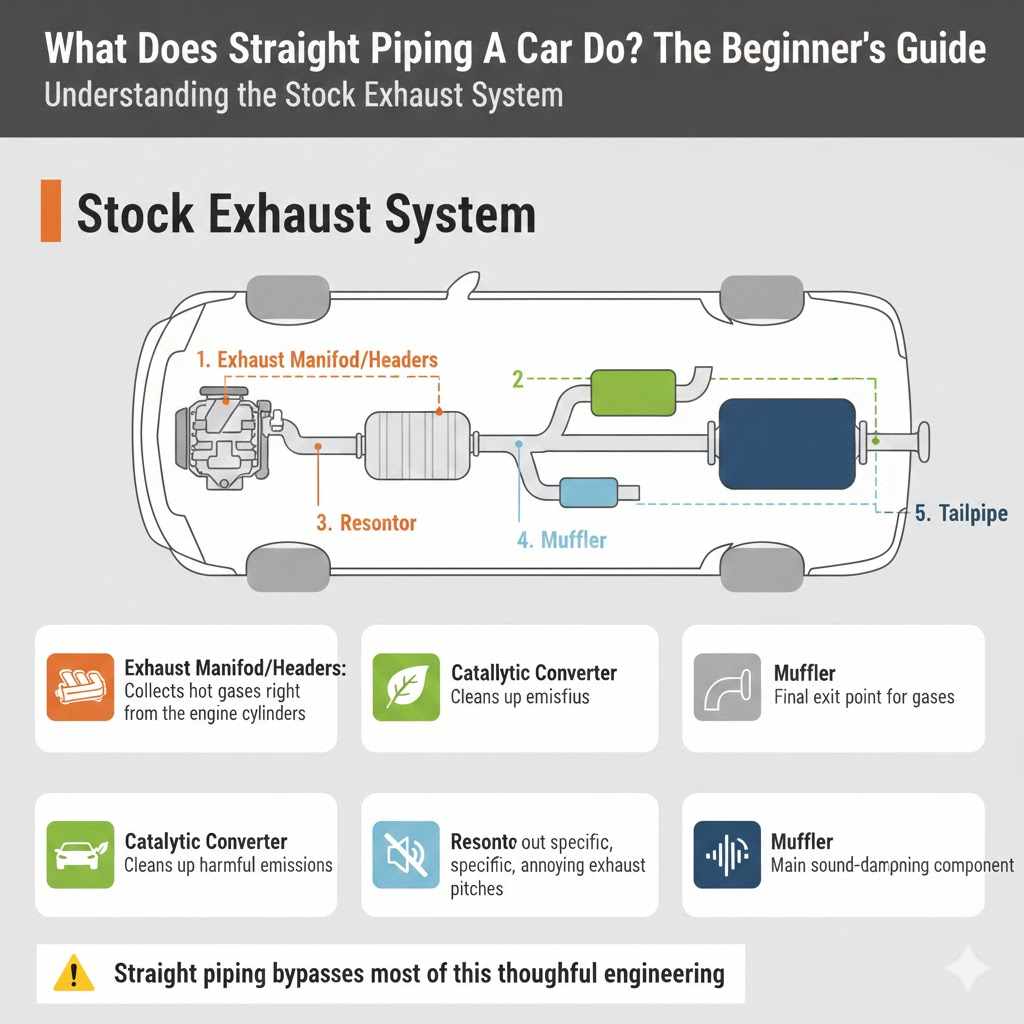
To know what straight piping does, we first need a quick look at what it removes. A standard exhaust system has several main parts, all working together:
- Exhaust Manifold/Headers: Collects hot gases right from the engine cylinders.
- Catalytic Converter: This is crucial for the environment. It cleans up harmful emissions before they leave the tailpipe.
- Resonator: A smaller chamber designed to cancel out specific, annoying exhaust pitches (like a high-pitched drone).
- Muffler: The main sound-dampening component. It uses baffles and chambers to quiet the loud pulses created by the engine.
- Tailpipe: The final exit point for the exhaust gases.
These parts work hard to meet environmental standards and keep your ride comfortable for daily driving. Straight piping bypasses most of this thoughtful engineering.
The Simple Definition of Straight Piping
So, what is straight piping? Simply put, it means replacing the factory muffler and resonator—sometimes even the catalytic converter—with a single, straight piece of pipe. Think of it like removing all the speed bumps and winding roads from a highway and replacing them with one long, open lane.
The core goal of straight piping is noise. It allows the engine’s exhaust pulses to exit the system with almost no restriction or sound muffling. This results in a much louder, raw sound that many enthusiasts crave.
The Proven Secrets: What Happens When You Straight Pipe?
When you remove those muffling devices, you unlock several distinct changes. These are the “secrets” that enthusiasts chase, but they come with trade-offs.
1. The Sound Transformation (The Biggest Change)
This is the most noticeable effect. Factory mufflers are designed to reduce sound pressure waves. When you remove them, you get:
- Significantly Louder Volume: Your car will sound much louder, especially under heavy acceleration.
- Deeper Tone: The exhaust note changes from a muffled rumble to a deeper, more aggressive roar.
- Exhaust Pops and Crackles: Depending on the engine tune, you might hear more crackles and pops on deceleration (deceleration burble).
- Drone: This is the major downside for daily driving. Drone is a continuous, low-frequency humming sound that stays constant when cruising at highway speeds. It can become very tiring over long drives.
2. Airflow and Performance Effects
Less restriction usually means better flow. However, automotive engineers design exhaust systems for a balance between flow and back pressure.
Engines, particularly naturally aspirated (non-turbo) ones, actually need some level of “back pressure” to help pull the next charge of air and fuel into the cylinder efficiently, especially at low RPMs (revolutions per minute).
- Potential High-End Gains: On a highly tuned or forced-induction (turbo/supercharged) engine, removing restrictions can help maximize high-RPM horsepower.
- Potential Low-End Loss: For most standard daily drivers, removing the muffler can actually hurt low-end torque (the pulling power you feel when starting from a stop or accelerating gently). The gases exit too quickly, potentially hurting cylinder scavenging.
- No “Magic Horsepower”: Don’t expect massive horsepower gains just from removing the muffler. True performance gains require tuning the engine’s computer (ECU) to account for the increased airflow.
3. Legal and Emissions Consequences
This is perhaps the most critical “secret” to understand before proceeding. In many states and countries, modifying the exhaust system to be excessively loud or removing emissions equipment is illegal.
- Noise Ordinances: Most local municipalities have laws limiting how loud a vehicle can be, often measured in decibels (dB). Straight piping almost always exceeds these limits.
- Emissions Laws: If you remove the catalytic converter (a step often associated with aggressive straight piping), your car will fail mandatory emissions testing. Emissions standards are set by government bodies, such as the Environmental Protection Agency (EPA) in the United States, to protect public health. The EPA regulates vehicle emissions to ensure cleaner air.
Step-by-Step: How Straight Piping is Typically Done
If someone decides to perform this modification, it usually involves cutting out the unwanted parts and welding in a straight pipe section. As your trusted guide, I strongly recommend leaving this type of modification to experienced professionals, especially if welding or emissions equipment removal is involved, due to safety and legal risks.
Tools and Materials Needed (For Reference Only)
This list outlines what a professional shop would use:
| Category | Item | Purpose |
|---|---|---|
| Cutting | Reciprocating Saw (Sawzall) or Pipe Cutter | To safely cut the old exhaust sections. |
| Welding (If necessary) | MIG or TIG Welder and Safety Gear | To attach the new pipe sections securely. |
| Replacement Pipe | Stainless Steel or Aluminized Steel Pipe | The new section to replace the muffler/resonator. |
| Hangers & Clamps | Exhaust Clamps and Hangers | To ensure the new pipe is mounted securely to the chassis. |
The General Process Outline
- Safety First: Ensure the car is safely supported on jack stands with the parking brake engaged. Never work under a car supported only by a jack.
- Locate the Components: Identify the exact location of the muffler and/or resonator to be removed.
- Mark the Cut Points: Measure and mark where the new pipe needs to start and end to achieve the desired length.
- Remove the Old Section: Carefully cut out the muffler/resonator using a saw designed for metal.
- Install the Straight Pipe: Insert the new, straight pipe section, connecting it to the existing exhaust system using clamps or welding. Welding provides a much more durable seal and mount.
- Check Clearance: Inspect thoroughly to ensure the new pipe does not touch any fuel lines, brake lines, or the car’s body, as this can cause vibrations or fire hazards.
- Test Drive: Listen for leaks and check for proper mounting stability.
Straight Piping vs. Muffler Deletes vs. Cat-Back Systems
Many people confuse straight piping with other, less extreme exhaust modifications. Understanding the difference is key to achieving the sound you want without running into major issues.
Muffler Delete
This is the mildest form. You only remove the muffler, leaving the resonator and catalytic converter intact. This gives you a boost in sound—louder than stock—but usually keeps the annoying highway drone down because the resonator is still there to handle mid-range frequencies.
Cat-Back System
This modification replaces everything from the catalytic converter back to the tailpipe with performance tubing and a high-flow muffler. These systems are engineered for good sound improvement without sacrificing low-end performance or violating most emissions laws. They are a great choice for beginners.
Full Straight Pipe
This is the most extreme. It often involves removing both the resonator and the muffler, and sometimes the catalytic converter entirely. This offers maximum volume but also the highest risk of drone and legal trouble.
Here is a simple comparison table to help you decide:
| Modification Type | Sound Level | Drone Risk | Emissions Risk (Legality) | Performance Impact |
|---|---|---|---|---|
| Stock System | Quiet | Low | Low (Legal) | Balanced |
| Muffler Delete | Loud | Medium | Low (Usually Legal) | Minor Gain |
| Straight Pipe (Muffler & Resonator Removed) | Very Loud | High | Medium (Noise Laws) | Slight Low-End Loss |
| Full Straight Pipe (Including Cat Removal) | Extremely Loud | Very High | High (Emissions & Noise) | Unpredictable |
The Hidden Costs of Going Straight Pipe
While the parts themselves might be cheap (just a section of pipe), the real costs are often hidden in long-term use and potential interactions with other car systems.
1. Exhaust Drone and Comfort
As mentioned, drone is a major pain point. If you drive long distances, that constant low hum vibrating through the cabin can cause fatigue and headache. Many people who initially love the loud sound end up regretting the constant drone after a week of commuting.
2. Vibration and Component Failure
Factory systems use flexible joints and carefully mounted mufflers to absorb engine vibrations. A simple straight pipe connection often doesn’t absorb these vibrations as well. Over time, this can place extra stress on your exhaust manifold gaskets, flanges, and even exhaust hangers, leading to premature failure and expensive leaks.
3. Check Engine Lights (If Cats are Removed)
If you remove the catalytic converter (which is technically necessary for a true “straight pipe” on some vehicles), the car’s sensors will immediately detect the change in oxygen levels post-catalyst. This triggers the Check Engine Light (CEL). While specialized tools exist to “trick” the sensors, this is complex work that pushes far beyond beginner DIY territory.
Safety and Legal Considerations for the Everyday Driver
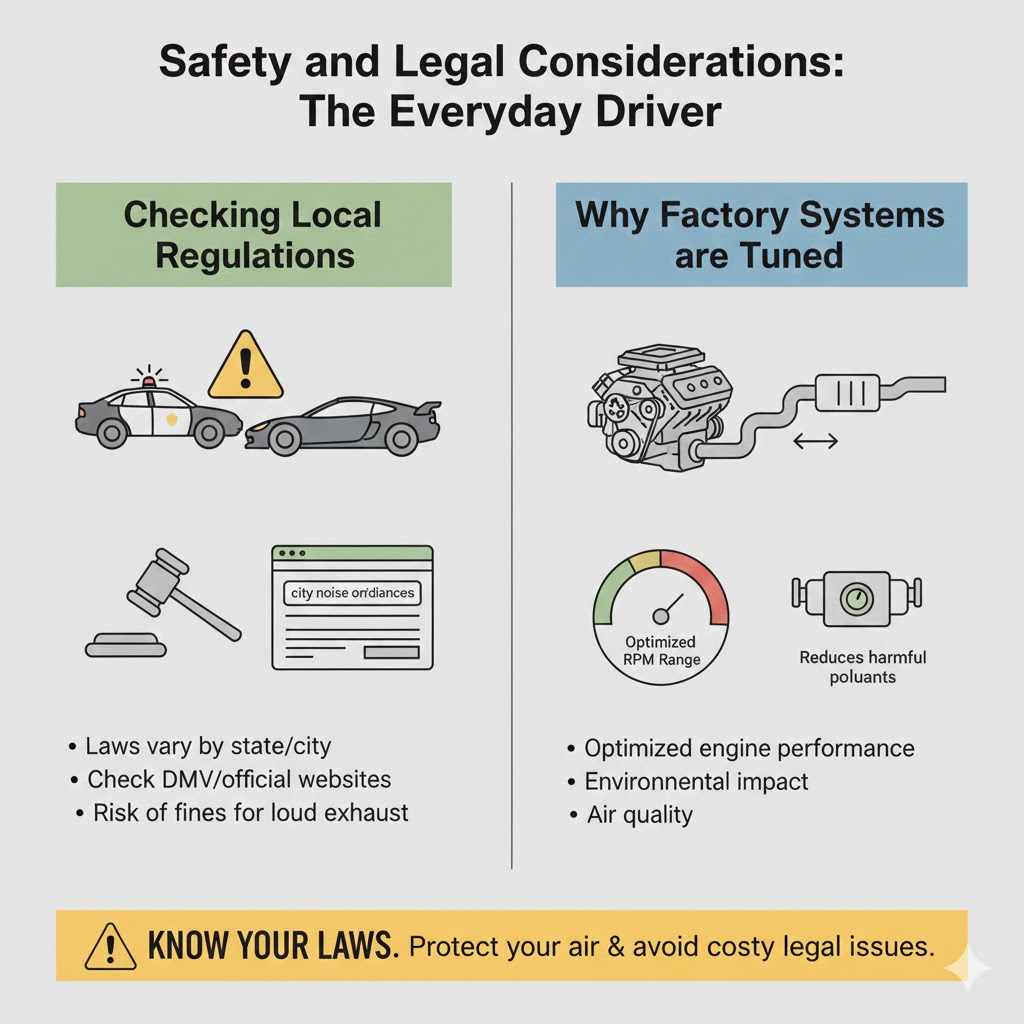
My priority is always your safety and ensuring your vehicle remains roadworthy. Before you even consider straight piping, you must check your local laws.
Checking Local Regulations
Laws regarding vehicle modifications change frequently and vary greatly by state, county, and city. You can often find local noise ordinances by searching your city or county’s official website. For instance, you might look up California Vehicle Code sections regarding noise if you are in that state, or consult your local Department of Motor Vehicles (DMV) resources.
Generally, if your exhaust is louder than stock, you risk getting pulled over, especially in densely populated areas.
Why Factory Systems are Tuned
Automotive engineers spend years tuning exhaust flow to optimize the engine’s performance across the entire RPM range, not just at wide-open throttle. The catalytic converter is essential for reducing pollutants like carbon monoxide and nitrogen oxides. Removing it is not just a performance decision; it’s an environmental one that directly affects the air quality in your neighborhood.
FAQ: Straight Piping for Beginners
Q1: Is straight piping my car illegal?
A: It depends entirely on where you live. In many places, modifications that make the exhaust excessively loud violate local noise ordinances. If you remove the catalytic converter, it is usually illegal under federal/state emissions laws.
Q2: Will straight piping give me more horsepower?
A: Maybe a little at very high RPMs, but often, it can actually decrease low-end torque for a standard engine. You need an ECU tune to really take advantage of the extra airflow for consistent gains.
Q3: What is exhaust drone, and how bad is it?
A: Drone is a constant, annoying humming noise at cruising speeds (like 55-70 mph). It’s caused by sound waves resonating inside the straight pipe. It can make long trips uncomfortable, and many drivers find it overwhelming.
Q4: Can I just remove the muffler and not the resonator?
A: Yes, this is called a “muffler delete.” It’s a popular middle ground. It makes the car louder but often keeps the drone down because the resonator helps cancel out those specific low frequencies.
Q5: Will straight piping hurt my engine’s reliability?
A: Removing the muffler or resonator usually won’t hurt reliability directly, but removing the catalytic converter can cause issues with sensors, leading to a Check Engine Light and potential long-term engine performance problems if the computer compensates incorrectly.
Q6: How much does it cost to straight pipe a car?
A: If you buy a simple replacement pipe and have a shop weld it in, costs can range from $100 to $300. If you have a full custom system fabricated, it will cost significantly more.
Conclusion: Making the Right Choice for Your Ride
Straight piping a car is a modification that delivers an undeniable, aggressive sound. It strips away the factory muffling to let your engine’s voice ring out clearly. As we’ve explored, this process fundamentally changes the sound profile, often resulting in a much deeper roar but carrying the significant risk of annoying highway drone and potential conflict with local noise laws.
If your primary goal is raw sound volume and you rarely drive on the highway, straight piping might seem tempting. However, for the everyday driver seeking a confident upgrade in sound without sacrificing comfort or facing constant legal worries, simpler options like a muffler delete or a quality cat-back system offer a much safer and more balanced approach.
Always prioritize local regulations, ensure your exhaust is securely mounted, and remember that a good modification enhances your driving experience, rather than detracting from it with constant noise or unwanted maintenance issues. Drive confidently, knowing you made an informed decision for your vehicle!