What Is A Demo Car? The Ultimate Essential Answer
A demo car is a new vehicle used by a dealership for test drives, as a temporary car for staff, or as a loaner for service customers. It has low mileage but is sold at a discount because it’s technically no longer brand new. It’s an excellent way to get a like-new car for a lower price.
Have you ever walked into a car dealership and seen a great deal on a car that looks new but has a few miles on the odometer? You might have stumbled upon a “demo car.” It’s a common term, but what does it really mean? Is it new? Is it used? Is it a good deal?
Thinking about buying a car can be overwhelming. There are so many options, and the jargon can be confusing. But don’t worry. I’m Md Meraj, and my job is to make car topics simple and clear for everyone. You don’t need to be a mechanic to make a smart car-buying decision.
In this guide, we’ll break down exactly what a demo car is, look at the pros and cons, and give you a simple checklist to follow if you consider buying one. Let’s make this journey easy and confident together.
What Exactly Is a Demo Car?
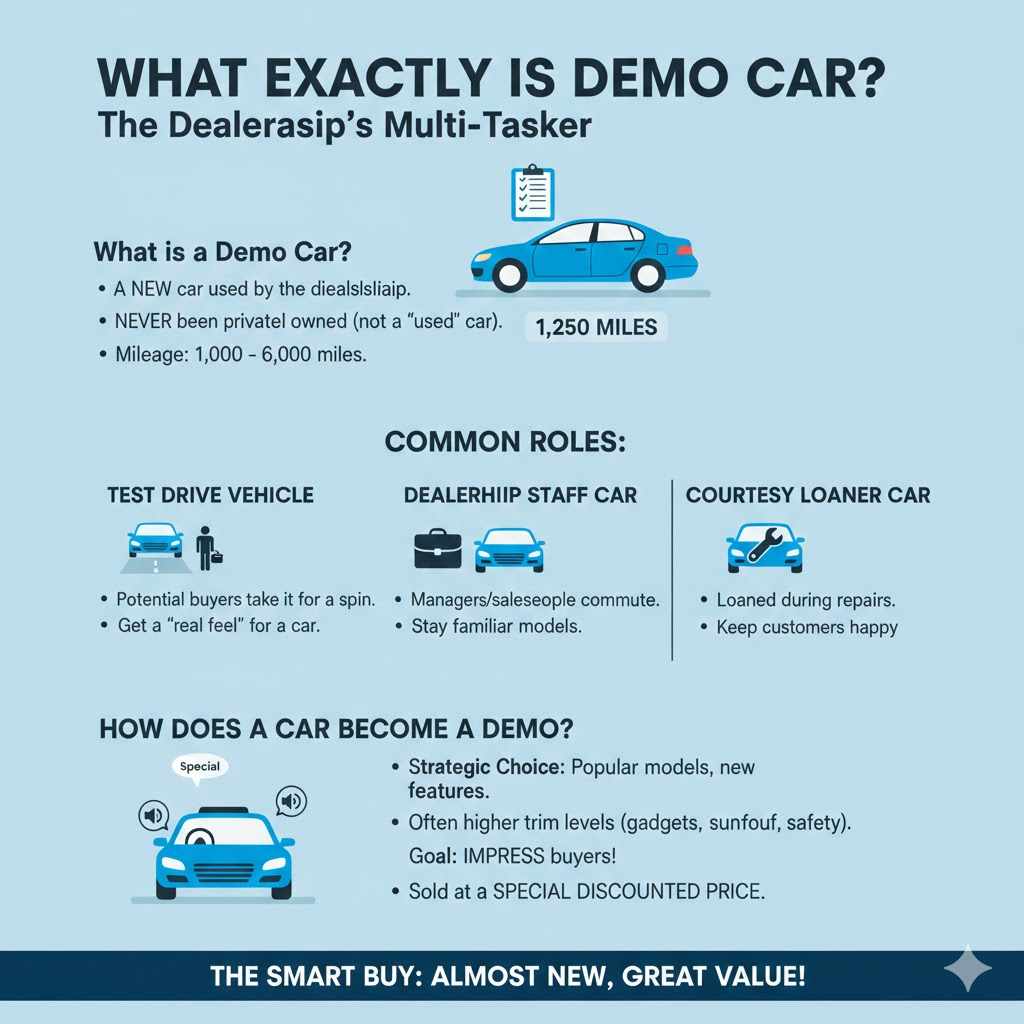
Think of a demo car, or “demonstrator,” as a car with a very specific job. It’s a new car that a dealership owns and uses for business purposes before selling it to a customer. It has never been privately owned, which is a key difference between a demo car and a used car.
So, what kind of work does a demo car do? Here are its most common roles:
- Test Drive Vehicle: This is the most common use. When you want to see how a new model drives, the salesperson will likely grab the keys to a demo car. It gives potential buyers a real feel for the car on the road.
- Dealership Staff Car: Sometimes, managers or top salespeople at the dealership use a demo car for their daily commute. It helps them stay familiar with the models they sell.
- Courtesy Loaner Car: If you take your car to the dealership for a big repair, they might give you a demo car to use while yours is in the shop. This is a great way for them to keep you happy and show off a newer model.
Because these cars are used for these tasks, they will have some miles on them—usually between 1,000 and 6,000 miles. They are not fresh off the factory truck, but they are also not your typical “used” vehicle. This puts them in a unique sweet spot that can be very attractive to savvy buyers.
How Does a Car Become a Demo Car?
A dealership doesn’t just pick a car at random to be a demo. They are often strategic about it. Dealerships tend to choose models that are popular or have new features they want to highlight. They might pick a higher trim level with all the fun gadgets, like a sunroof, a premium sound system, or advanced safety features. Their goal is to impress potential buyers during a test drive, so they want the car to be a great example of what the model has to offer.
Once a demo car reaches a certain mileage or has been in service for a few months, the dealership will decide it’s time to sell it. They then clean it up, make sure it’s in top shape, and put it on the lot with a special discounted price.
Demo Car vs. New Car vs. Used Car: What’s the Difference?
Understanding the key differences between these car categories is crucial for making an informed decision. They each have their own set of benefits and drawbacks. Let’s break it down in a simple table so you can see everything side-by-side.
| Feature | New Car | Demo Car | Used Car |
|---|---|---|---|
| Mileage | Under 100 miles (usually just from transport) | Typically 1,000 – 6,000 miles | Any mileage above a demo car |
| Ownership History | None. You are the first owner. | Owned by the dealership, never privately registered. | Owned by at least one private individual. |
| Price | Full Manufacturer’s Suggested Retail Price (MSRP) | Discounted from MSRP | Varies greatly based on age, condition, and mileage. |
| Warranty | Full manufacturer’s warranty from the date of purchase. | Remaining portion of the manufacturer’s warranty. | May have remaining warranty, a dealer warranty, or no warranty. |
| Condition | Pristine, straight from the factory. | Excellent, but may have minor cosmetic wear. | Varies from excellent to poor. |
A Deeper Look at the Differences
The table gives you a quick overview, but let’s talk a bit more about what these differences mean for you.
For a New Car, you get the peace of mind of being the very first owner. Everything is perfect, the mileage is near zero, and the full warranty starts the day you drive it off the lot. The downside? You pay the highest price due to depreciation, which is the loss in a car’s value over time. A new car loses a significant chunk of its value the moment you drive away.
For a Used Car, you get the biggest potential savings. The first owner has already absorbed the biggest hit of depreciation. However, a used car comes with more unknowns. You don’t know how the previous owner treated it, and the warranty may have already expired. You need to be extra careful and get a thorough inspection.
A Demo Car sits perfectly in the middle. You get a substantial discount compared to a new car, avoiding that initial steep depreciation. You also get more peace of mind than with a typical used car because you know it was maintained by the dealership. The main trade-off is that you aren’t the first person to drive it, and the warranty has already started ticking.
The Pros and Cons of Buying a Demo Car
Like any car-buying decision, purchasing a demo car comes with its own set of advantages and disadvantages. Knowing both sides will help you decide if it’s the right choice for your needs and budget.
The Pros: Why a Demo Car Can Be a Great Deal
- Significant Savings: This is the biggest draw. Demo cars are priced lower than their brand-new counterparts. The discount is meant to compensate for the mileage and minor wear. You can often save thousands of dollars on a vehicle that is practically new.
- Well-Maintained Vehicle: Since the car is owned by the dealership and used to impress customers, it’s almost always kept in excellent condition. The dealership’s own service department performs all the scheduled maintenance, so you know it has been cared for by professionals.
- Includes Remaining Warranty: A demo car is sold with the remainder of the factory warranty. While the warranty clock started when the car was put into service by the dealership, you still get a significant amount of coverage. Be sure to ask for the exact “in-service” date to know how much warranty is left.
- Often High-End Models: Dealerships want to showcase the best features of a model. That’s why demo cars are frequently higher trim levels with premium options like leather seats, advanced tech packages, and larger engines. You get more features for less money.
- You Know Its History: Unlike a used car from a private seller, the history of a demo car is completely transparent. The dealership has all the records and can tell you exactly how it was used.
The Cons: What to Watch Out For
- Some Miles on the Clock: It’s not a brand-new car with zero miles. While the mileage is low, it still has been driven. This means some components have already experienced wear.
- Potential for Minor Wear and Tear: Many different people have driven a demo car on test drives. Some might have driven it hard, testing its acceleration and braking. Look closely for small scratches, dings in the doors, or scuffs on the interior.
- Warranty Has Already Started: This is a big one. The manufacturer’s warranty begins on the date the dealership puts the car into service, not the date you buy it. If a car was a demo for six months, you’ve already lost six months of warranty coverage. Always confirm the start date.
- Limited Selection: You can’t just pick any color or trim you want. The selection of demo cars is limited to what the dealership has been using. If you have your heart set on a specific configuration, you might not find it as a demo.
- It May Be Considered “Used” for Financing: Some banks and credit unions may classify a demo car as used, which can sometimes lead to slightly higher interest rates on a loan compared to a new car. It’s important to check with your lender beforehand.
A Special Case: The “Show Car” or “Promotional Vehicle”
Now, let’s address a very specific question: what’s it called when a car body kit company makes a car to show off the bodykit?
This is a different beast entirely from a dealership demo car. These vehicles are typically called “show cars,” “promotional cars,” or “display vehicles.”
A show car is built for one primary purpose: marketing. A company that makes aftermarket parts—like body kits, wheels, suspension systems, or performance upgrades—will build a car to be a rolling advertisement for their products. You’ll see these incredible-looking vehicles at big auto shows like the SEMA Show in Las Vegas, in magazines, or on social media.
How Is a Show Car Different from a Demo Car?
Here’s a simple breakdown of the key differences:
| Feature | Dealership Demo Car | Promotional Show Car |
|---|---|---|
| Purpose | Test drives and daily use by the dealership. | Marketing and showcasing aftermarket products. |
| Modification Level | Stock from the factory, usually a high trim level. | Heavily modified with non-factory parts (body kits, wheels, etc.). |
| Condition | Driven regularly, may have minor wear. | Often kept in pristine, show-ready condition, but modifications may affect daily drivability. |
| Warranty | Remaining factory warranty. | Factory warranty may be voided by the modifications. |
| Where to Buy | Official new car dealerships. | Usually sold directly by the parts company, a specialty dealer, or a private sale after its promotional life is over. |
Buying a show car can be exciting, but it’s a decision for an enthusiast who understands what they’re getting into. The heavy modifications can make the car less practical for daily driving, and getting it serviced can be tricky. The unique parts may not be covered by any warranty, and finding a mechanic who can work on it might be a challenge. If you’re a beginner, it’s generally safer and simpler to stick with a standard dealership demo car.
Your Smart Buyer’s Checklist for a Demo Car
Feeling like a demo car might be the right choice for you? Great! Now, let’s get you ready to buy one with confidence. Follow this simple, step-by-step checklist to make sure you get a great vehicle at a fair price.
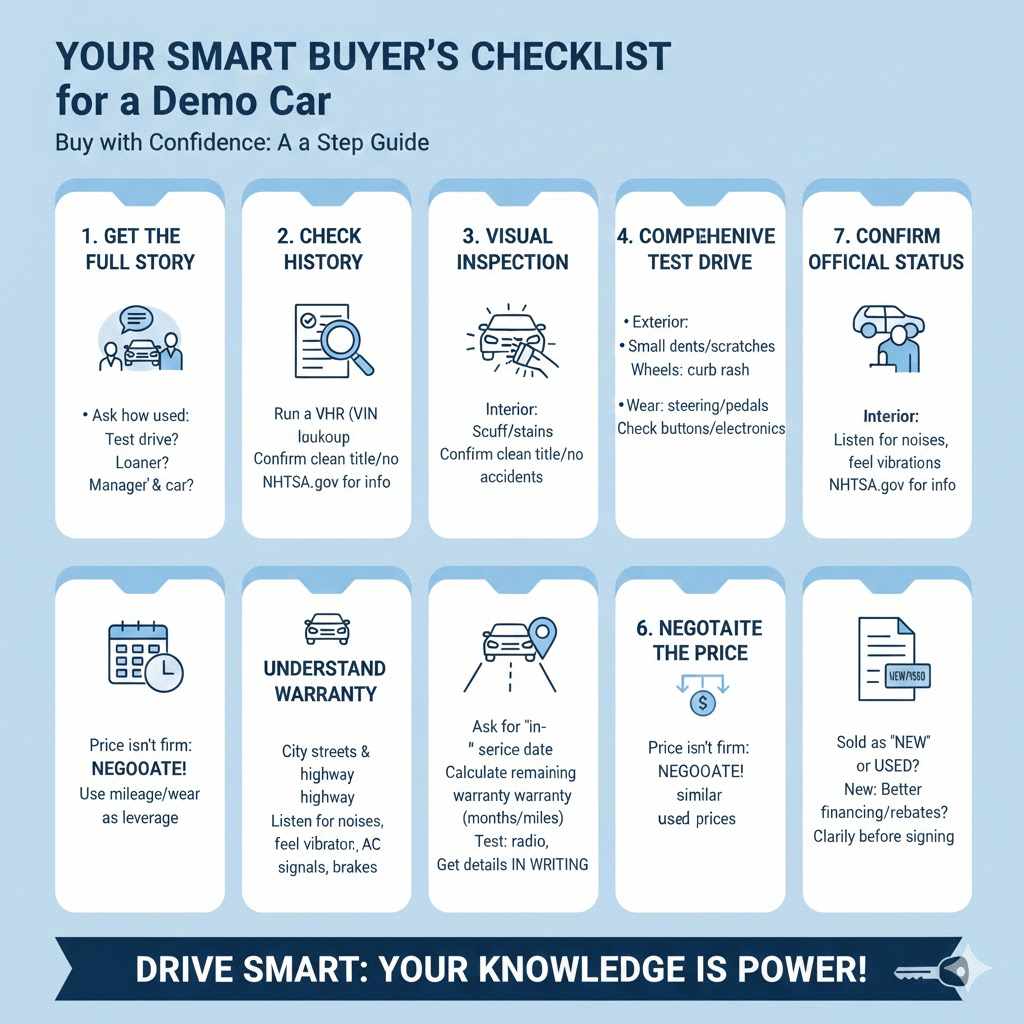
Get the Full Story
Ask the salesperson how the car was used. Was it a test-drive vehicle? A loaner car? A manager’s personal driver? This gives you an idea of how it was treated. A manager’s car likely had an easier life than a test-drive car driven by hundreds of different people.
Check the Vehicle History Report (VHR)
Even though the car hasn’t been privately owned, it’s still a smart move to run a VHR. This will confirm it has a clean title and hasn’t been in any reported accidents. You can check a vehicle’s history using its VIN (Vehicle Identification Number). Resources like the National Highway Traffic Safety Administration (NHTSA) provide valuable information on how to get a vehicle’s history.
Do a Thorough Visual Inspection
Treat it like you would any used car. Walk around the entire vehicle in good light. Look for:
- Exterior: Small dents, dings, and scratches, especially on the doors and bumpers. Check the wheels for curb rash.
- Interior: Look for scuffs on the plastic trim, stains on the seats or carpet, and wear on the steering wheel, shifter, and pedals. Check that all the buttons and electronics work.
Tires: Check the tire tread. Low mileage doesn’t guarantee the tires are perfect, especially if the car was driven aggressively on test drives.
Take a Comprehensive Test Drive
Don’t just drive it around the block. Take it on a route that you normally drive, including city streets and highways. Listen for any strange noises, feel for vibrations, and make sure the brakes are smooth and responsive. Test everything—the radio, the air conditioning, the turn signals—to ensure it all works as it should.
Understand the Warranty Details
This is one of the most important steps. Ask for the “in-service date.” This is the exact date the dealership started using the car, which is when the warranty period began. Calculate how many months and miles are left on the warranty. Make sure you get this information in writing.
Negotiate the Price
Just because the car is already discounted doesn’t mean the price is firm. You still have room to negotiate. Use the car’s mileage and any wear and tear you found during your inspection as leverage. Research what a similar used model with the same mileage is selling for to help you make a fair offer.
Confirm Its Official Status
Ask the dealership if the car will be sold and registered as “new” or “used.” In most states, a car that has never been titled to a private owner can still be sold as new. This can be beneficial for getting better financing rates and may even qualify you for new-car incentives or rebates. Clarify this before you sign any paperwork.
Frequently Asked Questions (FAQ)
Is a demo car considered new or used?
This can be a bit tricky, but in most cases, a demo car that has never been registered to a private owner can legally be sold as a “new” car. This is a huge advantage because it may qualify you for new-car financing rates and incentives. However, for insurance purposes, some companies may classify it based on its mileage. Always clarify its status with both the dealer and your insurance agent.
Does a demo car come with a full warranty?
No, it comes with the remainder of the full factory warranty. The warranty’s clock starts ticking on the “in-service date”—the day the dealership first started using the car. For example, if it has a 3-year/36,000-mile warranty and was used as a demo for 6 months and 4,000 miles, you will have 2.5 years and 32,000 miles of warranty coverage left.
How much cheaper is a demo car?
The discount varies depending on the car’s model, mileage, and condition, but you can typically expect to save anywhere from 10% to 20% off the original MSRP. The discount is often calculated based on a certain amount per mile driven, plus deductions for any cosmetic imperfections.
Can I lease a demo car?
Yes, many dealerships offer leasing options on their demo cars. Because the car’s value has already depreciated slightly, a lease on a demo car can sometimes result in a lower monthly payment than a lease on a brand-new equivalent. If you prefer leasing, it’s definitely worth asking about.
What mileage is too high for a demo car?
There’s no hard-and-fast rule, but a typical demo car has between 1,000 and 6,000 miles. If you see a demo car with more than 8,000 miles, the discount should be significantly larger. At that point, it starts to compete more with certified pre-owned (CPO) vehicles, so you should compare your options carefully.
What’s the difference between a demo car and a loaner car?
These terms are often used interchangeably, as many demo cars also serve as loaners for service customers. A “loaner” is simply a car loaned to a customer. A “demo” is a broader term for a car used by the dealership for any business purpose, including test drives. The important thing isn’t the name but the car’s history, mileage, and condition.
What is a “show car” from a body kit company called?
A car built by a body kit company or other aftermarket manufacturer to display their products is called a “show car,” “promotional vehicle,” or “display car.” These are very different from dealership demo cars, as they are heavily modified and built for marketing, not for general test drives.
Conclusion: Is a Demo Car Right for You?
So, there you have it. A demo car is that unique vehicle that bridges the gap between new and used. It offers the enticing discount of a used car with many of the benefits of a new one, like a factory warranty and a known history of professional maintenance.
Buying a demo car can be an incredibly smart financial decision. You let the dealership take the biggest depreciation hit while you drive away in a nearly new car for thousands less. However, it’s not a decision to be made lightly. You have to be comfortable with a car that has a few miles on it and a slightly shorter warranty period. You also need to do your homework by following the checklist, inspecting the car carefully, and asking the right questions.
By now, you should feel much more confident about what a demo car is and whether it fits your needs. Remember, knowledge is your best tool in the car-buying process. Take your time, trust your gut, and you’ll be well on your way to finding the perfect car at a price you feel great about. Happy driving!