What is S in Car Gear: Unlocking Sport Mode Benefits
S in a car gear selector usually means Sport mode, or a sport-oriented setting. The transmission often holds lower gears longer, downshifts sooner, and keeps the engine in a higher rpm range for quicker response. Used at the wrong time, it can add noise, cut fuel economy, and make the car feel busy without giving you any real gain. This guide explains what S changes inside the transmission, when it helps, and when you should leave it alone.
What does S mean in a car shifter?
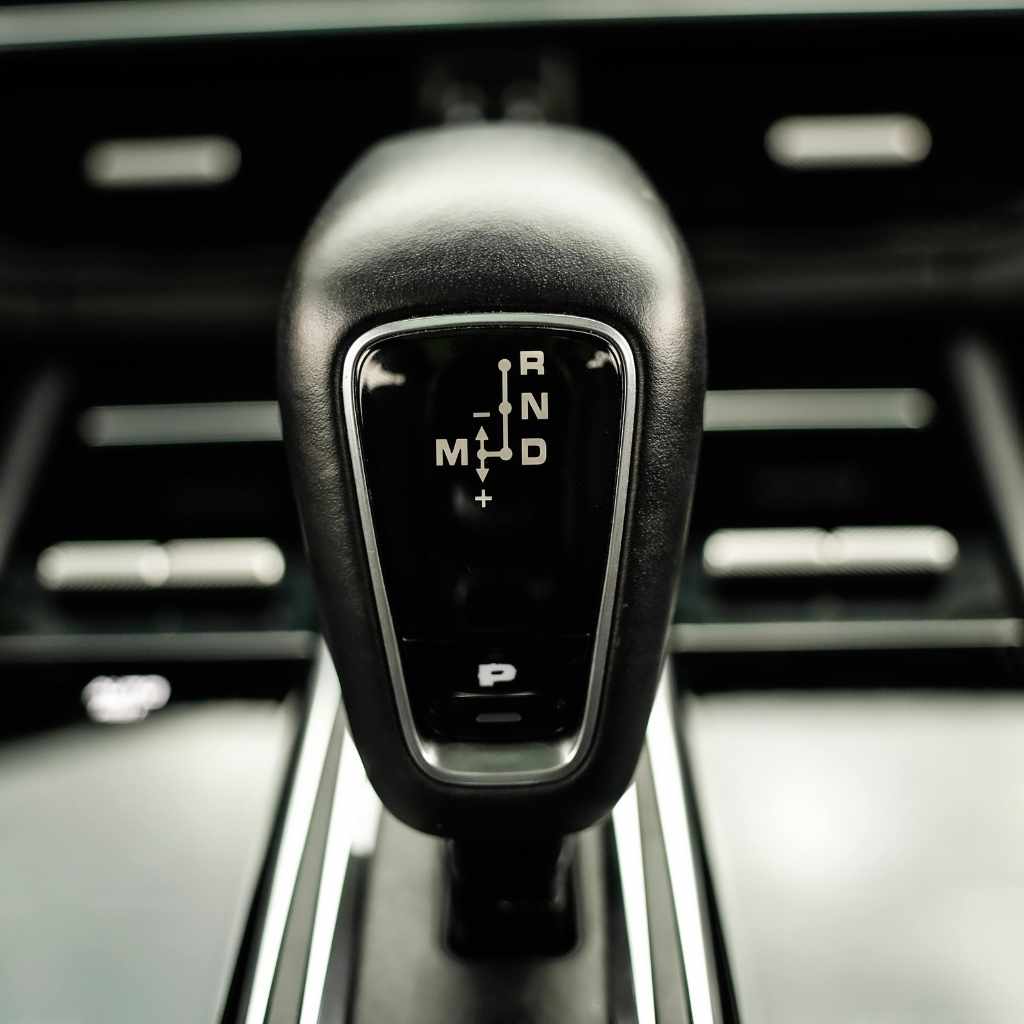
S usually means Sport mode or a sport-oriented setting, but the exact behavior depends on the manufacturer. In many automatic transmissions, it changes shift logic so the gearbox keeps the engine in a higher rpm band and reacts faster to throttle input. Some cars make S a separate selector position; others use a button or software setting.
The label is common, but the action is not universal. One model may sharpen shifts and hold gears. Another may mainly change throttle mapping, with only modest shift changes. Some versions also work with a manual-like mode, where the transmission still protects itself if you ask for an unsafe gear.
How the selector layout usually works
Many automatics place P, R, N, D, and S in the same general pattern, with S separate from Drive. The exact location varies by model, so the lever, dial, or button may not look the same from one vehicle to the next. That placement does not guarantee the same function.
How S mode changes transmission behavior
S mode changes the transmission control logic rather than acting like a simple label. In many automatics, the transmission control unit shifts later, downshifts sooner, and keeps the engine spinning faster for quicker response. The result is usually a stronger acceleration feel, not a higher top speed.
Higher shift points and rpm
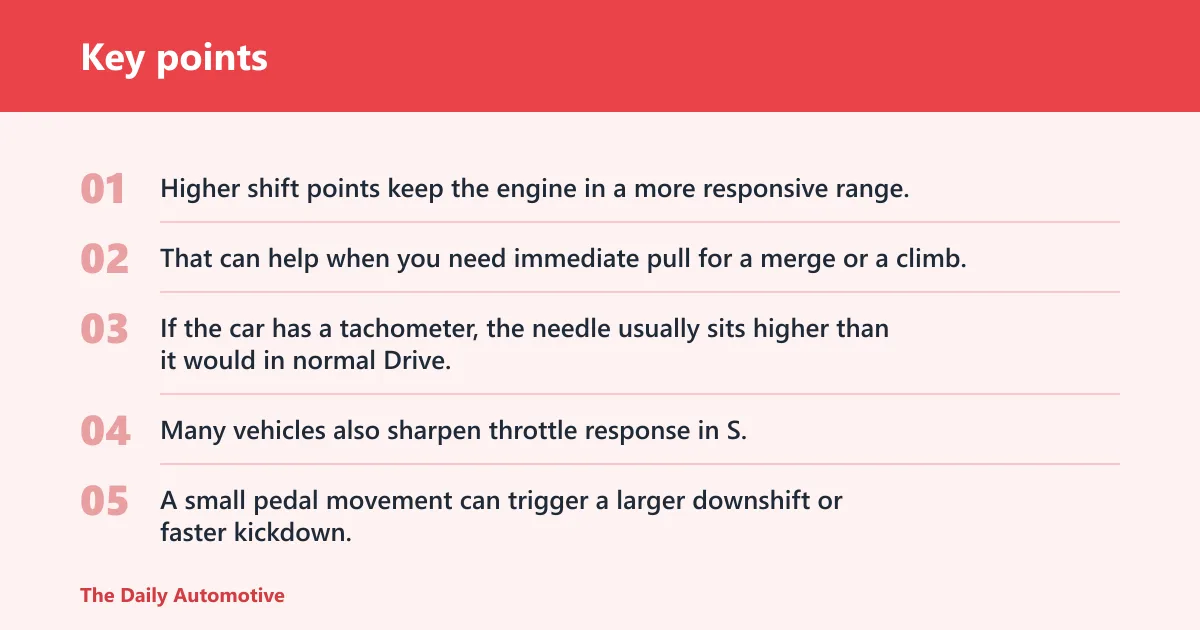
Higher shift points keep the engine in a more responsive range. That can help when you need immediate pull for a merge or a climb, but it also means more engine noise and more fuel use. If the car has a tachometer, the needle usually sits higher than it would in normal Drive.
Throttle response and gear holding
Many vehicles also sharpen throttle response in S. A small pedal movement can trigger a larger downshift or faster kickdown. The gearbox may hold a lower gear longer while you stay on the throttle, which cuts hesitation but can make steady-speed driving feel busy.
How the control unit reacts
Automatic transmissions rely on a transmission control unit, and that controller can change shift logic based on the mode you select. On some vehicles, it also accepts manual-like commands from paddle shifters or the lever. Even then, the control logic may override your request to protect the engine or gearbox.
Suppose you are merging onto a freeway from a short ramp. In normal Drive, the transmission may upshift early and ask for more pedal before it responds. In S, it may stay in a lower gear longer, which gives cleaner acceleration without needing a full-throttle push.
Sport mode decision table
| Driving situation | Expected benefit | Downside | Recommendation |
|---|---|---|---|
| Merging | Faster response and quicker downshifts | Higher rpm and more cabin noise | Use if you need a short burst of acceleration |
| Mountain roads | Better gear holding on climbs and descents | More engine braking and louder operation | Good choice on clear roads with repeated grade changes |
| City traffic | Sharper pickup from low speeds | Can feel jerky and waste fuel in stop-and-go driving | Use only when you want extra response for a brief stretch |
| Highway cruising | Little or no real benefit | Higher rpm, more noise, and worse economy | Leave it in normal Drive |
| Towing | Helps the transmission avoid hunting between gears | Can raise rpm and heat if you push too hard | Useful on grades or when load control matters |
| Wet roads | Possible quicker throttle response if needed | Easier to spin the tires or upset traction | Usually avoid unless conditions and speed are controlled |
| Spirited driving | Improved response and more direct feel | More noise and higher fuel use | Appropriate on dry roads when you want quicker acceleration feel |
| Fuel-saving commuting | None in normal use | Usually burns more fuel than Drive | Do not use it for routine economy commuting |
Is S mode the same as Sport mode?
S mode is often Sport mode, but not every vehicle uses it the same way. In some cars, S is a true sport setting that changes shift points, throttle response, and gear holding. In others, it is a software mode or button that changes only part of that behavior.
That difference matters. A car with a real S selector position may keep the transmission in a sport schedule until you move the shifter again. A separate sport button may alter shift timing, steering effort, or throttle mapping while the lever stays in Drive. You need the owner’s manual to know which system your vehicle uses.
When S is a true sport setting
When S is built into the selector, it usually tells the transmission to behave differently right away. The gearbox may downshift sooner, upshift later, and resist moving into taller gears. That is common in automatic transmissions, including some CVTs and dual-clutch units, though the details vary by type.
When S is a software mode or button
Some vehicles use a separate mode button rather than a shifter position. In those cases, the drivetrain may still feel more eager, but the shift lever itself does not move to a distinct S gate. The label can look similar across brands while the control logic underneath differs a lot.
When should you use S mode?
S mode is most useful when you want quicker response or more gear control than normal Drive gives you. It works well for merging, passing, hill climbs, towing, and dry-road driving when you want the transmission to stay in a lower gear longer. It is usually less useful for relaxed commuting or steady highway cruising.
Merging and passing
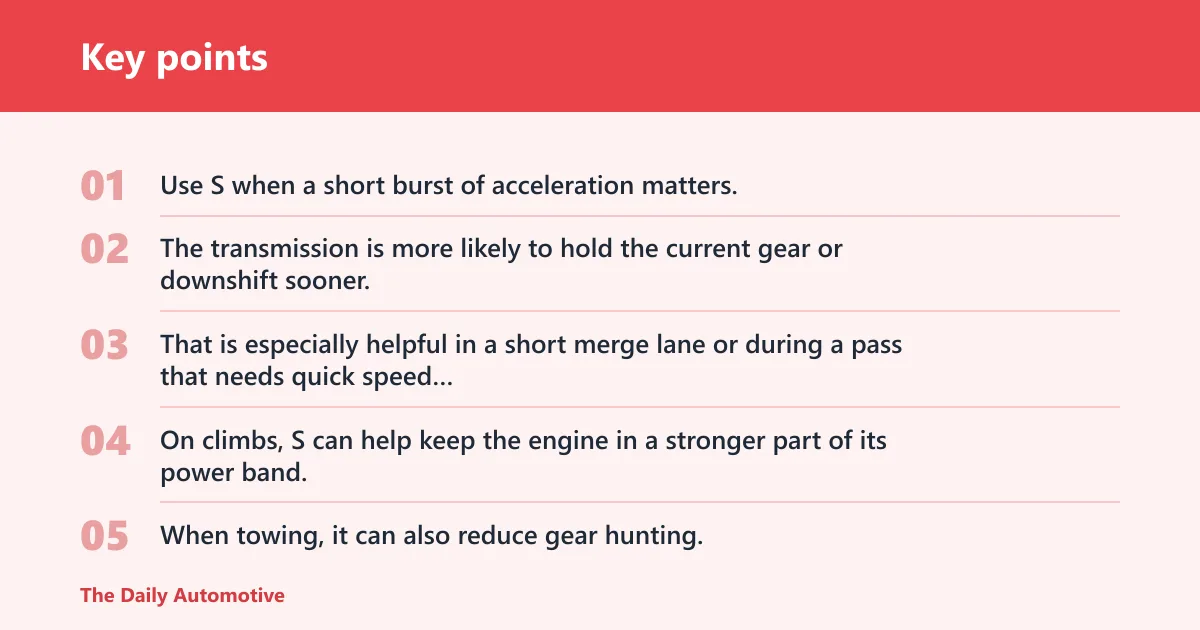
Use S when a short burst of acceleration matters. The transmission is more likely to hold the current gear or downshift sooner, which can reduce hesitation when you need a gap. That is especially helpful in a short merge lane or during a pass that needs quick speed gain.
Mountain roads and towing
On climbs, S can help keep the engine in a stronger part of its power band. When towing, it can also reduce gear hunting, where the transmission keeps switching back and forth between ratios. That said, you still need to watch rpm, load, and temperature if the vehicle is working hard.
Spirited driving on dry roads
On clear pavement, S can make the car feel more immediate. It often improves acceleration feel more than top speed, because the car is already capable of the same maximum speed in Drive. The change is in how quickly the transmission gets there.
A common first-timer mistake is leaving S on during a 40-minute highway commute because the car feels “more ready.” At a steady 65 mph, the engine may sit at a higher rpm than needed, the cabin may get louder, and the fuel penalty appears with no real payoff.
When S mode is the wrong choice
S mode is often a poor fit for wet, icy, or other low-grip roads, and it is usually not the best choice for long, steady commutes. The higher-rpm behavior can make throttle response feel abrupt, which is the opposite of what you want when traction is limited or when you are trying to save fuel.
Wet or icy roads
On slippery surfaces, extra throttle response can make the car harder to modulate. A lower gear may also send more torque to the wheels than you want. Driver control matters more than the mode label here, and normal Drive usually gives a calmer, easier-to-manage response.
Highway cruising
At a steady cruise, S usually offers little advantage. The transmission may hold a lower gear or avoid its most economical shift pattern, which can add noise and raise rpm without making the car meaningfully quicker. If the road is flat and traffic is light, Drive is usually the better fit.
Fuel-saving commuting
For economy-focused driving, S works against your goal. Higher rpm usually means higher fuel use, especially in stop-and-go traffic where the transmission keeps responding to small throttle changes. If fuel economy matters, use the normal shift schedule and avoid unnecessary throttle inputs.
Can you shift to S while driving?
In many vehicles, yes. Moving from D to S while driving is usually allowed, but you should check the owner’s manual because the procedure and behavior vary by model. Some vehicles let you move directly into S at speed. Others want a specific lever movement or button press.
The important point is that S is often a normal operating mode, not a parking-only setting. Still, the transmission may react immediately, so the car can downshift as soon as you select it. If road speed, traction, or engine load make that change awkward, wait until conditions are smoother.
- Check the owner’s manual for the exact selector procedure.
- Move to S only when you want different shift behavior, not as a habit.
- Watch for a downshift or higher rpm after the mode change.
- Return to Drive when you want quieter, steadier, more economical cruising.
Frequently asked questions
What does S mean in a car gear shifter?
S usually means Sport mode or a sport-oriented setting. In many automatic transmissions, it tells the control unit to hold lower gears longer, shift later, and keep the engine at a higher rpm. The exact result depends on the manufacturer, so the same label can behave differently across models.
What happens when I put my car in S mode?
The transmission usually becomes more eager to downshift and less eager to upshift. That keeps the engine in a stronger response range, which can help with passing, merging, or climbing. It also increases noise and fuel use in many cars, especially if you keep it on during steady driving.
When should I use S mode while driving?
Use it when you want quicker response for merging, passing, hills, towing, or dry-road driving with a more direct feel. It is usually less useful for highway cruising, fuel-saving commuting, or low-grip roads. If the road is slippery, the calmer Drive setting is usually easier to manage.
Does S mode use more fuel?
Usually, yes. Because the engine spends more time at higher rpm, fuel use often rises compared with normal Drive. The exact penalty depends on vehicle design, terrain, and how hard you press the accelerator. If your goal is economy, S is usually the wrong choice.
Is it bad to leave my car in S mode all the time?
Usually, it is unnecessary and often less efficient. If you are driving normally, S can keep rpm higher than needed, add cabin noise, and use more fuel. It is not automatically harmful, but it is usually better reserved for moments when you actually want sportier shift behavior.
Does S mode work on an automatic transmission?
Yes, that is where it is most common. Automatic transmissions use a transmission control unit, and S changes the shift schedule that controller follows. Some CVTs and dual-clutch units also have S, but their behavior is not identical to a traditional automatic, so the result can vary by design.
Products related to this article
Sponsored / affiliate links. As an Amazon Associate I earn from qualifying purchases. I may earn additional commission from eligible campaigns.