What Is a Car Down Payment? Typical Amount Is 20 Percent
A car down payment is cash you pay upfront on a vehicle purchase, and 20 percent is a common target because it cuts the loan amount, interest cost, and negative-equity risk. Put down too little and you may owe more than the car is worth. This guide explains when 20 percent makes sense, when less is reasonable, and how trade-ins and gap insurance change the math.
What is a car down payment?
A car down payment is the amount you pay before financing the rest of the vehicle. It applies to new and used cars, and some buyers can qualify for a zero-down auto loan. The main effect is simple: more money down means a smaller auto loan principal.
That matters because the loan principal equals the purchase price minus the down payment and any trade-in credit. A smaller principal usually means a smaller monthly payment and less interest over the life of the loan. A larger down payment also helps you build equity faster.
Say you buy a $30,000 car and put $6,000 down. Your loan starts at $24,000 before taxes, fees, and any trade-in effect. If you put $3,000 down instead, you finance $27,000. That $3,000 difference changes both the monthly bill and the total interest charged.
Zero-down financing can work for some borrowers, but it leaves you more exposed if the car loses value quickly. That is where depreciation and negative equity become a problem early in the loan.
How much should you put down?
Typical car down payment amounts run from 10% to 20% of the vehicle’s total value. Brand-new cars are generally closer to 20%, while used cars are usually closer to 10%. Those are common benchmarks, not mandatory rules.
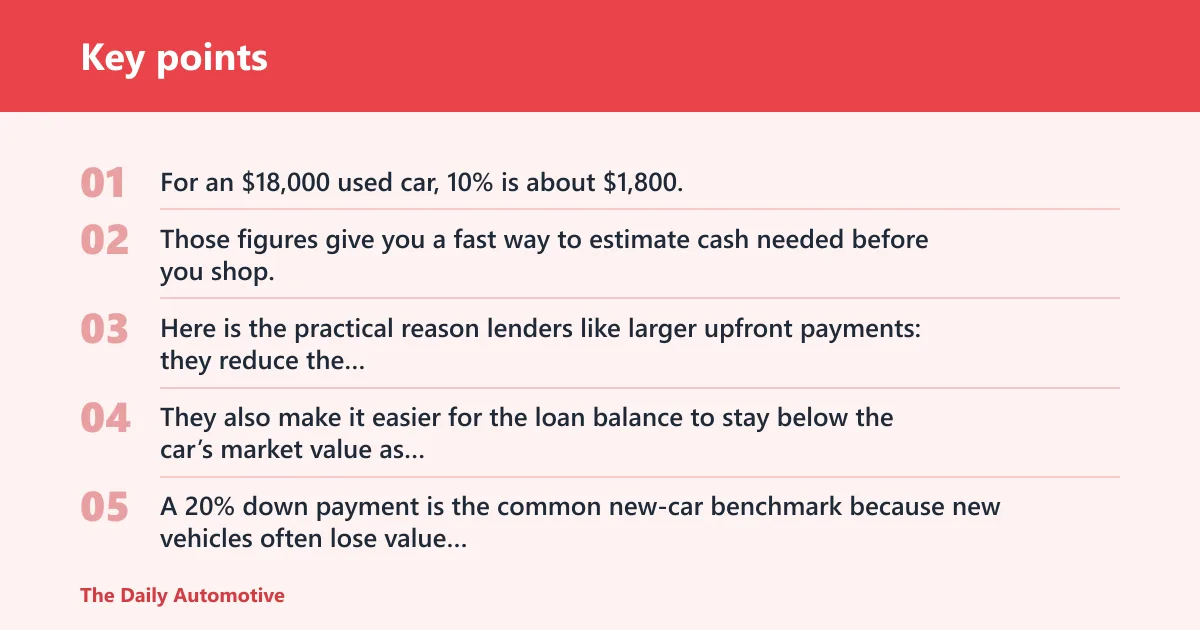
For a $25,000 new car, 20% is about $5,000. For a $35,000 new car, 20% is $7,000. For an $18,000 used car, 10% is about $1,800. For a $22,000 used car, 10% is $2,200. Those figures give you a fast way to estimate cash needed before you shop.
Here is the practical reason lenders like larger upfront payments: they reduce the amount financed, which can lower monthly payments and reduce interest. They also make it easier for the loan balance to stay below the car’s market value as the vehicle depreciates.
New-car benchmark
A 20% down payment is the common new-car benchmark because new vehicles often lose value quickly in the first year. That larger upfront amount helps create more equity on day one and reduces the chance of starting the loan upside down.
Used-car benchmark
A 10% down payment is the common used-car benchmark because the buyer is usually financing a lower price to begin with. Credit profile can still move the target higher or lower. Strong credit may help with approval and terms, while weaker credit may lead a lender to ask for more upfront money.
Dollar examples for common prices
| Vehicle price | 20% down | 10% down | Loan principal after down payment |
|---|---|---|---|
| $20,000 | $4,000 | $2,000 | $16,000 at 20%; $18,000 at 10% |
| $30,000 | $6,000 | $3,000 | $24,000 at 20%; $27,000 at 10% |
| $40,000 | $8,000 | $4,000 | $32,000 at 20%; $36,000 at 10% |
Does a bigger down payment help?
A bigger down payment usually helps because it shrinks the loan principal. That can lower the monthly payment, reduce total interest, and improve your equity position faster. It may also improve the rate a lender is willing to offer, since a larger upfront stake lowers lending risk.
Car loans use the standard amortization formula, so even a modest reduction in principal can change the total cost over time. The effect is strongest on longer loans, where interest has more months to build up. Industry research tracked an average auto loan term of 68 months for new cars, which gives extra time for interest to add up.
Suppose two buyers finance the same $32,000 car. One puts $2,000 down and one puts $8,000 down. The second buyer starts with a $6,000 smaller principal. That difference can trim the monthly payment and shorten the amount of interest that builds over the term.
A larger down payment is less useful if you need to drain your emergency savings to make it. A cash cushion still matters. If a flat tire, repair, or job change would force new debt, a slightly smaller down payment may be the safer choice.
How does credit score affect the down payment?
Credit score can affect loan approval, the down payment a lender asks for, and the terms you receive. Borrowers with the highest credit scores are more likely to see the lowest down payment requirements. Lower scores can mean stricter terms because the lender sees more risk.
That does not mean every lender uses the same rule. It means credit score changes the odds. A strong credit profile can make a low down payment or even a zero-down offer more likely, while a weak profile can push the required upfront amount higher.
Credit also affects the size of the payment in a second way. Better credit can improve the interest rate, and a lower rate means less interest charged over time. So the same car can cost less to finance even before you change the down payment amount.
A buyer with weaker credit should compare the cost of putting more money down against the benefit of keeping cash on hand. If the down payment is the only thing keeping the deal together, the real question is whether the payment and the loan terms still fit the budget.
Should I use a trade-in as part of my down payment?
Yes, if the trade-in has positive equity. Trade-in value can supplement a small cash down payment and reduce the amount left to finance. That can help you reach the lender’s target without bringing as much cash to the deal.
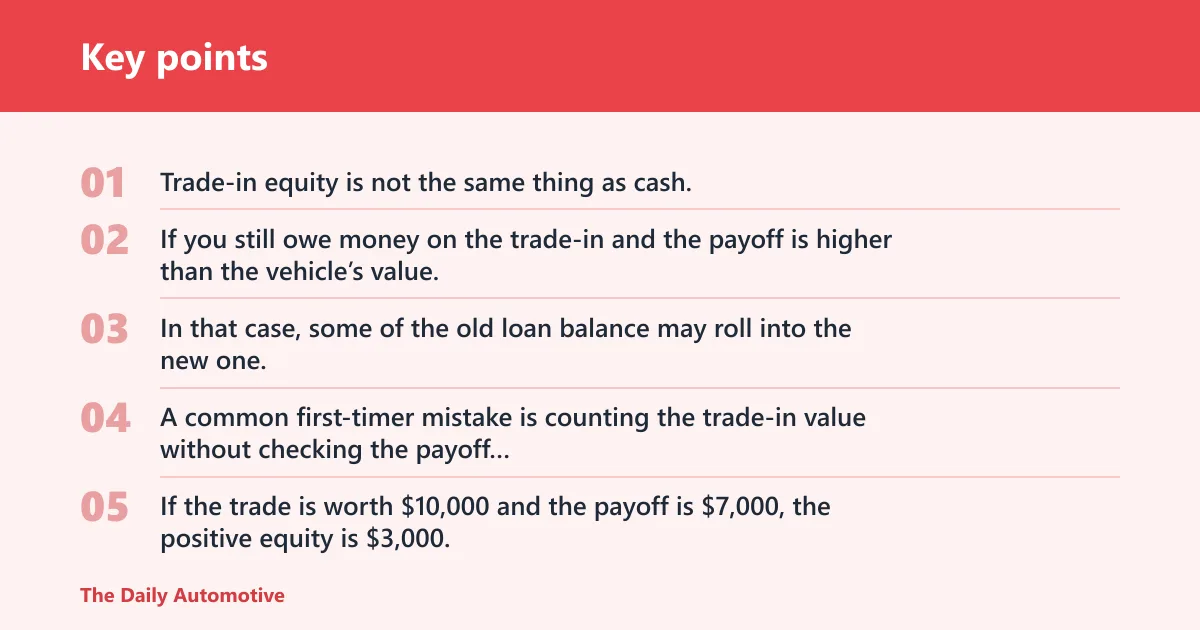
Trade-in equity is not the same thing as cash. If you still owe money on the trade-in and the payoff is higher than the vehicle’s value, you have negative equity, which can reduce the benefit. In that case, some of the old loan balance may roll into the new one.
A common first-timer mistake is counting the trade-in value without checking the payoff first. If the trade is worth $10,000 and the payoff is $7,000, the positive equity is $3,000. That $3,000 can act like part of your down payment.
When gap insurance matters
Gap insurance helps if a car is totaled before positive equity is built. That matters most when you put little money down, finance a long term, or start with negative equity. In those cases, the insurance can cover the gap between what you owe and what the vehicle is worth after a total loss.
Picture a buyer who puts no money down on a $28,000 car and signs a long loan. In the first year, depreciation can outrun the slow paydown of principal. If the car is totaled early, the loan balance may still be higher than the insurance payout. Gap coverage is designed for that failure case.
Down payment decision table
Use this table to match the payment strategy to the risk. The right answer depends on the car’s age, your credit, and how much equity you start with.
| Scenario | Recommended down payment range | Likely risks | Prioritize gap insurance or trade-in equity? |
|---|---|---|---|
| New car buyer | 15% to 20% | Fast first-year depreciation, slower equity build | Gap insurance if equity is thin; use trade-in equity if available |
| Used car buyer | 10% to 15% | Smaller price cushion, lender may still ask for more with weaker credit | Trade-in equity can help; gap insurance if the loan starts close to the car’s value |
| Low-credit borrower | More than 10% when possible | Stricter approval, higher rate, larger required upfront amount | Gap insurance often matters more; trade-in equity can reduce lender risk |
| Zero-down offer | 0% upfront, if allowed | High negative-equity risk, higher exposure to depreciation | Gap insurance should be high priority; trade-in equity can offset the risk if positive |
How to choose your target amount
Start with the car type, then check your credit, trade-in position, and savings. If you are buying new and can reach 20% without draining cash reserves, that is a strong target. If you are buying used, 10% may be enough when credit is solid and the lender agrees.
If your trade-in has positive equity, count it toward the upfront amount. If it has negative equity, do not treat it like free down payment. That shortfall can follow you into the next loan and weaken the whole point of putting money down.
Save more before buying if the only way to make the deal work is a very small down payment and no gap coverage. Choose a smaller down payment if a larger one would leave you short on essentials or force you into new debt elsewhere. The best target is the one that lowers loan risk without breaking the rest of your budget.
Frequently asked questions
How much should I put down on a car?
Typical car down payment amounts are between 10% and 20% of the vehicle’s total value. The common benchmark is 20% for a new car and 10% for a used car. A larger amount usually helps with equity, payment size, and interest cost.
Is 20% down on a car always required?
No. Twenty percent is a common target for new cars, not a universal rule. Some lenders accept less, and some buyers qualify for zero-down financing. Your credit score, vehicle type, and loan terms can all shift the required amount.
How does my credit score affect the down payment?
Credit score can affect whether a lender approves the loan, how much it asks you to put down, and what rate it offers. Higher scores are more likely to get the lowest down payment requirements. Lower scores can mean stricter terms and a larger upfront ask.
Can I buy a car with no money down?
Yes, some buyers may qualify for a zero-down auto loan. That can make sense if the payment still fits the budget and you have a plan for depreciation risk. Gap insurance matters more in that setup because the loan can start with very little equity.
Products related to this article
Sponsored / affiliate links. As an Amazon Associate I earn from qualifying purchases. I may earn additional commission from eligible campaigns.
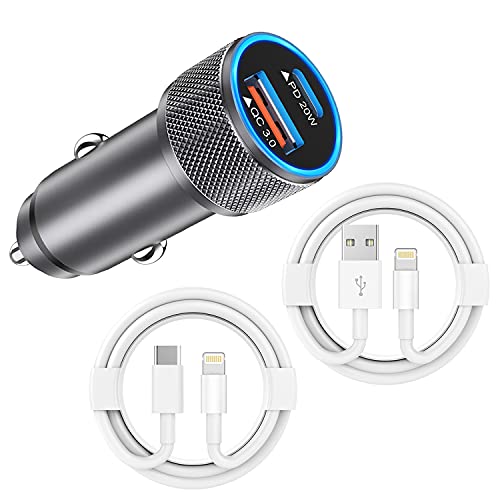 iPhone Car Charger,USB C Fast Car Charger[Apple MFi Certified] Apple Car Charging 38W Dual Port CarCharger Cigarette Lighter Adapter 2x3ft PD&QC 3.0 Lightning Cable for iPhone 14/13/12 Pro/11/Airpods
 Car A/C Repair Kit, 270PCS Rubber O-Ring Seal Kit + 40PCS Car Air Conditioner Valve Core Kit for R12 R134a A/C with Remover & Install Tool+10pcs R134a AC Valve Caps, Fix Refrigeration System