Who Created the First Car? The Real History of Karl Benz
Karl Benz is usually credited with the first modern car, because his Patent-Motorwagen from the mid-1880s is widely treated as an early practical gasoline automobile under a clear car definition. Use a broader definition, and steam wagons, tricycles, and prototypes all crowd in. Here’s the timeline, the definition problem, and why earlier self-propelled vehicles belong in the prehistory of the automobile.
Who created the first car?


Why the wording matters: first car vs first modern automobile
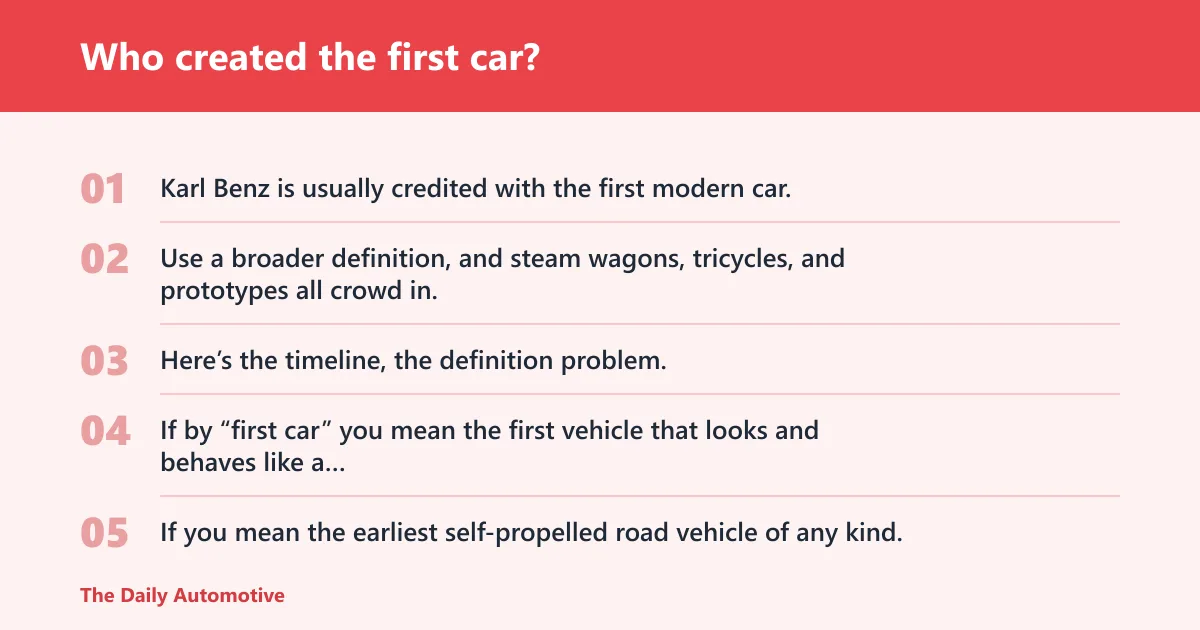
The core issue is definition. If by “first car” you mean the first vehicle that looks and behaves like a gasoline-powered automobile, Benz is the usual answer. If you mean the earliest self-propelled road vehicle of any kind, the answer shifts to earlier steam and experimental machines.
That is why the question comes up so often. “Car” can mean a motorized carriage, a prototype, a road-going steam machine, or the first practical gasoline automobile. Those are related categories, but they are not the same claim.
📊 Karl Benz patented the three-wheeled Motor Car, known as the Motorwagen, in 1886. Source: Who invented the car? The history of the automobile.
What counts as a car in this question?
A vehicle counts as “the first car” only if you apply a clear standard. A common modern standard is a road vehicle with its own propulsion, a practical layout for carrying people, and a design that moves beyond horse-drawn buggy logic. By that yardstick, Benz’s Patent-Motorwagen fits better than earlier experiments.
The criteria readers can use
Use a simple checklist: self-propelled, intended for road use, built as a passenger vehicle rather than a test rig, and separated in design from a horse-drawn carriage frame. The tighter the definition, the more likely Benz is to win.
If you loosen the definition to include any powered road machine, then steam vehicles and experimental contraptions enter the conversation. That is where confusion starts.
Why buggies, carriages, and prototypes are different categories
Horse-drawn buggies were the baseline design the automobile had to move beyond. They gave early builders a familiar body shape, seating arrangement, and wheel layout. A motorized carriage that still behaves like a buggy is not the same milestone as a purpose-built automobile.
Prototype vehicles matter, but they often prove one system at a time. A prototype can be historic without being the first modern car.
Why Karl Benz is usually credited
Karl Benz is credited because he built a gasoline-powered vehicle that most historians treat as the first true modern automobile. Benz patented the three-wheeled Motor Car, known as the Motorwagen, in 1886, and the Benz Motor Car No. 1 is often described as the missing link between cars and horse-drawn buggies.
Benz Motor Car No. 1 and the Motorwagen
The Motorwagen was not a horse carriage with an engine bolted on. It was a three-wheeled machine designed around the new propulsion system. That matters, because the layout shows a shift from carriage thinking to automobile thinking.
Live Science describes Benz’s vehicle as the first true, modern automobile, and Benz is most often identified as the man who invented the car. That language reflects the common modern answer, not a claim that no earlier powered vehicle ever existed.
The 1886 patent and the move beyond horse-drawn design
The 1886 patent is the key reference point because it anchors the claim in a specific, documented vehicle. The year also matters because it places Benz after decades of earlier experiments and before the better-known mass-market auto era.
The Benz machine is the bridge from buggy to automobile. It kept the road-going purpose, dropped the horse, and reorganized the vehicle around an engine.
What came before Benz?

Before Benz, inventors built steam, electric, and experimental self-propelled vehicles. The Cugnot steam dray, nineteenth-century steam carriages, and electric road vehicles all came before the Motorwagen. These machines matter, but they usually do not get the same credit for the first modern car because they did not settle the car formula that later dominated road transport.
Early self-propelled vehicles
Early self-propelled vehicles were real vehicles, not myth. Some ran on steam; others used electric power; others were one-off experiments that never moved from demonstration to practical road use. They belong in the story because they show how many paths led toward the automobile.
But they are prehistory in the modern sense. They helped define the problem before Benz solved it in a form that looked like a car, not just a powered machine.
Steam and electric experiments before the gasoline car
Steam vehicles came first in many histories of road propulsion, and electric cars also appeared before gasoline cars became dominant. Those categories matter because they show that the “first” depends on whether you mean first powered road vehicle, first commercially practical automobile, or first gasoline automobile.
The article structure on this subject often includes internal combustion engines and electric cars for a reason. They are part of the answer, but they are not the same answer.
How the internal combustion engine changed the story
The internal combustion engine is the core technology behind early gasoline automobiles. It made a lighter, more self-contained road vehicle possible than many steam designs, and it pointed toward the gasoline-powered automobile that most readers mean when they ask about the first car.
That is why Benz’s design is so important. It ties the question of “who created the first car” to the vehicle type that became the future of cars.
What did the first modern car actually look like?
The first modern car was compact, three-wheeled, and powered by a gasoline engine. It did not resemble today’s car in every detail, but it was closer to the modern automobile than to a horse-drawn buggy or a pure prototype.
Three wheels, a light frame, and a gasoline engine
The Motorwagen’s three-wheel layout is one of the easiest ways to see the transition. Three wheels, a light frame, and a combustion engine make it a road vehicle designed around machine power rather than animal draft.
That design choice also explains why the vehicle is a reference point in car history. It is not the final form of the automobile, but it is a workable one.
How it differed from a horse-drawn buggy
A horse-drawn buggy depends on animal power and carriage geometry. The Motorwagen was built around its engine, so the body, drive system, and purpose all changed. That shift is the historical break readers are looking for when they ask about the first car.
Say your definition includes “looks like a buggy with an engine.” Then steam carriages may fit. Say your definition requires a purpose-built gasoline road vehicle, and Benz becomes the clear answer.
How to judge competing claims about the first car
Use a simple rule: the more a vehicle depends on carriage design or prototype status, the less likely it is to count as the first modern car. The more it is built around road use, passenger transport, and a gasoline engine, the stronger the Benz claim becomes.
Prototype vehicles vs first modern automobile
| Prototype vehicles | First modern automobile |
|---|---|
| Often steam, electric, or experimental | Gasoline-powered automobile |
| May be one-off or demonstration-only | Built as a practical road vehicle |
| Can keep carriage-style thinking | Designed beyond horse-drawn buggy form |
| May prove that motion is possible | Shows a usable automobile concept |
| Useful prehistory of the car | Common benchmark for “the first car” |
A checklist for evaluating any “first car” claim
- Is the vehicle self-propelled?
- Is it meant for road use?
- Does it use a gasoline internal combustion engine?
- Is it built as a car, not just a carriage with a motor?
- Was it practical enough to point toward the modern automobile?
If a claimed first car fails several of those checks, it is probably a prototype vehicle or an early powered carriage rather than the first modern automobile.
Why different inventors get credit in different sources
Different sources credit different inventors because they are answering different questions. One source may mean the first self-propelled road vehicle, another the first gasoline automobile, and another the first practical modern car. That is why the same history can produce different names.
Different definitions lead to different answers
If the question is “who built the first powered vehicle?” then early steam inventors enter the picture. If the question is “who created the first modern car?” then Benz is the standard answer. If the question is “who invented the first electric car?” then the answer changes again.
A common first-timer mistake is to treat all powered vehicles as the same milestone. They are not.
Why the common answer still points to Benz
The reason Benz keeps coming back is simple: his 1886 Motorwagen matches the category most readers mean when they say “first car.” It was a three-wheeled Motor Car, patented in 1886, powered by a gasoline engine, and built as a step beyond horse-drawn design.
That is also why the story often appears in sections labeled “The first car,” “internal combustion engines,” and “electric cars.” The broader history matters, but Benz remains the key answer after the timeline is sorted.
What was the very first car ever invented?
If “very first car” means the first modern gasoline automobile, Karl Benz’s Patent-Motorwagen from the mid-1880s is the answer many histories give. If “car” includes earlier self-propelled road machines of any type, then the answer moves to older steam or experimental vehicles. The exact wording decides the result.
Who created the first cars?
There was no single inventor of all first cars, because the automobile emerged through multiple steps. Early steam, electric, and experimental vehicles came first, then Benz’s 1886 Motorwagen set the standard for the modern gasoline car. That is why “first cars” is a plural history, not one clean line.
What came before the first modern car?
Before the first modern car came early self-propelled vehicles, especially steam and electric experiments, plus many one-off mechanical prototypes. These machines proved that road vehicles could move without horses, but they did not yet settle the practical automobile formula that Benz’s Motorwagen made famous.
Were there earlier self-propelled vehicles before Benz?
Yes. Earlier self-propelled vehicles existed before Benz, including steam-powered road machines and other experimental designs. They are important because they show the car did not appear from nowhere, but they are usually treated as prehistory rather than the first modern automobile.
Why do some sources credit different inventors?
Because “first car” can mean different things. Some sources credit the first powered road vehicle, others the first practical gasoline automobile, and others the first vehicle that clearly broke from horse-drawn buggy design. Benz is the common answer because his 1886 Motorwagen fits the modern-car definition best.
Frequently asked questions
who created the first car in history
Karl Benz is usually credited with the first modern car in history, because his 1885–1886 Patent-Motorwagen was a practical gasoline automobile built as a car, not a carriage with an engine. If you widen the definition to any self-propelled road vehicle, earlier steam and experimental machines enter the story.
was Karl Benz really the first person to invent a car
He was first for the modern gasoline automobile, not necessarily for every powered road vehicle ever built. Benz patented the three-wheeled Motorwagen in 1886, and that is why many histories call him the man who invented the car. Earlier self-propelled vehicles still came before him.
what makes a vehicle count as the first car
It needs to be self-propelled, road-capable, and built as a practical passenger vehicle rather than a test machine. Most historians also look for a gasoline internal combustion engine and a clear break from horse-drawn buggy design. By those criteria, Benz’s Motorwagen fits best.
what came before the first modern car
Steam road vehicles, electric experiments, and other prototype machines came before the first modern car. They mattered because they proved motion without horses was possible. But they did not usually combine practicality, gasoline power, and a car-specific layout the way Benz’s 1886 machine did.
were there earlier self-propelled vehicles before Benz
Yes, there were. Earlier self-propelled vehicles appeared in several forms, especially steam and experimental road machines. They belong in the history of the automobile, but they are not usually treated as the first modern car because they do not meet the same standard Benz’s Motorwagen does.
why do some sources credit different inventors
Different sources use different definitions of “first car.” Some count any powered road vehicle, while others mean the first practical gasoline automobile. That is why the name changes from source to source. Once the definition is fixed, Benz is the most common answer for the modern car.
Products related to this article
Sponsored / affiliate links. As an Amazon Associate I earn from qualifying purchases. I may earn additional commission from eligible campaigns.
 Portable Car Heater Car Heater, Portable Electronic Auto Heater Fan Fast Heating Defrost 12V 120W Car Defrost Defogger, 2 in 1 Heating/Cooling Function 3-Outlet, Plug Adjustable
 ZFSJTAG Car GPS Tracking Device for Vehicles, 1PCS Real Time GPS Tracker for Car, Work with Find My (iOS Only),Hidden Mini GPS Tracker,No Monthly Fee (Black Tracker, Black Magnetic Case)