Winter Car Wash Cost: What You’ll Really Pay for Basic Washes
Winter car wash cost is commonly reported at about $10 to $25 for a basic automatic wash, with heated, undercarriage, or salt-removal add-ons sometimes pushing it into the $20 to $40 range. The better buy is the wash that strips salt before it dries. Skip winter washes and road salt can sit on paint, brakes, and suspension, which raises corrosion risk and can make later repairs far more expensive than a few extra dollars. This guide breaks down price tiers, which add-ons pay off, and when to wash in freezing weather.
Winter wash cost table
This table turns winter car wash cost into a simple tradeoff: what you pay now versus what you may avoid later. It uses common market pricing ranges, since rates vary by region, labor, utilities, and the kind of equipment the wash runs.
| Wash type | Likely add-ons | When it makes sense | Hidden cost of skipping undercarriage cleaning |
|---|---|---|---|
| Basic automatic wash | None, or a simple dryer pass | Light winter dust, no fresh salt, mild temperatures | Salt can stay on the underbody and hard-to-reach areas, where corrosion starts quietly |
| Automatic touchless wash | Undercarriage rinse, wax, rust inhibitor | Near-freezing weather when you want less physical contact with the finish | Road grime can remain under the car if the package skips the underbody rinse |
| Heated indoor wash | Dryer upgrade, undercarriage wash, protective coating | Subfreezing days, icy roads, or when you want the lowest freeze risk | Skipping a heated option can leave water in seams that may freeze after exit |
| Membership or loyalty plan | Bundled undercarriage wash, wash credit, reward pricing | Frequent winter driving, repeated salt exposure, predictable weekly use | Pay-per-wash add-ons add up fast if you need salt removal after every storm |
For operating context, professional washes often use water reclamation systems, and Thornwood says its green system uses about 20 gallons of water per car and 80% less water than a typical driveway car wash. That does not guarantee a lower ticket price, but it helps explain why some operators can keep winter service competitive.
How much does a winter wash cost?
A winter wash usually costs more than the summer version because drivers often add undercarriage cleaning, stronger drying, or protective treatment. A basic automatic wash commonly lands around $10 to $25, while a winter-focused package with heated drying, underbody rinse, or wax can move into the $20 to $40 range.
Basic wash price range by market
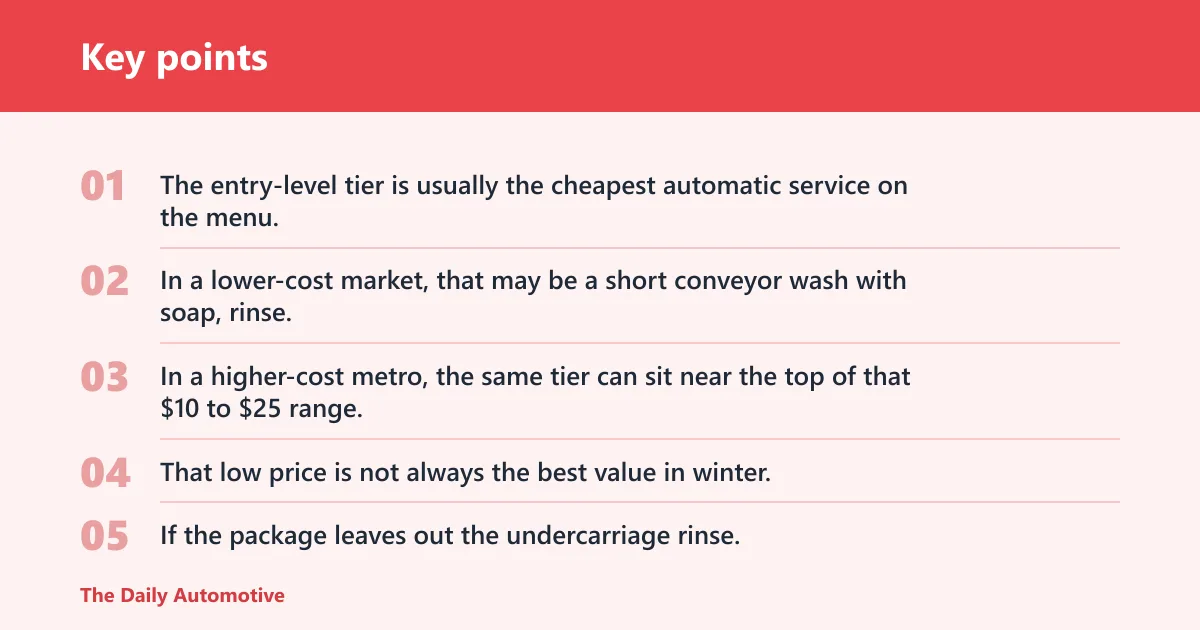
The entry-level tier is usually the cheapest automatic service on the menu. In a lower-cost market, that may be a short conveyor wash with soap, rinse, and a basic air dry. In a higher-cost metro, the same tier can sit near the top of that $10 to $25 range.
That low price is not always the best value in winter. If the package leaves out the undercarriage rinse, you may save a few dollars and still leave salt in places you cannot easily see.
What a standard wash usually includes
A standard wash usually covers exterior soap, rinse, and some form of dry cycle. In winter, that may be enough only if the roads are dry and the car has not been hit with fresh salt spray. Once slush and brine build up, the base tier often needs help.
Common winter add-ons include an undercarriage wash, rust inhibitor, wax, or a heated-dryer option. Each one adds to the bill, so the real question is whether the extra protection is worth more than the price jump.
What pushes the total higher
Three things usually raise the total: undercarriage cleaning, protective products, and heated or indoor handling. A car that has seen salted highways after a storm is a better candidate for the higher package than one that only saw dry cold roads for a short commute.
For example, say your sedan sees about a 30-mile highway commute after each snow event. A basic wash may look cheaper at the kiosk, but an undercarriage rinse and a dryer package can be the smarter spend if they keep salt from sitting on the chassis and suspension.
Which wash type is best in winter?
The best winter wash depends on temperature, road salt, and how much freeze risk you want to avoid. In near-freezing weather, a touchless wash is often a practical choice. On subfreezing days, a heated indoor wash usually gives the best margin of safety. A brush-based automatic wash can still fit when conditions are mild enough.
Touchless wash in near-freezing weather
Touchless systems use high-pressure water and detergents without spinning brushes. Coast 2 Coast recommends a heated, touchless wash in winter, and says touchless car washes work best in winter. That makes this format a solid option when the temperature is close to freezing and you want to reduce contact with cold panels and trim.
Touchless does not mean no risk. It still uses water, and Coast 2 Coast warns that water can freeze on the vehicle below freezing. If the car is going to sit outside right after the wash, drying matters as much as the wash style.
Heated indoor wash on subfreezing days
A heated indoor wash is the better fit when temperatures fall below freezing. The warmer bay helps reduce freeze risk and supports safer drying, especially around mirrors, door handles, locks, and other crevices that trap water.
That higher ticket can be the cheaper move if it prevents frozen doors or ice buildup that forces a return trip. On a very cold day, paying a little more for heat may beat paying twice: once for the wash and again for the hassle.
When a brush-based automatic wash is still a fit
A brush-based automatic wash is not automatically a bad winter choice. Many modern systems operate safely in cold weather. The better question is whether the equipment is maintained well and whether the package includes an undercarriage rinse and strong drying.
If the day is mild and above freezing, a conventional automatic wash can still be a sensible value. The price is often lower than heated indoor service, and the result may be perfectly adequate if the roads were only lightly treated.
Do winter add-ons pay off?
Winter add-ons are worth paying for when they treat the parts that winter weather hits hardest. The undercarriage rinse is the most practical add-on for salt removal. Rust inhibitor and wax can add protection, but they should be treated as optional upgrades, not magic fixes.
Undercarriage wash and salt removal
An undercarriage wash flushes salt and road grime from below the car. Thornwood says winter salt can collect under the car and in hard-to-reach areas, and recommends an under wash at least every other wash in winter. That is the add-on most likely to matter if you drive on salted roads often.
Does an undercarriage wash cost more? Usually yes, but not by much compared with what it may help you avoid. If the package costs a few dollars more and keeps salt from settling where you cannot scrub it by hand, it can be the best value on the menu.
Rust inhibitor as an optional treatment
Rust inhibitor is a protective chemical treatment sold as an add-on. It is meant to slow oxidation on exposed metal surfaces, especially during winter-heavy driving. It does not replace washing, and it does not turn a cheap package into complete corrosion protection.
The same source says professional washes use special ingredients that offer rust prevention. That supports the idea that winter add-ons can do more than make the car look cleaner, but the protection is still limited to the treatment itself and the surfaces it reaches.
Wax or protective coating for winter water beading
Wax or a protective coating can improve shine and water resistance. IMO describes its protection-coated wash as cost-effective for seasonal protection. The value is strongest when the upgrade is bundled at a modest price difference rather than sold as a big standalone add-on.
Wax does not stop salt from landing on the car. It can, however, help water bead and slide off more readily, which may help with drying and keep the finish looking better between washes.
What does frequent washing cost per month?
Monthly winter wash cost depends on how often you drive in salt and whether you pay per wash or subscribe. If you wash two or three times a month, the total may stay modest. If winter roads push you into weekly washing, a membership can lower the average cost per visit.
Pay-per-wash monthly estimate
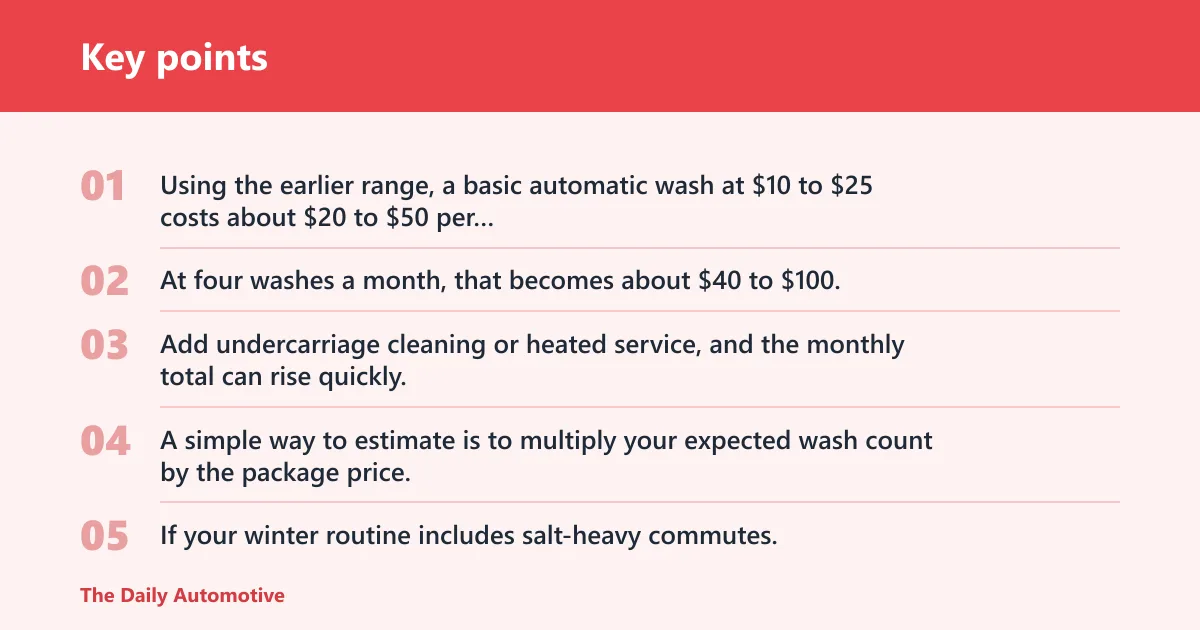
Using the earlier range, a basic automatic wash at $10 to $25 costs about $20 to $50 per month if you wash twice. At four washes a month, that becomes about $40 to $100. Add undercarriage cleaning or heated service, and the monthly total can rise quickly.
A simple way to estimate is to multiply your expected wash count by the package price. If your winter routine includes salt-heavy commutes, that math can make a higher tier look less expensive than it first appears.
Membership break-even math
A car wash membership or loyalty program works when your monthly wash count is high enough to beat the pay-per-wash total. If a plan costs less than what you would otherwise spend on three or four winter visits, it is probably worth a closer look.
The same source recommends washing about twice a month in general and says washing should be more frequent during winter. That means many drivers will at least want to compare two-wash, four-wash, and membership pricing before winter settles in.
When a subscription lowers the average cost
Subscriptions make the most sense for drivers who keep washing after every storm, after highway slush, or after repeated salt exposure. The more often you need an undercarriage rinse, the faster a flat monthly fee can beat single-ticket pricing.
Suppose a membership costs about the same as three premium washes in a month, but your winter commute calls for four. The plan lowers your average cost per wash and makes it easier to stay on schedule when the weather keeps changing.
How often should you wash in winter?
Wash more often in winter than in summer, but base the timing on salt exposure rather than the calendar alone. The same source recommends washing about twice a month in general and says winter should be more frequent, with an under wash at least every other wash. That is a practical guide, not a universal rule.
After salt exposure and storm driving
If the car has been driven on salted roads, especially after snow or freezing rain, washing sooner is better. Salt can cling to paint, trim, brakes, and suspension components, then stay there until removed. The longer it sits, the more it can work into seams and crevices.
A common first-timer mistake is waiting for the car to “look dirty enough.” Salt does not need a dirty appearance to cause problems. Clear slush and brine can be just as important to wash off as visible grime.
Why timing matters after road treatment
Road treatment matters because salt becomes more stubborn as it dries. If you wait too long, the wash has more work to do and the salt has more time to settle into hard-to-reach spots. That is why winter wash timing is a cost decision as much as a maintenance decision.
Wash on milder days above freezing when possible. Coast 2 Coast gives that guidance, and it helps limit freeze risk while giving the vehicle a better chance to dry safely afterward.
When to wait for warmer conditions
If temperatures are well below freezing and the car will sit outside afterward, waiting for a warmer window is often smarter than choosing the cheapest wash right away. The goal is not just to clean the car, but to do it without creating door seal ice, frozen locks, or trapped water.
That does not mean skipping the wash entirely. It means choosing the right wash type, the right time of day, and the right drying setup so the cleanup does not become a cold-weather problem of its own.
Water use and the real bill
Water use affects the operating cost of a wash, which can influence pricing. Professional washes often use water reclamation systems to recycle part of the wash water, while driveway washing may use far more water and send runoff wherever it lands. That operating difference helps explain why professional winter service can still be competitively priced.
How water reclamation systems fit
Water reclamation systems reduce the amount of fresh water a wash needs each day. The same source says its green initiatives use 80% less water than a typical driveway car wash, and that kind of setup can help a commercial wash manage utility costs while controlling runoff.
For the driver, the practical takeaway is simple: a professional wash is not automatically the more wasteful option. In many cases, the equipment is designed to recycle and filter water more efficiently than a driveway rinse.
Why professional washes can vary in operating cost
Heated bays, dryers, water treatment, labor, and winter additives all affect what a wash must charge. A facility that offers undercarriage rinses, heated drying, and protective products will usually price those services above a bare-bones exterior wash.
That extra cost is not always markup. It often reflects the utility and equipment burden of keeping vehicles cleaner and drier in freezing weather.
What that means for price differences
Price differences between washes are usually about equipment and package mix, not just the sign at the entrance. A low base price can turn into a higher real cost if you need to add underbody cleaning every time, while a pricier bundled wash may be cheaper over the month.
That is why winter car wash cost should be judged as a total plan, not a single receipt. The cheapest ticket is only the better deal if it actually removes the salt and dries the vehicle safely.
Frequently asked questions
How much do car wash cost?
Most basic automatic car washes run about $10 to $25, with winter-focused packages often landing higher when you add undercarriage cleaning, wax, or heated drying. Monthly cost depends on how often you wash and whether a membership cuts the per-visit price.
How much does a basic car wash cost?
A basic car wash usually sits at the entry level of the menu and commonly includes soap, rinse, and a basic dry cycle. In many markets, that means roughly $10 to $25, though winter add-ons can move the total well above that range.
How much does a typical car wash cost?
A typical wash cost depends on service tier. For winter drivers, the usual range is closer to $10 to $25 for the base wash and $20 to $40 when you add heated drying, undercarriage cleaning, or salt-focused protection. Market size and local operating costs matter.
Is it safe to get a car wash in winter?
Yes, it is generally safe to get a car wash in winter if you choose the right timing and equipment. Coast 2 Coast advises washing on milder days above freezing and notes that water can freeze on the vehicle below freezing, so drying and temperature matter.
How often should I wash my car in winter?
Wash more often than in summer, especially after salted roads or storms. The same source recommends washing about twice a month in general and says winter should be more frequent, with an under wash at least every other wash. Heavy salt exposure can justify more frequent visits.
What type of car wash is best in winter
Touchless and heated indoor washes are usually the strongest winter choices. Touchless works well near freezing, while heated indoor service is better on subfreezing days because it lowers freeze risk and helps drying. A brush-based automatic wash can still work when conditions are mild.
Does an undercarriage wash cost more?
Usually yes, but it is often a modest add-on rather than a major jump. The extra charge can be worthwhile in winter because it removes salt and road grime from the underside, where corrosion starts and where Thornwood says winter salt can collect in hard-to-reach areas.
Is a touchless car wash better in winter?
It can be, especially near freezing, because it uses high-pressure water and detergents without spinning brushes. That said, touchless is not automatically the best choice in every cold-weather situation. If temperatures are below freezing, a heated indoor wash may be the better buy.
How.much does a car wash cost
Winter car wash cost usually starts around $10 to $25 for a basic automatic wash and rises when you add undercarriage cleaning, wax, rust inhibitor, or heated drying. If you wash often, a subscription may lower the average cost per visit over the season.
Products related to this article
Sponsored / affiliate links. As an Amazon Associate I earn from qualifying purchases. I may earn additional commission from eligible campaigns.