Best 12V Water Heater for Car: 2 Picks Compared
The best 12V water heater for car use is a smart car kettle if you need boiling water for coffee or soup; pick a simple beverage heater if you only want hot drinks and lower cost. Pick the wrong style and you waste time, drain the battery faster, or end up with lukewarm water on the road. This guide compares both 12V approaches and shows which one fits your driving and drinking habits.
These two options solve the same problem in different ways. A smart kettle gives you more control, better spill management, and clearer shutoff behavior. A simple immersion-style beverage heater is easier to set up, but it depends more on the container you use and gives you less protection against mistakes.
Best 12V water heater for a car at a glance


12v water heater table
| Criterion | FVPE smart car kettle | RoadPro RPBH-012 beverage heater |
|---|---|---|
| Use-case fit | Best for drivers who want controlled heating, warm-keep use, and a lidded container for coffee, tea, or instant meals. Choose this if you want one vessel that handles heat and pouring more predictably. | Best for simple hot-drink prep when you want a basic 12V solution with fewer controls. Choose this if you only need the lightest setup and can accept more manual handling. |
| Voltage compatibility | Supports both 12V and 24V vehicle systems. Choose this if you move between passenger cars and higher-voltage work vehicles. | Designed for 12-volt use. Choose this if you only need a passenger-car solution and do not need 24V support. |
| Boil time | Typically boils in 28–35 minutes. Choose this if you can wait for a more controlled heating cycle. | No verified boil-time figure is provided here. Choose this if you care more about a basic heating tool than a published time claim. |
| Capacity | 400 mL. Choose this if one mug or one soup cup is the main goal. | No verified capacity figure is provided here. Choose this if you already know the container size you plan to use. |
| Spill risk | Lower spill risk because water stays in a purpose-built kettle with a lid. Choose this if you want better control while parked. | Higher spill risk because the heating setup depends more on the cup or vessel. Choose this if you can keep the setup steady and upright. |
| Cleanup difficulty | Moderate. A food-grade stainless steel liner is easier to clean, resists corrosion, and is less likely to hold odor. Choose this if you want a container that wipes out cleanly after repeated use. | Lower part count, but more container-dependent cleanup. Choose this if you want less built-in hardware and do not mind washing the drinking vessel more often. |
| Best vehicle type | Compact car, SUV, pickup, truck, or RV, depending on socket compatibility. Choose this if you want the broader fit across vehicle types. | Compact car or SUV with a stable 12V socket and a simple hot-drink routine. Choose this if you keep the setup small and short-haul. |
Which one fits your vehicle outlet?
Most passenger vehicles use a 12V outlet or cigarette lighter socket, but that does not mean every socket can support the same load. A water heater that draws too much current can trip a fuse or simply heat too slowly to be useful. Check the vehicle manual and the device label before you plug anything in.
12V outlet and cigarette lighter socket limits
A 12V outlet is the standard power source for these products in cars and crossovers. The limit is not the socket shape alone; the real issue is the outlet’s current capacity and the vehicle’s fuse rating. If the heater asks for more than the circuit can safely provide, the port may shut down or the fuse may fail.
Why 24V support matters in trucks and RVs
24V compatibility matters because some trucks and RVs use higher-voltage electrical systems. FVPE supports both 12V and 24V vehicle systems, and MIICASA also supports both 12V and 24V inputs. That makes them more flexible for mixed fleets, while a 12V-only unit like RoadPro RPBH-012 stays tied to standard 12V use.
Fuse risk, current draw, and compatibility checks
Do not assume a socket can handle any “car kettle.” Compare the heater’s power draw with the outlet rating, then leave a margin for the vehicle’s electrical system. If the heater is large or the circuit is already shared with other loads, fuse risk goes up. That is especially important with older cars and small compact models.
Picture a compact hatchback with a single front 12V socket. A high-draw kettle may still fit physically, but if the circuit is weak, the device may heat slowly or shut the port off. In a pickup with a higher-capacity accessory circuit, the same kettle may be a better match.
Best fit by vehicle type
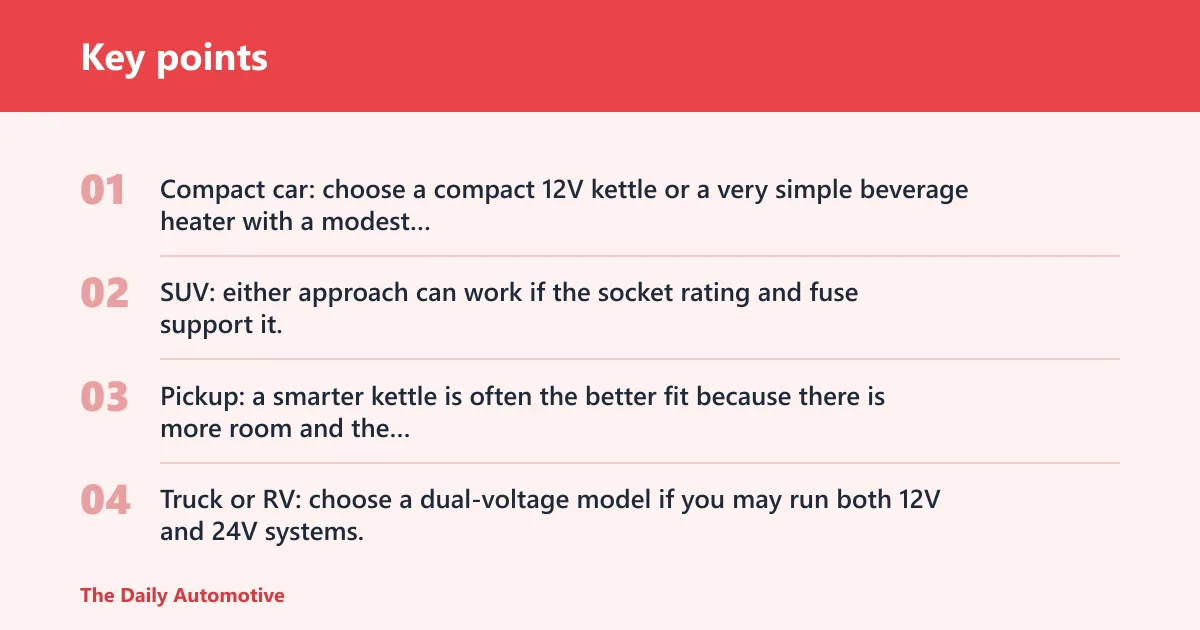
- Compact car: choose a compact 12V kettle or a very simple beverage heater with a modest power draw.
- SUV: either approach can work if the socket rating and fuse support it.
- Pickup: a smarter kettle is often the better fit because there is more room and the cabin power setup is usually friendlier.
- Truck or RV: choose a dual-voltage model if you may run both 12V and 24V systems.
How fast do they heat water?
Boil time depends on how much power the heater can deliver, how cold the water starts, and how full the container is. FVPE typically boils in 28–35 minutes, while QIURUIFFA heats about 300 ml in roughly 15 minutes. In cold weather or from a weak outlet, either type can slow down noticeably.
Capacity bands that matter in practice
For one person, compact units in the 350-420 mL range are easiest to live with because they keep refill needs low without taking much space. QIURUIFFA has a 420 ml capacity, which sits at the top of that compact band. FVPE’s 400 mL capacity fits the same single-serving range.
Mid-size units in the 475-750 mL range suit drivers who want more than one cup or who plan to make tea, soup, or a second serving without refilling immediately. MIICASA has a 16 oz / 475 mL capacity, and Fdit holds 750 ml. Bigger tanks usually mean more waiting time.
Single-serving use and refill frequency
If you only want one mug, a 400 mL kettle is usually enough. If you want a full thermos-style pour or a second cup, a larger unit reduces refill frequency. That convenience comes with a trade-off: more water takes longer to heat, and a bigger vessel can be less convenient to store.
How cold weather changes the result
Cold ambient conditions pull heat away from the water and from the kettle body. A low-power port makes that worse. In practice, the same unit that is acceptable in mild weather can feel slow in winter, especially when you start with cold tap water and a near-empty battery after short trips.
Which is safer to drive with?
For use while driving, the safer option is usually the smart kettle with lid, shutoff, and dry-boil protection. An open-contact heater or immersion-style setup carries more spill exposure and depends more on the stability of the cup or container. Parked use is safer than moving use, and that matters more than marketing terms.
Auto shut-off and dry-boil protection
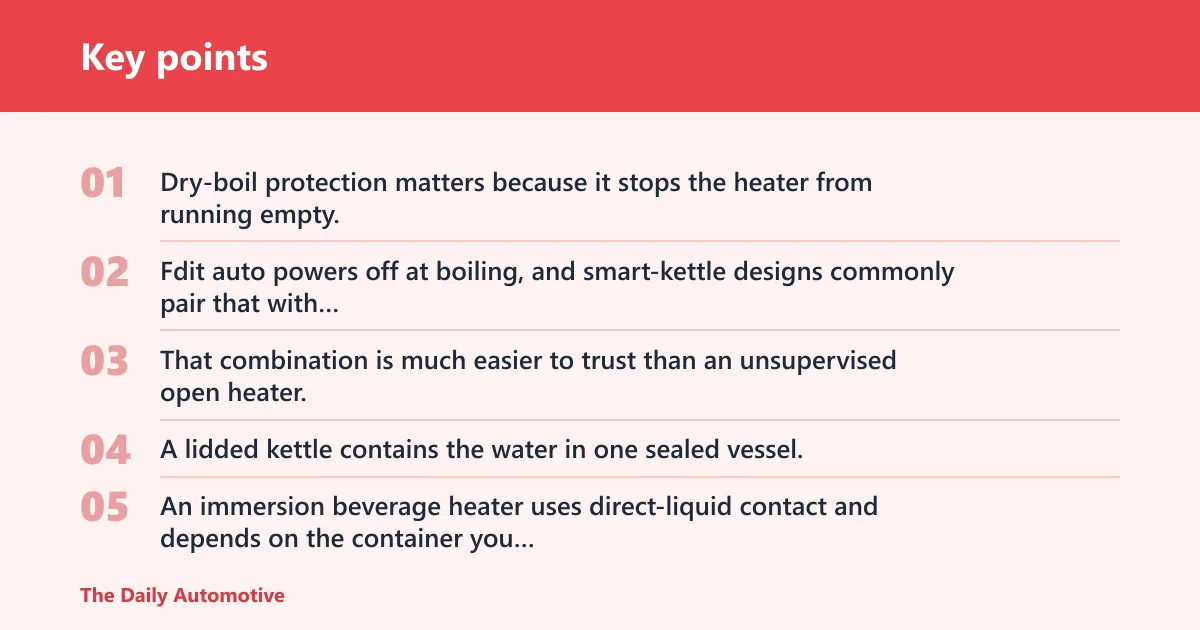
Dry-boil protection matters because it stops the heater from running empty, which helps prevent burn damage and reduces the chance of a fault during travel use. Fdit auto powers off at boiling, and smart-kettle designs commonly pair that with temperature control. That combination is much easier to trust than an unsupervised open heater.
Spill risk: lidded kettle versus direct-liquid contact
A lidded kettle contains the water in one sealed vessel, so splash risk is lower during heating and carrying. An immersion beverage heater uses direct-liquid contact and depends on the container you place it in. That makes it simpler, but it also means more chance of splatter, instability, and hot liquid movement if the vehicle shifts.
Suppose you are heating water in a narrow travel mug during a stop-and-go commute. A lidded kettle keeps the hot water in one place. A direct-contact heater in a shallow cup is more likely to slosh if the vehicle moves before the liquid settles.
Parked versus moving use
Parked use is the right time for nearly all 12V water heaters. Moving use is only sensible if the unit is stable, the lid is secure, and the cord routing does not interfere with the driver. An open-style heater is a poor fit while the vehicle is moving because the liquid is exposed and the setup can tip more easily.
Materials: stainless steel liner, BPA-free parts, and insulation
A food-grade stainless steel liner matters because it resists corrosion, cleans more easily, and is less likely to hold odor from coffee or soup. BPA-free plastics matter for the same reason buyers usually want any food-contact parts to be suitable for hot liquid. Vacuum insulation helps reduce heat loss and keeps the exterior safer to handle.
FVPE keeps water warm from 86°F to 203°F, which is useful if you want hot water to stay usable after the boil. MIICASA can keep water warm for up to 12 hours without power, which is a strong fit for longer stops or overnight use in a parked vehicle. That kind of keep-warm performance is more useful than raw boil speed for some drivers.
Choose smart car kettle or immersion heater
Choose the smart car kettle if you want temperature control, better spill control, and more predictable use. It is the stronger choice for commuters, solo drivers, and anyone who wants boiling water for coffee, tea, or soup with less guesswork. It is also the better fit when you care about warm-keep performance.
Choose the immersion beverage heater if you want the simplest setup and accept its container and safety limits. It works best for very basic hot-drink use, especially when the goal is low cost and minimal storage space. It is not the right pick if you need a sealed vessel, better control, or routine use while the vehicle is moving.
Short buying checklist
- Check whether your vehicle uses 12V only or a 24V system.
- Match the heater to the outlet rating and fuse capacity.
- Pick 350-420 mL for one serving or 475-750 mL for more than one cup.
- Look for auto shut-off and dry-boil protection.
- Prefer stainless steel liners and BPA-free food-contact parts.
- Choose a lid and vacuum insulation if you want better heat retention and safer handling.
- Confirm cup-holder fit and storage space before buying.
Frequently asked questions
What is the best 12V water heater for a car?
The best 12V water heater for a car is a smart kettle if you want controlled heating, safer handling, and better spill control. FVPE is the stronger fit for that job because it supports both 12V and 24V systems, holds 400 mL, and includes keep-warm capability. Choose a simple beverage heater only if you want the easiest setup.
Are 12V car water heaters safe to use while driving?
They are safer when parked. While driving, the risk comes from spills, unsecured cords, and a unit that tips during braking or turns. A lidded smart kettle with dry-boil protection is the safer design, but even then, parked use is the better choice whenever possible.
How long does a 12V car kettle take to boil water?
Boil time varies with outlet strength, water volume, and ambient temperature. FVPE typically boils in 28–35 minutes, while QIURUIFFA heats about 300 ml in roughly 15 minutes. A cold cabin or weak outlet can slow either result, so treat published times as a guide, not a promise.
Will a 12V water heater work in my car cigarette lighter port?
It may work if the outlet can supply enough current and the fuse rating matches the heater’s demand. Do not assume every cigarette lighter socket is identical. Check the vehicle manual and the device label first, especially in older cars or smaller compact models with lighter accessory circuits.
What size car water heater is best for one person?
For one person, about 350-420 mL is usually a good range. It is enough for a mug of coffee, tea, or a small soup serving without taking too long to heat or hogging cabin space. FVPE’s 400 mL size and QIURUIFFA’s 420 ml size both fit that use well.
Do I need a 12V or 24V car water heater?
Use 12V for standard passenger cars and 24V support if you also drive trucks or RVs that use higher-voltage systems. Dual-voltage models are the safer buy when your vehicle mix changes. FVPE and MIICASA both support 12V and 24V, while RoadPro RPBH-012 is designed for 12-volt use.
Can a 12V car water heater keep water warm after boiling?
Yes, some can. Vacuum insulation helps reduce heat loss, and some models add warm-keep settings. FVPE keeps water warm from 86°F to 203°F, and MIICASA can keep water warm for up to 12 hours without power. That matters if you want a second cup without reheating.
How much power does a 12V car water heater draw?
The draw depends on the model, and not every socket can support the same load. That is why checking the vehicle’s fuse rating and outlet spec matters. A heater that asks for too much current can slow down, trip protection, or fail to run at all in a weaker port.
Products related to this article
Sponsored / affiliate links. As an Amazon Associate I earn from qualifying purchases. I may earn additional commission from eligible campaigns.