3 Best 12V Coolers for Car (2026): We Compared
The best 12V cooler for a car depends on use: choose a compressor model for overnight cooling or hot-weather storage, a thermoelectric unit for low-cost short trips, and a low-draw portable fridge if battery drain is the main concern. Pick the wrong type and you get warm drinks, spoiled food, or a dead starter battery. This guide compares three picks by trip length, vehicle size, heat, noise, and power source.
Quick comparison
| Product | Badge | Best for | Price | ||
|---|---|---|---|---|---|
 |
VEVOR 12V Car Refrigerator 10 QT, Portable Mini FreezerVEVOR | Our pick | 10 QT · Compressor · APP Control | $124.90
Price as of 24 Oct 2026
|
View |
 |
VEVOR 12 Volt Car Refrigerator 26.4QT/25L Car Fridge -4℉ toVEVOR | Also great | 26.4 QT · Compressor · Rapid Cooling | $169.11
Price as of 24 Oct 2026
|
View |
 |
Igloo IE24 Thermoelectric Cooler & Warmer | 12V PortableIgloo | Budget pick | 32-Can · Thermoelectric · Cools 36℉ Below Ambient | $123.13
Price as of 24 Oct 2026
|
View |
The real split is not capacity alone. It is whether you need freezing temperatures, a light cooler for short drives, or a bigger dual-zone unit for longer family travel.
How we chose
This comparison focuses on the factors that decide whether a cooler works in a car, truck cab, or campsite.
- Cooling type and temperature range: compressor vs thermoelectric, plus whether the unit can actually freeze food.
- Power draw and battery protection: how the unit behaves when the engine is off, and whether it offers cutoff settings.
- Noise, capacity, and portability: whether the cooler fits behind a seat, in a trunk, or in a truck bed without becoming a burden.
- Vehicle-fit practicality: cord length, opening width, and whether the unit suits a small sedan or a larger cabin.
- Use-case match: road trips, commuting, camping, truck sleeping, and family hauling.
Comparison matrix
| Trip and vehicle factor | Compressor cooler | Thermoelectric cooler | Dual-zone fridge freezer |
|---|---|---|---|
| Best trip length | Road trips, camping, overnight use | Short drives, commuting, light errands | Long hauls, family travel, extended stays |
| Heat performance | Better in high ambient heat | Struggles when the cabin or outside air is hot | Strong, but only if the vehicle has space and power |
| Power source | 12/24V DC, often AC as well | Usually 12V DC, often AC as well | Usually DC and AC, sometimes solar support |
| Noise sensitivity | Usually acceptable for sleep if the cab is isolated | Often quieter, but varies by fan design | Can be quiet enough for sleepers, but depends on compressor cycle |
| Fit in small car | Best in compact sizes only | Usually the easiest fit | Often too large for a small sedan |
| Battery risk overnight | Manageable with cutoff settings | Lower draw, but still not risk-free | Highest concern if the battery is small and the engine stays off |
Decision matrix
Use this rule set before you pick a model. It maps trip length, vehicle size, ambient heat, power source, and overnight use to the type that is least likely to fail in practice.
| Trip length | Vehicle size | Overnight use | Ambient heat | Power source | Best cooler type |
|---|---|---|---|---|---|
| Under 2 hours | Small car or commuter hatchback | No | Mild | 12V DC only | Thermoelectric |
| All day | Small sedan with limited trunk space | Maybe | Hot summer weather | 12V DC and home AC | Compact compressor |
| Weekend road trip | SUV, truck, or van | Yes | Hot or variable | 12/24V DC plus AC | Compressor |
| Family travel or camping | Large cargo area | Yes | Hot weather | DC, AC, or solar | Dual-zone fridge freezer |
| Frequent engine-off use | Truck cab or RV | Yes | Moderate to hot | Battery-managed DC power | Compressor with battery protection |
A common first-timer mistake is buying a large fridge freezer because the spec sheet looks impressive, then trying to fit it behind the front seats of a sedan. The cooler may work perfectly and still fail the trip because the door cannot close or the cargo opening is too narrow.
Suppose a driver wants cold drinks for a 45-minute commute and one grocery stop after work. A thermoelectric unit is usually the cleaner fit. Change only one variable, and the answer changes too: that same driver wants to camp overnight in a hot parking lot. At that point, the thermoelectric unit becomes the weak choice because ambient heat limits how cold it can get.
Compressor cooler: best for road trips
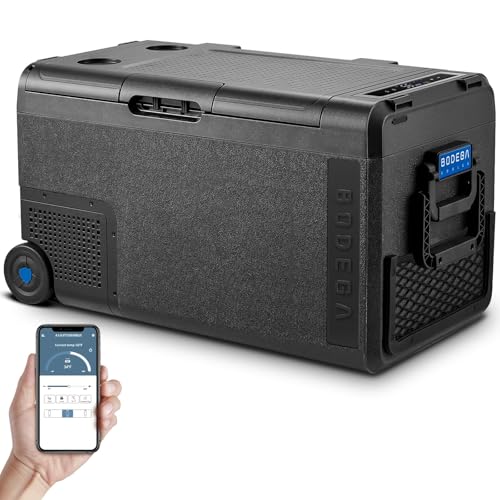
A compressor cooler is the safest pick when you need real refrigeration, especially on road trips, at campsites, or during long truck stops. The VEVOR 12V Car Refrigerator 10 QT is the compact example in this group. It can cool to -4℉ to 68℉, supports 12/24V DC & 110-220V AC, and has battery protection for engine-off use.
Its biggest strength is that it can hold food at freezer-level temperatures instead of just cooling below ambient. That matters when you want frozen meals, meat, or ice cream to stay safe in summer heat. The app control is useful when the unit sits behind a seat or in a cargo area.
The drawback is fit. A 10 QT cabinet is compact, but compressor coolers in general become bulky fast as capacity rises, and a larger model can crowd a small sedan or add awkward weight for frequent carry-in use. Compressor units also cost more than basic thermoelectric coolers.
For buyers who need more room, the BougeRV 23-quart compressor cooler is the reference point for this class. It cools to 32°F in 15 minutes and can maintain temperatures as low as -5°F. That makes it the kind of unit people choose when they want freezing performance, not just chilled drinks.
Why it wins in hot weather
Compressor cooling does the hard work itself. It does not rely on ambient air being cool enough to help the process, so it keeps performing when the cabin is hot, the sun is beating on the vehicle, or the cooler sits in a truck bed during summer travel.
That is the main reason a compressor cooler belongs in a road-trip comparison. Published specs matter here because a claimed 15-minute cooldown means little if the unit cannot hold low temperatures once outside conditions climb.
Where it fails: size, weight, and cost
Compressor coolers are not the best answer for every car. Large versions can be awkward in a small sedan, and even compact ones take more planning than a soft-sided tote. The power lead, ventilation space, and lid clearance all matter.
They are also the least forgiving on price. A buyer paying for freezing ability, battery protection, and dual-power support should expect to give up some portability and budget friendliness.
Thermoelectric cooler: best for short trips
A thermoelectric cooler is the cheapest way to get powered cooling in a car, and it is usually the lighter, simpler option for short trips. The Igloo IE24 is the budget pick here. It holds 32 cans, cools 36°F below ambient, heats to 136°F, and works on AC/DC power.
This type is best when you need a straightforward container for drinks, snacks, or lunch on a commute. It can also warm food, which helps delivery drivers, rideshare drivers, and commuters who want one box for both cold and hot items.
The honest downside is that it cools relative to ambient temperature, not to a fixed refrigeration target. On hot days, that is the failure mode. If the cabin is already warm, the contents will still be warm enough to disappoint anyone expecting fridge performance.
Thermoelectric coolers also commonly land around a 14L class, so they suit solo use and short errands more than family storage. They are convenient, but convenience is not the same as true cold storage.
Why it works for commuting and light use
For a driver who wants a lunch cooler, a 12V office run box, or a low-cost option for quick grocery trips, thermoelectric cooling makes sense. It is simple, easy to carry, and usually cheaper than compressor gear.
The BODEGA 16QT operating at 31 dB is a useful benchmark for quiet cab use. Low noise matters when the cooler sits near the driver or a sleeping passenger, especially in a small cabin where fan sound carries.
Where it fails: ambient heat and overnight cooling
Thermoelectric units struggle most when the vehicle sits in summer heat for hours. They do not create the same deep cooling range as compressor models, so they are the wrong tool for frozen food, long overnight storage, or hot-weather camping.
They also do not solve the battery question by themselves. Lower draw helps, but engine-off use still needs caution, especially if the unit runs all night and the vehicle battery is already old.
Dual-zone fridge freezer: best for families
A dual-zone fridge freezer makes sense when one cooler has to do two jobs at once. The EUHOMY CF-55 is a 55-liter dual-zone freezer, and that kind of layout is best for families, long-haul travelers, and campers who need one side colder than the other.
Separate zones reduce compromise. One compartment can hold drinks and fresh food while the other holds frozen items. That is useful when a trip includes groceries, meals, and several days away from home. App or Bluetooth control is also common on this class, which helps when the unit sits in the cargo area.
The trade-off is obvious: this is the least friendly option for small vehicles. A 55-liter cabinet takes space, and large portable units can be awkward to lift in and out. If a sedan already has limited trunk depth or a narrow opening, the cooler may be a poor fit even if the specs look ideal.
The VEVOR 26.4QT compressor cooler is the smaller alternative in this category. It targets buyers who want faster cooling and battery protection without jumping to a full family-size cabinet.
Why separate zones matter
Families do not always need one cold setting. They need flexibility. A freezer side can hold ice packs, meat, or frozen meals, while the fridge side protects fruit, drinks, or leftovers. That split is the practical reason dual-zone units earn their place.
It also reduces food planning errors. You do not have to choose between drinks that are too cold and produce that freezes.
Where it fails: cost and cargo space
Dual-zone units are usually the priciest and largest option here. They are excellent when you can spare the room and want a mobile fridge freezer, but they are hard to justify for solo commuters or occasional errands.
If the vehicle is a small sedan, the downside is not subtle. The unit may fit only after other cargo is moved, and that turns a convenient appliance into a storage problem.
Choose VEVOR 12V Car Refrigerator 10 QT if… / Choose Igloo IE24 if… / Choose EUHOMY CF-55 if…
Choose the VEVOR 10 QT compressor cooler if you want a compact freezer-capable box for a small car, camping weekend, or solo road trip. It also makes sense if you want app control and a published freezer range down to -4℉.
Choose the Igloo IE24 if your priority is price, simplicity, and short-trip convenience. It is the better fit for commuters, rideshare drivers, and light-duty use where 36°F below ambient is enough and the cooler will not sit overnight in heavy heat.
Choose the EUHOMY CF-55 if you need two temperature zones, family storage, or long-haul flexibility. It is the strongest match for truck beds, SUVs, and camping setups where cargo room matters more than compact size.
Which one should you buy?
If you drive a small car, start with the compact compressor cooler. A 16QT to 23QT class is the right ceiling for most tight cabins because it is easier to place behind a seat or in a trunk without fighting the vehicle layout.
If you sleep in the vehicle, buy a compressor model with battery protection. A 3-level cutoff setting helps reduce starter-battery drain when the engine is off, which matters for overnight camping, truck sleeping, and long rest stops.
If price matters most, the thermoelectric cooler is the cheapest path into powered cooling. It is the least powerful choice, but for short trips and light use, it is the one that can make sense without a big upfront cost.
For camping, the best 12 volt cooler for camping is the compressor type. It is the only one here that can keep working toward freezing temperatures in real heat, and that is what makes it safer for food over time.
Ownership cost also matters. A compressor cooler can save repeated ice runs, avoid soggy food, and reduce food spoilage. A cheap thermoelectric box may cost less up front, but that benefit shrinks fast if it cannot hold temperature where you actually drive.
- Pick thermoelectric only for short, low-stakes trips.
- Pick a compact compressor for road trips and overnight cooling.
- Pick dual-zone only if you can spare cargo space and want freezer plus fridge storage.
- Match the cord length and plug type to your vehicle layout before you buy.
- Use battery protection any time the engine may stay off.
Frequently asked questions
Which is the best cooler?
The best cooler for most drivers is a compact compressor model. It is the safest middle ground when you need real refrigeration, usable overnight cooling, and better hot-weather performance than a thermoelectric unit. If you only need drinks cold for short trips, a cheaper thermoelectric box is enough.
What size 12V cooler fits a small car?
For a small car, a compact 16QT to 23QT cooler is the easiest fit. That size is more likely to clear seat backs, trunk openings, and footwell space without becoming a storage problem. Larger 30QT to 48QT units are better suited to SUVs, vans, or trucks.
Do 12V coolers need ice?
No. Powered 12V coolers are designed to cool without ice, which avoids meltwater and reduces the mess that comes with traditional ice chests. That said, thermoelectric models only cool relative to ambient temperature, while compressor models can reach true refrigeration and freezing levels.
How much power does a 12V car cooler draw?
Power draw varies by type. Compressor models often fall around 28W to 50W, while thermoelectric units may feel lighter on the electrical system but still need steady power for long runs. If you plan to use the cooler with the engine off, battery protection becomes more important than raw wattage alone.
Should I buy a compressor or thermoelectric cooler?
Buy a compressor cooler if you need hot-weather performance, freezing temperatures, or overnight use. Buy a thermoelectric cooler if you want a lower-cost option for short commutes, lunch runs, or light travel. The wrong choice usually fails at the first real heat wave.
Can a 12V cooler run overnight without killing the battery?
Yes, but only if the cooler and the vehicle battery are matched carefully. Look for a battery protection system with 3-level cutoff settings, and do not assume every vehicle battery can support a full night of engine-off cooling. Large coolers and weak batteries raise the risk quickly.
Products related to this article
Sponsored / affiliate links. As an Amazon Associate I earn from qualifying purchases. I may earn additional commission from eligible campaigns.