Active vs Passive Car Safety Features: What to Buy
Active safety features step in before impact, from automatic emergency braking to stability control, while passive safety features take the hit and limit injury. I start with AEB, ESC, and airbags before I spend on convenience gear. Skip those basics, and you invite preventable crashes, bigger repair bills, and worse injuries. This guide breaks down which features belong on every budget, which matter most for families and new drivers, and what used-car buyers should check first.
| Decision factor | Active | Passive Car Safety Features | Winner |
|---|---|---|---|
| Primary job | Aims to avoid the crash before it happens | Absorbs impact and protects people during or after the crash | Depends on the goal |
| Value in rain, night driving, and traffic | High when sensors can see clearly and the driver responds | Always there once impact occurs | Active |
| Dependence on driver action | Often needs the driver to heed warnings or stay engaged | Works without driver intervention in the moment | Passive Car Safety Features |
| Failure mode | Can be limited by blocked sensors, faded lane lines, glare, or ignored alerts | Can be overwhelmed by very severe impacts, but still works as designed | Passive Car Safety Features |
| Best use case | Daily commuting, highway merging, new-driver assistance, bad weather support | Every car, every trip, every budget | Passive Car Safety Features |
| Trim availability | Some items are standard, others are trim-dependent or optional | Core items are usually standard hardware on most modern cars | Passive Car Safety Features |
What is the difference between active and passive car safety features?
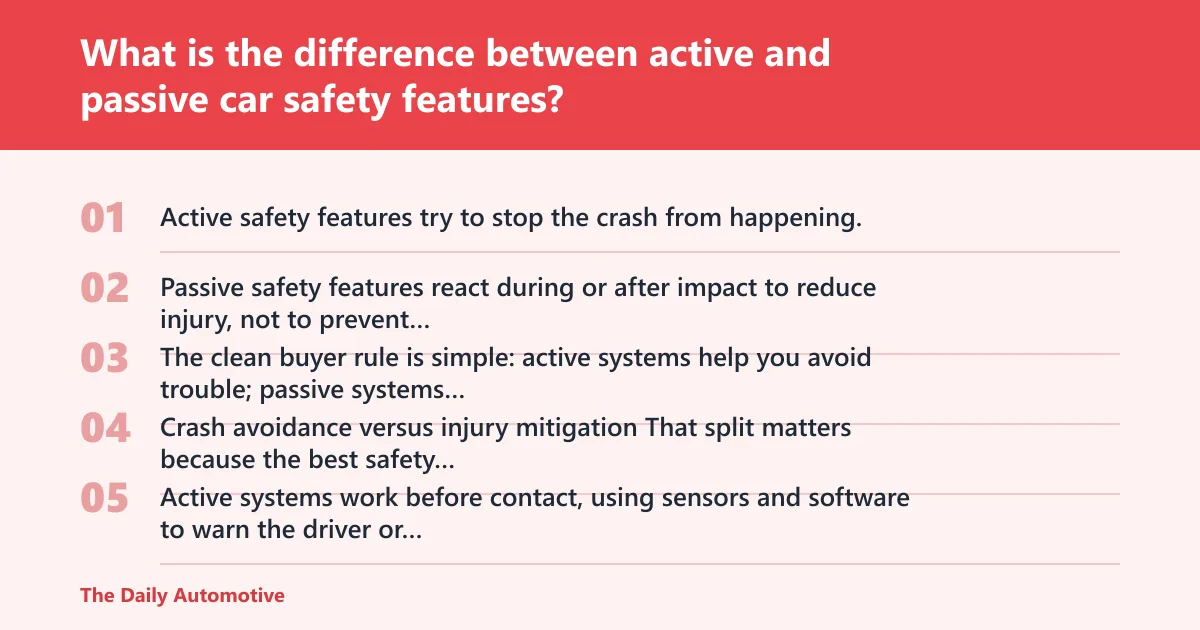
Active safety features try to stop the crash from happening. Passive safety features react during or after impact to reduce injury, not to prevent the collision itself. The clean buyer rule is simple: active systems help you avoid trouble; passive systems help you survive it.
Crash avoidance versus injury mitigation
That split matters because the best safety feature changes with the moment. Active systems work before contact, using sensors and software to warn the driver or intervene automatically. Passive systems are mostly hardware and structure, and they do their job when the hit has already started.
Why both categories matter together
Active and passive safety do different jobs, and one cannot replace the other. A strong safety cell and airbags will not stop a rear-end crash in traffic, while lane keep assist will not protect a belted occupant from force in a severe impact. Modern cars need both layers.
Which car safety features are active vs passive?
ABS, traction control, ESC, forward collision warning, automatic emergency braking, lane keep assist, and blind-spot monitoring are active safety features. Seatbelts, airbags, crumple zones, a reinforced passenger cell, and laminated windshield design are passive safety features. The key divide is prevention first versus injury reduction first.
Active safety examples shoppers should recognize
ABS is generally meant to reduce wheel lock-up under hard braking and help preserve steering control, so it is commonly treated as an active-safety feature. ESC, also called ESP, can brake individual wheels when stability is lost. Forward collision warning alerts the driver before impact, and automatic emergency braking may brake on its own if the driver does not react. (en.wikipedia.org)
Passive safety examples shoppers should recognize
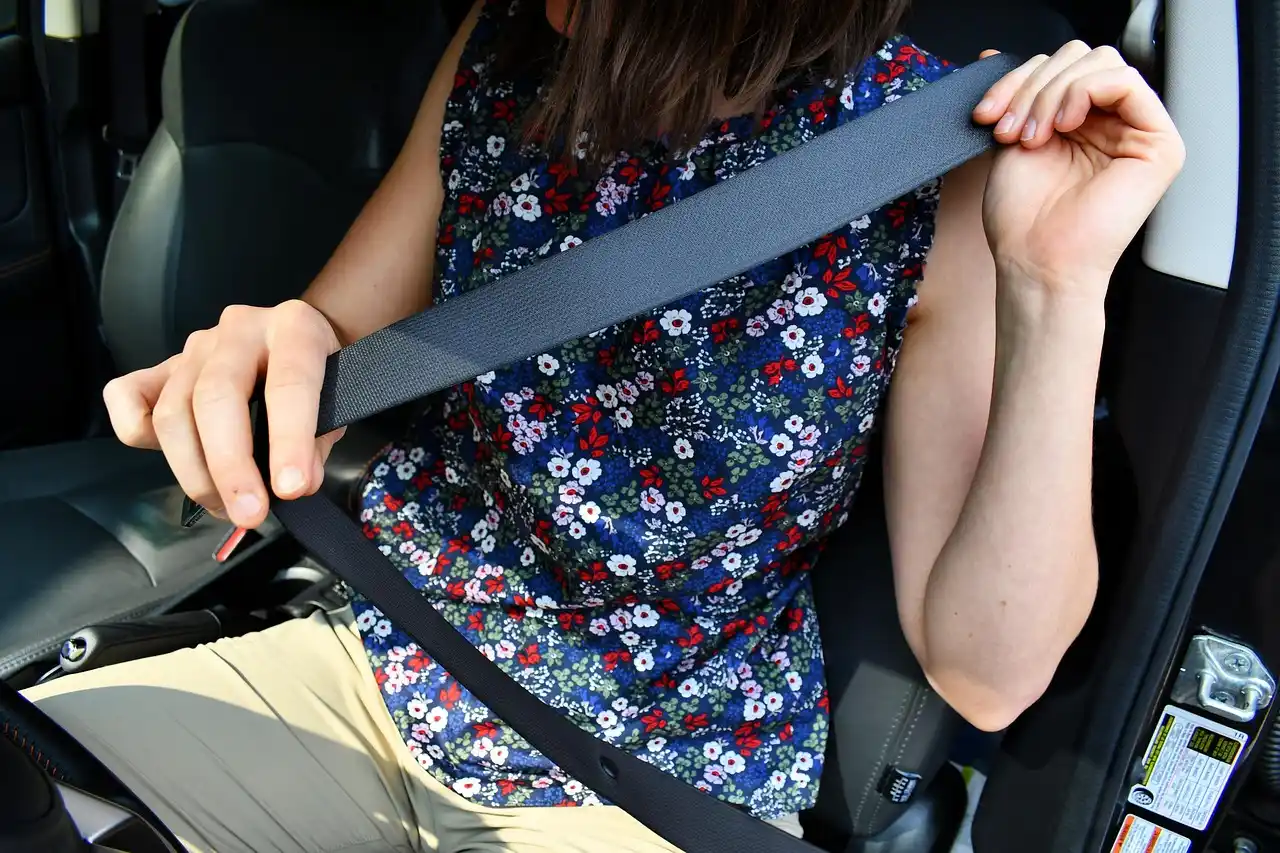
Seatbelts are the simplest and most effective passive system in the car. Airbags deploy in a collision, crumple zones deform to absorb energy, and the reinforced passenger cell helps preserve cabin integrity. These parts do not avoid the crash; they limit what the body experiences when the crash arrives.

How active safety works in real driving
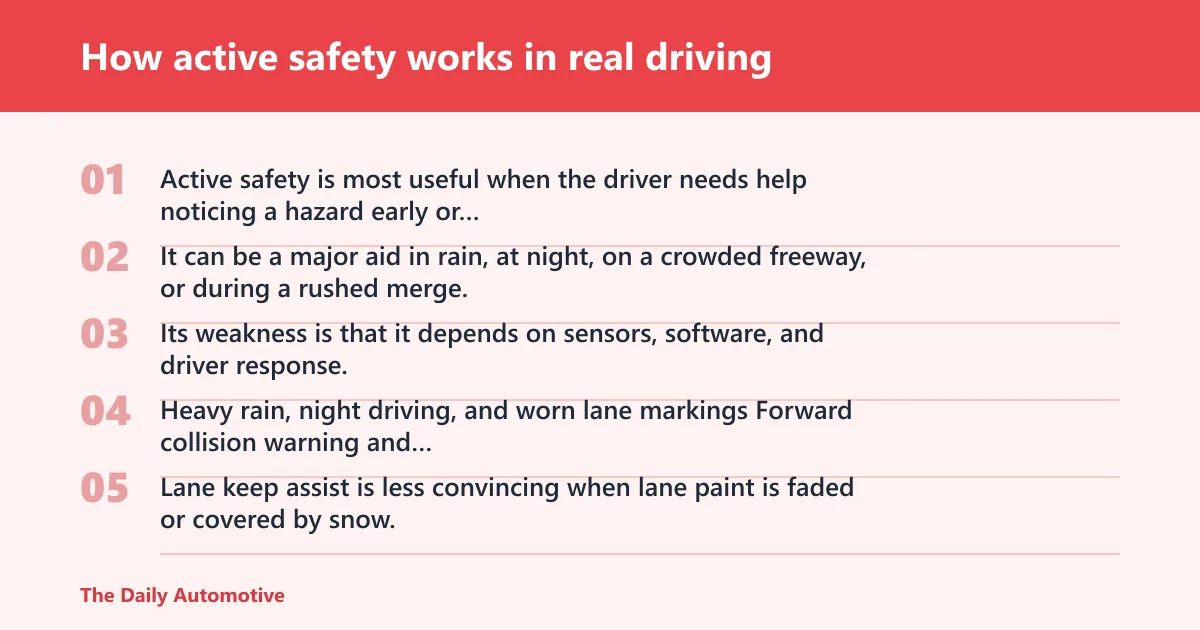
Active safety is most useful when the driver needs help noticing a hazard early or keeping the car stable on a slick surface. It can be a major aid in rain, at night, on a crowded freeway, or during a rushed merge. Its weakness is that it depends on sensors, software, and driver response.
Heavy rain, night driving, and worn lane markings
Forward collision warning and automatic emergency braking can help in traffic, but heavy rain, glare, dirty sensors, and poor visibility can limit what the car sees. Lane keep assist is less convincing when lane paint is faded or covered by snow. Blind-spot monitoring can also be less certain when sensors are obstructed by grime or road spray.
Why some systems warn first and others intervene
Some active systems only alert the driver because the car cannot safely choose every response on its own. Others step in with braking or steering support when the situation crosses a threshold. That difference matters in shopping, because a warning-only feature is helpful, but it is not the same as one that can reduce impact on its own.
Failure cases buyers should expect
Active systems can be disabled by the driver, muted by road conditions, or overtrusted. A tired driver may ignore a warning sound. A blocked camera can reduce lane support. That is why active tech should be treated as backup help, not as permission to drive carelessly.
How passive safety protects you in a crash
Passive safety protects the body once the crash begins. Seatbelts hold occupants in the correct position, airbags cushion contact with hard surfaces, and the body structure manages the energy path around the cabin. This protection works even when the driver has no time to react.
Seatbelts and airbag timing
Volvo introduced the three-point seatbelt in 1959, and Mercedes-Benz added pre-tensioner technology in 1981. Those details matter because seatbelts are the foundation of occupant protection. Airbags, invented in 1953 and later fitted to commercial vehicles in 1972, add cushioning, but they are meant to work with the belt, not instead of it.
Crumple zones and cabin strength
Crumple zones are built to deform and soak up collision energy before it reaches the passenger cell. The reinforced safety cell, sometimes described as a strong body structure or monocoque-style architecture, helps preserve cabin integrity. That is not the same thing as a driver aid; it is the shell around the people inside.
Why passive protection still matters at all speeds
Even a low-speed hit can injure an unbelted occupant if the body moves into the wheel, dash, or glass. At higher speeds, the cabin structure and restraint system become even more important. ScienceABC lists seatbelts, airbags, crumple zones, laminated windshields, and a reinforced cabin as passive safety features for a reason: they are the last line of defense.
The feature-by-feature decision matrix

This matrix ranks common safety items by crash-prevention value, occupant-protection value, trim availability, and where each one tends to fail. It is the most useful way to shop because it separates what helps you avoid a crash from what helps you survive one. Read it as a buying map, not a lab score.
| Feature | Crash-prevention value | Occupant-protection value | Trim availability | Common failure cases | When it matters most |
|---|---|---|---|---|---|
| Automatic emergency braking | Very high | Moderate | Often standard on newer cars, optional on some trims | Dirty sensors, poor lane/target detection, late intervention | Stop-and-go traffic, distracted-driving backup, city following distances |
| Electronic stability control | Very high | Moderate | Widely standard on modern cars | Can be switched off in some driving modes, limited by tires and road grip | Wet ramps, emergency maneuvers, snow, sudden lane changes |
| ABS | High | Moderate | Commonly standard on most modern cars | Less effective with bad tires or on loose surfaces if the driver expects too much | Hard braking in rain, surprise stops, slippery pavement |
| Forward collision warning | High | Low | Standard on many late-model trims, optional on some lower trims | False alerts, missed alerts, driver ignores warnings | Heavy traffic, following distance mistakes, night driving |
| Lane keep assist | Moderate | Low | Trim-dependent on many cars | Faded markings, snow, curves, construction zones | Long freeway trips, fatigue support, wandering within lanes |
| Blind-spot monitoring | Moderate | Low | Often trim-dependent | Sensor blockage, motorcycles in blind areas, wet-road interference | Highway merging, multilane city driving, changing lanes in traffic |
| Seatbelts | Low | Very high | Standard | Misuse, slack, improper fit | Every trip, every seat, every speed |
| Airbags | Low | Very high | Standard on most modern vehicles, but coverage varies by trim and body style | Wrong seating position, no belt use, impact types outside deployment logic | Frontal and side impacts, occupant head and chest protection |
| Crumple zones | None | Very high | Built into the vehicle structure | Severe crash energy can exceed design limits | Front and rear impacts, energy management |
| Reinforced passenger cell | None | Very high | Built into the vehicle structure | Extreme intrusion can still occur in major crashes | Side impacts, roof strength, cabin survival space |
Why automatic emergency braking sits near the top
Automatic emergency braking is one of the most useful active features because it can prevent or reduce a crash when the driver reacts too slowly. ScienceABC lists it among active safety features, and that matches real shopping priorities. It matters most in traffic where closing speeds change fast.
Why seatbelts stay at the top of passive protection
Seatbelts are the foundation because they work without driver intervention and control how the body moves in a crash. CarBikeTech describes seatbelts as a passive safety system, and that is the right classification. A car with advanced driver aids but poor restraint use is still a weak safety package.
What should you prioritize when buying a car?
Prioritize automatic emergency braking, ESC, ABS, and a full belt-and-airbag package before paying for convenience tech. After that, pick the features that match your driving: lane support for long freeway drives, blind-spot monitoring for dense traffic, and better crash protection for family duty. Budget should decide the extras, not the basics.
Best picks for used cars
Used-car buyers should check first for ABS, ESC, functioning seatbelts, and a complete airbag system. Those are the baseline items that protect against both crash loss of control and injury in impact. If the budget allows, forward collision warning and AEB are valuable additions, but they should never come before the basics.
Best picks for family cars
Family buyers should look for the strongest mix of active and passive safety, with AEB, ESC, side airbags, good belt fit, and a cabin structure that looks built to keep the passenger cell intact. Rear-seat protection matters too, especially if children ride often. A family car should be easy to trust, not just easy to park.
Best picks for new drivers and tight budgets
For new drivers, stable braking and stability control matter more than flashy driver aids. ABS and ESC help when panic braking or overcorrection happens. If the budget is tight, spend on the safest trim you can afford, then verify tire quality and belt use before chasing extra electronics.
Can active safety replace passive safety?
No. Active safety can reduce the chance of a crash, but it cannot erase every mistake, every weather problem, or every other driver’s error. Passive safety is the backup plan once impact happens, and the minimum worthwhile package is strong restraint systems, airbags, ABS, and ESC.
Why the answer is no
Active systems depend on what they can sense and how quickly the driver responds. Passive systems do not need a warning, a camera view, or lane markings. If the crash happens anyway, the body still needs restraint, cushioning, and cabin survival space.
The minimum feature set worth having
At a minimum, shoppers will usually want seatbelts, airbags, ABS, and ESC. That mix covers both crash avoidance and injury reduction better than any one feature alone. If AEB is available at a reasonable trim step, it is often a strong next active addition.
How to think about tradeoffs by budget
If the budget is very tight, buy the car with the better passive package and the core active systems already fitted. If there is room to move up a trim, spend it on AEB or blind-spot monitoring before spending on comfort items. Safety tech that helps in bad weather or late reaction moments is usually money well spent.
active safety vs passive safety
Active safety wins when the question is “can this car help avoid the hit?” Passive safety wins when the question is “what happens if the hit still occurs?” For real buyers, the right answer is usually a mix, but the purchase order should start with ESC, ABS, AEB, belts, and airbags before any comfort-focused driver aid.
Verdict
Choose active safety if you do a lot of highway merging, night driving, commuting in rain, or city traffic with sudden stops. Choose passive safety features as the non-negotiable base for every car, especially for family use and used-car shopping. If the budget only stretches so far, buy the car with the strongest standard belt, airbag, ABS, and ESC package first, then add active aids next.
Frequently asked questions
What is the difference between active and passive car safety features?
Active safety features aim to prevent a crash before contact happens. Passive safety features react during or after impact to reduce injury. The buyer takeaway is simple: active systems help you avoid the incident, while passive systems help protect people when avoidance fails.
Are airbags active or passive safety features?
Airbags are passive safety features because they deploy in a collision rather than trying to stop the crash itself. Their job is to cushion occupants against hard interior surfaces. They work best when the seatbelt is also worn correctly, which is why the two systems are treated as a pair.
Are ABS and ESC active safety features?
Yes. ABS is an active safety feature because it prevents wheel lock-up under hard braking and helps preserve steering control. ESC, or ESP, is also active because it can brake individual wheels when stability is lost. Both are aimed at crash avoidance, not injury cushioning.
Do passive safety features work without driver intervention?
Yes, that is one of their main advantages. Seatbelts, airbags, crumple zones, and the reinforced passenger cell protect occupants during or after a crash without needing the driver to press a button or react in time. Their weakness is not dependency on attention, but limits set by crash severity.
What safety features should I prioritize when buying a car?
Start with seatbelts, airbags, ABS, and ESC. If the car has automatic emergency braking, that is a strong next step, especially for commuting and city driving. After those basics, pick extras based on use case: blind-spot monitoring for dense traffic, lane keep assist for long freeway runs.
What is the difference between active safety vs passive safety?
Active safety vs passive safety is a split between prevention and protection. Active systems try to stop the crash; passive systems try to reduce harm once the crash has started. A good car needs both, but the safest purchase begins with the systems that are already standard and always ready.
Products related to this article
Sponsored / affiliate links. As an Amazon Associate I earn from qualifying purchases. I may earn additional commission from eligible campaigns.