
Denso Oxygen Sensor Review for Reliable Repairs
Denso oxygen sensors are a solid buy when the fault points to the sensor itself, the heater circuit fails, and the connector, thread, and wire length match the vehicle. If trims, vacuum leaks, or exhaust leaks are the real issue, replacement alone will not fix the light.
Verdict

That is where Denso fits well: OE-style shape, vehicle-specific connector details, and a direct-fit layout that cuts installation guesswork. It is a good choice for reliable repairs, but only after OBD-II data supports the diagnosis.
Pros
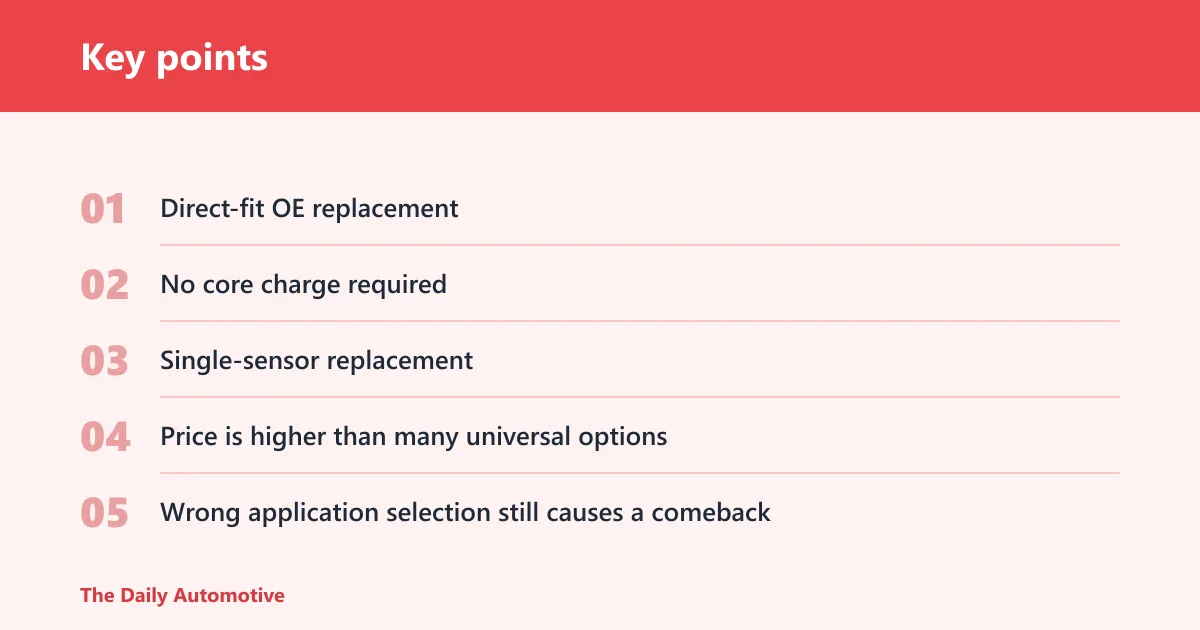
- Direct-fit OE replacement
- No core charge required
- Single-sensor replacement
Cons
- Price is higher than many universal options
- Wrong application selection still causes a comeback
- It will not cure wiring, leak, or catalyst faults by itself
Specs at a glance
| Detail | Denso 234-4513 |
|---|---|
| Brand | Denso |
| Type | Direct-fit OE replacement oxygen sensor |
| Application style | Single sensor |
| Fitment style | Vehicle-specific connector and harness |
| Replacement note | Listed as replacing 22690AA960 and related part numbers |
| Price | $94.80 |
Who it
Denso makes the most sense for a driver who wants an OE-style repair with less fitment risk, especially on a daily driver where a comeback is expensive. It also suits DIY work when the scan tool already points to a failed heater circuit or a sluggish sensor response.
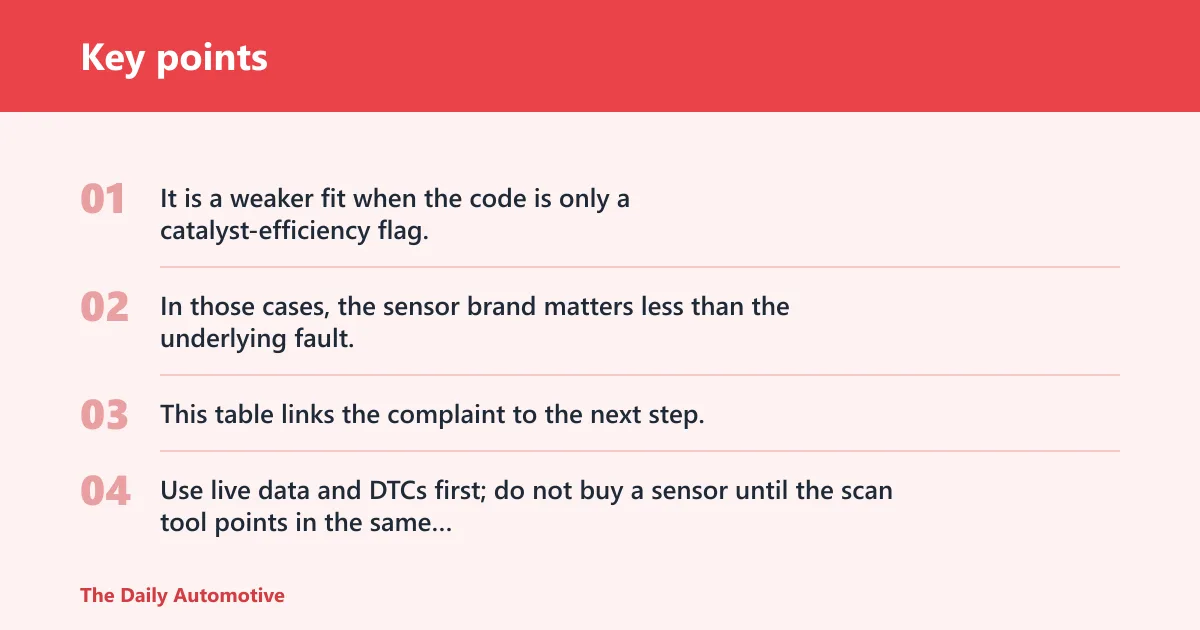
It is a weaker fit when the code is only a catalyst-efficiency flag, or when the vehicle needs wiring repair, an exhaust leak fix, or a fuel-trim diagnosis first. In those cases, the sensor brand matters less than the underlying fault.
Oxygen sensor decision matrix
This table links the complaint to the next step. Use live data and DTCs first; do not buy a sensor until the scan tool points in the same direction as the symptom.
| Symptom | DTC | Upstream or downstream | Likely cause | Test to run | Replacement confidence |
|---|---|---|---|---|---|
| Rough idle, poor fuel economy, long warm-up correction | P0130, P0131, P0171, P0174 | Upstream | Slow sensor, vacuum leak, wiring fault, or exhaust leak ahead of the sensor | Check fuel trims at idle and 2,500 rpm, inspect exhaust leaks, watch switching activity | Medium only after trims and leaks check out |
| Check engine light with heater fault on cold start | P0135, P0141, P0155, P0161 | Either, depending on code | Heater circuit failure, blown fuse, damaged connector, or poor ground | Measure heater resistance and circuit power/ground, inspect wire runs near heat sources | High if circuit tests fail |
| Poor response during cruise and acceleration, trims drift positive | P0133, P0153 | Upstream | Slow zirconia sensor, contamination, or exhaust leak | Compare live switching rate under cruise and snap throttle | High if switching is slow and leak-free |
| P0420 or P0430 with normal drivability | P0420, P0430 | Downstream | Catalyst efficiency issue, exhaust leak, or upstream sensor problem | Compare upstream and downstream waveforms; inspect for leaks before replacing parts | Low for the downstream sensor alone |
| Random rich or lean behavior without sensor-specific code | None or fuel-trim codes only | Usually upstream system | Fuel delivery, vacuum leak, MAF issue, or exhaust leak | Test fuel trim first, then confirm sensor activity | Low until the root cause is found |
Is Denso a good oxygen sensor brand?
Yes, Denso is a good oxygen sensor brand when you want OE-style fit and a repair that follows the vehicle’s original connector, harness length, and application. That matters because oxygen sensors are part of closed-loop fuel control, where the engine uses sensor feedback to adjust fuel trim during idle, cruise, and acceleration.
OE-supplier status helps most on jobs where access is tight and the wire route is specific. It matters less if the real fault is outside the sensor: an exhaust leak can skew readings, and a damaged wire can create the same code as a failed sensor.
Why OE fit matters
Denso’s direct-fit parts are built around vehicle-specific connectors and pre-attached wire looms. That cuts splice work, lowers the chance of a wiring mistake, and helps keep the heater circuit and signal wire routing close to factory layout. For a daily driver, that can mean fewer comebacks after the repair.
Picture a sedan that sets P0133 on the highway after a small exhaust leak at the manifold. A new sensor may still report slowly if the leak is pulling in outside air, so the brand choice cannot fix a bad diagnosis.
What works
Denso’s strongest case is direct-fit replacement. The OE-style connector, wire length, and application matching make installation cleaner than a universal splice job, especially on sensors mounted near heat shields or tucked above the exhaust.
The other advantage is heater performance. A heated oxygen sensor, or HO2S, uses an internal heater to bring the zirconia element into operating range faster, which helps closed-loop fuel control during cold start. If the heater circuit fails, the sensor may lag or never wake up properly.
Upstream and downstream fit
Upstream sensors sit before the catalytic converter and drive fuel control. They need faster response because the powertrain control module watches their switching behavior closely. Downstream sensors sit after the converter and mostly monitor catalyst efficiency, so their signal should be steadier.
A common first-timer mistake is to replace the downstream sensor for a P0420 code without checking the upstream pattern first. If the upstream sensor is slow, the converter may look bad even when it is not.
What does not?
Universal oxygen sensors are not always a better value. The part may cost less, but splice-and-connect installation adds labor time and leaves more room for wire-count or connector mistakes. If the wire length is wrong, the sensor can be routed too close to the exhaust or pulled tight.
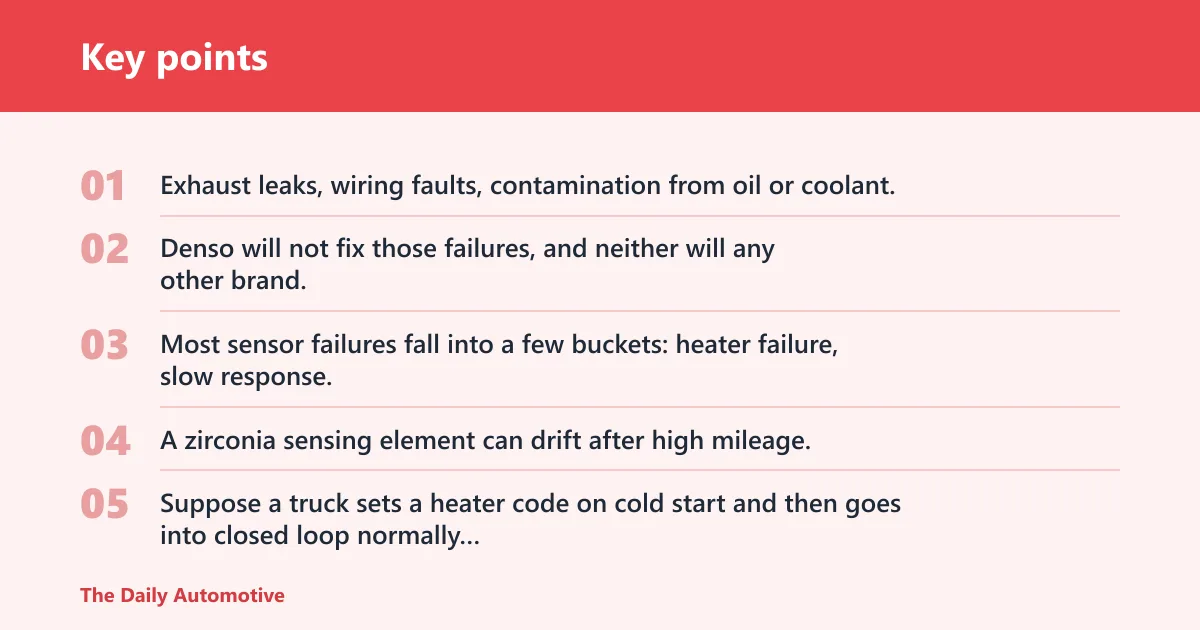
The bigger problem is false sensor blame. Exhaust leaks, wiring faults, contamination from oil or coolant, and fuel-trim problems can all mimic a bad sensor. Denso will not fix those failures, and neither will any other brand.
Common failure modes
Most sensor failures fall into a few buckets: heater failure, slow response, contamination, exhaust leaks, and age-related wear. A zirconia sensing element can drift after high mileage, but the scan tool still needs to confirm that the signal is lazy or fixed before replacement.
Suppose a truck sets a heater code on cold start and then goes into closed loop normally once warm. That pattern points more toward the heater circuit than the sensor element itself, which changes the repair path.
Should you buy a Denso oxygen sensor?
Buy it when the scan tool confirms the right sensor location, the connector and thread match the vehicle, and the data supports a failed sensor or heater circuit. Denso is a sensible pick for repairs where OE fit reduces risk and where you want the replacement to behave like the original part.
Do not buy first and diagnose later. Check fuel trims, inspect for exhaust leaks, and confirm switching behavior before you spend money. For P0420 and P0430, inspect the catalyst system and the upstream sensor pattern before assuming the downstream sensor is bad.
- Read the DTCs and freeze-frame data.
- Identify whether the code points to sensor 1 or sensor 2.
- Check for exhaust leaks, damaged wiring, and heater circuit faults.
- Watch live data for switching speed and trim correction.
- Buy the exact application only after the diagnosis lines up.
Alternatives

Bosch 15284 is the budget alternative in this group at $24.99, and its listing calls out direct-fit OE connectors, a fast-acting heater, and factory-tested quality checks. The drawback is simple: the lower price does not change the need to verify exact fitment, and it still will not fix a leak or fuel-trim problem.

NTK 23162 is another direct-fit OE replacement, with vehicle-specific fit and a corrosion- and abrasion-resistant design in the listing. It is a reasonable alternative when you want OE-style construction, but the same caution applies: check the exact application before buying, because the wrong application creates the same comeback risk as a cheap part.
How long do Denso oxygen sensors last?
There is no single mileage number that fits every vehicle, because heat, fuel quality, contamination, and exhaust leaks change sensor life. Many sensors last for years, but a heater circuit failure or slow response can show up earlier, especially on vehicles that run rich, burn oil, or have coolant intrusion.
If the sensor is original and the vehicle has high mileage, age becomes part of the diagnosis. Even then, scan-tool evidence should lead the decision. A sensor that still switches quickly and keeps trims stable does not need replacement just because of age.
What are the signs of a bad oxygen sensor?
The usual signs are a check engine light, poor fuel economy, rough idle, failed emissions testing, and trim corrections that stay too far positive or negative. On the scan tool, a bad upstream sensor may switch too slowly, stay fixed, or fail to respond cleanly to throttle changes.
Those symptoms still need confirmation. Exhaust leaks, wiring damage, and fuel delivery problems can create the same complaints, so do not replace the sensor until the live data and DTCs support it.
Should I choose Denso or Bosch for an oxygen sensor?
Choose Denso when OE-style fit, connector shape, and wire routing matter most, and when you want a direct-fit replacement that closely matches the factory setup. Bosch can also be a valid OE-fit option, but the better choice is the one that matches your vehicle’s exact application and diagnostic need.
Brand alone should not drive the repair. If the issue is a heater circuit fault, a slow upstream signal, or a confirmed sensor failure, either OE-quality part can work. If the problem is a leak or fuel-trim fault, neither brand is the answer yet.
Will a Denso oxygen sensor fit my car?
It will fit only if the listing matches your exact engine, model year, sensor position, connector style, and wire length. Denso makes both direct-fit and application-specific parts, so the part number matters more than the brand name.
Before buying, match the OE number, confirm whether the sensor is upstream or downstream, and check the wire length and plug. A part can look close and still miss the connector keying or wire routing.
How do I tell if I need an upstream or downstream oxygen sensor?
Use the code first. Upstream sensors are usually sensor 1 and are tied to fuel control, while downstream sensors are usually sensor 2 and are tied to catalyst monitoring. P013x and P015x families often point upstream; P0420 and P0430 are catalyst-efficiency codes that usually involve downstream comparison, not a guaranteed bad sensor.
If the code is vague, compare live data. The upstream sensor should switch more actively, while the downstream sensor should be steadier if the converter is working. If both signals look odd, inspect the exhaust for leaks before ordering parts.
Can I replace an oxygen sensor myself?
Yes, if you can safely access the sensor, disconnect the battery when the vehicle manual calls for it, and follow the vehicle-specific removal steps. Use jack stands on level ground if you must raise the car, and never work under a vehicle supported only by a jack.
The job is manageable for many DIY mechanics, but diagnosis still matters. Replacing the sensor is the last step, not the first one, because a wiring fault or exhaust leak can leave the warning light on after the repair.
Do universal oxygen sensors work as well as direct-fit?
They can work, but they usually cost more in labor and fitment risk. Universal sensors rely on splice-and-connect installation, so wire count, polarity, and routing all matter. Direct-fit sensors use an OE-style connector and pre-attached wire loom, which lowers the chance of an installation error.
If the vehicle is simple and the installer is careful, a universal part can be acceptable. On a repair where comeback risk matters, direct-fit is usually the safer value because the extra labor of splicing can erase the savings.
What causes an oxygen sensor to fail early?
Heat is one cause, but contamination and upstream faults are just as common. Oil burning, coolant contamination, rich running, exhaust leaks, and damaged wiring can shorten sensor life or make a good sensor look bad on the scan tool.
The heater circuit can also fail early if the wire run is too close to the exhaust or if the connector is damaged. That is why diagnosis should include circuit checks, not only code reading.
How much does a Denso oxygen sensor cost?
Price depends on the exact application and whether you are buying a direct-fit or universal-style part. In this group, the listed Denso 234-4513 is $94.80, which is typical of OE-style direct-fit pricing rather than bargain universal pricing.
Cost should be weighed against labor and comeback risk. A cheaper part that does not fit cleanly, or that leaves the warning light on because the diagnosis was wrong, costs more in the end than a correct OE-style replacement.
Products related to this article
Sponsored / affiliate links. As an Amazon Associate I earn from qualifying purchases. I may earn additional commission from eligible campaigns.