Bosch Oxygen Sensor Review: Fitment, Specs, and Value
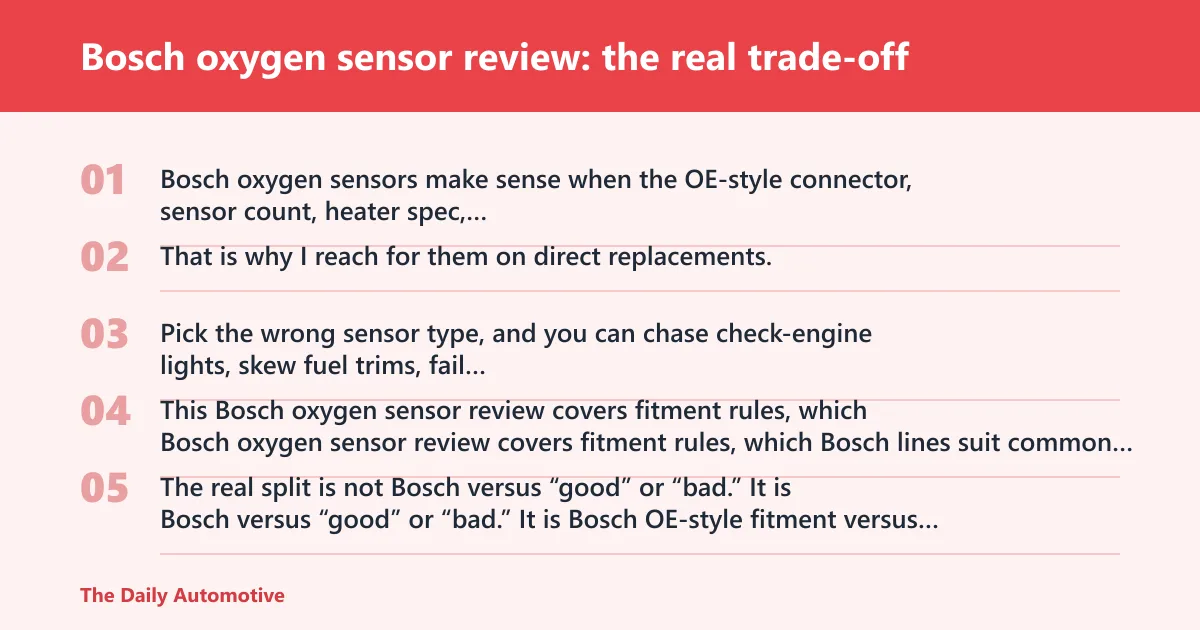
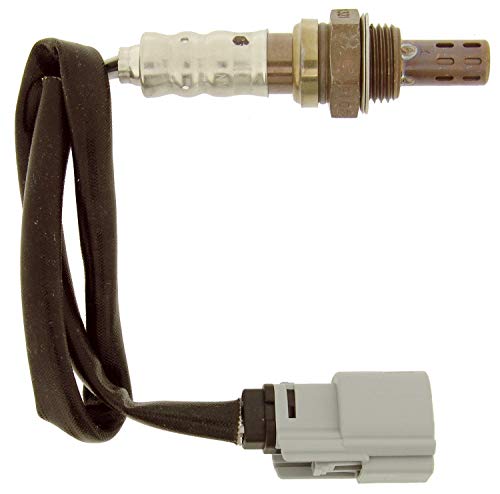
Bosch oxygen sensors make sense when the OE-style connector, sensor count, heater spec, and mounting location match your vehicle exactly. That is why I reach for them on direct replacements. Pick the wrong sensor type, and you can chase check-engine lights, skew fuel trims, fail an emissions test, and waste labor. This Bosch oxygen sensor review covers fitment rules, which Bosch lines suit common applications, and when a cheaper or different-spec sensor is the smarter buy.
The real split is not Bosch versus “good” or “bad.” It is Bosch OE-style fitment versus cheaper universal replacement logic. Bosch fits well when the car needs the same sensor architecture the ECU expects, especially on late-model European cars and on engines with specific heater and signal demands.
Bosch oxygen sensor review: the real trade-off


Bosch is also a major global supplier of technology and services. The company was founded on 15 November 1886, reported 412,800 associates worldwide, and reported sales revenue of 91 billion euros in 2025. Bosch also reported 417,859 employees in its 2024 figures. That scale matters because O2 sensor design lives close to OEM engineering, not generic parts-bin logic. (en.wikipedia.org)
According to bosch.com — Bosch reported sales revenue of 91 billion euros in 2025.
What an O2 sensor does in the exhaust system
An O2 sensor measures exhaust oxygen content so the engine controller can correct the air-fuel ratio. That input helps the ECU keep the mixture near target, protect the catalytic converter, and manage drivability during idle, cruise, and warm operation.
Air-fuel ratio feedback to the ECU
On most gasoline engines, the upstream sensor is the feedback sensor. It tells the ECU whether the engine is running rich or lean, and the computer trims injector pulse width accordingly. If the signal is slow or biased, fuel trims drift and the engine may surge, stumble, or use more fuel than it should.
Emissions control and catalyst protection
The catalytic converter depends on correct mixture control. Before-cat placement affects the ECU’s live correction strategy, while after-cat placement is used to monitor converter efficiency. A sensor that is wrong for its position can create false catalyst faults or hide a real emissions problem.
Fuel economy and drivability symptoms when readings go bad
Fuel economy usually drops before the driver notices a dead sensor. Rough idle, hesitation, poor cold manners, and repeated rich or lean codes are more common clues than a dramatic failure. A bad reading can also come from wiring damage, exhaust leaks, or an aging catalytic converter.
Is Bosch a good O2 sensor?
Bosch is a strong O2 sensor choice when the replacement matches the vehicle application exactly and the buyer wants OEM-style signal behavior. Bosch has long OEM credibility, and its heated sensor designs are built for quick cold-start warm-up, which matters because the engine runs in open loop until the sensor comes online.
OEM-style accuracy and application coverage
Bosch’s strength is application matching. On modern cars, that means the right connector, the right heater circuit, the right signal type, and the right location. A sensor that is chemically decent but electrically wrong can still fail the job.
Heated sensor design and cold-start behavior
Heated oxygen sensors use an internal heater element to get the sensor up to operating temperature sooner. That shortens the time the engine spends without closed-loop correction after a cold start. On daily drivers, that can matter as much as ultimate lifespan.
Where Bosch can beat a universal replacement
Bosch usually wins when the car is sensitive to signal shape or heater load, or when the vehicle uses a dedicated part number for one engine code and one location. Universal parts may save money up front, but the labor bill and comeback risk can erase that gap fast.
Which Bosch O2 sensor fits my vehicle?
The right Bosch sensor is determined by year, model, engine code, sensor location, and signal type. Start with the exact application catalog, then confirm whether the car needs an upstream or downstream sensor, a narrow-band or wide-band design, and a before-cat or after-cat placement.
Year, model, engine code, and part-number check
Fitment verification should begin with the vehicle’s year, model, and engine code, then move to the Bosch part number. Engine-code specificity matters because the same model can use different exhaust layouts or sensor calibrations across trims and markets.
Upstream vs downstream placement
Upstream sensors sit before the catalytic converter and feed mixture correction. Downstream sensors sit after the cat and watch converter performance. Swapping these by position, even if the connector fits, is one of the most common mistakes in O2 sensor work.
Narrowband vs wideband selection
Walker describes oxygen sensors as monitoring exhaust oxygen content for air-fuel regulation and says there are two main sensor types: narrow-band and wide-band. Bosch options must match the type the ECU expects. A narrow-band sensor and a wide-band sensor are not interchangeable just because they screw into the same bung.
Bosch oxygen sensor fitment table
Use this table to narrow the replacement before you order. The exact signs that confirm the right part are usually the connector shape, the sensor count in the exhaust, the engine code, and whether the failed unit is upstream or downstream. If any one of those details is off, stop and recheck the application.
| Engine type | Upstream/downstream location | Narrowband/wideband type | Before-cat/after-cat placement | Exact signs that confirm the right replacement |
|---|---|---|---|---|
| Turbocharged gasoline, BMW N55 example | Upstream | Wideband | Before catalytic converter | Matches the BMW application listing for F25 X3 xDrive35i, 2011 to 2017, and F26 X4 35i xDrive, 2015 to 2018; connector and heater spec match the OE part |
| Gasoline engine with rear emissions monitor | Downstream | Narrowband | After catalytic converter | Failed sensor is physically located behind the cat, and the code points to catalyst monitoring rather than mixture correction |
| European gasoline engine with precise air-fuel control | Upstream | Wideband | Before catalytic converter | Live data shows the ECU using air-fuel ratio feedback, not simple switching voltage, and the OE catalog calls for a wideband design |
| Domestic gasoline engine with standard closed-loop trim control | Upstream | Narrowband | Before catalytic converter | Scan data shows conventional rich/lean switching, and the sensor sits ahead of the cat in the primary feedback position |
A Bosch oxygen sensor product example is listed for BMW N55 engines before the catalytic converter. That example is priced at $164.99. It covers F25 X3 xDrive35i models from 2011 to 2017 and F26 X4 35i xDrive from 2015 to 2018. That is the kind of fitment detail a buyer should demand before clicking “buy.”
What are the failure signs before you buy?
The best time to replace an O2 sensor is when diagnosis points to the sensor, not when the engine simply feels off. Common failure signs include fuel-trim drift, a slow or stuck sensor trace, repeated mixture codes, hesitation, rough idle, and poor fuel economy. A catalytic converter fault can look similar, so scan data matters.
Check-engine codes and scan data clues
Codes related to heater circuit faults, signal response, or mixture correction can point toward the sensor. Live data is more useful than the warning lamp alone. If the upstream sensor is lazy or flat while fuel trims move hard in one direction, the sensor is suspicious.
When the catalytic converter is the real issue
Do not blame the sensor first if there is an exhaust leak, an oil burning issue, misfire history, or a converter that is clearly not storing oxygen properly. Downstream codes can be a converter problem with a healthy sensor attached. That is why part-number matching and diagnosis should happen together.
Bosch vs universal-fit sensors: which is the better buy?
Bosch direct-fit sensors are usually the better buy when the goal is low labor risk and a fast, correct repair. Universal-fit sensors can cost less at checkout, but they add splice work, increase wiring mistakes, and raise the chance of a comeback if the connector, heater, or signal spec is off.
Direct-fit convenience versus pigtail splicing
Direct-fit sensors can save time because the connector and wire length are already matched for the application. Universal-fit parts often require cutting and splicing the old connector. That can work, but every extra splice is another place for resistance, water intrusion, or wrong wire pairing.
Labor time, comeback risk, and return risk
Labor risk is the hidden cost in O2 sensor buying. A cheap sensor that creates a false code or poor driveability can cost more than the price difference after one return trip. On European cars with tight packaging, that risk climbs fast.
Daily driver, high-mileage car, and European car use cases
For a daily driver, the safer call is usually exact-match Bosch if the catalog confirms the part. For a high-mileage car, inspect wiring and exhaust leaks first, because an old harness can ruin a good sensor. For many European applications, Bosch is often the first place to look because the OE-style fitment matrix is stricter.
Choose Bosch oxygen sensor if… / Choose universal-fit sensor if…
Choose Bosch oxygen sensor if you want exact application matching, the vehicle uses a specific heater or signal setup, or the car is sensitive to scan-tool confirmation and emissions readiness. Choose a universal-fit sensor only when the correct OE-style part is unavailable and you can splice with care.
Choose Bosch oxygen sensor if…
- The vehicle calls for a specific upstream or downstream sensor.
- The engine code and part number must match exactly.
- You want the lowest comeback risk on a direct replacement.
- The car is a European application with stricter sensor logic.
Choose universal-fit sensor if…
- The OE-style Bosch part is unavailable.
- You can verify wire functions before splicing.
- The vehicle is older and less sensitive to connector style.
- The repair budget matters more than installation time.
When to walk away and buy a different sensor type
Walk away from the Bosch part number if the catalog calls for a different type, even if the connector looks close. A narrowband sensor should not replace a wideband unit, and a before-cat sensor should not be used where an after-cat monitor belongs. Wrong type means wrong data.
How long do Bosch oxygen sensors last
Bosch oxygen sensors can last up to 90,000 miles, but that is not a promise for every engine, fuel quality, or heat cycle. A sensor may age faster on short-trip cars, oil-burners, and vehicles with exhaust leaks or misfires. Heat and contamination usually end them before mileage alone does.
What shortens life in the real world
Rich running, coolant contamination, silicone sealants, and repeated thermal shock all shorten sensor life. A sensor in a healthy exhaust stream lasts longer than one sitting next to an engine with chronic misfire or an oil consumption issue.
Do Bosch O2 sensors work for European and domestic cars
Bosch oxygen sensors work for many European and domestic cars, but only when the exact vehicle application matches. Bosch’s catalog coverage is broad, yet the buyer still has to match connector, placement, heater design, and engine code. Brand recognition alone is not enough.
European application guidance
European cars often use more specific sensor logic, especially on turbocharged gasoline engines and later emissions systems. Bosch is frequently a good starting point there because OE-style fitment and sensor behavior tend to matter more than the lowest sticker price.
Domestic application guidance
Domestic cars can be more forgiving, especially on older narrow-band setups. Even then, upstream and downstream positions still need to be kept separate. A downstream monitor is not the same part as the fuel-control sensor ahead of the cat.
Frequently asked questions
is bosch a good o2 sensor
Bosch is a good O2 sensor choice when the part number matches the exact vehicle and sensor position. The brand is strong on OEM-style fitment, heated sensor design, and application coverage. It is less about the logo and more about whether the ECU expects that exact sensor type.
are bosch 02 sensors good
Yes, Bosch 02 sensors are generally a solid buy when the replacement is matched by year, model, engine code, and upstream or downstream location. They are best treated as fitment-sensitive parts, not generic consumables. If the type is wrong, even a good sensor can cause problems.
what is the difference between Bosch oxygen sensors and cheaper aftermarket options
The main difference is fitment control and signal confidence. Cheaper sensors may work, but they often add connector, heater, or calibration risk. Direct-fit parts can often reduce install time and may lower the chance of a comeback, while universal aftermarket options can require splicing and extra diagnosis.
which Bosch O2 sensor fits my vehicle
The right Bosch O2 sensor fits your exact year, model, engine code, and sensor position. Then confirm whether it is upstream or downstream, narrowband or wideband, and before-cat or after-cat. If the catalog does not match all of those points, keep searching.
how long do Bosch oxygen sensors last
Walker’s material says Bosch sensors can last up to 90,000 miles, but actual service life depends on heat, contamination, and engine condition. Short trips, misfires, oil burning, and exhaust leaks can shorten life. A healthy engine and correct installation usually give the sensor a better shot.
what symptoms suggest a Bosch oxygen sensor has failed
Failed Bosch oxygen sensors often show up as rough idle, hesitation, poor fuel economy, mixture codes, or fuel trims that stay skewed rich or lean. A scan tool is the best next step. The converter, wiring, or an exhaust leak can mimic the same symptoms, so diagnosis comes first.
Products related to this article
Sponsored / affiliate links. As an Amazon Associate I earn from qualifying purchases. I may earn additional commission from eligible campaigns.