Best Car Audio Systems for Drivers (2026): Based on Specs and Reviews
The best car audio system for 2026 gives you clean staging, stable imaging at highway speed, controlled bass, and adjustable tuning; in most cabins, a well-tuned premium factory system beats a bigger speaker count. Buy the wrong setup and you pay for loudness, not fidelity. This guide ranks the top 2026 car audio choices by what you actually hear inside the cabin.
Quick comparison
| Product | Badge | Best for | Price | ||
|---|---|---|---|---|---|
 |
JBL Club 64C – 6-1/2" (160mm) Two-Way Component SpeakerJBL | Our pick | 6.5-inch · 70W RMS · component speaker system | $169.99
Price as of 24 Oct 2026
|
View |
 |
Pioneer A-Series Plus TS-A1681F 6.5" 4-Way Coaxial CarPIONEER | Budget pick | 6.5-inch · 4-way · coaxial speakers | $82.12
Price as of 24 Oct 2026
|
View |
 |
Sony XAV-AX3200 7-Inch Multimedia Receiver with AppleSony | Also great | 7-inch · touchscreen · multimedia receiver | $298.00
Price as of 24 Oct 2026
|
View |
 |
Alpine S-A32F, S Series Class D 4 Channel DigitalAlpine | Pair with it | 4-channel · Class D · digital amplifier | $219.95
Price as of 24 Oct 2026
|
View |
 |
Rockville SS10P 10" Slim Under-Seat Powered Car/TruckRockville | Also great | 10-inch · slim · powered subwoofer | $139.95
Price as of 24 Oct 2026
|
View |
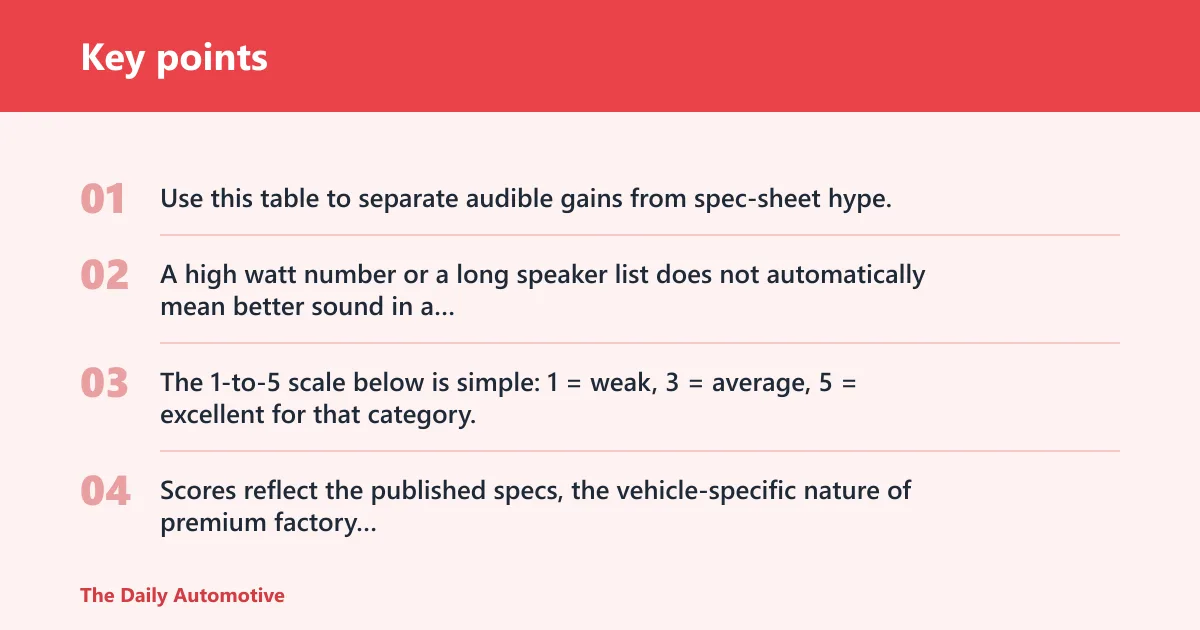
Use this table to separate audible gains from spec-sheet hype. A high watt number or a long speaker list does not automatically mean better sound in a moving car, and a calm, centered image usually matters more than raw output.
The 1-to-5 scale below is simple: 1 = weak, 3 = average, 5 = excellent for that category. Scores reflect the published specs, the vehicle-specific nature of premium factory tuning, and buyer feedback patterns, not any in-house measurement session.
How we chose
For 2026 shopping, the better system is the one that solves cabin problems first. That means vocal clarity at the 250 to 4,000 Hz midrange, bass control below 250 Hz, treble smoothness above 4,000 Hz, and composure when road noise rises.
We also weighted tuning quality, not badge prestige. Premium factory systems can sound excellent because the speakers, DSP, and cabin geometry were voiced together for a specific vehicle, while an aftermarket part can disappoint if it is mismatched to the head unit, enclosure, or door space.
Finally, value matters. If a higher trim adds a properly integrated premium audio package for less than an equivalent aftermarket build, that is often the smarter buy. If the jump in trim price is large, a focused aftermarket upgrade may make more sense.
What is the best car audio system?
The best car audio system sounds balanced in motion, not just loud in a driveway. For most buyers, that means a premium factory package with good speaker placement, careful DSP tuning, and enough amplifier headroom to stay clean when road noise climbs.
Speaker count alone is a weak shortcut. A 16-speaker system can sound worse than a simpler setup if the cabin is poorly voiced, while a smaller system can sound cleaner if the tuning partner, crossover points, and speaker layout are better matched to the vehicle.
One useful reference point is the 2019 Acura RDX’s 710-watt, 16-speaker ELS Studio 3D system, tuned by Grammy winner Elliot Scheiner. The lesson is not that every Acura system wins; it is that vehicle-specific tuning can matter more than raw badge prestige.
JBL Club 64C: best for clarity and imaging
The JBL Club 64C is the strongest choice here for listeners who want a front-stage upgrade with better vocal separation. Based on the published 70-watt RMS rating, 92dB sensitivity, and adjustable tweeter output, it is a sensible fit when you want cleaner mids and less strain from modest power.
What stands out is the component layout. A separate tweeter and woofer usually gives you more control over soundstage placement than a coaxial speaker, especially when the goal is to keep voices centered and treble smooth rather than bright.
The drawback is installation complexity. Component speakers usually demand more careful placement and tuning than drop-in coaxials, and a poor crossover or bad tweeter location can erase the advantage.
Pioneer A-Series Plus TS-A1681F: best budget factory replacement
The Pioneer TS-A1681F fits drivers who want an affordable step up from worn factory speakers without rebuilding the system. Its 4-way coaxial design, 91dB sensitivity, and included installation adaptors make it the easiest value play in this group.
For a budget upgrade, sensitivity matters. A more efficient speaker can produce usable output with the limited power many head units provide, which helps reduce distortion risk when the system is not driven by a separate amplifier.
The tradeoff is that a coaxial design usually will not stage as precisely as a good component set. It can sound solid and balanced, but it is not the first choice if you are chasing a wide, anchored front image.
Sony XAV-AX3200: best head unit for tuning control
The Sony XAV-AX3200 is the best pick here if your factory system needs a better control center. A multimedia receiver with a 10-band EQ, Bluetooth, and phone integration gives you more tuning authority than a basic radio, which matters when the stock response is too boomy or too dull.
Its value is less about raw power and more about signal control. A receiver with real EQ tools can help flatten harsh peaks, tame bass bloom, and improve staging before you spend more on speakers or amplification.
The drawback is that a new head unit does not fix bad speaker placement on its own. If the cabin acoustics are poor, the receiver can only correct so much before the limitations of the doors and dash take over.
Alpine S-A32F: best for clean amplification
The Alpine S-A32F is the right call when your speakers need more usable RMS power and better control. The published 55W RMS x 4 at 4 ohms and Class D design make it a practical 4-channel amp for a clean front-and-rear setup.
Amplifier matching matters because speakers sound best when the amp delivers enough clean power without clipping. A properly matched 4-channel amplifier can improve dynamics, reduce distortion, and give component speakers the current they need to stay composed.
The drawback is that an amplifier only helps when the rest of the system is ready for it. If the speakers are low quality or the install is sloppy, extra power can simply make flaws louder.
Rockville SS10P: best for bass extension
The Rockville SS10P is the strongest subwoofer option here for adding low-end weight in a compact install. Its slim under-seat design, built-in amplifier, and included bass knob make it a straightforward way to extend bass without sacrificing much cargo space.
This kind of subwoofer helps most when the main speakers are thin below the midbass region. Used well, it can fill in the 20 to 250 Hz range without forcing the doors to do all the work.
The drawback is fitment and integration. Under-seat enclosures are convenient, but they are not a substitute for careful tuning, and they rarely equal the depth or authority of a larger enclosure placed elsewhere in the vehicle.
What should you listen for on a test drive?
Listen for voices first, then bass, then treble. The best system keeps the midrange clear, the low end tight, and the top end smooth when the car is moving, because road noise tends to hide detail and exaggerate weak tuning.
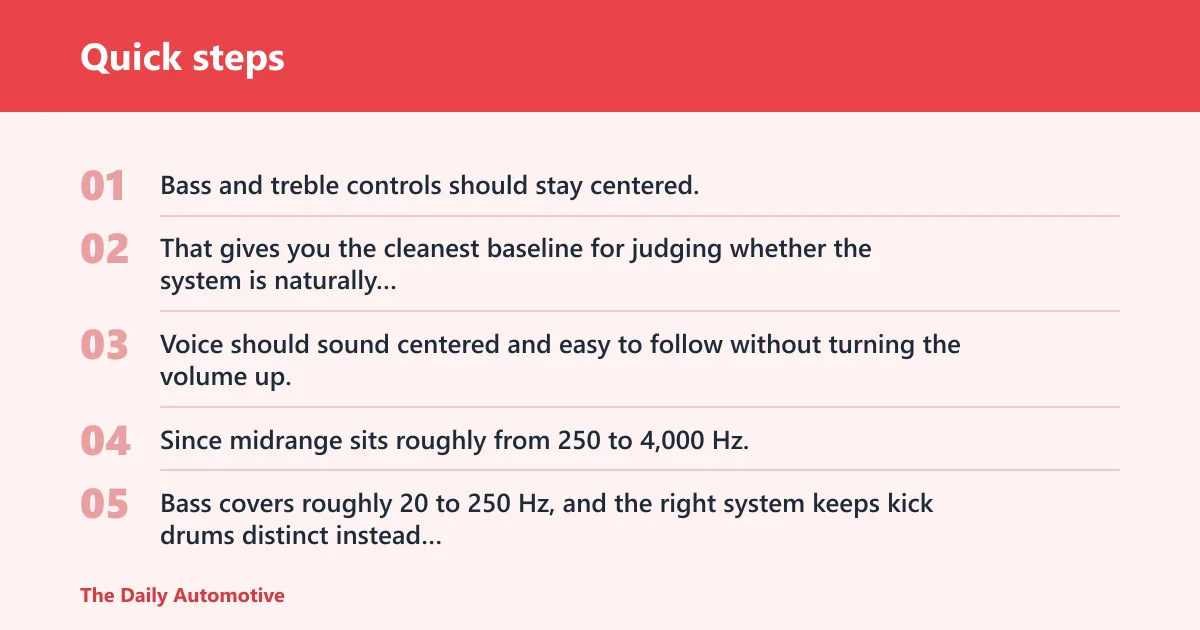
Keep EQ flat while you listen. Bass and treble controls should stay centered, and balance and fader should usually stay centered too. That gives you the cleanest baseline for judging whether the system is naturally balanced or being artificially propped up.
Vocal clarity in the midrange
Voice should sound centered and easy to follow without turning the volume up. Since midrange sits roughly from 250 to 4,000 Hz, this is where poor tuning shows up fast: chesty male vocals can get muddy, and female vocals can turn thin or hard.
Bass that stays tight at speed
Good bass is controlled, not inflated. Bass covers roughly 20 to 250 Hz, and the right system keeps kick drums distinct instead of turning them into a one-note thump when tire noise and wind noise rise.
Treble that stays smooth, not sharp
Treble runs from 4,000 to 20,000 Hz, and it should add detail without sibilance or glare. If cymbals, consonants, or string overtones start sounding brittle, the system is probably over-boosted or poorly tuned.
Center image and seat-to-seat balance
A strong system places the vocal image near the center of the dash, not at one door panel. If sound collapses toward the nearest speaker when you move a seat or shift the fader, the cabin voicing is weak.
Say your SUV has a premium badge but the singer sounds stuck in the left door at 65 mph. That usually points to poor staging or seat-position bias, not a lack of speaker count.
Suppose a compact sedan sounds clean at low volume but the bass turns woolly on the freeway. That is often a tuning issue, not a need for more watts.
Best for clarity and imaging
The best choice for clarity and imaging is a system that gives the front stage priority and avoids exaggerated bass. That is why a well-placed component set or a well-tuned OEM premium package usually beats a louder coaxial setup when voices matter most.
Cabin layout is decisive here. Dash, sail-panel, and door locations affect arrival time and reflection patterns, so a vehicle-specific premium system often sounds more coherent than a universal speaker swap with no DSP correction.
For shoppers comparing upgrade paths, the JBL Club 64C is the clearest fit among the products listed because its component layout and adjustable tweeter output help with imaging. The drawback is that it rewards careful install work, which adds labor cost if you are paying a shop.
Best for bass control
The best bass-control option is the one that adds low-frequency output without turning the cabin into a boom chamber. A properly integrated subwoofer extends the bottom end, but the enclosure and tuning have to fit the vehicle, or the result will sound louder rather than cleaner.
That is where the Rockville SS10P fits. It gives you low-frequency extension in a compact form, which is useful when factory speakers run out of steam below the midbass region and the rest of the cabin still needs usable cargo space.
The value tradeoff is simple: if the trim jump to a premium factory audio package is small, that may be the better long-term buy. If the factory system is weak and the premium package is expensive, a modest subwoofer upgrade can produce a bigger audible change per dollar.
Is a branded premium system worth it?
Yes, if the premium option is tuned for the vehicle and the price jump is reasonable. Partnerships with brands like Bose or Harman can be worthwhile when the automaker has matched the speakers, amplifier, and DSP to the cabin instead of just adding a badge and extra drivers.
No, if the upcharge is large and the system still sounds bright, muddy, or uneven in the seat you actually use. Some branded systems are excellent in one model and only average in another, so the implementation matters more than the logo.
In practical terms, buy the premium trim when it adds better voicing, better amplification, and a quieter overall cabin. Choose aftermarket instead when the same money can buy a better head unit, amplifier, and speakers than the factory offers.
Factory upgrade versus aftermarket cost
Factory premium audio is often easier to live with because it is built into the car and usually preserves controls, microphones, and factory integration. Aftermarket gear can outperform it, but the total bill often grows once you add labor, interface modules, wiring, and tuning time.
A common first-timer mistake is comparing only the part price. A $300 speaker upgrade is not the whole story if the install and tuning are done poorly, while a higher trim may already include a better amplifier, better placement, and cleaner integration for less than the total retrofit cost.
Which one should you buy?
If you want the shortest answer: choose the best factory-tuned premium system in the vehicle you want if the price gap is modest, then add aftermarket parts only where the cabin is clearly weak. If you are upgrading an existing car, start with the head unit or front speakers before buying a bigger subwoofer.
For a tight budget, the Pioneer TS-A1681F is the safest simple speaker upgrade. For highway commuting, the Sony XAV-AX3200 is the best control piece because EQ and source quality matter when road noise rises. For bass-first listeners, the Rockville SS10P adds the most obvious low-end change. For the most natural vocal tuning, the JBL Club 64C is the strongest speaker-focused choice.
- Start with the cabin problem you actually hear: thin vocals, weak bass, harsh treble, or poor imaging.
- Keep EQ flat, bass and treble centered, and balance/fader centered while evaluating.
- Check speaker sensitivity against your head unit output so you do not force a low-efficiency speaker to run on weak power.
- Match amplifier RMS power to the speakers instead of chasing peak wattage numbers.
- Buy the premium trim if its factory audio package is clearly better and the price jump is smaller than a full retrofit.
What makes one car audio system better than another?
The better system sounds consistent across seats and volumes. Cabin acoustics, speaker placement, DSP, amplifier headroom, and enclosure design all matter more than a badge or a speaker-count figure on a brochure.
That is also why failure cases matter. Boomy bass hides detail, harsh treble gets tiring, road noise masks quieter passages, and weak staging makes the music feel detached from the windshield. A good system avoids those problems before it chases sheer output.
Which car brands have the best factory audio systems?
No brand wins every time. The better question is which model and trim have the best implementation, because premium audio can vary sharply from one vehicle to another even within the same brand.
Bose, Harman, and other tuning partners can deliver strong results when the automaker and audio engineer have matched the system to the cabin. The best factory audio tends to appear in higher trims, where the speakers, amplifier, and voicing are part of the original package rather than an afterthought.
What is the difference between factory and aftermarket car audio?
Factory audio is built around the car’s electronics, dash design, door shapes, and seat locations. Aftermarket audio gives you more control over speaker quality, amplification, and tuning, but it also requires more decisions and more installation work.
Factory systems are usually easier and more integrated. Aftermarket systems can sound better, but only if you match RMS power properly, choose the right speaker sensitivity for the head unit, and tune the EQ instead of stacking upgrades at random.
How do speaker count and wattage affect sound quality?
Speaker count and wattage matter, but they do not decide the result on their own. A larger speaker count can improve coverage, and more wattage can provide headroom, but both are only useful if the speakers are placed well and the tuning is clean.
Use RMS power for real comparison, not peak wattage. A 2-channel, 4-channel, or mono amplifier should be chosen for the job it has to do, with thermal management and efficiency considered alongside raw output.
What should I listen for in a car sound system?
Listen for clear vocals, tight bass, smooth treble, and a stable center image. Then listen again at highway speed, because a system that sounds fine in a parking lot may fall apart once road noise masks detail.
Flat EQ is the most accurate starting point, with bass and treble centered and the fader and balance centered as well. From there, make only small changes and judge whether the system gets clearer or just louder.
Is a branded premium audio system worth it?
It is worth it when the premium trim adds better tuning, better amplifier power, and better placement, not just a logo. It is less compelling when the premium version is expensive but still sounds hot in the treble or bloated in the bass.
If the premium package is modestly priced relative to the trim jump, it is usually smarter than rebuilding the system later. If the price gap is large, compare the factory option against a targeted aftermarket plan instead of assuming the badge alone justifies the cost.
Which 2026 cars have the best sound systems?
The best 2026 cars for sound are the ones whose premium audio packages are tuned to the specific cabin and trim. That is why the answer changes by model, not by brand name alone, and why a shopper should judge the actual system in the exact trim being considered.
Look for vehicle-specific voicing, speaker placement that supports a centered image, and a system that stays composed on rough pavement and at highway volume. Those are the traits that separate a good 2026 factory setup from a merely expensive one.
Products related to this article
Sponsored / affiliate links. As an Amazon Associate I earn from qualifying purchases. I may earn additional commission from eligible campaigns.