3 Best Audio Systems for Cars (2026): We Compared
The best audio system for cars depends on your goal: choose a full component upgrade for sound quality, a wireless CarPlay and Android Auto unit for convenience, or a vehicle-specific package for the cleanest fitment. Cheap mismatched parts can leave you with hiss, weak bass, poor call quality, and a bigger install bill than you expected. This guide compares three upgrade paths by sound, phone connectivity, fitment, and installed cost.
Best audio system for cars: three upgrade paths compared
Quick comparison
| Product | Badge | Best for | Price | ||
|---|---|---|---|---|---|
 |
4 New Rockford Fosgate P1650 6.5" 2-Way Full Range CarRockford Fosgate | Our pick | 6.5" · 55W RMS · Full-range coaxial | $199.98
Price as of 24 Oct 2026
|
View |
 |
Alpine S2-S50 – Next-Generation S-Series 5.25" CoaxialAlpine | Also great | 5.25" · Hi-Res Audio · Coaxial | $129.92
Price as of 24 Oct 2026
|
View |
 |
Pyle 6.5 Inch Dual Marine Speakers – 2 Way Water ResistantPyle | Budget pick | 6.5" · 200W peak · Marine-rated | $36.99
Price as of 24 Oct 2026
|
View |
 |
Rockford Fosgate Prime R2-300X4 300-Watt 4-ChannelRockford Fosgate | Also great | $309.99
Price as of 24 Oct 2026
|
View | |
 |
Audiobank P1004 4-Channel 1000W Bridgable Car Audio StereoAudiobank | Also great | $56.99
Price as of 24 Oct 2026
|
View |
The core trade-off is simple: a full aftermarket build usually wins on sound quality and room to add more later, while a head unit swap is the cleanest path to modern phone integration. OEM premium audio sits in the middle for factory fitment, but it usually offers the least room for later changes.
For most drivers, start with the symptom you actually hear. Muddy mids, no bass, and weak volume point to different upgrades than bad phone connectivity or a dash that cannot accept a large screen.
How we chose
Three criteria drove the comparison. First, sound quality gain over stock. Second, daily usability, especially wireless Apple CarPlay and Android Auto, rear camera input, and steering-wheel control retention. Third, total installed cost, which matters more than the sticker price on the box.
Fitment risk also mattered. A good-looking unit can still fail if the dash opening is too shallow, the speaker depth is wrong, or the vehicle needs a dash kit and wiring adapter to keep factory controls.
Aftermarket full build: best for sound quality
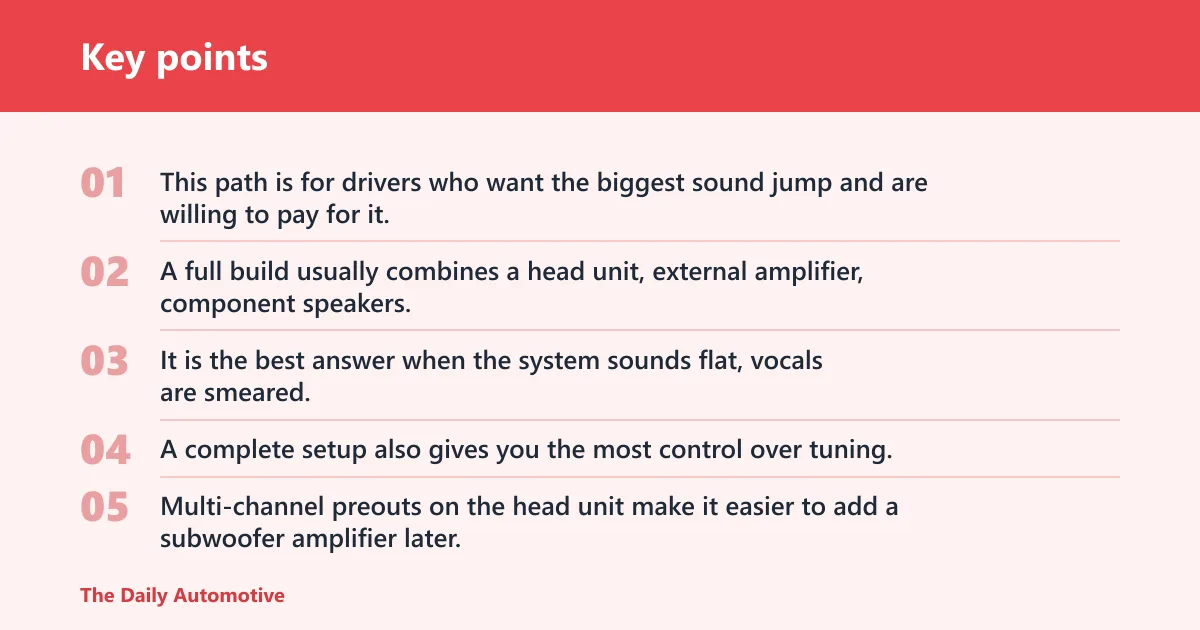
This path is for drivers who want the biggest sound jump and are willing to pay for it. A full build usually combines a head unit, external amplifier, component speakers, a subwoofer, and professional installation. It is the best answer when the system sounds flat, vocals are smeared, or bass disappears at higher volume.
A complete setup also gives you the most control over tuning. Multi-channel preouts on the head unit make it easier to add a subwoofer amplifier later, and that leaves room for later changes without starting over.
The drawback is cost and complexity. Even a modest full aftermarket build typically starts around $600 to $800 before the final tuning, and the total can rise quickly once you add amp wiring, speaker adapters, a dash kit, and labor.
What this route should include
Start with a head unit that has the features you need, then add a quality amplifier and properly matched speakers. For speakers, size matters: 6.5-inch and 6×9-inch options are common, but mounting depth, sensitivity in dB/W/m, RMS power handling, and component versus coaxial design all affect fit and performance.
As a practical rule, sensitivity matters more than wattage for most factory systems. A speaker with higher sensitivity will usually play louder from the same radio power, which is useful when you are not adding a separate amp right away.
Who should choose it?
Choose this path if you want the strongest bass, clearer vocals, and room to expand later. It also suits drivers who plan to keep the vehicle for years and want the system tuned around the cabin instead of around a single screen feature.
Main risks
The biggest failure points are fitment and labor. A component set may need adapter rings, the amp may need clean power and ground routing, and some vehicles require extra parts to keep steering-wheel controls working after the head unit swap.
OEM premium audio package: best for factory integration
This is the right choice for buyers who want the cleanest original-style setup and the least visual disruption. OEM premium audio is factory-installed or dealer supplied, usually with a matched speaker count and amplifier configuration tuned for cabin acoustics. It is tidy, but customization after purchase is limited.
Because the system is designed around the vehicle, it often avoids the fitment problems that come with aftermarket screens and universal brackets. The trade-off is that you usually get less flexibility in speaker choice, tuning, and later changes than you do with a full aftermarket build.
What to check before you choose it
Look at the speaker count, where the amplifier sits, and whether the package adds a separate subwoofer channel or just stronger door speakers. The exact layout matters more than the badge on the trim level.
Suppose a sedan has a premium package with a factory amp and more speakers, but the bass still rolls off early. In that case, the car may sound smoother than base audio, yet still fall short of a properly tuned aftermarket system with a dedicated subwoofer output.
Where it falls short
The main drawback is limited post-purchase customization. If you want more bass later, or want a different crossover slope, you may be constrained by the factory amplifier and its tuning. That makes it a poor fit for buyers who plan to build the system in stages.
Head unit swap: best for wireless CarPlay
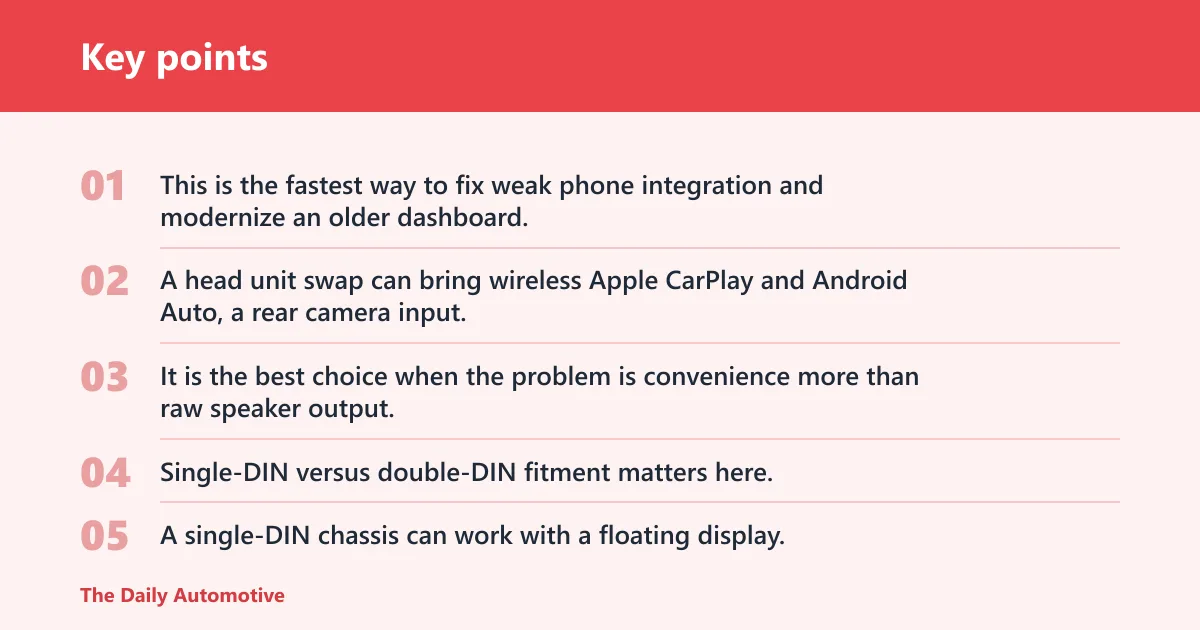
This is the fastest way to fix weak phone integration and modernize an older dashboard. A head unit swap can bring wireless Apple CarPlay and Android Auto, a rear camera input, and better pre-out voltage for later amplification. It is the best choice when the problem is convenience more than raw speaker output.
Single-DIN versus double-DIN fitment matters here. A single-DIN chassis can work with a floating display, while a double-DIN opening may accept a flush touchscreen. Screen size helps usability, but larger screens do not automatically mean better audio or better fit.
The drawback is that a stereo swap alone does not fix tired speakers or a weak factory amplifier. If the mids are muddy or the doors rattle, new phone mirroring will not solve that by itself.
Wireless CarPlay and Android Auto basics
Wireless CarPlay uses Bluetooth plus Wi-Fi connection, so you can keep your phone in a pocket or bag and still use hands-free navigation, calls, and messages without a cable. Android Auto comes in wired and wireless forms, and compatibility should be checked before you buy.
The BOSS BVB9358RC includes Apple CarPlay and Android Auto with a 7-inch capacitive touchscreen. That makes it a straightforward option for drivers who want a standard-sized display and simple smartphone integration. The trade-off is that a 7-inch unit will not suit every dashboard opening.
Fitment details that matter
Check the dash opening depth before you choose a screen. A tight dashboard may only accept a shallow chassis or a floating screen, and larger displays can interfere with vents, knobs, or trim. A vehicle-specific dash kit and wiring adapter are required for many installs, especially when you want steering-wheel control retention.
Rear camera input is worth checking even if you do not plan to install a camera immediately. A head unit with subwoofer output and multiple preouts also gives you room to add an amplifier later, which keeps the system from becoming a dead end.
Rockford Fosgate P1650: best for clearer factory speakers
This speaker set suits buyers who want a measurable improvement without rebuilding the whole system. The 6.5-inch format is common in doors, and the listed 55W RMS rating gives you a useful ceiling for a factory or modest aftermarket amp. The mineral-filled cone should help the mids stay cleaner than tired stock drivers.
It is a sensible first step when vocals sound dull and the current speakers distort early. Buyer feedback and the published specs also point to an easy install approach, helped by the FlexFit basket.
The drawback is that coaxial speakers are not the same as a full component setup. They can sound better than stock, but they will not separate tweeter placement and midrange duty the way a component system can.
Alpine S2-S50: best for compact door installs
This pair fits buyers who need a smaller speaker size and want a simple factory-style replacement. The 5.25-inch format can be useful when the vehicle does not accept a 6.5-inch basket without adapter work. Its Hi-Res Audio certification and HAMR surround point toward a clean, detailed presentation.
It is a sensible choice for compact doors or older cars with shallow mounting space. The multi-material cone also helps when you want to keep distortion in check at moderate volume.
The drawback is obvious: a 5.25-inch speaker will not move as much air as a 6.5-inch or 6×9-inch model. If your main complaint is weak bass, this may improve clarity more than punch.
Pyle marine speakers: best for rough environments
This pair is for vehicles and installations that see moisture, open air, or rougher conditions. The 6.5-inch size and 90dB sensitivity make it easy to drive from a basic radio, and the water-resistant build helps where standard door speakers would be a poor fit.
For open vehicles, boats, or utility setups, that matters more than a fancy crossover network. High sensitivity can also make the system sound livelier from limited power.
The drawback is that marine-rated speakers are not the usual pick for a sealed passenger cabin. They may fit the application, but they are not the first choice for a pure sound-quality build aimed at the cleanest midrange.
Rockford Fosgate Prime R2-300X4: best for adding clean power
This 4-channel amplifier is the clean-power piece that helps a full build make sense. An external amp gives properly matched speakers more headroom, which is useful when the factory radio runs out of clean output before the speakers do.
It also supports the kind of staged upgrade that many drivers prefer. You can improve front-stage speakers now and leave room for a subwoofer amplifier later if the head unit has the right preouts.
The drawback is install complexity. You need power wiring, grounding, signal routing, and enough space to mount it cleanly. That adds labor even when the hardware price seems manageable.
Audiobank P1004: best for low-cost amplification
This amp fits a tight budget when the goal is louder output rather than a high-end tuning exercise. It is a lower-cost way to add external amplification to a speaker swap or a starter build.
For a driver trying to wake up weak doors on a limited budget, that can be enough to move the system from thin to acceptable. It is also a way to get more control than a head unit alone can provide.
The drawback is that budget amplifiers often ask for more care during setup. If the gain is set badly, or the wiring is rushed, you can end up with noise or clipping that erases the value of the upgrade.
Which audio upgrade fits your car?
Choose the full aftermarket build if your main complaint is sound quality. That path is the strongest answer for muddy mids, weak bass, and a system that runs out of breath when you turn it up. It also makes the most sense if you want later amplifier changes.
Choose the head unit swap if daily use matters more than deeper bass. Wireless CarPlay and Android Auto, a rear camera input, and steering-wheel control retention can make the car easier to live with every day, especially if the rest of the system is still decent.
Choose the OEM premium package if you want the factory look and the least install risk. It works best when you value clean integration over customization and do not plan to chase a fully tuned aftermarket system later.
Choose a speaker-first upgrade if you want the biggest sound improvement for the money. Most drivers get the best return from a single speaker swap, with single-component swaps typically costing $80 to $400. That is often the smartest first step when the head unit already handles your phone and camera needs.
Choose sound quality if… / Choose convenience if…
Choose sound quality if the system sounds muddy, bass-light, or strained at volume, and you are willing to pay for install parts and labor. Choose convenience if your biggest complaint is cable clutter, outdated Bluetooth, or a screen that does not support your phone well.
Choose OEM integration if you want a clean dashboard, factory controls, and minimal risk of trim mismatch. Choose a speaker-first path if the car already has usable connectivity but the doors sound weak or harsh.
A common first-timer mistake is buying a larger touchscreen before checking dash depth and wiring needs. A 10.1-inch display can look attractive, but if the opening is tight or the vehicle needs extra adapters, the install may become more expensive than the audio gain justifies.
Car audio fitment matrix
The matrix below maps common goals to the most suitable path, an estimated installed cost based on the figures given in the research, and the fitment risk most likely to appear first. Use it as a short list before you buy parts.
| Driver goal | Best upgrade path | Estimated installed cost | Most likely fitment risk |
|---|---|---|---|
| Better bass | Aftermarket full build | Typically starts around $600 to $800 | Subwoofer space, amp wiring, and trunk or under-seat mounting |
| Clearer vocals | Speaker-first upgrade | $80 to $400 for a single-component swap | Mounting depth and adapter-ring fit |
| Wireless phone integration | Head unit swap | Varies by dash kit, adapter, and labor | Dash opening size and steering-wheel control compatibility |
| Factory-look install | OEM premium audio package | Varies by trim and dealer option | Limited upgrade path after purchase |
| Low-budget upgrade | Single speaker swap | $80 to $400 | Speaker size, depth, and polarity matching |
Say your sedan already has Bluetooth but the front doors sound muddy and the vocals sit behind the music. A speaker swap is the first place to spend money, because it attacks the symptom directly without forcing a full dash rebuild.
Suppose your hatchback has no smartphone integration and the factory screen is tiny. A head unit swap makes sense first, but only after you verify whether the dash needs a single-DIN chassis, a double-DIN faceplate, or a floating display to fit cleanly.
Frequently asked questions
Which car sound system is the best?
The best car sound system is the one that matches your goal. For pure sound quality, a full aftermarket build with an external amp, component speakers, and a subwoofer is strongest. For daily convenience, a modern head unit with wireless CarPlay and Android Auto is the better choice.
What cars have good sound systems
Cars with good sound systems are usually the ones that offer a factory premium audio package with more speakers and a properly tuned amplifier. That said, the trim level matters more than the badge. A well-executed OEM premium setup often sounds better than a base system with the same screen.
What is the best audio system for cars if I want the best sound quality?
The best audio system for cars if you want the best sound quality is a full aftermarket build. That gives you the most control over speaker choice, amplifier power, subwoofer output, and tuning. It also leaves room for later amplifier changes through multi-channel preouts.
Which car audio system is best for wireless CarPlay and Android Auto?
A head unit swap is the best option for wireless CarPlay and Android Auto. Wireless CarPlay uses Bluetooth plus Wi-Fi connection, while Android Auto may be wired or wireless depending on the unit and phone compatibility. Check the dash fitment before you buy a larger screen.
What should I choose: OEM premium audio or aftermarket speakers?
Choose OEM premium audio if you want factory integration, simple fitment, and a clean dashboard. Choose aftermarket speakers if you want more clarity or bass for less money, since a single speaker swap often gives the best return. The aftermarket path also leaves more room for later changes.
Do I need a new head unit to improve car sound quality?
Not always. If the main problem is worn or low-quality speakers, a speaker upgrade can deliver the biggest audible gain for the money. A new head unit helps most when you need better connectivity, more preouts, a rear camera input, or cleaner signal control for later amplification.
Which car stereo fits a tight dashboard opening?
A tight dashboard opening usually favors a single-DIN chassis or a floating display with shallow mounting depth. The Sony XAV-AX8100 has a 9-inch floating display and a single-DIN chassis, while larger touchscreen models need more space. Always check dash depth and trim clearance before ordering.
What should I check before buying a car audio system for my vehicle?
Check speaker size, mounting depth, dash opening, adapter needs, and whether you must retain steering-wheel controls. Also verify rear camera input, USB and AUX support if needed, and whether the head unit offers enough preouts for a later amplifier or subwoofer. Fitment is where many installs go wrong.
Are larger touchscreen stereos always better for car audio?
No. A larger display can improve visibility, but it does not guarantee better sound or easier installation. A 10.1-inch floating screen may be a great fit in one vehicle and a poor fit in another. Screen size should follow dash space, not the other way around.
What upgrade gives the biggest sound improvement for the money?
For many drivers, a single speaker swap gives the biggest sound improvement for the money. Research summaries commonly point to that route because it fixes the parts of the system most people actually hear: dull vocals, muddy mids, and early distortion. Add an amp only if the speakers and install space justify it.
Products related to this article
Sponsored / affiliate links. As an Amazon Associate I earn from qualifying purchases. I may earn additional commission from eligible campaigns.