Best Auto Insurance for Families
The best auto insurance for families is the policy that gives your household the lowest total premium after multi-car, teen-driver, homeowner, and military discounts, while keeping liability, collision, and uninsured motorist limits high enough for every driver. Skip that comparison and you can overpay for years or leave a teen, a second car, or a claim exposed to gaps. This guide shows how to choose coverage by household setup, then rank insurers by price and service using the same limits, deductibles, and drivers on every quote.
Best overall pick for families
Erie is the best value option for many families because it is positioned as the value choice in one major family ranking, and its published average annual rates are lower than many shoppers expect for both full coverage and minimum coverage. But “best” still depends on your drivers, your state, and whether you need military access or a national footprint.
For broad national reach, State Farm is labeled the best national insurer in the same ranking. For military households, USAA is singled out for eligibility-based access and strong benchmark pricing. Those are different jobs, and families should not force one carrier to fit every setup.
Use this as a starting point:
- Erie for value-focused families that want a strong quote comparison baseline.
- State Farm for families that want a national carrier and a strong teen-driver fit.
- USAA for military households that qualify for membership.
Quick picks by household type
| Household type | Best starting point | Why it fits | Quote focus |
|---|---|---|---|
| Homeowner with two cars | Erie | Strong value profile for families that can bundle home and auto. | Compare bundled full coverage against the same limits from other carriers. |
| Renters with one teen driver | State Farm | Useful if you need teen-driver support and a good-student discount path. | Check driver education, accident forgiveness, and telematics options. |
| Military family | USAA | Eligible military households can access a carrier built around their needs. | Confirm membership eligibility before you compare quotes. |
| Large multi-car family | Allstate | Highlighted for multiple-vehicle families and multi-car shopping. | Ask how the multi-car discount stacks with good student and bundling discounts. |
Homeowners with two cars
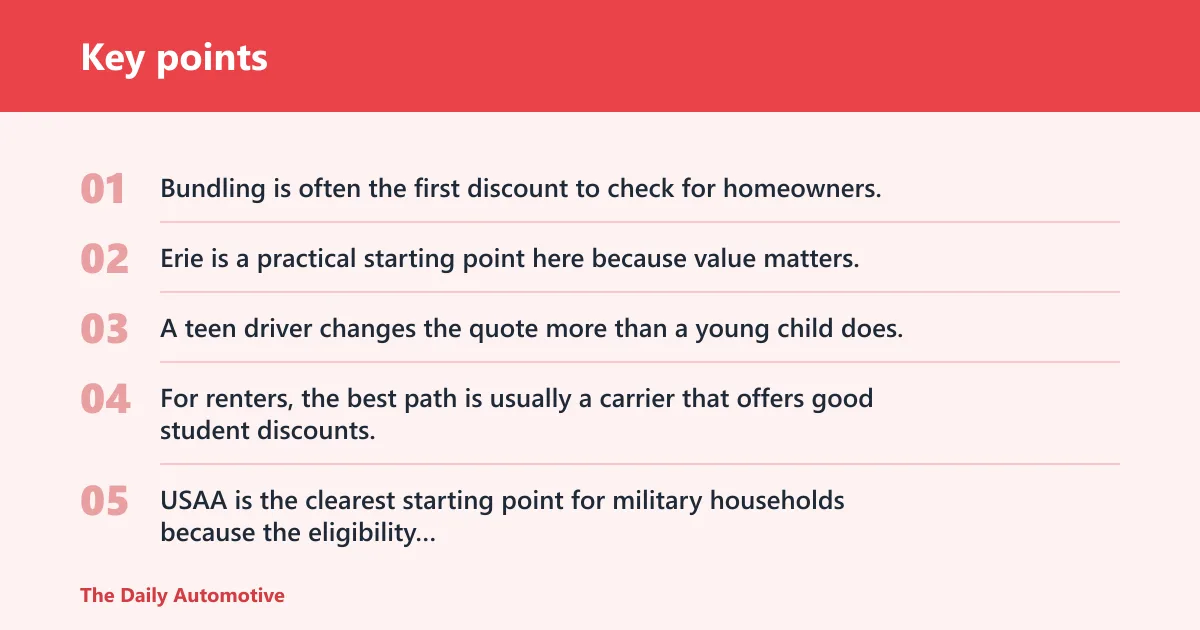
Bundling is often the first discount to check for homeowners, because a home-and-auto package can reduce the family total before you add a multi-car discount. Erie is a practical starting point here because value matters, but the best final answer depends on whether the bundled policy still keeps your liability and uninsured motorist limits where they should be.
Renters with one teen driver
A teen driver changes the quote more than a young child does. For renters, the best path is usually a carrier that offers good student discounts, driver education discounts, and clear accident forgiveness rules, because those can soften the premium spike that often comes with a newly licensed driver.
Military families
USAA is the clearest starting point for military households because the eligibility filter is built into the product. That matters more than a headline price, because the right carrier is the one your household can actually join.
Large multi-car families
Allstate can be worth checking when a household insures several vehicles, because the multi-car discount can be an important savings lever. That discount often stacks with good student and bundling discounts, so large households should compare the total after all three are applied.
Which coverage fits your family?
Families should compare both full coverage and liability-only coverage, because the cheapest quote is not always the safest choice for a household with multiple drivers. Full coverage is the standard comparison baseline for newer cars, financed vehicles, or families that cannot afford to replace a car after a collision or theft. Liability-only coverage is the lower-cost benchmark, but it leaves your own vehicle out of the payout picture.
Start with the same liability limits on every quote, then decide whether collision and comprehensive belong on every car or only the newer one. If your family owns an older second car with low value, liability-only can make sense on that vehicle while the primary car keeps full coverage.
Liability limits, uninsured motorist coverage, and medical payments
Family policies should not stop at the state minimum. Higher liability limits protect your household if your teen causes a serious crash, uninsured motorist coverage helps if the other driver has too little insurance, and medical payments coverage can help with early medical bills after a crash.
Picture a household with two drivers and one aging sedan. If the sedan is worth very little, dropping collision may be reasonable, but dropping liability protection too far can create a much larger financial problem after a major accident.
When umbrella coverage belongs in the quote set
Umbrella coverage belongs in the quote set when your household has meaningful assets, a teen driver, or more than one car on the road every day. It adds another layer above auto liability and can matter more than shaving a few dollars off the base premium. Families with a home, savings, or a higher-income profile should at least ask for the price.
Which insurers fit teen drivers?
Teen drivers usually raise household premiums because younger drivers are riskier, and the gap is large enough that families should quote the teen separately in their minds even if the policy is one household contract. State Farm is a strong starting point for teen-driver households, and the real savings usually come from the right mix of good student discounts, driver education discounts, and usage-based insurance.
Good student discounts and driver education discounts
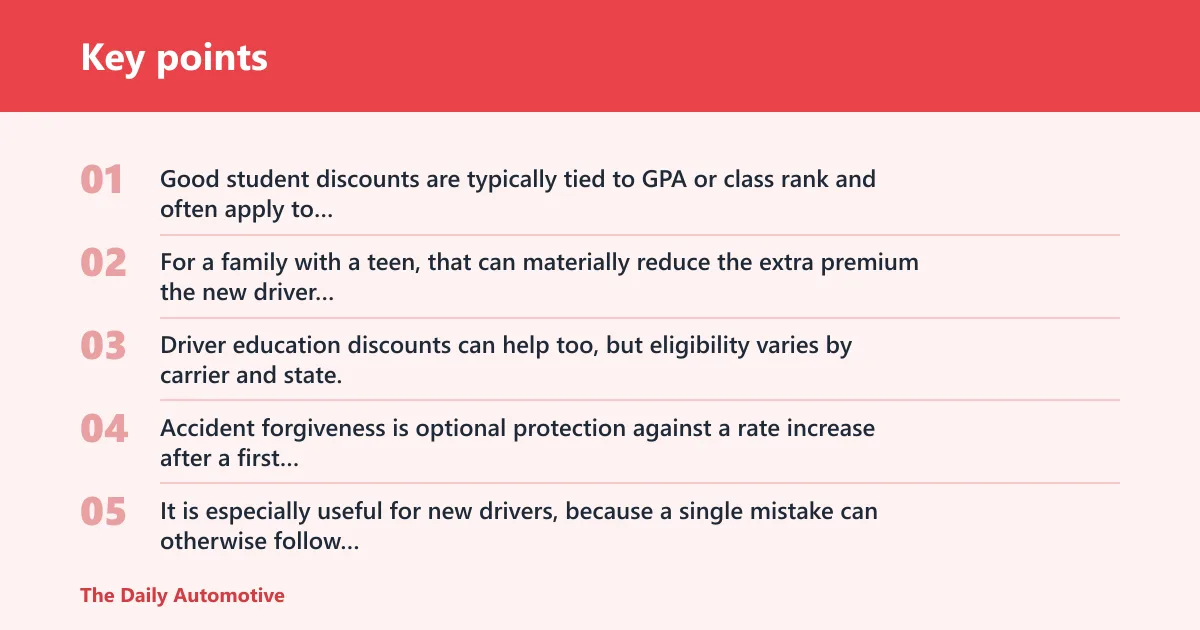
Good student discounts are typically tied to GPA or class rank and often apply to drivers under 25. For a family with a teen, that can materially reduce the extra premium the new driver adds to the policy. Driver education discounts can help too, but eligibility varies by carrier and state.
Accident forgiveness for new drivers
Accident forgiveness is optional protection against a rate increase after a first at-fault crash. It is especially useful for new drivers, because a single mistake can otherwise follow the household premium for years. Not every carrier offers it, and not every policy includes it automatically, so ask directly before you bind coverage.
Where usage-based insurance can help
Usage-based insurance uses telematics to reward safer driving habits, which can help families with careful teens or low-mileage drivers. It is best treated as a savings program, not a promise. If your household has a teen, a second car that barely moves, or one parent with a short commute, ask how the program works before assuming it is worth it.
Say your teenager drives to school, soccer practice, and a weekend job, while the family’s second car only leaves the driveway twice a week. That is exactly the kind of household where telematics and a multi-car discount should be compared together instead of one at a time.
Which insurers fit military families?
USAA can be a strong fit for military families because membership eligibility is generally limited to military members, veterans, and eligible families. That constraint matters more than a marketing slogan. If you qualify, USAA belongs at the top of the quote list; if you do not, move on quickly instead of waiting on a quote you cannot buy.
What to check if USAA is not available to your household
If you do not qualify for USAA, compare a national carrier and a value-focused regional carrier on the same limits, deductibles, and household drivers. State Farm is the clearest national comparison point in the supplied family rankings, while Erie is the value comparison point. That gives you a fair two-way benchmark without chasing guesses.
State availability checks before you quote
State availability can change the best choice for a family, and this matters in edge cases like Massachusetts and Rhode Island, where some carriers are not available in all situations. Before you compare discounts, confirm that the carrier writes policies in your state and can insure every driver and vehicle in the household.
Family insurance decision matrix

| Household type | Recommended coverage | Discount stack | Likely tradeoffs | Questions to ask an agent |
|---|---|---|---|---|
| Homeowner with two cars | Full coverage on the newer car; consider liability-only on the older car if its value is low | Bundling + multi-car | Bundling may lower the total, but deductibles and limits still need review | Does the bundled quote still keep liability and uninsured motorist limits where they should be? |
| Renters with one teen driver | Full coverage if the car is newer; otherwise compare full coverage to liability-only | Good student + driver education + telematics | Teen pricing can rise fast, and accident forgiveness may or may not be available | Which discounts apply to under-25 drivers, and does accident forgiveness cost extra? |
| Military family | Full coverage or liability-only based on vehicle value and loan status | Military eligibility-based access + possible multi-car | USAA access is limited to eligible families, so availability comes first | Can every driver in the household be added under the same eligibility rules? |
| Large multi-car family | Full coverage on higher-value vehicles; liability-only only where it makes sense | Multi-car + good student + bundling | One bad teen driver can change the whole household premium | How do the discounts stack if one driver has an at-fault claim? |
| Low-income family | Liability-only as a benchmark, then compare the price of adding collision and comprehensive | Multi-car if applicable + telematics if safe driving fits | Lower premiums can mean weaker protection if the household cuts limits too far | What is the cheapest policy that still protects the family from a major liability claim? |
| Family with a college student | Full coverage if the student uses a newer car; otherwise compare liability-only on a low-value vehicle | Good student + multi-car + occasional telematics | The student may qualify for savings, but garaging location and mileage can change the quote | Does the student still qualify while away at school, and what happens if the car stays off-campus? |
How do you compare family quotes?
The cleanest way to compare family quotes is to build the same coverage on every carrier before you look at price. Match the liability limits, the deductible, the vehicle list, and every driver first. After that, stack discounts and see which policy still protects the household well enough.
- List every driver, including teens and college students who still belong on the policy.
- Match liability, collision, comprehensive, uninsured motorist, and medical payments limits across quotes.
- Ask for the multi-car discount if the household insures two or more vehicles.
- Ask whether good student discounts apply to drivers under 25 and whether class rank can count if GPA does not.
- Check whether bundling is possible with home or renters coverage.
- Ask about accident forgiveness for new drivers and the rules for adding it.
- Compare telematics only after you know whether the household is comfortable with usage-based monitoring.
A common first-timer mistake is comparing a bare-bones liability quote from one carrier with a full-coverage quote from another and calling the cheaper one the winner. That is not a real comparison. It is a mismatch.
Another common failure case is the household with one low-mileage second car and one driver who commutes daily. The low-mileage car may qualify for a better setup, but the daily driver still needs limits that can stand up to a serious claim.
Frequently asked questions
What is the cheapest and best auto insurance?
There is no single cheapest and best policy for every family. In the supplied benchmark data, USAA appears to have the lowest average annual minimum coverage at about $436, and Erie is shown with average annual minimum coverage of about $565 and full coverage of about $1,833. The right choice depends on eligibility, state availability, and the limits you need.
Does having a child make car insurance cheaper?
No. A young child in the household does not usually lower auto insurance on its own. The major premium change comes when the child becomes a teen driver, because young drivers are riskier and usually increase the household rate. Savings usually come later through good student, multi-car, or bundling discounts.
How to get the best home and auto insurance rates
Start by bundling home and auto or renters and auto, then compare the same liability limits, deductibles, and drivers across carriers. Homeowners should ask for the bundling discount first, then add the multi-car discount if the household insures two or more vehicles. Do not accept a bundle until the auto side still fits the family’s protection target.
Is there an alternative to car insurance?
For most families, no practical alternative exists to the auto insurance your state requires. Some households look at lower-cost liability-only coverage, but that is still car insurance, not a substitute. If the goal is lowering cost, compare minimum coverage, higher deductibles, and discount stacking rather than trying to avoid coverage altogether.
What is the best auto insurance for families with teen drivers?
State Farm is a strong starting point for teen-driver families because it is identified as excellent for teen drivers in one supplied ranking. The best setup usually combines a good student discount, driver education, possible accident forgiveness, and telematics if the family wants to trade monitored safe driving for a lower premium.
Which insurers offer the best multi-car discounts for families?
Allstate is highlighted for multiple-vehicle families, and multi-car discounts are a core savings lever for households insuring two or more vehicles. That discount can stack with good student and bundling discounts, so families with more than one vehicle should always ask for the multi-car price before comparing carriers on headline rates alone.
Products related to this article
Sponsored / affiliate links. As an Amazon Associate I earn from qualifying purchases. I may earn additional commission from eligible campaigns.