Should You Precondition Your Electric Car in Winter?
Yes, precondition your EV in winter when you can do it while plugged in, especially before a fast charge or a cold-soaked departure. Skip it for short trips if cabin comfort and peak charging speed do not matter. Leave it off and you can lose range to a cold battery, slow DC fast charging, and spend more energy warming the pack on the road. Here’s when preconditioning pays off, when it barely matters, and how to use it without wasting power.
What preconditioning does
Battery preconditioning warms the high-voltage traction battery before driving or charging. Cabin preconditioning warms or cools the interior for comfort, but it may not warm the battery on every EV. That split matters in winter, because a warm cabin does little for a cold pack that charges slowly and delivers less power.
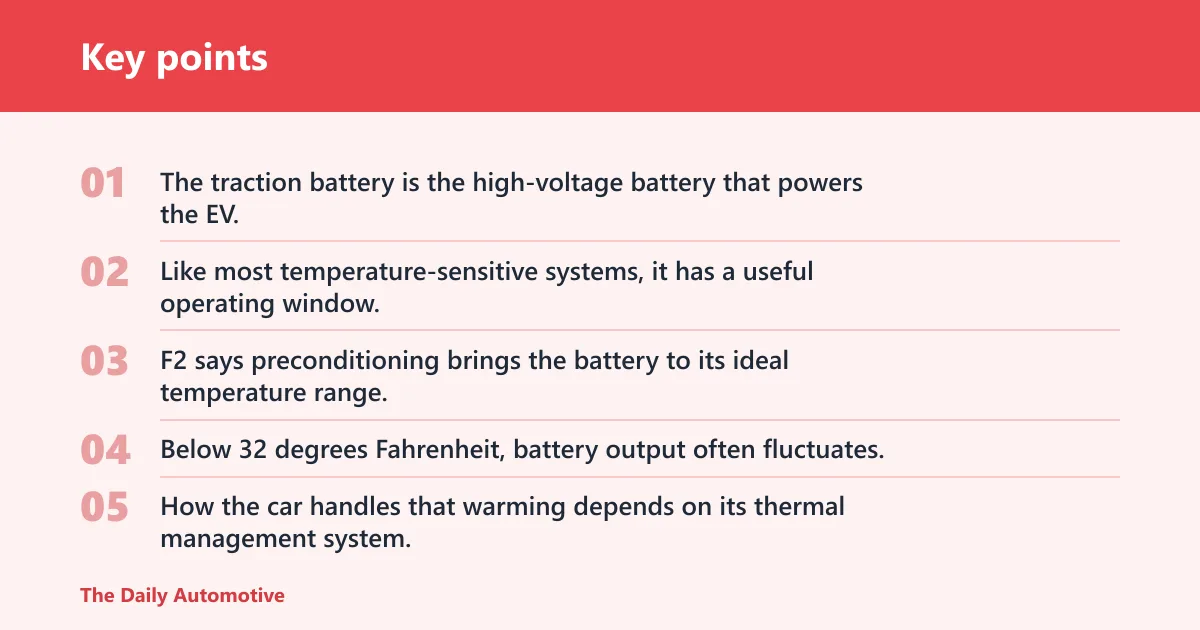
The traction battery is the high-voltage battery that powers the EV. Like most temperature-sensitive systems, it has a useful operating window. F2 says preconditioning brings the battery to its ideal temperature range, and F3 says most batteries work best between 60 and 95 degrees Fahrenheit. Below 32 degrees Fahrenheit, battery output often fluctuates, which is why range and charging speed fall at the same time.
How the car handles that warming depends on its thermal management system. Some vehicles manage battery and cabin together. Others separate the two, especially when you only turn on remote climate from the app or key fob. The owner’s manual matters because the logic varies by vehicle and software version.
Battery preconditioning vs cabin preconditioning
Battery preconditioning is a drivetrain function. Cabin preconditioning is a comfort function. Both may run from the app or infotainment screen, but they do different jobs, and on some models the cabin warms while the battery stays cold unless route guidance or departure logic is active.
That distinction is why winter advice should not stop at “turn on the heater early.” A warm windshield and defrosted seats help the driver. A warmer pack helps the car preserve range and accept higher charging power. Those are related, but they are not the same.
How a thermal management system uses heat
A thermal management system automates heating and cooling so the EV can protect the battery and cabin without constant driver input. On some vehicles it can handle both at once; on others, the cabin gets priority unless the car sees a departure timer, a navigation target, or a DC fast-charge stop in the route plan.
Modern EVs are designed to draw power from the grid when preconditioning, which is why F5 says it is advised while plugged in and F6 says the car can draw power from the grid during that process. That is the cleaner setup. It reduces drain on the stored battery energy before you leave.
Should you precondition in winter?
Precondition when the battery is cold enough to matter, when you want better charging speed, or when you are leaving after a cold soak. Skip it when the car is already warm enough, the trip is short, and you only need cabin comfort. Preconditioning is a tool, not a blanket winter habit.
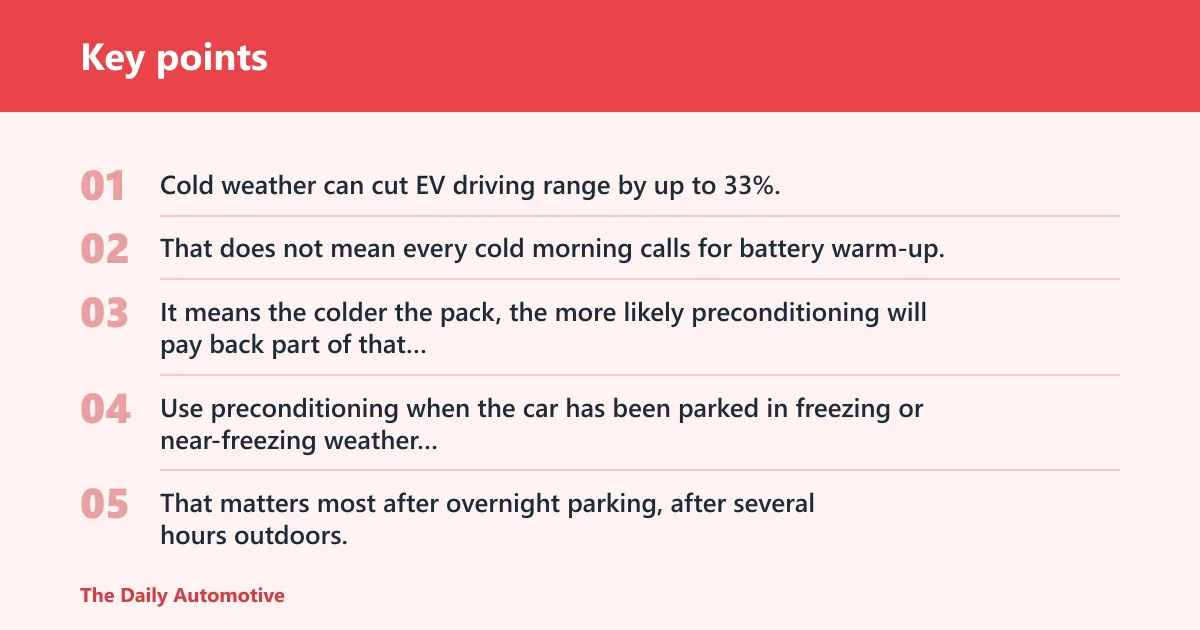
Cold weather can cut EV driving range by up to 33%, and Recharged says winter range loss can be 10% to 40%. That does not mean every cold morning calls for battery warm-up. It means the colder the pack, the more likely preconditioning will pay back part of that loss, especially before a longer drive or fast-charge stop.
When the battery is cold enough to matter
Use preconditioning when the car has been parked in freezing or near-freezing weather long enough for the pack to cool down. That matters most after overnight parking, after several hours outdoors, or when battery output is already reduced below 32 degrees Fahrenheit. A cold battery can reduce available driving range by up to 30%.
Short trips feel the penalty fastest. The car spends a larger share of the trip warming itself, and the heater load matters more when the drive is brief. Highway driving can magnify the loss too, because higher speed increases energy demand while a cold battery is still lagging behind.
When cabin-only climate is enough
Cabin-only climate is enough when you want a defrosted windshield, a warm seat, and a comfortable start, but you do not need better charging speed or maximum winter efficiency. Many drivers can leave battery preconditioning off on these days and rely on heated seats and the steering wheel to cut cabin load.
A common first-timer mistake is starting the app climate for a 10-minute errand and assuming the battery has been prepared too. On some EVs, that only warms the interior. The car may feel ready, but the pack may still be cold when you pull away.
When the energy cost is not worth it
Skip battery preconditioning when the trip is short, the battery is already near a normal temperature, or you cannot finish the warm-up while plugged in. If the car must pull a lot of energy from the pack just to warm itself, the gains may vanish on a short commute.
That is especially true if the only payoff is comfort. If you are not trying to preserve DC fast-charging speed and do not care about maximum range on that trip, cabin-only climate is usually the better trade.
Winter preconditioning checklist
Use this as a morning decision guide. The right answer depends on temperature, whether the car is plugged in, whether you have a DC fast-charge stop ahead, and whether the vehicle uses a heat pump or a resistive heater. The colder the pack, the more the warm-up pays off.
| Temperature band | Precondition? | Which mode to use |
|---|---|---|
| Above 40°F / 4°C | Usually no, unless a fast charge is coming | Cabin-only if comfort matters; fast-charge preconditioning only for a planned DC stop |
| 32 to 40°F / 0 to 4°C | Sometimes | Departure preconditioning if plugged in and leaving after a cold soak; cabin-only for a short trip |
| 15 to 32°F / -9 to 0°C | Yes, if the car is plugged in or a DC stop is planned | Departure preconditioning for driving; fast-charge preconditioning if route guidance supports it |
| Below 15°F / -9°C | Strongly consider it | Departure preconditioning while plugged in; fast-charge preconditioning before a DC stop; cabin-only is a fallback |
Plugged in versus unplugged changes the answer. F5 says preconditioning is advised while plugged in, and F14 says the energy comes from the mains when plugged in. That means the grid, not the battery, does the heavy lifting. If you are unplugged, the car may still warm itself, but it will draw from stored energy.
Heat pump versus resistive heater matters too. Heat pump vehicles usually lose less winter range because they move heat more efficiently. Cars with PTC or resistive heaters can use more energy to heat the cabin, which makes the preconditioning decision more sensitive on weak home charging or short drives.
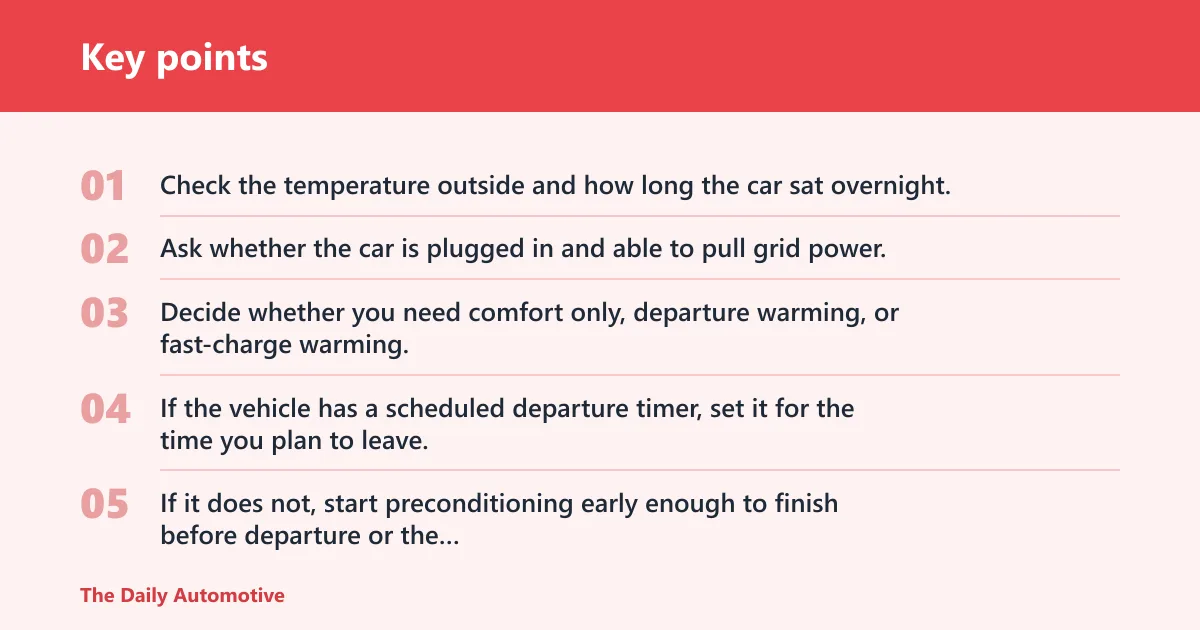
- Check the temperature outside and how long the car sat overnight.
- Ask whether the car is plugged in and able to pull grid power.
- Decide whether you need comfort only, departure warming, or fast-charge warming.
- If the vehicle has a scheduled departure timer, set it for the time you plan to leave.
- If it does not, start preconditioning early enough to finish before departure or the charger arrival.
Suppose your EV is parked outside at 18°F, plugged into a Level 2 charger, and you plan a 40-mile highway commute with a DC fast-charge stop after lunch. That is a strong case for departure preconditioning in the morning and battery warm-up again before the charger, if the route system supports it. The pack is cold enough to matter twice.
How long should you precondition an EV before driving?
A practical starting point is 20 to 30 minutes, and very cold starting temperatures below -5 C may need 40 minutes or more. Start earlier if the car has been parked outside for many hours. Start later only if your vehicle’s system can finish the warm-up during a timed departure window.
That timing is not fixed across all EVs. Some cars heat the cabin quickly but take longer to bring the battery into range. Others will only begin the battery portion if navigation, charging, or a departure timer is active. Check the owner’s manual for the specific control path.
Starting too late
If you start preconditioning too late, you may get cabin heat but not a fully warmed pack. The car can still leave on time, but you may not get the range or charging benefit you expected. That is one reason scheduled departure is better than guessing.
Using scheduled departure instead of guessing
Scheduled departure or a departure timer lets the vehicle finish warming by a set time. That is commonly used while plugged in, and it reduces battery draw from stored energy. It also keeps the warm-up from running too early and wasting power while the car sits idle.
For many drivers, that is the cleanest routine: set the departure time the night before, leave the car plugged in, and let the thermal system handle the rest. If the model supports app-based activation, that can be the same process from a phone.
What to do if the car lacks a timer
If the car has no scheduled departure feature, use the app or infotainment system to start climate early enough to reach cabin comfort and, if supported, battery warm-up. If the vehicle exposes no battery control at all, treat it as a cabin climate system and focus on plugging in, heated seats, and route planning.
Does preconditioning help DC fast charging?
Yes. A warmed battery can accept higher initial power, and a cold battery may accept lower power when you first plug in. That is why preconditioning before a DC fast charger can shorten the stop. It matters most on a cold-soaked pack and less when the battery is already warm from driving.
Use route-based battery warm-up when the car supports it. Many EVs can prepare the pack automatically if you enter a fast-charger destination in navigation. That feature is more targeted than simple cabin climate, because it is aiming at charging speed, not just comfort.
Route-based battery warm-up before a charger
When the car sees a charging stop in navigation, it may begin warming the battery on the way. That is the best case for winter charging because the battery reaches the charger closer to its ideal temperature range. You spend less time waiting for the car to ramp up from a cold start.
Why a cold pack limits initial charging power
Cold batteries charge more slowly because the cells sit outside their preferred temperature window. F9 says a cold battery can reduce available driving range by up to 30%, and F4 says battery output often fluctuates below 32 degrees Fahrenheit. The same temperature penalty affects how much charging power the car will accept at first.
Best Chargers says allow 20 to 30 minutes for effective preconditioning, and that very cold starting temperatures below -5 C may need 40 minutes or more. That is why the best plan is to start warming before you are already at the station.
When to start warming on the way
Start as soon as the charger is in the navigation route and the vehicle supports charging preconditioning. If you wait until the last few minutes, the pack may still be cold when you arrive. If the car supports a route-triggered mode, use that instead of starting and stopping the climate manually.
How much range can winter cost?
Winter range loss varies with temperature, speed, heater type, and trip length. F1 says cold weather can cut EV driving range by up to 33%, and Recharged says winter range loss can be 10% to 40%. Those are not fixed losses on every drive. They describe a wide winter penalty band.
Heat pump vehicles usually stay on the better end of that range because they need less energy for cabin heating. Resistive heater setups can pull more from the pack, especially on long cold starts. That is why two EVs can behave very differently in the same weather.
Short trips hurt more because the car spends a larger share of the drive warming cabin and battery. Highway driving can be worse too, because speed pushes up total energy use while the pack is still cold. Preconditioning does not erase those losses, but it can reduce the penalty before departure or charging.
When remote climate is enough
Remote climate is enough when your main goal is comfort. It is also the right choice when your EV only warms the cabin through the app and does not expose a separate battery preconditioning control. In that case, you should not expect the same range or charging benefit from the feature.
Use heated seats and the steering wheel when you want to keep cabin load down. Those features warm the occupant directly, which often uses less energy than blasting the whole cabin. That can matter on a short commute or in a car with a resistive heater.
Picture a 12-mile city commute in 28°F weather, with the car parked in a garage but not plugged in. Cabin preconditioning may be enough if the windshield needs clearing. Battery warm-up is less likely to be worth the energy unless a DC fast charger is part of the trip.
A weak home charging setup changes the calculation. If the charger cannot supply enough power for the car to precondition efficiently and still recover state of charge before morning, you may need to shorten the warm-up, rely on cabin-only climate, or schedule charging earlier in the night. The manual should say whether the vehicle can manage that load cleanly.
Frequently asked questions
Should you precondition your electric car in winter?
Yes, when you can do it while plugged in and the car will be cold enough for range or charging speed to suffer. Skip it for short trips if cabin comfort is the only goal. The biggest payoff comes before a cold-soaked departure or a planned DC fast charge.
Should you precondition while the car is plugged in?
Yes. That is the preferred setup because the car can draw from the grid instead of draining the traction battery. The same source says preconditioning is advised while plugged in, and F6 says modern EVs are designed to draw power from the grid when preconditioning. That helps preserve range.
Does preconditioning help EV range in cold weather?
It can help preserve usable range by warming the battery before departure, but it does not erase winter losses. Cold weather can cut EV driving range by up to 33%, and Recharged says winter range loss can be 10% to 40%. Preconditioning helps most when the battery is cold-soaked.
Does preconditioning make DC fast charging faster?
Yes, when the battery is cold enough to limit initial charging power. A warmed pack can accept higher power at the start of the session, which can shorten the stop. The best time to start is before you arrive, ideally through route-based charging preconditioning.
Does cabin preconditioning also warm the battery?
Sometimes, but not always. Some EVs tie cabin and battery heating together, while others warm only the interior unless departure or charging logic is active. That is why remote climate and battery preconditioning are not the same feature. Check the manual for your vehicle’s behavior.
Products related to this article
Sponsored / affiliate links. As an Amazon Associate I earn from qualifying purchases. I may earn additional commission from eligible campaigns.