Do Hybrids Lose MPG in Winter?
Many hybrids are reported to lose roughly 10% to 30% MPG in winter, with the biggest drop often on short trips and in city driving. Skip it and you can misread a healthy car as faulty, then waste fuel chasing the wrong fix. This guide explains why the drop happens by hybrid type and trip length, and which winter habits change MPG versus comfort only.
Winter MPG loss in hybrids
Cold weather cuts fuel economy in every hybrid, but the causes stack up differently. A cold engine runs less efficiently, fluids thicken, tire pressure falls, the traction battery delivers less power, and the cabin heater can bring the engine on sooner and keep it running longer.
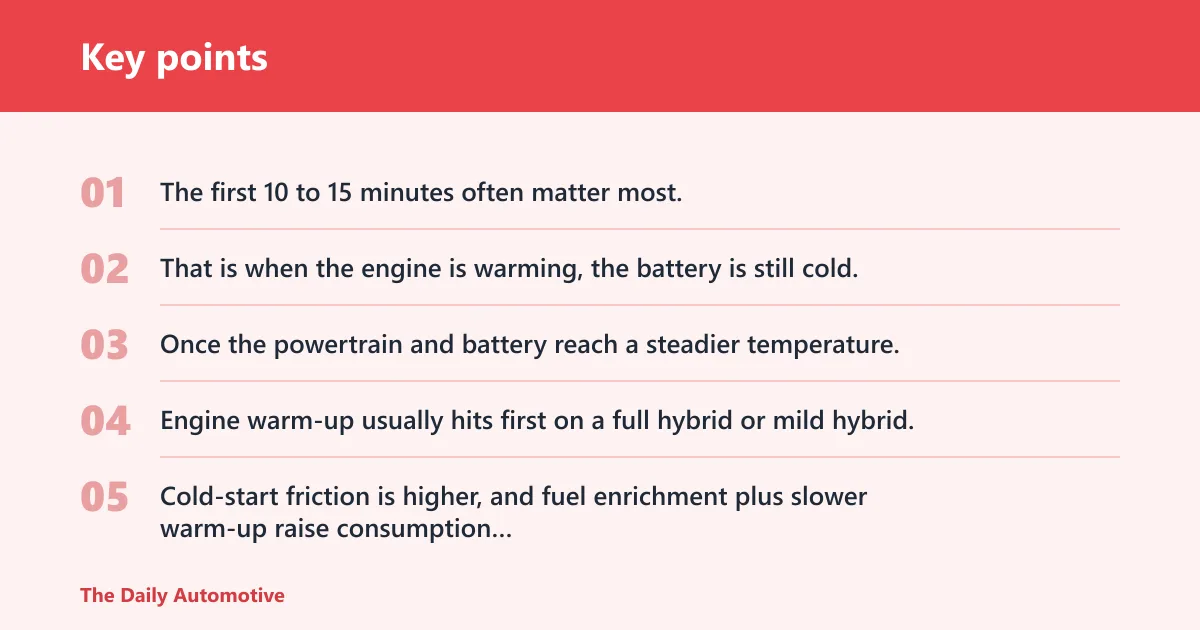
The first 10 to 15 minutes often matter most. That is when the engine is warming, the battery is still cold, and regenerative braking may be limited. Once the powertrain and battery reach a steadier temperature, the MPG penalty usually shrinks.
What changes first: engine warm-up, battery output, or cabin heat
Engine warm-up usually hits first on a full hybrid or mild hybrid. Cold-start friction is higher, and fuel enrichment plus slower warm-up raise consumption before the system settles down. In a plug-in hybrid, the battery can also lose usable capacity and power delivery right away, so EV mode may be shorter or unavailable.
Cabin heat becomes the next load. If the system uses engine waste heat, the gas engine may run even when the vehicle could otherwise glide or shut off. Defrost mode can make that worse because clear glass takes priority over fuel savings.
Why the first 10 to 15 minutes matter most
That early window is where several penalties overlap. Cold oil and transmission fluid increase drag, the battery accepts less regenerative charge, and the cabin may demand heat before the powertrain is ready to spare it. On short trips, the vehicle spends a large share of the drive in that worst phase.
Suppose a compact hybrid makes a 4-mile school run in 20°F weather. The car may spend nearly the entire trip warming up, so the MPG hit is far larger than on a 20-mile commute where the last 10 miles happen after everything stabilizes.
📊 For hybrids, fuel economy can drop about 30% to 34% under cold-weather conditions. Source: Fuel Economy in Cold Weather.
Do hybrids lose MPG in winter?
Yes. The DOE uses 20°F and 77°F as the standard comparison points for winter fuel economy effects, and the difference can be large in city driving. For hybrids, fuel economy can drop about 30% to 34% under cold-weather conditions, and the decline is usually worse on short trips.
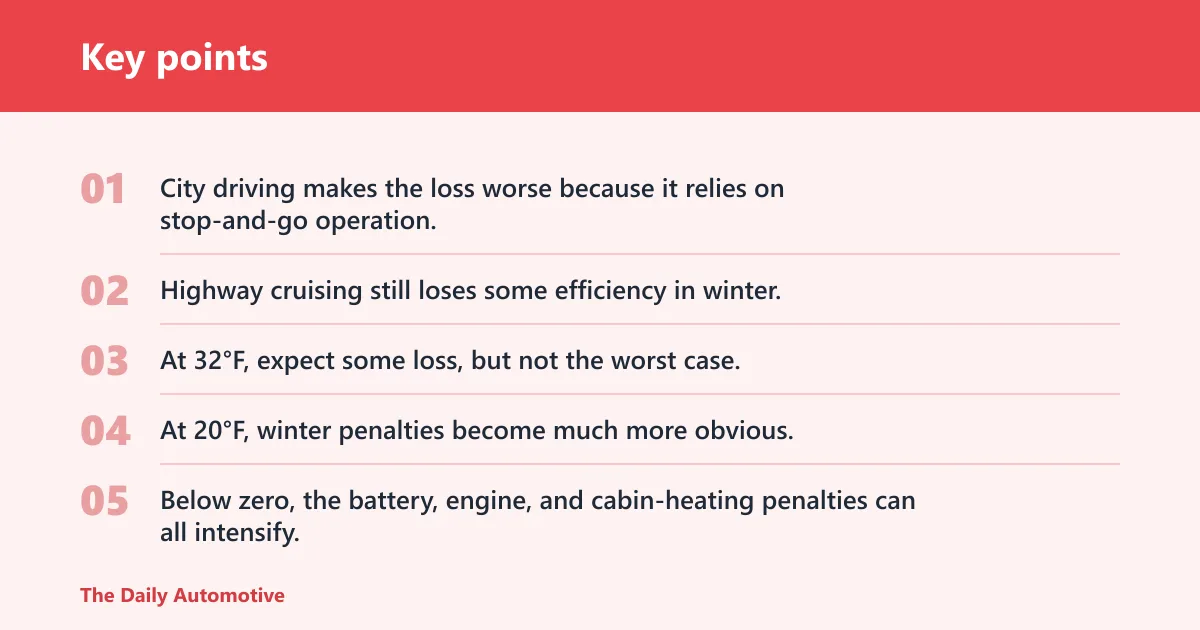
City driving makes the loss worse because it relies on stop-and-go operation, repeated cold starts, and more battery assistance and regeneration. Highway cruising still loses some efficiency in winter, but the penalty is usually smaller because the powertrain stays warm longer and runs more steadily.
What the weather does to fuel economy at 32°F, 20°F, and below zero
At 32°F, expect some loss, but not the worst case. At 20°F, winter penalties become much more obvious, which is why that temperature is the DOE benchmark. Below zero, the battery, engine, and cabin-heating penalties can all intensify, especially for trips that never fully warm the vehicle.
The exact number depends on the hybrid type and trip length. A full hybrid on a long drive may lose far less than a plug-in hybrid doing repeated short EV-mode trips in deep cold.
Why city driving loses more MPG than steady highway cruising
City driving keeps the car in the cold-start zone longer and uses more regeneration. In winter, both of those things work against MPG. The engine may run simply to supply heat, and the battery may not accept as much recaptured energy, so more braking energy turns into heat at the wheels instead of stored electricity.
Steady cruising gives the system time to warm up and stay there. That is why the same hybrid can look much better on a 25-mile highway drive than on three cold errands around town.
What a typical winter MPG drop looks like by trip length
For hybrids, fuel economy typically decreases by 20% to 40% in city driving and by 25% to 45% on short trips. The short-trip number is often the harshest because the car spends most of the drive warming up rather than operating efficiently.
A conventional gasoline car also loses mileage in winter. In city driving, gas mileage is roughly 15% lower at 20°F than at 77°F, and short 3- to 4-mile trips can drop as much as 24%. Hybrids can lose more because their battery and engine control strategy add another layer of cold-weather limits. (Fueleconomy)
Hybrid winter MPG by type
Not all hybrids behave the same way in winter. Full hybrids, plug-in hybrids, and mild hybrids lose MPG through different parts of the powertrain, so the same temperature can produce different results even if the dashboard warning lights never change.
Full hybrid behavior in cold weather
Full hybrids are most sensitive to short-trip cold starts and heater demand. They can still capture some regenerative energy, but a cold battery accepts less charge at first, so the car recovers less braking energy early in the drive. The engine also tends to run more often while the cabin warms up.
Plug-in hybrid behavior in cold weather
Plug-in hybrids face all the normal cold-weather penalties plus a bigger EV-mode hit. Cold weather can reduce usable battery capacity, limit power delivery, and shorten electric range. If the battery is cold and the heater is on, the car may switch to the engine sooner than expected.
Preconditioning matters here. Preheat while plugged in, and the car can warm the cabin and battery with wall power instead of draining the traction battery or starting the engine as early. That helps both winter readiness and EV-mode range.
Mild-hybrid behavior in cold weather
Mild hybrids usually lose less than full hybrids and plug-in hybrids because they rely less on electric-only operation. Still, cold weather reduces battery output and regenerative capture, so stop-start and assist functions may do less work until the system warms up.
That means the MPG drop is often smaller in absolute terms, but the system is still not immune. Short trips and heavy heater use can erase much of the mild-hybrid advantage.
Hybrid MPG winter decision table
Use this table to set expectations by hybrid type, trip length, and temperature band. The loss ranges are practical planning numbers, not a promise for every vehicle, but they line up with the DOE 20°F benchmark and the colder-end penalties owners see most often.
| Hybrid type | Trip length | 32°F | 20°F | Sub-zero | Top cause of loss |
|---|---|---|---|---|---|
| Full hybrid | Under 5 miles | 10% to 20% | 20% to 35% | 30% to 40% | Cold start plus cabin heat |
| Full hybrid | 5 to 15 miles | 5% to 15% | 15% to 25% | 20% to 30% | Battery still warming up |
| Full hybrid | Over 15 miles | 5% to 10% | 10% to 20% | 15% to 25% | Thicker fluids and heater load |
| Plug-in hybrid | Under 5 miles | 15% to 25% | 25% to 40% | 30% to 45% | EV-mode loss plus heater demand |
| Plug-in hybrid | 5 to 15 miles | 10% to 20% | 20% to 30% | 25% to 40% | Reduced battery capacity |
| Plug-in hybrid | Over 15 miles | 5% to 15% | 15% to 25% | 20% to 35% | Cold battery and cabin heat |
| Mild hybrid | Under 5 miles | 5% to 15% | 10% to 20% | 15% to 25% | Cold engine and weak assist |
| Mild hybrid | 5 to 15 miles | 3% to 10% | 8% to 15% | 12% to 20% | Heater load and tire pressure |
| Mild hybrid | Over 15 miles | 3% to 8% | 5% to 12% | 8% to 15% | Tire pressure and warm-up losses |
AutoEdgeView’s published ranges line up with this pattern: HEV winter loss at 10% to 15% and PHEV EV-mode loss at 15% to 25%. The practical point is simple. The colder the weather and the shorter the trip, the more winter losses move from mild to obvious.
Why cold batteries change MPG
Cold weather cuts battery capacity and power delivery, which changes how much electric help the hybrid can give. In a full hybrid or mild hybrid, that means less assist. In a plug-in hybrid, it means less EV driving, shorter electric range, and more engine use sooner.
Battery state of charge matters too. If the pack is already low, there is less room for assist and less room to absorb energy from regenerative braking. Cold weather tightens both sides of that equation.
Reduced capacity and power delivery
A cold traction battery cannot deliver or absorb energy as well as a warm one. That affects acceleration assist, electric-only driving, and how aggressively the car can charge itself during deceleration. The result is a system that leans on the engine more often.
Less EV mode and assist when the battery is cold
In a plug-in hybrid, the car may reserve the battery more carefully in winter. Even when the EV indicator still appears, the usable range often drops because the heater, defroster, and cold pack all consume part of the stored energy.
Lower regenerative braking acceptance until the pack warms up
Regenerative braking is not gone in winter, but it is often limited. A cold battery may accept less charge, so the system blends in more friction braking and captures less energy on the first part of the drive. That is one reason the same route can return better MPG after the vehicle is fully warm.
Does the heater make a hybrid use more fuel?
Yes. Cabin heat can increase fuel use, and in some hybrids it can keep the engine running even when the car would otherwise shut it off. Defrost mode adds to that because clear glass usually takes priority over fuel saving.
That does not mean every heater setting ruins MPG. Heated seats, heated steering wheels, and brief comfort settings may reduce the need for cabin heat, but they are comfort aids first. They are not a cure for winter MPG loss.
How cabin heat can keep the engine running
Many hybrids use engine waste heat for the cabin. Once the system asks for more heat, the engine may cycle on more often to make it. That is especially noticeable on short trips, where the heater load arrives before the engine has had time to warm up naturally.
Why defrost mode can add fuel use
Defrost pushes air across the windshield and often asks for warmer air and more compressor or blower activity. The goal is clear glass, not fuel economy. If the cabin is humid or the windshield is frosted, the engine may stay on longer simply to support the defrost request.
What changes are comfort-only versus MPG-changing
Heated seats and a heated steering wheel mostly change comfort. They may let you lower the cabin setpoint, which can help a little, but they do not address the main winter penalties. Cabin temperature settings, defrost use, and preconditioning matter more when the goal is MPG.
What actually helps winter MPG
The fixes that matter most are the ones that cut cold-start time, cabin heat demand, and rolling resistance. Start with tire pressure, then change driving habits, then use preconditioning when the vehicle supports it.
- Check tire pressure in cold weather. Tire pressure decreases in colder temperatures, increasing rolling resistance. Oards says pressure typically decreases by 1-2 PSI for every 10°F drop.
- Drive gently after startup. Light throttle and smoother braking give the engine and battery time to warm without extra waste.
- Limit unnecessary idling. Idling burns fuel without moving the car far enough to offset the warm-up cost.
- Use plug-in preconditioning when available. Preheat while plugged in so the cabin and battery draw from wall power instead of the traction battery.
- Park in a warmer place or garage when possible. Even a small temperature advantage can reduce the cold-start penalty.
Picture a plug-in hybrid parked outside in 20°F weather. If the driver preconditions it while plugged in, the cabin starts warmer and the battery starts less stressed. The trip still loses some MPG in cold weather, but the car begins closer to normal operating conditions.
A common first-timer mistake is chasing the heater setting instead of the real causes. Turning the cabin down a little can help at the margin, but a low tire, a cold battery, and a five-minute errand in freezing weather will still dominate the result.
Frequently asked questions
Do hybrids get worse gas mileage in cold weather?
Fuel economy in hybrids often falls by roughly 10% to 30% in winter, and the drop can be larger on short trips. The DOE uses 20°F versus 77°F as the benchmark because cold weather creates a clear and repeatable MPG penalty.
Does cold weather affect hybrid cars?
Yes. Cold weather affects the engine, fluids, tire pressure, battery output, regenerative braking, and cabin heating. Full hybrids, plug-in hybrids, and mild hybrids all feel those effects, but plug-in hybrids usually lose the most electric-range flexibility in winter.
How much MPG do hybrids lose in cold weather?
For hybrids, fuel economy can drop about 30% to 34% under cold-weather conditions. In city driving, the decrease is typically 20% to 40%, and on short trips it is typically 25% to 45%. The exact loss depends on temperature, trip length, and hybrid type.
Why does my hybrid use more gas when it is cold?
Cold starts raise friction, the battery is less willing to provide or accept energy, and the heater may keep the engine running. If the trip is short, the car spends most of its time warming up, so the gas engine carries more of the load than it does in mild weather.
What can I do to improve hybrid MPG in winter?
Check tire pressure often, drive gently after startup, avoid long idles, and precondition a plug-in hybrid while plugged in if the car allows it. Parking in a garage or warmer spot also helps. These steps will not erase winter losses, but they can reduce the worst of them.
Products related to this article
Sponsored / affiliate links. As an Amazon Associate I earn from qualifying purchases. I may earn additional commission from eligible campaigns.