How Much Does It Cost to Fix a Car AC Leak?
A car AC leak repair is often reported to cost roughly $150 to $1,500, with diagnosis commonly around $100 to $200, refrigerant recharge about $100 to $300, and parts such as an O-ring, hose, condenser, or compressor affecting the final bill. Ignore a leak and you can keep paying for recharges while the system loses cooling again. This guide breaks down diagnosis, repair, and refrigerant charges so you can judge quotes and decide between DIY, a refill, or a shop visit.
Typical cost range


The biggest split in any quote is between a diagnosis-only visit and a full repair with evacuation, vacuum, and recharge. A simple recharge may look cheap at first, but if the leak remains, that bill buys only temporary cooling. Most full repairs land somewhere inside the $100 to $1,200 range for most vehicles, with the failed part and labor deciding where you end up.
What changes the bill fastest is the failed component. A seal leak can be relatively cheap. A condenser or hose is usually midrange. An evaporator or compressor pushes the total much higher because labor climbs and related service steps are harder to avoid.
Diagnostic-only cost range
Standalone leak diagnostics are commonly quoted at $50 to $100, while broader AC leak detection and repair listings run $150 to $450. That gap matters. The lower number is often for finding the leak. The higher number may include part of the repair process, but not always the failed part itself.
Repair plus recharge cost range
A common AC leak-related service, refrigerant recharge with leak check, runs $150 to $300. That is not the same as replacing the leak source. If the system still leaks, the refrigerant will escape again and the cooling will fade.
What changes the bill fastest
Two vehicles can need the same refrigerant service and end up with very different totals. The first may need only an O-ring and recharge. The second may need a condenser, vacuum service, and a larger refrigerant charge, which raises both parts and labor.
AC leak quote decoder
This table helps you compare a quote line by line. Look for the symptom, the likely location, the test method, and whether the estimate includes the vacuum and recharge that belong in a real repair. If a quote lists only “recharge” with no leak check, it is incomplete.
| Symptom | Likely leak location | Expected diagnostic method | Normal price band | Red-flag upsells |
|---|---|---|---|---|
| Cooling fades over weeks | O-ring or seal leak | UV dye, electronic sniffer, soap solution where reachable | $50 to $300 for diagnosis plus repair | Recharge only, no leak check, or “service package” with no repair detail |
| Oil residue near a line or fitting | AC hose leak | Visual inspection, sniffer, UV dye | $150 to $450 | Replacing unrelated sensors or control parts |
| Front-end damage or stone impact | Condenser leak | Pressure test, dye inspection, visual check at the grille area | $400 to $900 | Bumper removal billed without explaining access needs |
| Musty odor with weak cooling | Evaporator leak | Sniffer, dye, pressure retention test | $600 to $1,500 | Quick recharge sold as a fix when the leak is inside the dash |
| System clutch noise, debris in the system | Compressor leak or failure | Oil inspection, pressure test, component teardown if needed | $500 to $1,200 | No flush, no debris cleanup, no related component list |
Why is my car AC low on refrigerant?
Low refrigerant usually means the system is leaking somewhere. A small amount of loss can happen over time, but a system that needs constant recharging has a problem that should be found and fixed. A recharge brings cooling back for a while; it does not stop the leak.
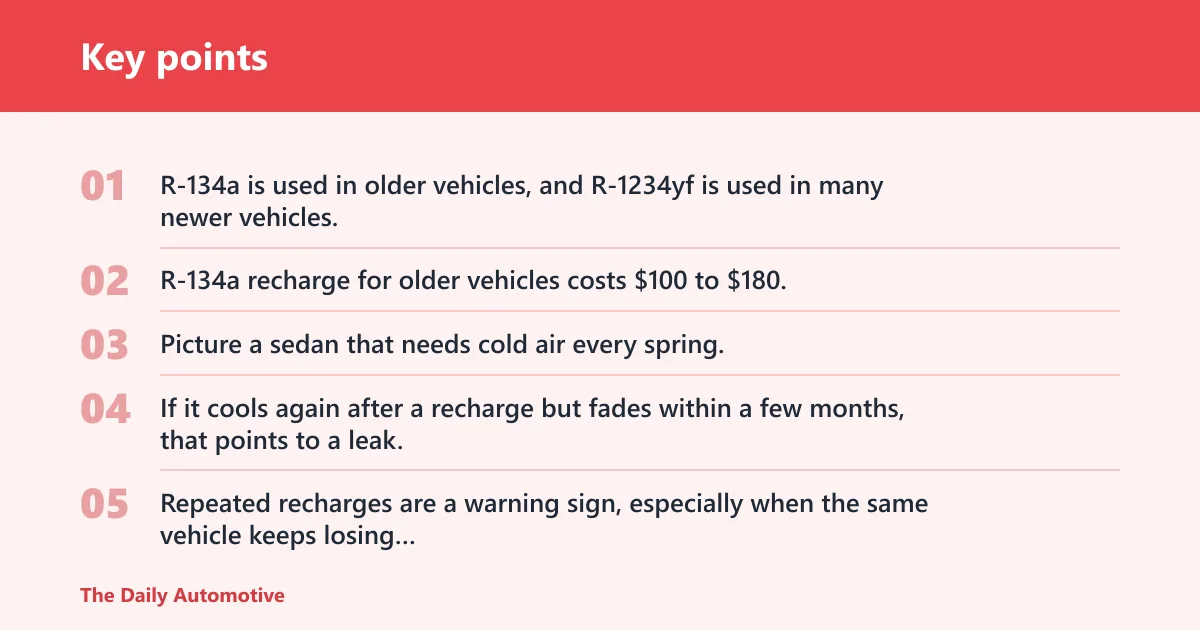
R-134a is used in older vehicles, and R-1234yf is used in many newer vehicles. The refrigerant itself changes the quote. R-134a recharge for older vehicles costs $100 to $180, while R-1234yf recharge for newer vehicles costs $150 to $300.
Picture a sedan that needs cold air every spring. If it cools again after a recharge but fades within a few months, that points to a leak, not normal “top off” maintenance. Repeated recharges are a warning sign, especially when the same vehicle keeps losing performance.
How much does a car AC leak diagnostic cost?
A car AC leak diagnostic usually costs $50 to $100, with some shops folding more of the test process into a broader $150 to $450 leak-detection-and-repair estimate. The price depends on whether the shop can find the leak quickly or has to spend time tracing a hard-to-see escape point.
UV dye and electronic sniffer
UV dye is useful when the system has enough refrigerant and dye circulation for the leak to leave a trace. An electronic sniffer can detect refrigerant around fittings, hoses, condensers, and other exposed areas. Both are common shop tools, but neither guarantees a fast answer if the leak is small or hidden.
Soap solution and pressure limits
Soap solution works best on accessible joints and fittings where the system has pressure and a leak is close to the surface. It is not enough by itself for buried leaks. Some methods need pressure in the system to show a leak path, so a fully empty system can be harder to diagnose.
When shops need evacuation and vacuum
A proper repair includes evacuation and vacuum after the system is opened. That step removes moisture and helps verify that the repaired system holds vacuum before recharge. A vacuum hold test checks sealing. It does not diagnose blend-door faults, control issues, or compressor-clutch problems.
- Ask whether the quote is diagnostic only or includes repair.
- Confirm the refrigerant type before approving service.
- Check whether leak detection includes UV dye, sniffer use, or both.
- Confirm evacuation, vacuum, and recharge are listed after any opened repair.
- Look for a line item naming the failed component, not just “AC service.”
Common leak repairs and typical costs
The cheapest leaks are usually at seals and O-rings. Hoses sit in the middle. Condensers and evaporators are more expensive, and compressor-related work often costs the most because the system may need extra cleanup. For most vehicles, the repaired part and labor matter more than the diagnosis fee.
O-ring or seal leak
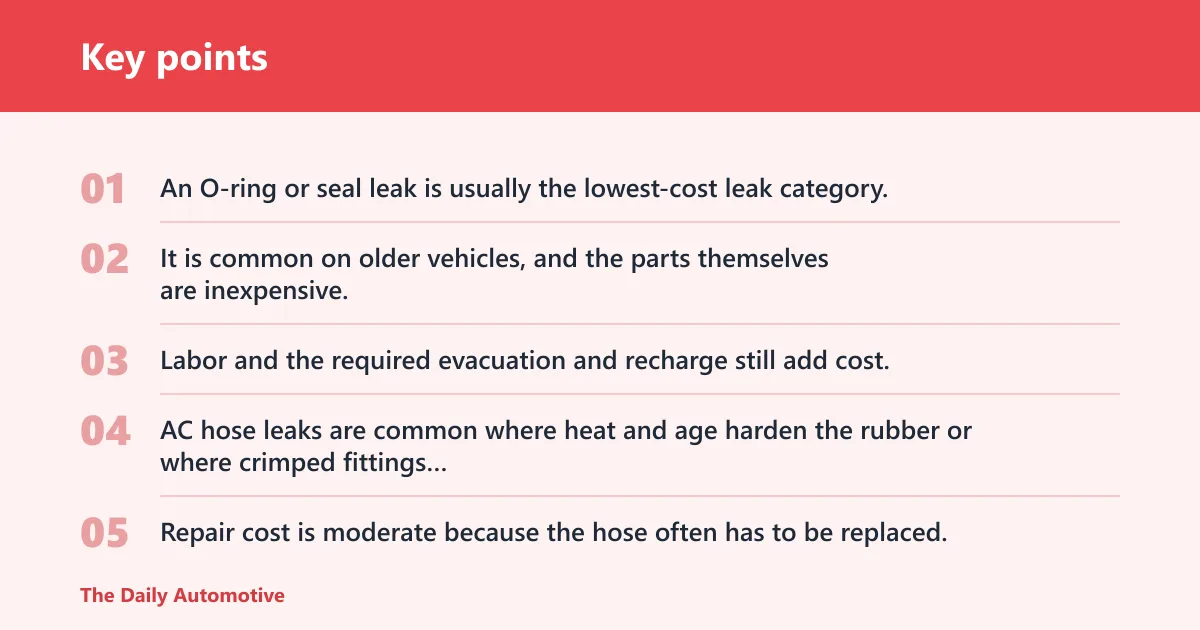
An O-ring or seal leak is usually the lowest-cost leak category. It is common on older vehicles, and the parts themselves are inexpensive. Labor and the required evacuation and recharge still add cost, so a small part does not always mean a tiny bill.
AC hose leak
AC hose leaks are common where heat and age harden the rubber or where crimped fittings weaken. Repair cost is moderate because the hose often has to be replaced, then the system must be evacuated and recharged. Oil staining near a hose connection is a common clue.
Condenser leak
A condenser sits at the front of the car, so road debris and stones can damage it. That is why condenser leaks are often repaired by replacement rather than patching. AC condenser replacement typically costs $400 to $900, and labor can rise if bumper removal is needed for access.
Evaporator leak
Evaporator replacement typically costs $600 to $1,500, and the labor burden is high because the dashboard usually has to come apart. A leaking evaporator can cost $600 to $1,500 including the new part and labor. Musty odor is one possible clue; a wet passenger floorboard is not a reliable evaporator sign by itself and may point elsewhere.
Compressor leak or failure
A compressor leak or failure is the most expensive common repair category. Compressor replacement with flush costs $500 to $1,200. If the compressor has shed metal debris, the system may need flushing and related component replacement before it can be charged again.
Suppose a compact car needs only an O-ring and a recharge. The repair may stay near the low end. Suppose a rear-AC SUV needs a condenser and extra refrigerant. The bill rises because parts, labor, and refrigerant volume all increase together.
How much does it cost to fix an evaporator leak?
An evaporator leak often costs $600 to $1,500 because the part sits deep in the dashboard and labor takes over the bill. The price can climb further on vehicles with tighter packaging, rear AC systems, or difficult cabin disassembly. This is one of the least convenient AC repairs.
Why labor drives the price up
Evaporator work usually requires removing large interior panels and related trim to reach the core. That labor is the reason the repair is expensive, not the refrigerant itself. If a quote is very low, it may be missing the real access time or the final recharge step.
Dashboard access and related parts
Many evaporator jobs also lead to fresh seals, new O-rings, and other small parts during reassembly. Some vehicles need more than simple dash removal because the HVAC box is buried behind other components. European models and vehicles with rear AC often trend higher in labor and parts because access is tighter.
Symptoms that point toward the evaporator
Weak cooling with no obvious front-end damage can fit an evaporator leak, especially when there is a persistent refrigerant loss and odor from the HVAC case. That said, no single symptom proves the evaporator is the source. A proper leak test still matters.
How refrigerant type changes the bill
Refrigerant type changes the total because the service material itself costs different amounts. R-134a systems are usually cheaper to refill, while R-1234yf systems cost more. That difference shows up even before any part replacement is added.
R-134a systems
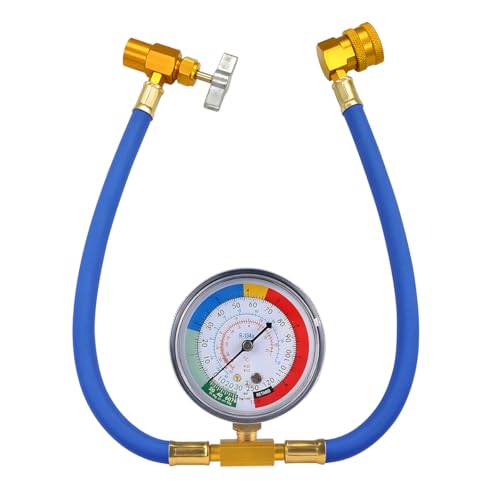
For a DIY R-134a-only system, recharge kits can cost $30 to $60, but that does not fix a leak. It also does not replace proper leak checking, evacuation, and vacuum service.
R-1234yf systems
That higher material cost can push the whole visit up even when the repair itself is small. The refrigerant alone does not explain the total. Labor, leak detection, and system access still shape the final quote.
Why refrigerant alone is not the whole quote
A shop may quote a recharge, but a proper job should include checking for the leak, evacuating the system, pulling vacuum, and then recharging. If the estimate skips those steps, ask what is included. A low number can hide a temporary refill instead of a repair.
Frequently asked questions
How much does it cost to fix a car AC leak?
For most vehicles, car AC repair costs between $100 and $1,200, depending on the leak location and the refrigerant type. The final bill rises fast when the failed part is a condenser, evaporator, or compressor.
Will recharging my car AC fix the leak?
No. A recharge restores cooling only until the remaining refrigerant leaks out again. If the system keeps needing more refrigerant, the underlying leak is still there. A recharge should include leak checking and vacuum service, but it is not a substitute for replacing the failed part.
What should a car AC leak diagnostic cost?
Ask what the shop will actually test: UV dye, sniffer use, soap solution, and pressure retention can all matter, depending on the leak.
Is it cheaper to replace an O-ring, hose, condenser, or evaporator?
Yes. O-rings are usually the cheapest, hoses are moderate, condensers are more expensive, and evaporators are often the priciest because the dashboard must come apart. Compressor repairs can also be costly if debris cleanup is needed. The part location often matters more than the part size.
Can a DIY recharge kit fix a leaking car AC system?
No. DIY recharge kits for R-134a-only systems cost $30 to $60, but they only add refrigerant. Sealant and recharge products can create future service problems by clogging tools or complicating repairs. They may buy time, but they do not repair the leak source.
How much does it cost to fix a car AC condenser leak?
AC condenser replacement typically costs $400 to $900. The condenser sits at the front of the car, so road debris and stones often cause the damage. If bumper removal is needed for access, labor can push the bill higher. Replacement is usually more practical than patching.
How much does it cost to fix a car AC evaporator leak?
A leaking evaporator can cost $600 to $1,500 including the new part and labor. The high price comes from dash removal, reassembly time, and the required evacuation and recharge afterward. If a quote is much lower, confirm that it includes full access work and not just a top-off.
How much is it to fix an AC leak in a car?
The answer depends on whether you are paying for diagnosis only or for repair plus recharge. A leak check may start near $50 to $100, while a proper repair can land from a few hundred dollars to more than $1,000. Refrigerant type and access difficulty are the biggest swing factors.
Products related to this article
Sponsored / affiliate links. As an Amazon Associate I earn from qualifying purchases. I may earn additional commission from eligible campaigns.