How Much Range Does an Electric Car Lose in Cold Weather?
An electric car can lose about 78% of range in cold weather, and on short trips with cabin heat the hit can climb to 40% or more. Miss that margin and you can arrive late, charge more often, or plan a DC fast-charge stop too late. This guide breaks winter loss into temperature, heater load, and trip type, then turns each into miles you can plan around.
Why cold weather cuts EV range—and when it rebounds
Plan on a noticeable drop, not a single fixed number. A mild freeze can trim range by around one-fifth, while deeper cold and full cabin heat can push the loss much higher. The first few miles often look worse than the later ones because the pack and cabin are still warming up.
That range loss is usually temporary. Lithium-ion traction batteries lose usable output when the cells are cold, and the pack can also spend energy warming itself and the cabin. Once the battery and cabin warm up, efficiency improves, and the lost range returns as temperatures rise.
What changes first on a cold morning
The battery often needs to wake up before the car gives its normal number of miles. That can mean a lower displayed range, a stronger heating load, and slower charging behavior until the pack warms. Short trips feel this most because the car spends a larger share of the drive in warm-up mode.
Why EV range drops in the cold
Cold weather cuts range for three reasons at once: lithium-ion chemistry slows down, cabin heat draws from the battery, and driving conditions get less efficient. Add denser air, stiffer tires, wind, snow, or slush, and the car needs more energy for the same trip.
Lithium-ion batteries and low temperature
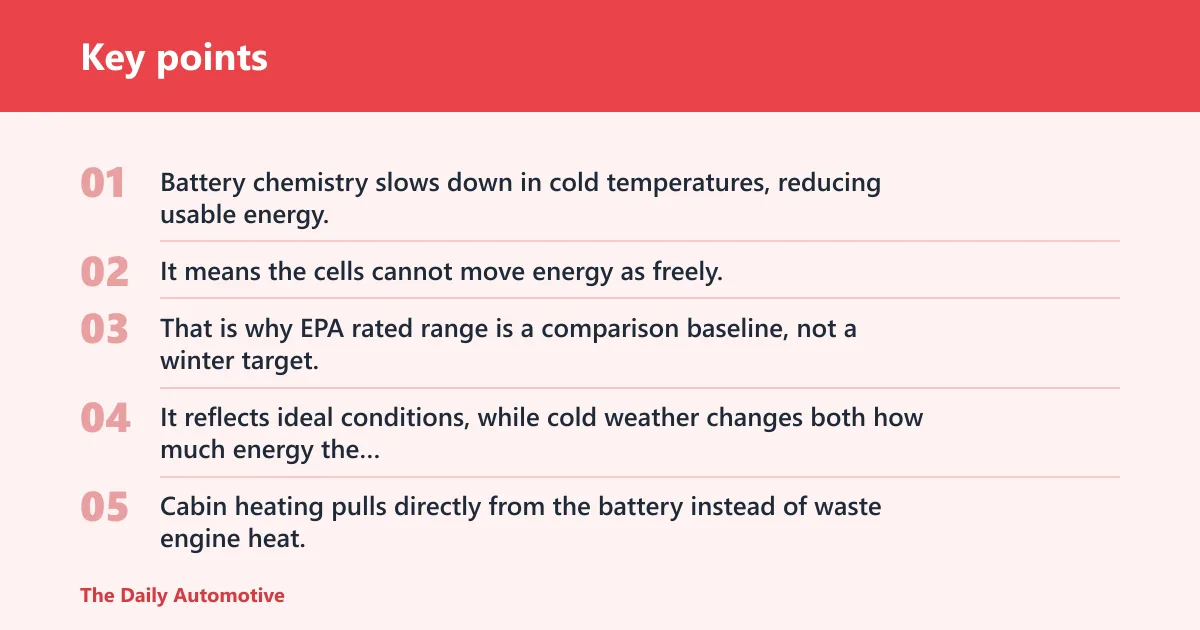
Battery chemistry slows down in cold temperatures, reducing usable energy. That does not mean the pack is damaged. It means the cells cannot move energy as freely, so the car may protect the battery and leave some capacity unused until the pack warms.
That is why EPA rated range is a comparison baseline, not a winter target. It reflects ideal conditions, while cold weather changes both how much energy the battery can deliver and how much the car must spend to keep people comfortable.
Cabin heat and battery thermal management
Cabin heating pulls directly from the battery instead of waste engine heat. In cold weather, that can be a major drain, especially on shorter drives where the heater runs hard from the start. A battery thermal management system may also heat or condition the pack, which can consume additional range in some vehicles.
Say your EV shows 250 miles on the dash after an overnight freeze. The first 10 minutes can consume a larger share of that range than a similar drive on a 50°F day because the cabin heater and battery heater may both be working at once.
Why highway trips usually lose more
Highway driving usually magnifies winter loss because speed, wind, and cold air all work against efficiency. Urban driving can still lose range, but stop-and-go traffic sometimes uses less energy than steady high-speed travel with a cold cabin and a cold pack.
Car and Driver calculated a Chevrolet Bolt EV at 140 miles in the cold versus 180 miles in warmer weather, and a 2018 Bolt saw 19 percent lower fuel economy at 36°F versus 56°F. Those numbers show how winter loss can show up as fewer miles, not just a lower percentage. (Caranddriver)
Cold weather range table
This table turns common EPA ranges into planning numbers. The estimates below assume the same route, same tires, and no unusual headwind or deep snow. Temperature-only reflects the battery and air effects. Heater-on adds cabin heat. Heat-pump-equipped reflects the same cold day with a more efficient heating system.
| EPA range | 32°F temperature-only | 32°F heater-on | 32°F heat pump | 20°F temperature-only | 20°F heater-on | 20°F heat pump | 0°F temperature-only | 0°F heater-on | 0°F heat pump |
|---|---|---|---|---|---|---|---|---|---|
| 200 miles | 184 | 156 | 172 | 170 | 130 | 144 | 144 | 100 | 116 |
| 250 miles | 230 | 195 | 215 | 213 | 163 | 180 | 180 | 125 | 145 |
| 300 miles | 276 | 234 | 258 | 255 | 195 | 216 | 216 | 150 | 174 |
| 350 miles | 322 | 273 | 301 | 298 | 228 | 252 | 252 | 175 | 203 |
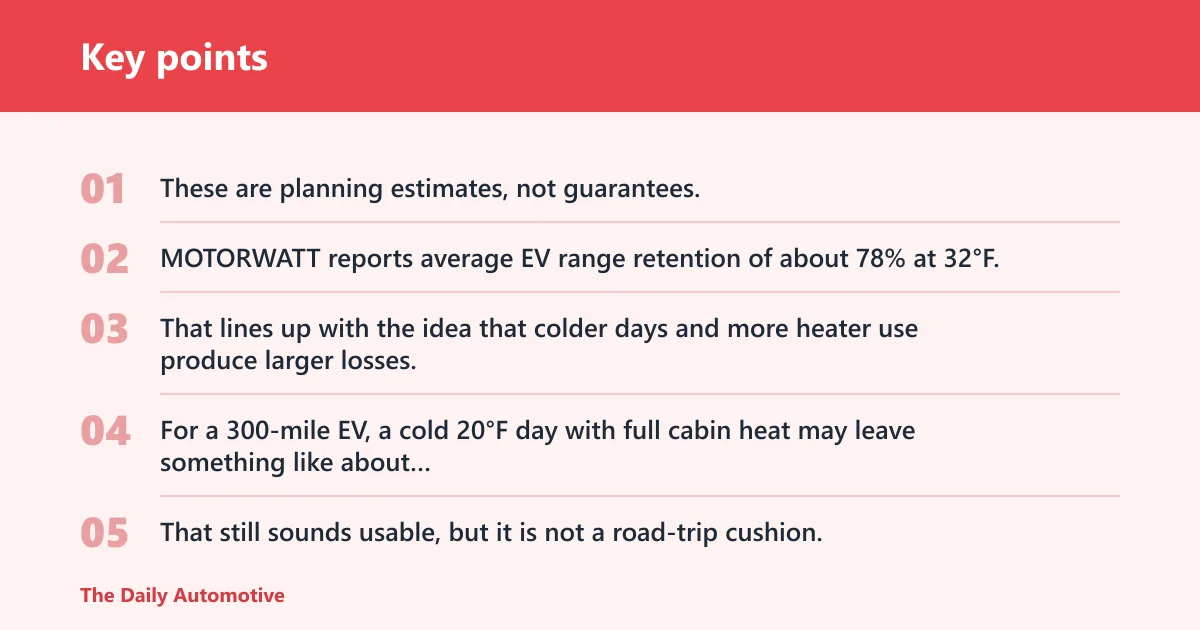
These are planning estimates, not guarantees. MOTORWATT reports average EV range retention of about 78% at 32°F, says heat pumps improve winter range by about 10%, and says range can drop to about 50% at 0°F in urban driving with full HVAC. That lines up with the idea that colder days and more heater use produce larger losses.
How to read the table
For a 300-mile EV, a cold 20°F day with full cabin heat may leave something like about 195 miles instead of the full 300. That still sounds usable, but it is not a road-trip cushion. Once you add wind, snow, and a cold battery at departure, the safe number falls again.
At 32°F, a heat-pump-equipped model may preserve more range than a resistive-heated car, but availability varies by model. A heat pump uses less energy than resistive cabin heat, yet it is not magic. It helps most when the heater would otherwise run for a long stretch.
Does using the heater make EV range drop more?
Yes. Cabin heat is one of the biggest winter drains, and full-output heating can materially reduce range. Seat heaters and steering-wheel heaters usually draw less energy than heating the whole cabin, so they are a better first choice when the goal is to save miles.
Heat pump versus resistive heat
A heat pump usually uses less energy than a resistive heater because it moves heat more efficiently. The same source says heat pumps improve winter range by about 10%. That help varies by vehicle, weather, and how hard the system has to work, so it should be treated as a gain, not a promise.
Suppose two similar EVs leave the same driveway at 20°F. One uses resistive heat, and the other has a heat pump. The second car may arrive with noticeably more range left, but both will still use extra energy compared with a mild day.
When heater use matters most
Heater load matters most on short trips, at very low temperatures, and on long highway runs where the cabin heater keeps cycling for a long time. It also matters when the car starts with a cold battery, because the pack may need extra energy before it can deliver its normal output.
Should you precondition before driving?
Yes, if the car supports it and you can do it while plugged in. Preconditioning warms the cabin and, in some vehicles, the battery before departure. That reduces battery drain at the start of the trip and can make the first miles more predictable.
Why it works best while plugged
When preconditioning runs on shore power, the battery does not have to supply as much heat. That helps preserve state of charge for driving instead of spending it on warm-up. It can also reduce the chance that the car begins a trip with a cold battery and limited output.
Preconditioning is most useful before a commute, a school run, or a road-trip departure from home or a hotel charger. It will not erase winter losses, but it can keep the first miles from being the worst miles.
How to plan winter range for commuting and road trips
Use the weather, route, and heater load together. Start with EPA range, then subtract a buffer for cold and another buffer for your trip type. City trips need a smaller reserve than highway trips, and DC fast-charging road trips need the most cushion because cold batteries can slow charging too.
City commute reserve rule
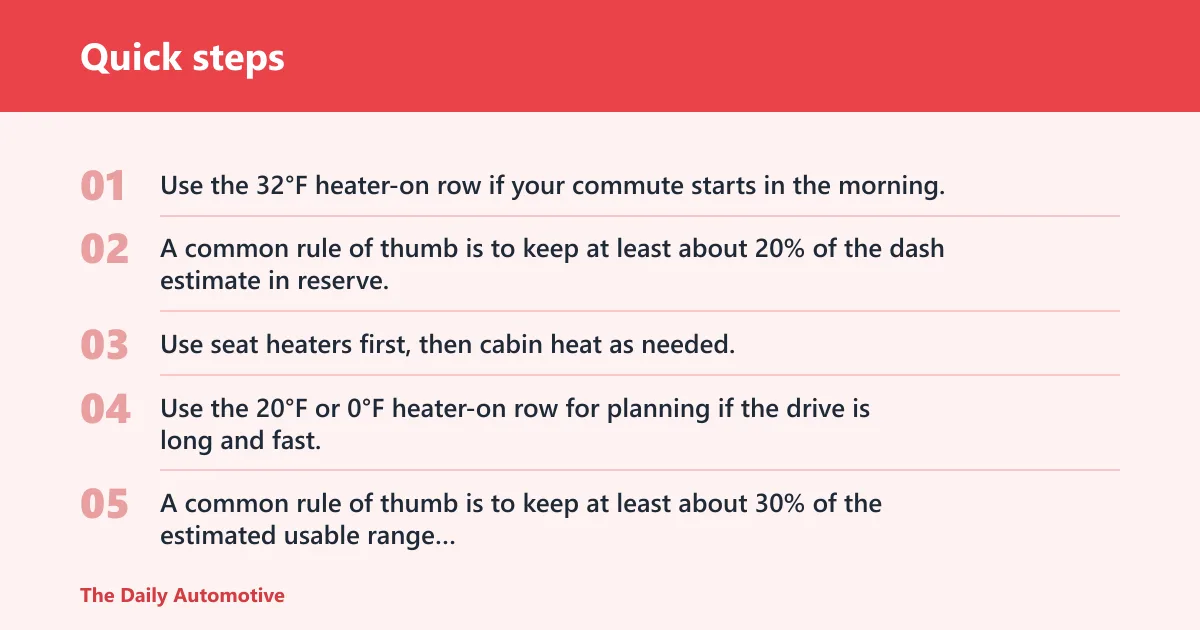
- Use the 32°F heater-on row if your commute starts in the morning.
- A common rule of thumb is to keep at least about 20% of the dash estimate in reserve.
- Use seat heaters first, then cabin heat as needed.
A common first-timer mistake is trusting the full indicated range for a 30-mile commute when the car is parked outside overnight. If the route is mostly city streets, the trip may still work, but the reserve should cover the heater load, traffic delays, and a colder-than-expected battery.
Highway trip reserve rule
- Use the 20°F or 0°F heater-on row for planning if the drive is long and fast.
- A common rule of thumb is to keep at least about 30% of the estimated usable range unused when you leave.
- Plan for stronger loss if wind, snow, or slush is in the forecast.
Highway travel punishes winter range more than local driving because speed increases drag and leaves less time for the battery to warm efficiently. If the route is 180 miles and the car looks capable on paper, the margin can shrink fast once the heater, wind, and a cold pack all start taking their share.
DC fast-charging reserve rule
- Arrive at the charger with more battery than you would in summer.
- Plan extra time for slower charging if the battery starts cold.
- Use preconditioning if the car supports it before reaching the charger.
Cold weather can slow charging because the battery may accept power more cautiously until it warms. That means a stop that looks short in warm weather can take longer in winter, and the car may not charge as quickly during the first minutes after arrival.
Cold weather charging and trip planning
Cold batteries can charge more slowly, and that changes road-trip timing. If the pack arrives cold, the car may spend part of the stop warming the battery before it can take higher power. That makes the first minutes of the session less productive than a warm-weather stop.
What to expect at a fast charger
Expect the charger session to depend on pack temperature, not just the state of charge. A car that has been sitting outside in freezing air may begin the stop with limited charging speed, then improve as the battery warms. That is why a cold-day stop should include extra time in the plan.
Charge stops are easier to manage if you think in miles left, not only in percent. A winter road trip becomes less stressful when you assume the car may lose range, the heater may pull extra energy, and the next stop may take longer than the same stop in spring.
Frequently asked questions
How much range does an electric car lose in cold weather?
Most EVs lose a noticeable amount of range in the cold, often in the double-digit range. A reasonable planning band is about 10% to 30%, with larger losses on short trips, at highway speed, and when the cabin heater runs hard. On very cold days, the loss can be higher.
How much range do electric cars lose in cold weather?
The answer depends on the temperature, heater use, and trip type. Around freezing, many drivers see a modest drop. At 20°F, the loss is larger. At 0°F, an urban drive with full HVAC can cut range to about half in some cases.
Do electric cars lose charge in cold weather?
Yes, they can appear to lose charge faster because the battery is less efficient and the car may use energy to warm the pack and cabin. The charge loss is usually temporary. Once the battery warms and temperatures rise, the available range improves again.
Why do electric cars have less range in winter?
They have less range because cold temperatures reduce usable battery energy, cabin heating pulls directly from the battery, and cold air plus stiffer tires raise energy use. Highway speed, wind, snow, and slush can add even more load, so winter range falls for several reasons at once.
How much range should I expect at 32°F?
The same source says the average EV retains about 78% of its range at 32°F. A heat pump may improve winter range by about 10%, while a resistive heater can pull the number lower. For planning, use the table above and keep a buffer for route conditions.
How much worse is EV range at 20°F?
At 20°F, range loss is typically worse than at freezing, especially with cabin heat running. The table above shows that a 300-mile EV may be closer to 195 miles with heater-on planning, and even less if the route is fast, windy, or snowy.
Should I precondition an EV before driving in winter?
Yes, especially if you can precondition while plugged in. Warming the cabin and battery before departure reduces the energy the car must spend right after startup. That can preserve range, improve early-trip comfort, and help the battery charge or deliver power more normally.
Products related to this article
Sponsored / affiliate links. As an Amazon Associate I earn from qualifying purchases. I may earn additional commission from eligible campaigns.