Best Windshield Washer Fluids for Winter (2026): We Compared
Choose Prime Guard -35°F All Season Blast Windshield Washer Fluid if your forecast regularly drops below 0°F, because its -35°F rating leaves more margin than a mild-weather fluid and it comes ready to use. If your lows stay near freezing, a warmer all-season formula can be enough; if you can mix accurately, a concentrate may fit an OEM-specific vehicle better.
Quick comparison
| Product | Badge | Best for | Price | ||
|---|---|---|---|---|---|
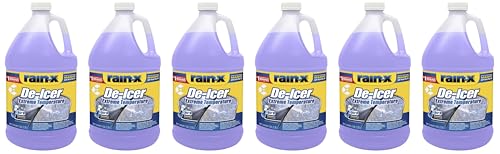 |
6 Pack 1 Gallon Rain X Windshield Washer Fluid ExtremeElite Tool Center | Our pick | 6 x 1 gal · -30°F · de-icer blend | $89.99
Price as of 6 Nov 2026
|
View |
 |
Prime Guard -35°F All Season Blast Windshield Washer FluidPrime Guard | Upgrade pick | 1 gal · -35°F · all-season | $16.54
Price as of 6 Nov 2026
|
View |
 |
Mercedes-Benz Genuine OEM Winter Fit Windshield Washer FluidMercedes-Benz | Pair with it | 1 L · concentrate · winter fit | $21.45
Price as of 6 Nov 2026
|
View |
Use freeze rating first, then decide whether you want convenience or flexibility. The wrong choice usually fails in one of three ways: it refreezes after spray, streaks on dirty glass, or gets diluted by leftover summer fluid in the reservoir.
How we chose
These picks are based on manufacturer specs, published product details, and buyer feedback, with winter freeze rating, formula type, ease of use, and vehicle-specific fit taking priority.
Winter washer fluid should protect below your lowest ambient temperature, not your day’s average. A common rule of thumb is to leave about 10°F of buffer below the coldest overnight low, and colder climates often benefit from a winter target around -20°F or colder.
Ready-to-use fluid is simplest when you want a no-mix refill. Concentrate is better when you want control over dilution, but only if you can measure it correctly and the product listing supports the vehicle you drive.
Prime Guard -35°F All Season Blast: best for deep cold
Prime Guard -35°F All Season Blast is the safest default for drivers who face hard freezes, repeated sub-zero mornings, or slushy spray that can refreeze on contact. Its ready-to-use format also makes it the easiest option when you just need to refill and go.
The listing calls out -35°F cold-weather protection, year-round cleaning, and a de-icer formula that removes ice, bugs, and road grime. That combination matters when the reservoir may still hold some leftover summer fluid, because a colder blend helps offset dilution better than a warmer formula.
One drawback is cost per gallon compared with a bulk concentrate. It is also a one-bottle solution, so you do not get the mixing flexibility that some OEM-specific concentrates provide.
Elite Tool Center Rain X extreme winter blend: best for bulk refills
Elite Tool Center Rain X Windshield Washer Fluid Extreme Winter Weather Blend fits drivers who burn through fluid quickly, such as commuters in snowy regions who refill often and want multiple gallons on hand. The six-gallon pack can be practical when winter use is constant and you do not want to reorder after every storm cycle.
The listing says it is a de-icer blend rated to -30°F, which gives substantial cold protection for sub-zero weather. The tradeoff is simple: bulk volume means a larger upfront spend, and the pack size is less convenient if you only need one bottle for seasonal topping off.
If your climate only sees occasional freezing, this is likely more fluid than you need at once. It makes the most sense when you value inventory and repeat refills over minimal purchase size.
Mercedes-Benz Genuine OEM winter fit concentrate: best for OEM fit
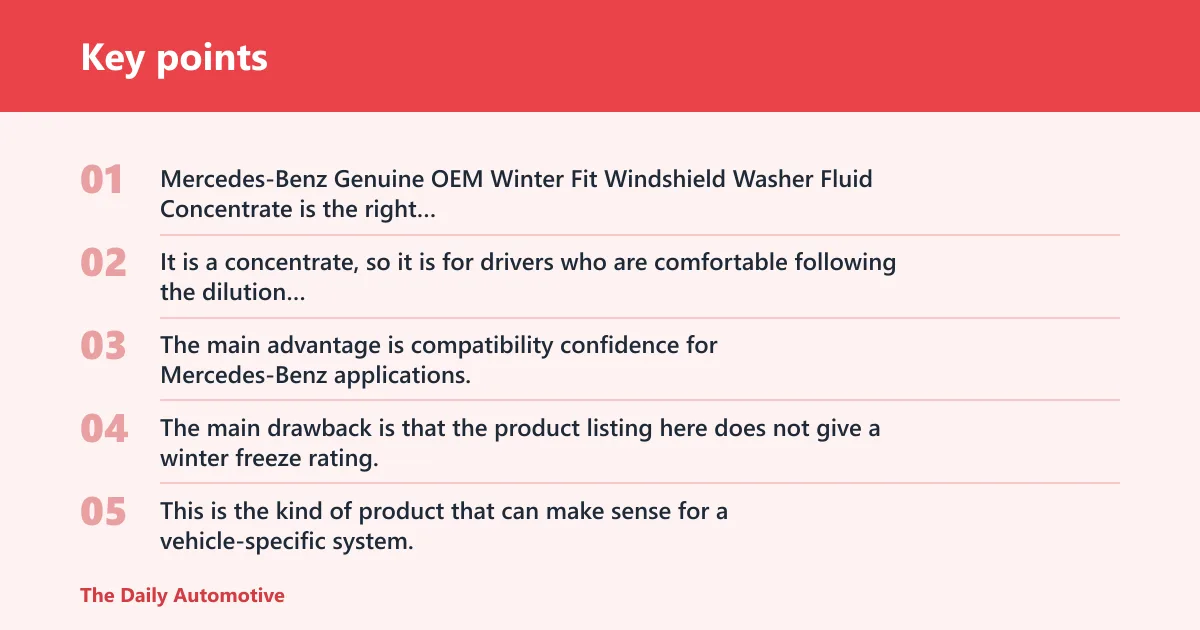
Mercedes-Benz Genuine OEM Winter Fit Windshield Washer Fluid Concentrate is the right kind of pick when your owner’s manual or vehicle listing points you toward an OEM-spec fluid. It is a concentrate, so it is for drivers who are comfortable following the dilution directions exactly as listed by the manufacturer.
The main advantage is compatibility confidence for Mercedes-Benz applications. The main drawback is that the product listing here does not give a winter freeze rating, so you should check the manufacturer’s listing and your owner’s manual for the exact mix ratio and the temperature protection that ratio provides.
This is the kind of product that can make sense for a vehicle-specific system, but only if you are willing to do the mixing work and verify the directions. A concentrate that is mixed too weakly can freeze sooner than expected.
Which one should you buy?
If your overnight lows regularly fall well below 0°F, start with Prime Guard -35°F All Season Blast. It gives the coldest posted protection in this group and avoids the dilution mistakes that make concentrates risky for hurried winter top-offs.
If you keep several gallons in reserve for repeated snow events, Elite Tool Center Rain X extreme winter blend is the practical bulk buy. That makes sense for a driver who wants fewer trips and does not mind a larger upfront purchase.
If your vehicle calls for an OEM-specific fluid, Mercedes-Benz Genuine OEM Winter Fit Windshield Washer Fluid Concentrate is the fit-first choice, but only if you follow the exact dilution instructions from the product listing and confirm compatibility in the owner’s manual. Do not guess the mix.
Say your car still has some summer fluid in the reservoir on the first cold snap. A cold-rated ready-to-use refill is the safer move, because leftover warm-season fluid can weaken the final blend and raise the chance of refreezing in the lines.
Suppose you drive a garage-kept sedan in a city where the forecast low is 8°F. A colder all-season or de-icer fluid still makes sense, but you do not need to buy a concentrate just to chase a number you will never use.
Winter washer fluid decision table
| Lowest expected temperature | Recommended fluid type | Minimum safe rating buffer | Ready-to-use vs concentrate | Failure-mode note |
|---|---|---|---|---|
| Above 32°F | All-season | About 10°F below the low if possible | Ready-to-use is simplest | Streaking on dirty glass |
| 0°F to 32°F | Cold-rated all-season or de-icer | At least 10°F colder than the forecast low | Ready-to-use favored for convenience | Refreeze after spray if the buffer is too small |
| -10°F to 0°F | De-icer | At least 10°F colder than the forecast low | Ready-to-use is safer unless you mix carefully | Reservoir dilution from leftover summer fluid |
| -20°F or colder | High-rated de-icer | At least 10°F below the coldest overnight low | Ready-to-use if you want the least hassle | Refreeze is more likely if you underbuy the rating |
| Vehicle-specific OEM system | OEM-spec concentrate | Follow the manual and the listing | Concentrate only if the dilution is clear | Sensor compatibility and mix error |
What windshield washer fluid is best for winter driving?
The best winter washer fluid is the one rated cold enough for your lowest expected ambient temperature, with a margin below that low. For many cold-climate drivers, a de-icer rated at -20°F or colder is the safer buy, and Prime Guard -35°F All Season Blast is the strongest fit in this group for deep cold.
All-season fluid can be enough in milder winters, but it should not be treated as a universal answer. If your lows regularly stay below 0°F, move to a colder de-icer rather than hoping a warm-weather blend will keep up.
Why freeze rating matters more than brand name
A gallon labeled for winter is only useful if its freeze rating matches the real weather you face. Wind chill does not lower the freezing point of the fluid, so judge by ambient temperature and the lowest overnight low, not by how harsh it feels outside.
When all-season is enough
All-season fluid is enough when your lows stay modest and you mainly want convenience, road-salt removal, and decent cold-weather cleaning. It is a poor fit for frequent sub-zero use unless the bottle’s rating clearly stays below your coldest forecast.
Will winter washer fluid help remove road salt and frost?
Yes. Winter washer fluid is meant to clear frost, road salt, grime, and winter debris from the glass, and de-icer formulas usually work faster on frozen residue than a basic warm-weather blend. That matters when salt film and slush cut visibility before the wipers can do their job.
Dirty glass can still streak if the blades are worn or the windshield has heavy residue. Washer fluid helps, but it cannot fix a neglected blade edge or a badly contaminated windshield on its own.
Is de-icer washer fluid better than all-season washer fluid?
De-icer washer fluid is better when freezing spray, frost, or sub-zero mornings are routine, because it gives you more margin before the fluid and the film on the glass refreeze. All-season fluid is fine for milder winters, but it is the weaker choice once the temperature stays well below freezing.
A de-icer is also the safer call if you are refilling from a reservoir that may still contain old summer fluid. That leftover fluid can dilute the new fill, which can be enough to spoil a marginal winter bottle.
Ready-to-use vs concentrate
Ready-to-use fluid needs no mixing, which reduces error and makes it the easiest winter refill. Concentrate can lower cost per mixed gallon and gives you more control, but the final freeze protection depends on the dilution ratio, the water you add, and whether the product is meant for your vehicle.
A concentrate only saves money when you mix it correctly. If you over-dilute it, the cost advantage disappears the moment the fluid freezes in the lines.
Can I use Rain-X washer fluid in freezing temperatures?
Rain-X washer fluid can work in freezing weather only if the specific bottle is rated cold enough for your actual lows. A bottle effective to 0°F is not a safe choice where temperatures regularly drop below 0°F, even if it handles light snow and frost well.
That is the key mistake to avoid: do not buy a warmer rating and hope the forecast softens. For sub-zero commutes, choose a colder de-icer instead of stretching a 0°F formula beyond its range.
What water-beading adds
Water-beading technology helps repel rain, sleet, and snow so the glass clears more quickly between wipe cycles. That can improve visibility in messy weather, but it does not replace freeze protection. A beading additive is useful only after the fluid itself is cold-rated enough.
How cold should windshield washer fluid be rated for winter?
As a practical target, choose a rating at least 10°F below your coldest expected overnight low. For many cold-climate drivers, a winter target around -20°F or colder is a safer rule of thumb, because it leaves room for real-world dilution and for the reservoir not to be perfectly empty.
That buffer matters more than chasing a label that sounds cold enough. A fluid rated right at your forecast low can still fail once summer residue is left in the tank or the system holds diluted fluid in the lines.
What is the difference between ready-to-use and concentrate washer fluid?
Ready-to-use fluid is pre-mixed, so you pour it in and go. Concentrate must be diluted, which can save money per mixed gallon and may better suit OEM-specific systems, but it also introduces mix error, water-quality issues, and the risk of undercutting winter freeze protection.
For winter use, ready-to-use is usually safer when you want certainty and speed. Concentrate makes sense when the product listing gives a clear ratio and you can follow it exactly without guessing.
Frequently asked questions
Which windshield washer fluid protects to -20°F or colder?
For a -20°F or colder target, look at de-icer formulas with a rating below that mark. In this group, Prime Guard -35°F All Season Blast and Elite Tool Center Rain X extreme winter blend both fit that need, while warmer all-season formulas are better left to milder climates.
Are there washer fluids compatible with rain-sensing wipers?
Compatibility with rain-sensing wipers is usually a vehicle question, not a fluid buzzword. Check the owner’s manual and the washer-fluid listing for any OEM-specific guidance. If the product does not state compatibility clearly, do not assume it is approved for your sensor system.
Products related to this article
Sponsored / affiliate links. As an Amazon Associate I earn from qualifying purchases. I may earn additional commission from eligible campaigns.