Blower for Car: Enhance Your Vehicle’s Shine with High-Flow Drying
Adam’s Air Cannon is the best all-around pick for most buyers because it combines warm, filtered air, a 30-foot self-expanding hose, and reach that makes it practical around a full vehicle without moving the unit constantly. Skip it if low noise matters most; the listed 88 dB puts it in the loud category for garage use.
It fits owners who want fast drying on paint, mirrors, grilles, badges, wheels, and trim seams. It is less appealing if you need the quietest option or if you mostly dry one small car and do not mind some towel finishing.
Top pick for quick drying


Quick picks
| Best for | Pick | Why it stands out | Key spec |
|---|---|---|---|
| Overall drying speed and reach | Adam’s Air Cannon | Warm, filtered air and long hose help with full-car coverage | Over 73,000 feet per minute; 30-foot hose; 88 dB |
| Large vehicles and garage power users | bigboi BlowR PRO MKII | Built for sustained drying on bigger panels and repeated use | Twin 1600-watt motors; up to 450 km/h; 9 m hose |
| Garage users who want steady power | Suds Lab JD Jet Dry | Hardwired, warmed airflow suits regular garage detailing | 1.5 HP motor; air about 25°F above garage temperature; 20-foot power cord |
| Portable cordless use | YUQUESEN cordless leaf blower | Battery freedom helps where cords are awkward or storage is tight | 2 x 4.0Ah batteries |
Adam’s Air Cannon
This is the best fit if you want one tool that handles most drying jobs without babying it around the car. The warm, filtered air and long hose help clear water from mirrors, badges, grille openings, and seams where towels can leave traces behind.
Bigboi BlowR PRO MKII
Choose this if you want a more heavy-duty garage unit for frequent use on SUVs, trucks, and larger wash days. The twin 1600-watt motors and 9 m commercial-grade hose point to sustained airflow, and the brand claims drying time can drop by up to 80%.
Suds Lab JD Jet Dry
This is the garage-focused option for someone who wants powered drying with a fixed setup. The 20-foot cord and air heated about 25°F above garage temperature make it practical when you wash indoors and want a repeatable routine.
YUQUESEN cordless leaf blower
Pick this only if portability matters more than sustained drying power. Two 4.0Ah batteries make it easier to carry around the driveway, but cordless drying usually gives up long, steady output compared with corded car dryers.
What the specs actually mean
Airflow specs do not mean the same thing. CFM measures how much air moves through the tool, MPH measures how fast that air exits the nozzle, and FPM is another air-speed figure often printed on product pages. The numbers are related, but they are not direct swaps.
CFM vs MPH vs FPM
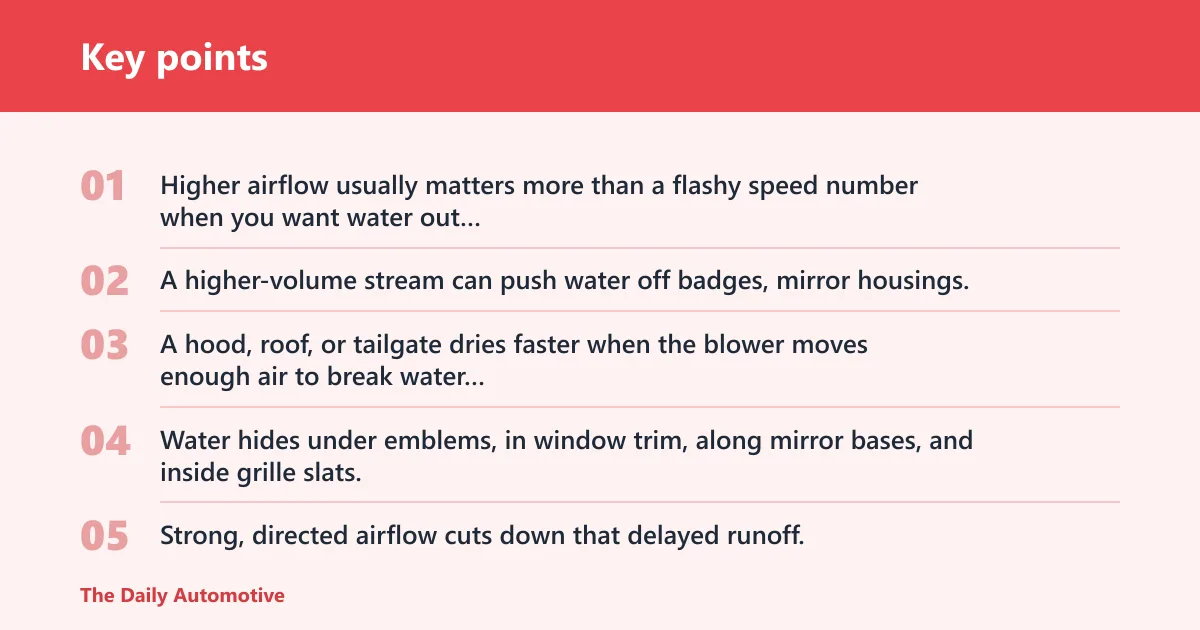
Higher airflow usually matters more than a flashy speed number when you want water out of crevices and panel edges. A higher-volume stream can push water off badges, mirror housings, and trim gaps faster than a narrow blast that sounds fast but moves less air overall.
That difference matters on large panels too. A hood, roof, or tailgate dries faster when the blower moves enough air to break water sheets and push runoff toward the edges instead of leaving tiny beads behind.
Why higher airflow clears crevices faster
Crevices are where blowers earn their keep. Water hides under emblems, in window trim, along mirror bases, and inside grille slats, then drips later after the towel is already away. Strong, directed airflow cuts down that delayed runoff.
Picture a midsize SUV with wet badge recesses after a wash. A blower with the right attachment can clear the emblem and the seam below it in one pass, while a towel reaches only the visible surface.
How to judge large-panel drying
For large panels, look for sustained airflow, a long hose, and a setup you can move around the vehicle without dragging the unit. Warm filtered air helps water leave the surface faster, but the panel still needs enough air volume to move water instead of only warming it.
Suppose a full-size truck has water sitting across the roof and tailgate. A weak unit may only scatter beads, which means you still need a towel to finish the job. A stronger unit can shorten that final wipe, but it does not always eliminate it.
Which blower type should you buy?
Choose the type that matches how often you wash, how much space you have, and whether you care more about mobility or sustained output. Corded car dryers are usually better for regular garage use. Cordless blowers are better when portability matters and your drying sessions are shorter.
Corded car dryers
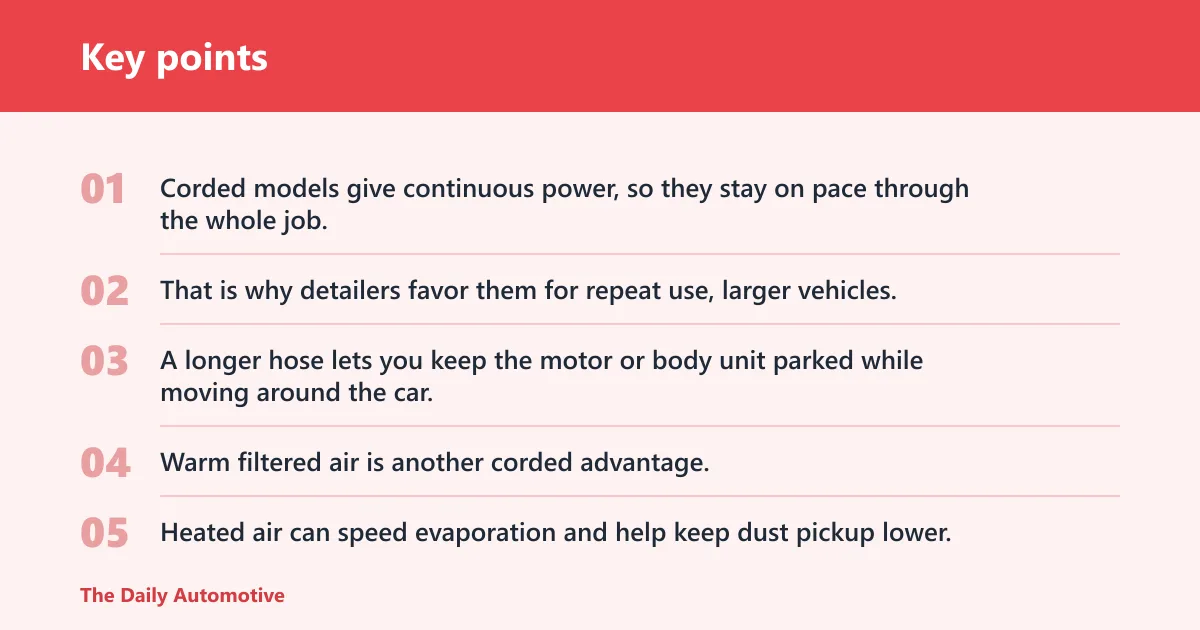
Corded models give continuous power, so they stay on pace through the whole job. That is why detailers favor them for repeat use, larger vehicles, and situations where you want steady output without waiting on a battery.
Hose length matters here. A longer hose lets you keep the motor or body unit parked while moving around the car, which improves maneuverability and makes garage work less awkward.
Warm filtered air is another corded advantage. Heated air can speed evaporation and help keep dust pickup lower, but the heat should be controlled and used with caution on delicate trim and wraps.
Cordless car dryers
Cordless models trade sustained output for easier movement. Battery runtime and charge time matter more than raw portability when you wash often, because a blower that fades early forces more towel work.
Use cordless if you dry one or two cars at a time, store tools in a tight space, or work where an extension cord is a nuisance. Speed modes help, but they do not replace continuous power on larger vehicles.
Warm filtered air versus ambient air
Warm filtered air can help in two ways: it speeds evaporation and keeps dust out of the stream. That can cut water spots and keep debris from landing on fresh paint during the final dry.
Heat is not always necessary. On modern paint, trim, and wheels, strong clean airflow is often enough. Use added heat when the manufacturer controls it well and the unit stays at a safe distance from the surface.
When towels still belong in the process
Towels are still useful for the last film of water that cling to panel edges, fuel-filler recesses, and lower door seams. A blower is not a full replacement for microfiber on every car, especially after a heavy rinse.
Use the blower first, then finish with a towel where a thin trace remains. That approach reduces contact on the paint while still handling the water the blower cannot fully clear.
Car drying blower decision matrix
| Vehicle size | Wash frequency | Storage space | Noise tolerance | Budget | Best match |
|---|---|---|---|---|---|
| Small car | Occasional | Tight | Low | Lower | YUQUESEN cordless leaf blower, if portability matters most |
| Small to midsize car | Frequent | Moderate | Medium | Midrange | Adam’s Air Cannon |
| SUV | Frequent | Garage space available | Medium to high | Midrange to higher | bigboi BlowR PRO MKII |
| Truck or multiple vehicles | Frequent | Garage setup | High | Higher | Suds Lab JD Jet Dry or bigboi BlowR PRO MKII |
For frequent washing, choose corded. For limited storage, choose cordless. For larger vehicles, choose the blower with the most sustained airflow and the best hose reach, not the one that only sounds powerful.
Best use cases for detail work
Mirrors, badges, and emblems
These are the places where blowers earn their keep. Water collects around edges and in shallow recesses, then drips later onto clean paint. A narrow attachment helps direct air into those small pockets.
Grilles, trim, and door handles
Grilles and trim gaps need controlled airflow more than brute force. A wide nozzle can clear general runoff, while a narrower nozzle helps reach deep openings without blasting water back across the panel.
Wheels and lug recesses
Wheels benefit from touchless drying because brake dust and trapped water are easy to smear with a towel. Blowing out lug recesses, valve stems, and spoke corners reduces lingering water and helps avoid streaks on finished wheels.
Convertibles and roof edges
Convertible tops and roof edges need more caution. Use filtered airflow and keep the nozzle moving, especially near seams and trim, so you do not force water deeper into stitching or weather seals.
What features matter most?
The most useful features are the ones that control the air path and your control over it. Nozzles, hose reach, heat management, and noise level matter more than marketing language.
Nozzles and attachments
A wide nozzle helps move water off large panels. A narrow nozzle helps with emblems, trim, and crevices. A rubber-tipped nozzle matters when you want to avoid paint contact near tight edges and delicate trim.
For car drying, attachment quality matters as much as the blower itself. A poor tip can scatter water, while a shaped nozzle can direct airflow exactly where it belongs.
Ergonomics, weight, and maneuverability
If the blower is awkward to hold, it will get used less. Look for comfortable handling, manageable weight, and a hose or body design that does not fight you around mirrors and wheel arches.
A long hose helps garage practicality because you can keep the motor unit out of the way while moving around the car. That matters more on larger vehicles than on compact hatchbacks.
Noise and garage practicality
Noise is a real buying factor. Adam’s Air Cannon is listed at about 88 dB, which can be loud enough to matter in a closed garage or shared driveway. Bigger garage units can be hard to ignore, so check your tolerance before you buy.
For enclosed spaces, noise plus hose reach often matters more than raw power. A unit that is easy to position and keep away from the car can feel more practical even if the motor is louder than expected.
Maintenance: filters, nozzles, and battery care
Filtered-air units need filter cleaning so dust does not ride along with the airflow. Nozzles should be checked for damage or looseness, especially rubber tips that contact edges.
Battery-powered blowers need battery care too. Battery aging reduces runtime over time, so a cordless model is best for users who are willing to manage charging and eventual replacement. Check the manufacturer’s listing for replacement battery options and charge time.
When not to buy one
Do not buy a blower if you only need it for an occasional wipe-down and already finish quickly with microfiber. In that case, the cost, noise, and storage burden may outweigh the benefit.
Skip it when heavy bead runoff still demands a towel anyway. Some hydrophobic coatings shed water fast, but they can leave scattered beads that still need a final wipe on lower panels, mirrors, and trim edges.
A blower is also a weak fit in winter condensation cases if your garage is cold, damp, or poorly ventilated. The unit may move water around without fully drying seams, which leaves more cleanup later.
Say your sedan has a ceramic-coated hood that sheets water well but still leaves tiny beads on the mirror base and around the badge. A blower helps most there, but a quick microfiber finish is still the practical last step.
How to choose
- Match the blower type to your parking and storage. If the tool will live in a garage, corded makes sense. If storage is tight or you move between wash spots, cordless may be the better fit.
- Decide whether you value sustained power or mobility. Regular washing, larger vehicles, and repeated use point toward corded. Short sessions on smaller cars can work with cordless.
- Check reach before chasing speed claims. Hose length, nozzle control, and how easily you can move around the car matter more than a single marketing number.
- Use heat as a helper, not a default. Warm filtered air can speed drying and help keep dust down, but it is not required for every paint surface.
- Plan for the last towel pass. A blower reduces contact, but it rarely replaces microfiber entirely on seams, rocker panels, and lower trim.
Frequently asked questions
What is the best blower for drying a car?
For most buyers, Adam’s Air Cannon is the strongest all-around pick because it combines warm, filtered air with a 30-foot self-expanding hose and a layout that works well around mirrors, badges, and grilles. If you want more heavy-duty garage power, the bigboi BlowR PRO MKII is the stronger alternative.
Can a leaf blower safely dry car paint?
Yes, if the air is clean and the nozzle never drags across the surface. Use filtered airflow, keep the tip off the paint, and avoid blowing grit from the ground onto the panel. A leaf blower without filtration is riskier because it can move dust and debris with the air.
Corded or cordless car dryer blower: which is better?
Corded is better for sustained power, larger vehicles, and regular garage use. Cordless is better for portability and tight storage, but battery runtime and recharge needs can limit longer drying sessions. If you dry multiple vehicles or large trucks, corded usually makes more sense.
How much airflow do I need to dry a car quickly?
There is no universal number that fits every car, because vehicle size, panel shape, and how much water remains after rinsing all matter. In practice, higher airflow helps more than raw speed claims for crevices and larger panels, while weaker units often still leave towel work behind.
Do heated car dryers reduce water spots?
They can help by speeding evaporation, especially when the air is filtered and the panel dries before droplets sit too long. Heat is not a cure-all, though. If the blower is weak, or the car is already covered in heavy beads, you may still need a towel finish.
Which car dryer is best for tight spots and emblems?
Look for the unit with the best nozzle control and enough airflow to push water out of seams. Adam’s Air Cannon and the bigboi BlowR PRO MKII are both strong choices for crevices, while a narrow nozzle matters more than raw power alone for badges, trim gaps, and mirror bases.
Products related to this article
Sponsored / affiliate links. As an Amazon Associate I earn from qualifying purchases. I may earn additional commission from eligible campaigns.