3 Best Audio Adapters for Cars (2026): We Compared
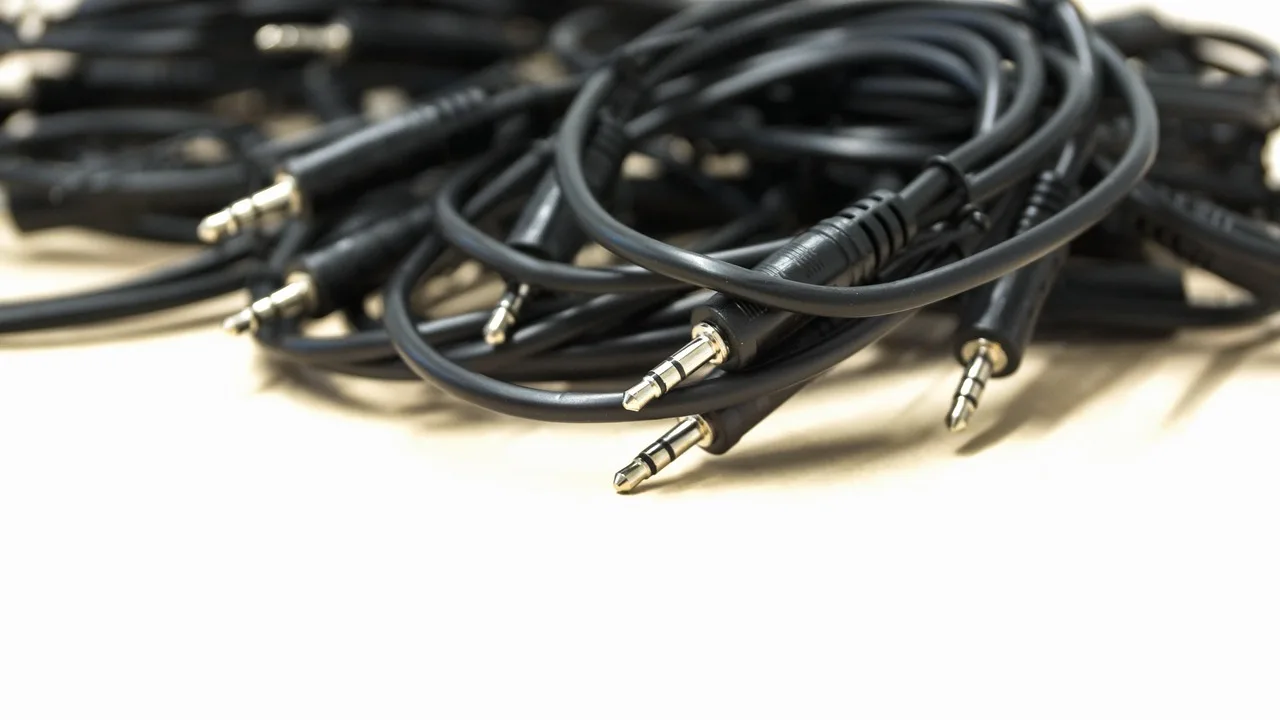
For most older cars, the best audio adapter is a Bluetooth FM transmitter for factory radios without AUX, a wired AUX-to-Bluetooth adapter for cars with an AUX jack, and a cassette adapter only for cassette decks. Pick the wrong type and you get static, charging noise, dropped calls, or a useless plug. This guide compares three picks by setup, then shows a short failure-case matrix so you match the adapter to your dashboard and commute.
Quick comparison
| Product | Badge | Best for | Price | ||
|---|---|---|---|---|---|
 |
Bluetooth 5.0 Adapter Audio Receiver for Audi MMI 2G/3G/3G+GUIRUIMOON | Our pick | Bluetooth 5.0 · Audi MMI · Compact | $19.99
Price as of 25 Oct 2026
|
View |
 |
COMSOON Bluetooth Receiver for Car, 3.5mm AUX Bluetooth CarCOMSOON | Budget pick | 3.5mm AUX · 16H Battery · CVC8.0 Noise Cancel | $16.99
Price as of 25 Oct 2026
|
View |
 |
UGREEN Bluetooth 6.0 AUX Car Receiver with LDAC, 3.5mmUGREEN | Upgrade pick | Bluetooth 6.0 · LDAC · 5-Device Memory | $18.99
Price as of 25 Oct 2026
|
View |
The real trade-off is connection path versus car layout. If your stereo has AUX, a receiver usually gives the cleanest audio path. If it does not, FM can work, but radio congestion and charger quality matter more. USB-C audio adapters are only the right answer when the phone connection itself is the problem.
How we chose
We ranked each option by four checks: the car’s input path, call quality in a noisy cabin, charging output and port layout, and connection stability tied to Bluetooth version and audio processing. Those four points decide whether an adapter fits real driving use.
We also weighed failure modes. A good adapter should still make sense if the radio band is crowded, the AUX jack is worn, or the phone needs charging during a long commute.
COMSOON Bluetooth receiver: best for AUX-equipped cars
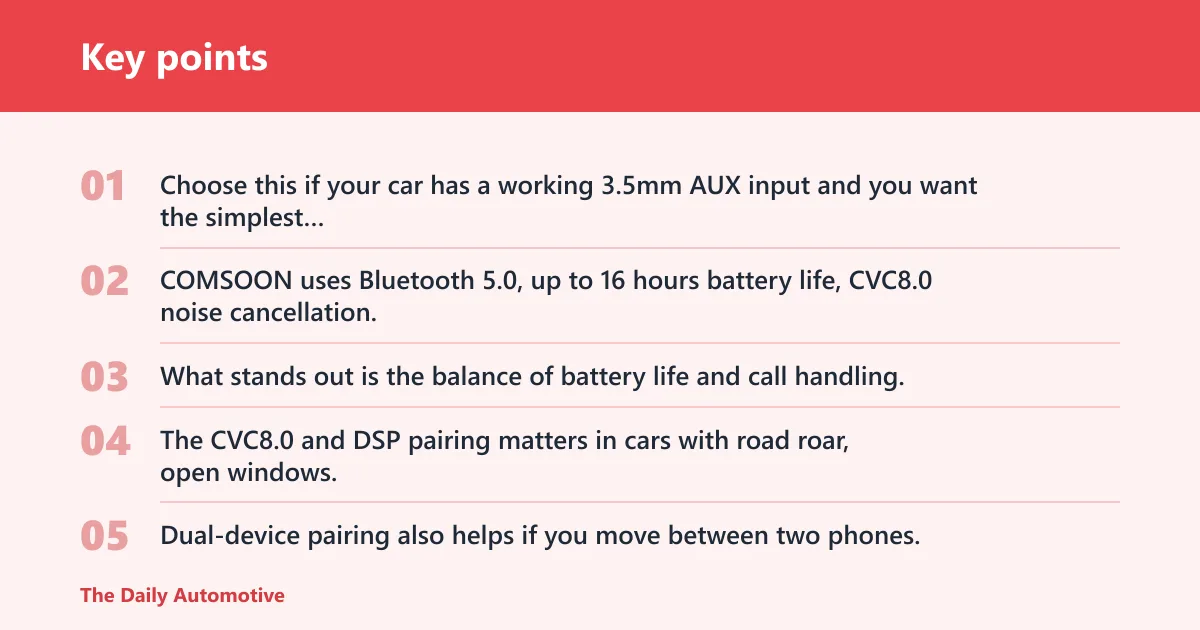
Choose this if your car has a working 3.5mm AUX input and you want the simplest clean-audio path. COMSOON uses Bluetooth 5.0, up to 16 hours battery life, CVC8.0 noise cancellation, and DSP for call clarity, so it fits older cars that need wireless audio without giving up the AUX connection.
What stands out is the balance of battery life and call handling. The CVC8.0 and DSP pairing matters in cars with road roar, open windows, or an older cabin seal, where a basic receiver can sound thin on calls. Dual-device pairing also helps if you move between two phones.
The honest drawback is obvious: it still depends on a usable AUX jack and separate charging. If the AUX port is buried, loose, or blocked by a bulky plug, this style can be awkward to place. It also does nothing for a car with no AUX input at all.
UGREEN Bluetooth 6.0 AUX receiver: best for newer-stability seekers
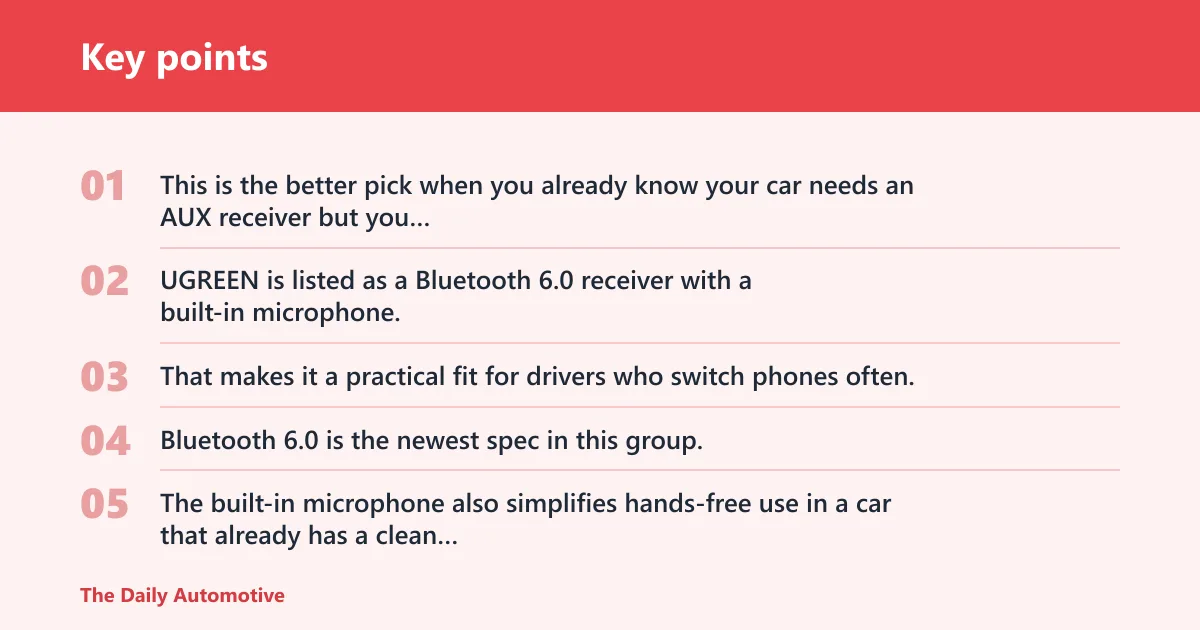
This is the better pick when you already know your car needs an AUX receiver but you want a newer Bluetooth stack. UGREEN is listed as a Bluetooth 6.0 receiver with a built-in microphone, a 10-meter range, and memory for up to 5 paired devices. That makes it a practical fit for drivers who switch phones often.
The main advantage is connection behavior. Bluetooth 6.0 is the newest spec in this group, and newer Bluetooth versions are usually chosen for steadier pairing, fewer dropouts, and more consistent latency handling. The built-in microphone also simplifies hands-free use in a car that already has a clean AUX path.
The drawback is that the product details focus more on connection and device memory than on charging or cabin noise handling. If call clarity in a loud truck or van is the top concern, a model with explicit CVC or DSP claims gives you more to go on.
Syncwire FM transmitter: best for cars without AUX
Use an FM transmitter when the factory radio has no AUX input and you still want music plus charging from one socket. Syncwire’s FM adapter is rated at Bluetooth 5.4 and 48W, and it includes dual USB ports for charging. That combination suits dashboard layouts where you need one plug to do several jobs.
What stands out is the usefulness in cars with only a cigarette-lighter socket and a crowded center stack. Bluetooth 5.4 is a current-generation spec, so it is the right direction for pairing stability and reduced dropout risk compared with older chipsets. The charging side matters too, because many FM users buy the adapter mainly to keep the phone powered on longer drives.
The drawback is the FM part itself. The buying guide notes that FM transmitters can be affected by radio interference, and that is the failure mode that matters most. In dense city bands, weak open frequencies can bring hiss, whine, or a need to retune more often than most shoppers expect.
Car audio adapter matrix
This matrix is the fastest way to avoid the wrong purchase. Match your car setup first, then worry about Bluetooth version, charging output, and call quality.
| Car setup | Best adapter type | Why it wins | Failure mode to watch | Quick buy checklist |
|---|---|---|---|---|
| Old car with AUX | Bluetooth receiver | Uses the cleanest audio path and avoids FM interference | Loose or blocked AUX port | 3.5mm AUX support, Bluetooth 5.x, CVC or DSP, battery life or charging method |
| Old car without AUX | FM transmitter car adapter | Works through the radio when the stereo has no line-in | Static in crowded FM bands | Bluetooth 5.3 to 5.4, strong charging output, dual USB or multi-port charging, 12V or 24V fit |
| USB-C phone only | USB-C to 3.5mm audio adapter | Gives direct wired audio from a phone with no headphone jack | No DAC, or no pass-through charging if you need it | Built-in DAC, AUX output, device compatibility, charging-pass-through if you drive long distances |
| Call-heavy commuter | Bluetooth receiver with CVC or DSP | Hands-free calling matters more than radio bandwidth | Weak microphone placement in a noisy cabin | CVC noise cancellation, DSP, built-in microphone, Bluetooth 5.x, stable pairing |
| Road-trip charger priority | FM transmitter with high-watt charging | Combines audio and phone charging in one socket | Socket blocked by a large plug or low-power ports | PD or QC support, total wattage, port count, 12V or 24V compatibility, compact body |
| FM-noisy city driving | Bluetooth receiver if AUX exists, otherwise USB-C audio or a stronger FM unit | Avoids the worst radio congestion when possible | Persistent hiss or interference on FM | Check for a free AUX path first, then look for FM transmitter claims about Bluetooth 5.4 and strong charging only if needed |
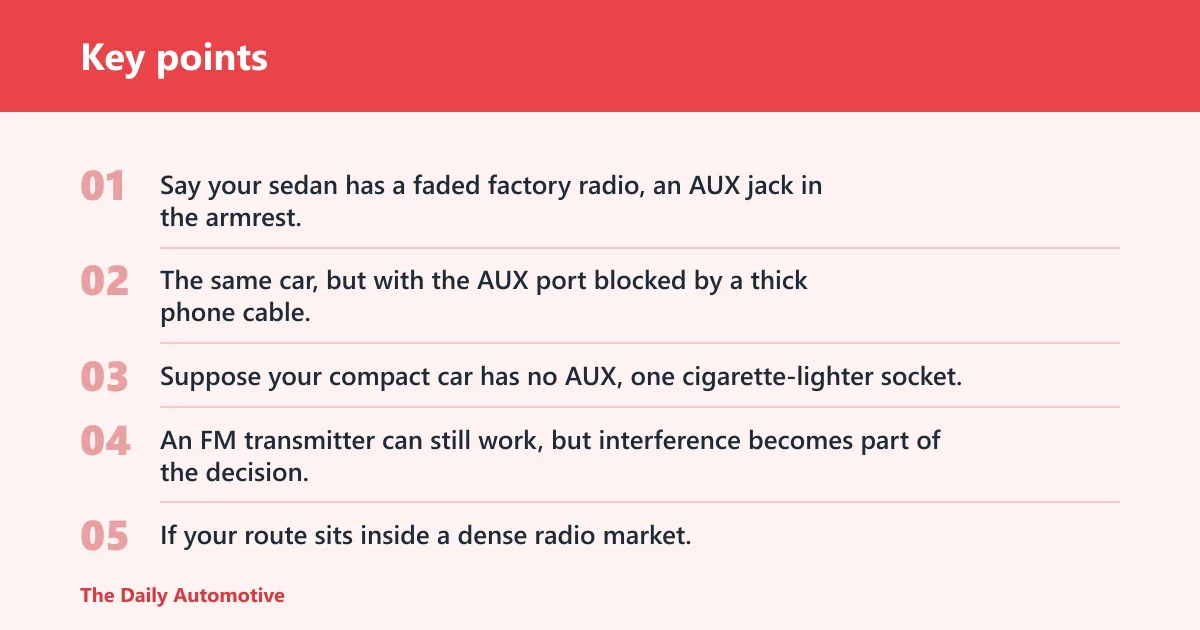
Say your sedan has a faded factory radio, an AUX jack in the armrest, and a phone that stays plugged in most of the day. A Bluetooth receiver is the cleaner buy. The same car, but with the AUX port blocked by a thick phone cable, is where a receiver becomes annoying instead of helpful.
Suppose your compact car has no AUX, one cigarette-lighter socket, and a city commute with crowded stations. An FM transmitter can still work, but interference becomes part of the decision, not a small side note. If your route sits inside a dense radio market, the wrong open frequency can make the audio sound brittle.
Which adapter fits your car?
Start with the dashboard, not the feature list. If your car has AUX, buy a Bluetooth receiver first. If it has no AUX and only a radio, buy an FM transmitter. If your phone is USB-C only and you want wired audio into AUX, use a USB-C to 3.5mm adapter. Then check charging needs and socket space.
Here is the short path. A clean AUX jack points to a receiver. No AUX points to FM. A USB-C-only phone with an AUX-capable car points to the USB-C audio cable. If you need to charge and listen at the same time, look for pass-through charging on USB-C gear or high-watt output on FM gear.
Two common mistakes show up again and again. The first is buying an FM transmitter because it looks more versatile, then discovering the local radio band is too noisy. The second is buying a USB-C audio cable and realizing the car has no AUX path at all, so the cable cannot solve the problem.
Should you buy a Bluetooth receiver or FM transmitter?
Pick a Bluetooth receiver if your car has AUX and you care most about clean sound and stable calls. Pick an FM transmitter if your car has no AUX and you need a radio-based workaround. Neither is right if your real problem is that your phone needs wired USB-C audio plus charging, because that calls for a different cable type.
When Bluetooth wins
Bluetooth wins when the stereo already gives you a 3.5mm AUX input. That path avoids radio interference entirely and usually gives better call behavior in a noisy cabin. Bluetooth 5.x also matters more here because stable pairing and fewer dropouts are what make the connection feel dependable day to day.
When FM wins
FM wins when the car has no AUX and you want one device for music and charging. It is also the practical answer when you need a quick retrofit for an older dashboard. The cost is that static and interference become part of the buying decision, especially in urban areas with crowded stations.
When neither is the right answer
Neither is right when your only issue is a USB-C phone with no headphone jack and a car that already accepts wired AUX input. In that case, a USB-C to 3.5mm adapter with a DAC chip is the cleaner fix. It keeps the signal path direct and avoids introducing FM noise or extra Bluetooth latency.
What features matter most in a car audio adapter?
The most important features are connection path, Bluetooth version, call processing, and charging layout. AUX compatibility matters more than any marketing claim because it decides whether a receiver even works. After that, Bluetooth 5.x, CVC, DSP, and port count are the features that affect daily use.
Bluetooth 5.x matters because newer versions are usually chosen for steadier pairing, lower dropout risk, and more predictable latency. That matters most for phone calls, turn-by-turn audio, and video sound if you ever use the adapter outside the car. Older versions can still work, but they leave more room for delays and reconnect trouble.
CVC noise cancellation and DSP matter in noisy cabins. CVC helps reduce background noise during calls, while DSP helps clean up the signal for both music and voice. In a sedan with good insulation, that may be a bonus. In a pickup, van, or older compact car, it can be the difference between usable and frustrating.
Charging matters just as much for FM transmitters. Nulaxy is positioned as a Bluetooth 5.3, 54W adapter with PD36W plus QC18W fast charging and four ports. That is the kind of specification that makes sense for long drives or a phone that stays connected for navigation. A high port count is useful only if the plug still fits your socket and leaves room around the shifter.
USB-C to 3.5mm adapter: best for USB-C phones
JXMOX is the type of adapter to look for when the phone has USB-C only and the car stereo accepts AUX. It is a USB-C to 3.5mm audio cable with a DAC chip, which means it converts the phone’s digital output into an analog signal for the car’s AUX input.
This kind of adapter is the right answer for drivers who want wired audio without Bluetooth pairing. It is also the right answer when charging and audio have to stay separate, because the simplest USB-C audio cable does one job well. That makes it practical in cars with a free USB power port and a usable AUX jack.
The drawback is that compatibility checks matter more here than with the other two types. You need a phone that supports USB-C audio output through the adapter, and you need a car with an actual AUX input. If your setup lacks either one, the cable will not solve the problem.
Bluetooth 5.0 to 6.0 in practice
Newer Bluetooth versions are not a badge for the box. They matter because they usually improve pairing stability, reduce dropouts, and make the connection feel less fussy when the phone enters or leaves the car. That matters most in stop-and-go commutes where reconnecting quickly is the whole point.
COMSOON includes Bluetooth 5.0, and UGREEN is listed as Bluetooth 6.0. LIHAN supports Bluetooth 5.4, and Syncwire’s FM adapter is rated at Bluetooth 5.4. For buyers, the practical takeaway is simple: 5.x is the baseline worth seeking, and 6.0 is the most current option in this group.
CVC and DSP in noisy cabins
CVC and DSP are most useful when the cabin is loud enough that the mic hears tire noise, wind, or road rumble. COMSOON uses CVC8.0 and DSP for call clarity, which is exactly the kind of spec to look for if your calls often happen on a highway or in a lightly insulated older car.
These features do not fix every bad call. Mic placement still matters, and some cabin layouts are simply noisy. But CVC and DSP reduce the odds that the person on the other end hears only background noise. That is why call-heavy commuters should rank them above extra lighting or decorative controls.
USB-C charging, power output, and car fit
Charging output matters most on long trips. Nulaxy’s PD36W plus QC18W and four ports suit cars where the adapter must charge the phone, a passenger device, and perhaps a second accessory. LIHAN is described as compatible with most 12V/24V vehicles, which matters if the car is not a standard passenger vehicle.
Fit matters too. A cigarette-lighter socket in a tight dashboard can make a large FM transmitter awkward, especially if the plug sticks out and blocks a nearby control or storage lid. If your car has a shallow socket or a crowded console, compact housing is worth more than extra lighting or a larger screen.
Which one should you buy?
Pick by setup first. If the car has AUX, start with a Bluetooth receiver. If it does not, start with an FM transmitter. If the phone is USB-C only and the car already has AUX, start with a USB-C audio adapter with a DAC chip. That order prevents most wrong purchases.
Pick by commute next. Call-heavy drivers should favor CVC or DSP and a built-in microphone. Road-trippers should favor higher charging output and more ports. Drivers in crowded radio markets should avoid treating FM as the default choice, because radio interference can turn a cheap solution into a noisy one.
Pick by port layout last. If the socket is tight, avoid bulky FM bodies. If the AUX jack is weak or blocked, a receiver can be frustrating even if it is technically the best audio path. If your phone and car both demand different cables, do not force a one-device solution that only partly fits.
Frequently asked questions
What is the best audio adapter for a car with no Bluetooth?
The best audio adapter for a car with no Bluetooth depends on the stereo input. If the car has AUX, a Bluetooth receiver is usually the cleanest choice. If it has no AUX, an FM transmitter is the practical option. A cassette adapter only belongs in cars with a working tape deck.
Should I buy a Bluetooth receiver or an FM transmitter for my car?
Buy a Bluetooth receiver if your car has AUX and you want the cleanest signal path with fewer interference risks. Buy an FM transmitter if the car has no AUX and you still want wireless playback plus charging. In radio-heavy cities, the receiver is usually the safer choice when AUX exists.
What audio adapter works best if my car only has a 3.5mm AUX input?
A Bluetooth receiver is usually best for a car with only a 3.5mm AUX input. It feeds audio directly into the stereo without using the radio band, so you avoid static from FM. Look for Bluetooth 5.x, CVC or DSP, and a charging method that fits your dashboard layout.
Can I charge my phone and stream music at the same time in the car?
Yes, but the best method depends on the adapter type. FM transmitters often handle charging and audio in one unit, and some offer PD or QC fast charging. USB-C audio adapters may offer pass-through charging, but that depends on the model. Check port count and wattage before buying.
Will a Bluetooth car adapter improve call quality in a noisy car?
It can, especially if the adapter includes CVC noise cancellation or DSP. Those features help reduce background noise in loud cabins and make the mic more useful for hands-free calls. They do not fix every bad cabin, but they are far more relevant than decorative features.
Are FM transmitters reliable for car audio?
They are reliable enough in the right setup, but they are more sensitive to radio interference than AUX-based receivers. In quiet FM regions, they can work well. In crowded city bands or areas with weak open stations, static and retuning become more common and can outweigh the convenience.
Products related to this article
Sponsored / affiliate links. As an Amazon Associate I earn from qualifying purchases. I may earn additional commission from eligible campaigns.