Car Badge Replacement Cost: What You’ll Pay
Car badge replacement usually costs $20 to $250 for a basic adhesive emblem, $75 to $400 for a clip-on badge, and $300 to $1,000+ if the emblem is tied to sensors or a grille assembly. Cheap fixes can leave misaligned trim, peeling adhesive, warning lights, or a badge that falls off again. Below, you’ll see what drives the price, what DIY can handle, and when dealer or body-shop fitting makes more sense.
How badge type changes replacement price
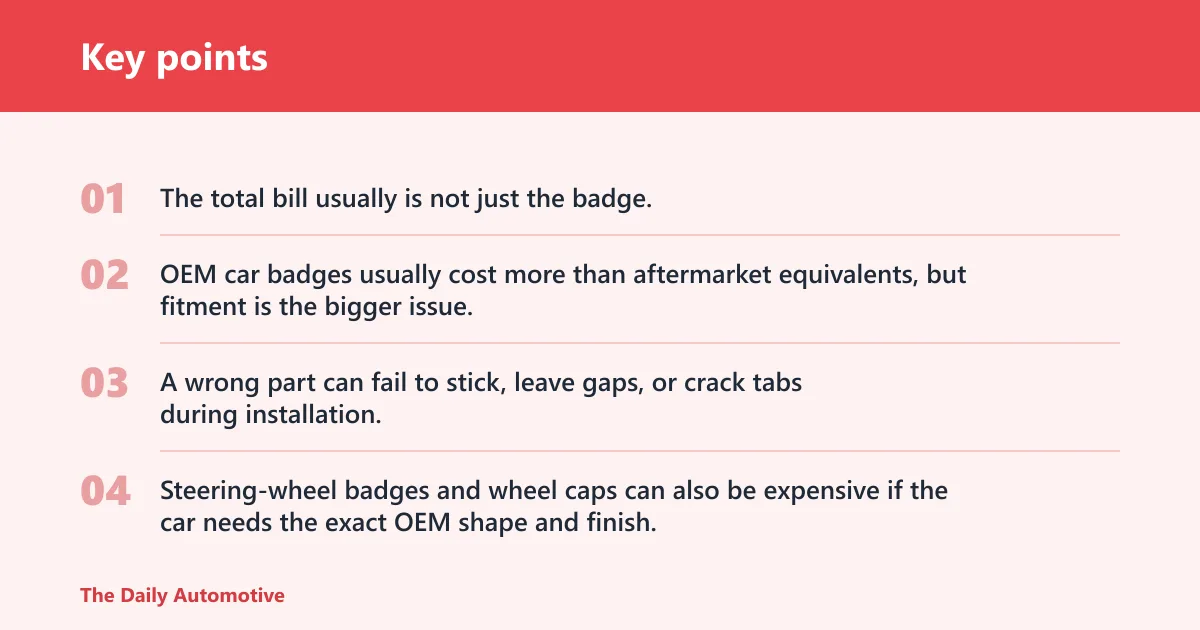


The total bill usually is not just the badge. A front grille emblem, rear tailgate badge, wheel center cap, steering-wheel emblem, or trim piece can use a different mount, finish, and labor path, so the installed price can vary widely even on the same model.
OEM car badges usually cost more than aftermarket equivalents, but fitment is the bigger issue. The correct part often depends on VIN lookup, trim matching, model year, and whether the car uses a painted, chromed, blacked-out, or illuminated finish. A wrong part can fail to stick, leave gaps, or crack tabs during installation.
Badge cost matrix
| Badge type | Parts cost band | Labor time band | Hidden-cost risks |
|---|---|---|---|
| Adhesive badge | $20 to $120 | 15 to 45 minutes | Poor surface prep, peeling from heat or cold, paint damage from old adhesive removal |
| Clip-on / push-pin emblem | $35 to $180 | 20 to 60 minutes | Broken mounting tabs, damaged grille slats, loose fit if the wrong trim version is ordered |
| Wheel center cap variant | $25 to $150 | 10 to 30 minutes | Broken retainers, scratched wheel finish, mismatched diameter or logo depth |
| Sensor-integrated front emblem | $150 to $700+ | 1 to 3 hours | ADAS calibration, radar housing damage, warning lights, grille replacement if the carrier is damaged |
| Custom automotive badge | $40 to $500+ | 15 to 90 minutes | Finish mismatch, short lifespan, color fade, weak adhesive or poor clip geometry |
A front badge can cost more than a rear badge because it may sit in the grille and interact with sensors, while a trunk badge is often a simpler adhesive or pinned emblem. Steering-wheel badges and wheel caps can also be expensive if the car needs the exact OEM shape and finish.
Which badge type do you have?
The mounting style drives both cost and risk. An adhesive replacement badge is cheap to buy but depends on clean, level paint. A clip-on emblem needs the correct retention method. A sensor-integrated emblem can turn a simple cosmetic job into a repair that needs calibration or a matching grille assembly.
Adhesive badges
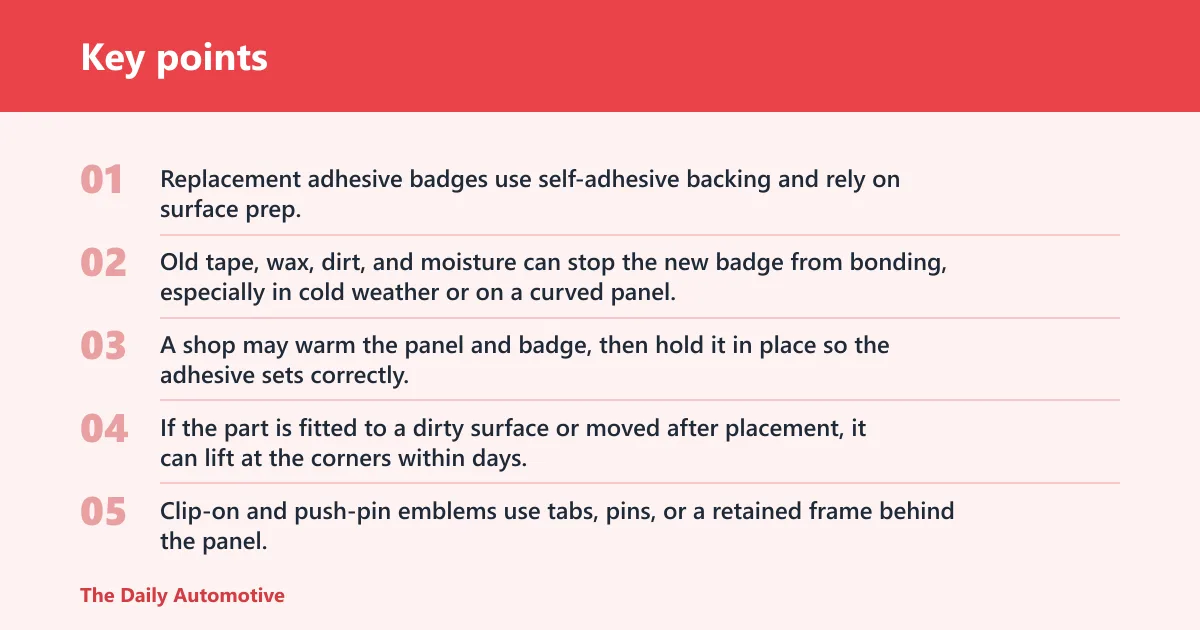
Replacement adhesive badges use self-adhesive backing and rely on surface prep. Old tape, wax, dirt, and moisture can stop the new badge from bonding, especially in cold weather or on a curved panel. Some temporary kits hold for a short period, but most vehicle badges are meant for a permanent bond once pressed in place.
Heat, cure time, and pressure matter. A shop may warm the panel and badge, then hold it in place so the adhesive sets correctly. If the part is fitted to a dirty surface or moved after placement, it can lift at the corners within days.
Clip-on and push-pin emblems
Clip-on and push-pin emblems use tabs, pins, or a retained frame behind the panel. They are common on grilles and wheel center caps. The main cost risk is breakage: one cracked tab can mean a new badge, a new retaining ring, or a larger grille repair if the mount is molded into the panel.
These badges should be matched to the exact opening and trim package. A pre-facelift part may look close, yet the tabs, thickness, or backing shape can be different.
Sensor-integrated emblems
Some modern front badges sit over radar or camera hardware. Those designs can require an OEM part with the correct sensor-safe shape and material, plus calibration after installation. If the badge housing is damaged, the bill can jump because the grille carrier, emblem bracket, or sensor mount may need replacement too.
Suppose a front emblem on an SUV is held to the grille with an integrated radar cover. If the cover is cracked, replacing only the logo may not solve the problem; the radar housing or calibration step can add several hundred dollars to the final invoice.
Does dealer replacement cost more?
Yes, dealer badge replacement often costs more than aftermarket fitting because dealers typically charge OEM part pricing, a higher labor rate, and sometimes calibration or programming. The advantage is better trim matching and lower odds of fitment mismatch on a vehicle with model-specific hardware.
OEM part pricing and markup
Dealers usually order the factory part tied to the VIN and trim code. That reduces the chance of getting the wrong finish or mounting style, but it often means a higher parts line on the estimate than an online aftermarket equivalent. Painted, chromed, blacked-out, and illuminated badges can all carry different factory prices.
Labor rates and add-on programming
Dealer labor often costs more than a body shop or trim shop. If the badge is simple, the labor line may stay modest. If the emblem sits on a grille with cameras, radar, or a heating element, the dealer may add diagnostic time, setup, or a calibration charge.
When calibration can add cost
Calibration enters the bill when the emblem is part of an ADAS path. A front camera or radar emblem may need alignment checks after removal, especially if the badge carrier or grille moved during the repair. Even a cosmetic-looking badge can hide a sensor mount underneath.
How much do custom badges cost?
Custom automotive badges usually cost more per piece than mass-produced emblems because they are made in smaller runs and use more specialized tooling or finishing. Prices can range from about $40 for simple aftermarket designs to $500 or more for metal or illuminated small-batch pieces.
ABS plastic, metal, and resin
ABS plastic is the cheapest common option and is often used for custom grille or trunk badges. Metal badges can feel more durable and hold sharper edges, but they cost more to make and finish. Resin can support detailed artwork, though it may scratch or fade faster if the coating is thin.
One-off versus small-batch pricing
A one-off badge usually costs more because the maker has to set up the design, mold, cut, or print without spreading that setup cost across many parts. Small-batch production lowers the per-piece cost, but finish consistency can vary from one run to the next.
Finish and durability tradeoffs
Black, chrome, and painted finishes all change the price. A glossy finish can look close to OEM, but it may chip sooner than a factory badge with a tougher coating. An illuminated badge adds wiring, sealing, and more labor, which is why the installed price climbs quickly.
How to order the right badge
Ordering the correct badge starts with VIN and trim matching. The same nameplate can use different sizes, mounts, or finishes across a lineup. Facelift parts, hybrid and EV emblems, wheel caps, and steering-wheel badges may all differ even when the model name is unchanged.
-
Check the VIN first. Use the VIN or exact model year to confirm the part number, finish, and mount style. This matters most for same-name models that changed grille shape, tailgate trim, or emblem depth mid-cycle.
-
Match the trim level. Look for package-specific badges, especially on performance trims, EVs, and hybrids. A blacked-out badge or illuminated emblem may look similar to the base version, but the backing and connector can differ.
-
Separate front and rear parts. A grille badge is not always the same as a trunk badge. Wheel center caps and steering-wheel emblems can also use different dimensions, so order by location, not only by logo shape.
-
Confirm the finish. Painted, chromed, blacked-out, and brushed finishes can change both price and fit expectations. If the badge is visible from the side or sits against a chrome grille surround, the wrong finish can stand out immediately.
Say your sedan lost a rear emblem after a wash, but the front grille badge still looks fine. The rear piece may be adhesive, while the front piece may be clipped into a different carrier. Buying both as one set can waste money and still leave the wrong part for the tailgate.
When DIY fits and when it does not
DIY works best for simple adhesive badges and some wheel caps. It becomes a poor choice when the part is clipped into a painted grille, tied to radar or camera hardware, or likely to break tabs during removal. In those cases, a dealer or body shop cuts the risk of repeat work.
-
Inspect the mounting style. Check whether the badge uses adhesive, tabs, pins, or a sensor carrier. If you can reach the back side and the mount is plain tape, DIY is usually more realistic than when the emblem is buried behind trim.
-
Prepare the surface fully. Remove old adhesive, wax, and dirt before fitting the new badge. A clean panel and stable temperature help the bond, especially for adhesive emblems that need several hours to settle.
-
Stop if tabs crack. If the original emblem breaks during removal, do not force the replacement into a damaged opening. Broken tabs often lead to a loose badge, rattles, or a second part purchase.
-
Book pro help for sensors. If the badge sits in front of radar or a camera, use a dealer or qualified body shop. The extra labor may be cheaper than replacing a sensor housing or paying for calibration after a mistake.
A common first-timer mistake is trying to reuse old adhesive in cool weather. The badge may look attached for a day, then lift at one corner after rain or a car wash. That usually means the panel was not clean enough, or the new part needed more curing time.
Paint-safe removal and re-bonding risks
Paint-safe removal means softening adhesive without gouging clear coat or bending trim. Plastic tools, steady heat, and slow lifting are safer than metal picks. If the old badge leaves residue, the remaining film must be cleaned fully before the new part goes on.
Body shops and trim shops often charge for careful prep because the hidden work takes time. Cleaning, test-fitting, alignment, and re-bonding can take longer than the badge swap itself.
What affects the price of a car badge replacement
Several items move the price at once: badge type, vehicle make and model, mounting method, finish, labor rate, and whether the part is front, rear, wheel, or interior trim. The bill can also rise if the old badge damages paint, clips, or a sensor bracket during removal.
- Vehicle-specific fitment. Same-model cars may use different badges by year, trim, or facelift.
- Mounting style. Adhesive parts cost less to install than pinned or sensor-linked emblems.
- Part source. OEM usually costs more than aftermarket.
- Finish. Chrome, painted, blacked-out, and illuminated versions rarely cost the same.
- Rework risk. Broken tabs, paint damage, and calibration add to the final bill.
Frequently asked questions
How much does it cost to replace a car badge?
If the badge is tied to radar, a camera housing, or a grille assembly, the total may reach about $300 to $1,000 or more once labor and calibration are included.
How much is a car badge replacement?
That depends on whether you are buying only the part or paying for installation. A simple rear badge may be a low-cost part, but dealer labor, trim matching, and removal of old adhesive can push the final price higher than the emblem itself.
How much is it to fix a missing front emblem?
A missing front emblem is often more expensive than a rear badge because the grille location can involve tabs, alignment, and sensor-safe fitment. If the emblem also covers radar or camera hardware, the repair may need calibration, which adds time and cost.
Can I buy the badge only and fit it myself?
Yes, if the badge is a simple adhesive piece or an easy wheel cap and the panel is undamaged. DIY is less suitable when the badge uses hidden clips, needs exact trim matching, or sits near radar or a front camera.
Does dealer badge replacement cost more than aftermarket?
Usually, yes. Dealers typically charge more for OEM parts and labor, but they also reduce fitment risk when the badge is trim-specific, facelift-specific, or tied to sensors. Aftermarket can save money, but only if the mount and finish match correctly.
How long does car badge replacement take?
A simple adhesive badge can take about 15 to 45 minutes. A clip-on emblem may take up to an hour, and a sensor-integrated front badge can take several hours if removal, reinstalling the grille parts, and calibration are needed.
Products related to this article
Sponsored / affiliate links. As an Amazon Associate I earn from qualifying purchases. I may earn additional commission from eligible campaigns.