Battery Charger vs Jump Starter: Which One to Buy
A jump starter gets the engine turning now; a battery charger restores the battery overnight and is the better buy for storage or repeated winter dead-starts. Miss the difference and you lose time, strand yourself in the cold, or keep wearing down a weak battery. This guide shows which one to buy for emergency use, battery recovery, and cold-weather maintenance.
This guide is part of our Winter car care series.
| Decision factor | Battery Charger | Jump Starter | Winner |
|---|---|---|---|
| Job | Replenishes a 12-volt lead-acid battery slowly and safely from AC power | Delivers a quick, high-power burst to start the vehicle immediately | Jump Starter for roadside starts |
| Time to useful result | Hours to overnight, sometimes longer for a deeply discharged battery | Minutes to get the engine running | Jump Starter |
| Best winter use | Garage charging, maintenance, recovery after cold soaking | Subzero mornings, parking lots, trunk kits, emergency starts | Tie |
| Power source needed | Requires an AC outlet | Portable lithium-ion pack with no external power source | Jump Starter |
| Battery recovery | Can bring a weak battery back properly, including maintenance and float stage | Does not recharge the battery | Battery Charger |
Battery charger vs jump starter: what each one actually does
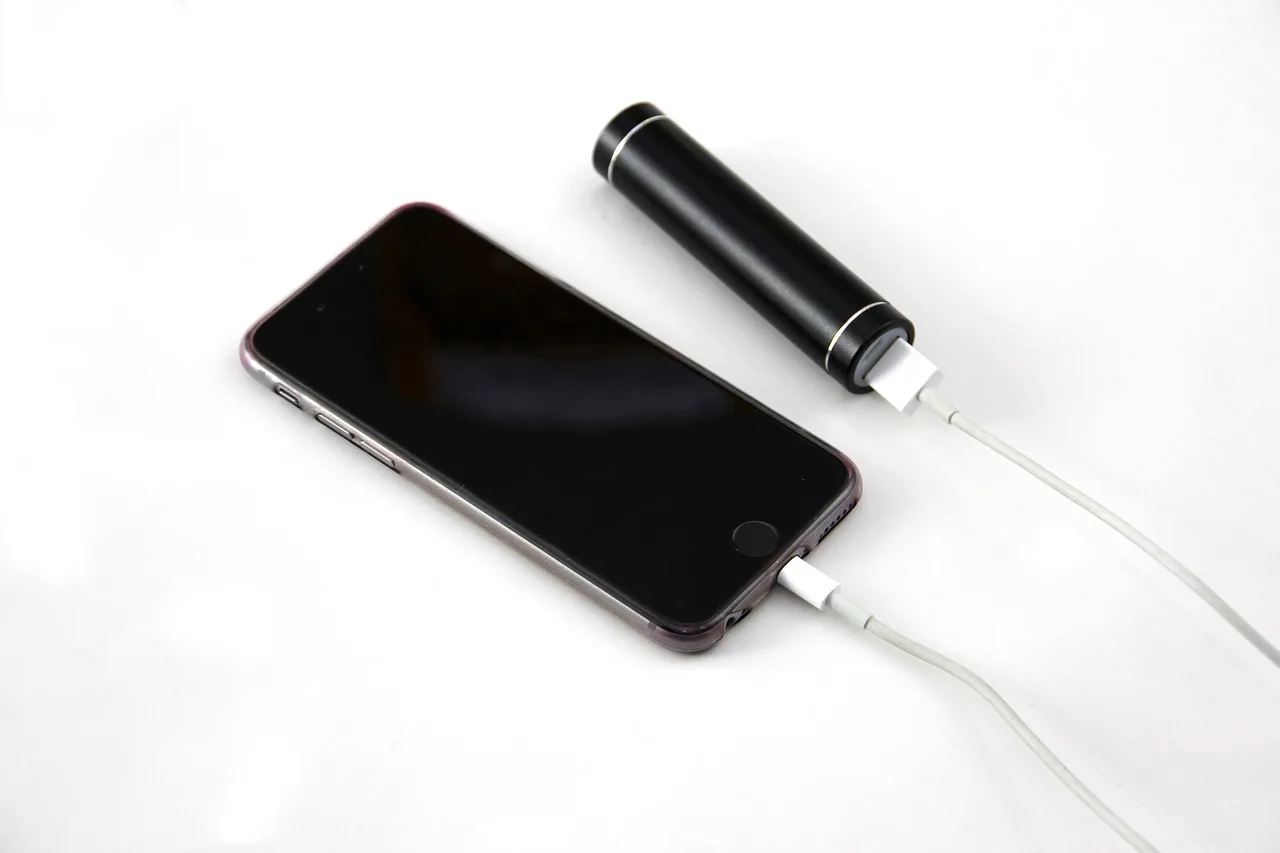


A battery charger can help restore a weak or dead 12-volt lead-acid battery over time using AC power. A jump starter is a portable battery pack that gives a short, high-current burst so the engine can start now; it does not recharge the battery. In winter, that difference decides whether the car leaves the driveway or stays put.
Battery charger: AC power, slow recovery, and the float stage
A charger connects to the battery and supplies controlled current. Many modern chargers move through bulk, absorption, and float stages, which matters because the battery may need more than a short boost after a cold night. The float stage holds charge at a safe level after recovery, so the battery is not pushed harder than it should be.
Smart chargers are the better all-around choice for home use. They use microprocessors and automatic adjustment, and many include reverse polarity protection and desulfation modes. A simple trickle charger is different: it delivers very low current, and it is usually best kept for long-term storage where unattended overcharging is not a risk.
Jump starter: portable lithium-ion power for a quick start
A jump starter is built for one job: start the vehicle immediately. It is portable, needs no external power source, and is rated by output such as peak amps or CCA, which both matter when the battery is cold and the engine is harder to turn. The burst gets the starter motor moving, then the alternator has to do the charging work.
That is why a jump starter is a field tool, not a recovery tool. It gets the engine running, but it does not refill a weak battery, correct sulfation, or fix a battery that is already worn out.
Why both tools matter more in winter
Cold weather punishes a 12-volt lead-acid battery. A battery that seems fine in mild weather can act low after sitting outside overnight, and a battery that is already marginal may fail completely after a cold soak. In that setting, the charger keeps the battery healthy at home, while the jump starter keeps the day from starting with a tow.
For commuters, that means different jobs for different places. For apartment parking or curbside parking, the jump starter belongs in the car. For a garage, the charger earns its keep by preventing the next failure.
According to Difference Between Battery Charger and Jump Starter Explained — The bulk stage charges until about 70–80% charge.
Which one do you need this morning?
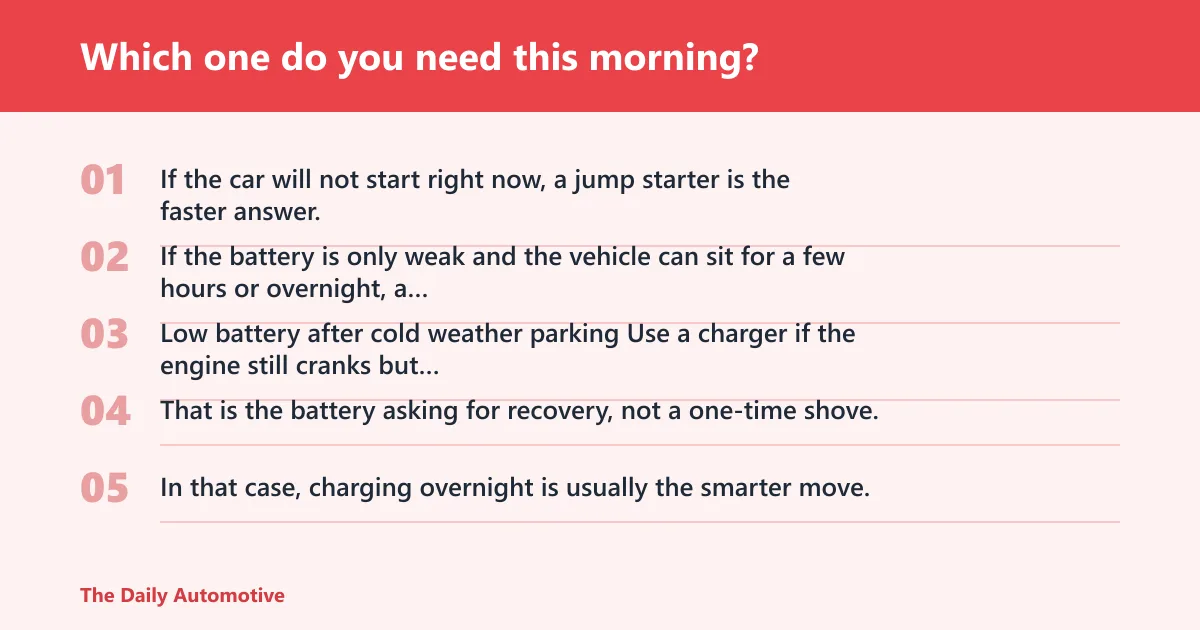
If the car will not start right now, a jump starter is the faster answer. If the battery is only weak and the vehicle can sit for a few hours or overnight, a charger is the better fix because it brings the battery back properly instead of simply masking the problem for one start.
Low battery after cold weather parking
Use a charger if the engine still cranks but slowly, the lights look dim, or the battery seems weak after a cold night. That is the battery asking for recovery, not a one-time shove. In that case, charging overnight is usually the smarter move.
Dead battery and no time to wait
Use a jump starter when the battery is flat and the vehicle has to move now. A charger cannot fill the gap fast enough on the roadside, and a dead battery in a cold lot is not the place to wait hours for recovery. Once the engine is running, the battery still needs proper charging later.
Repeated no-starts that keep coming back
Use a charger once, but do not keep treating the same problem as if it is only a weather issue. Repeated no-starts after charging often point to a battery that will not hold a charge, sulfation, or an alternator problem. A jump starter can keep the car moving for a day; it cannot fix the root cause.
Long-term storage and garage maintenance
Use a charger, ideally a smart charger or maintenance charger, when a vehicle sits for weeks or months. A float stage helps keep the battery ready without overcharging it. For stored cars, weekend drivers, and seasonal trucks, that is usually the right tool.
How chargers and jump starters differ in the real world
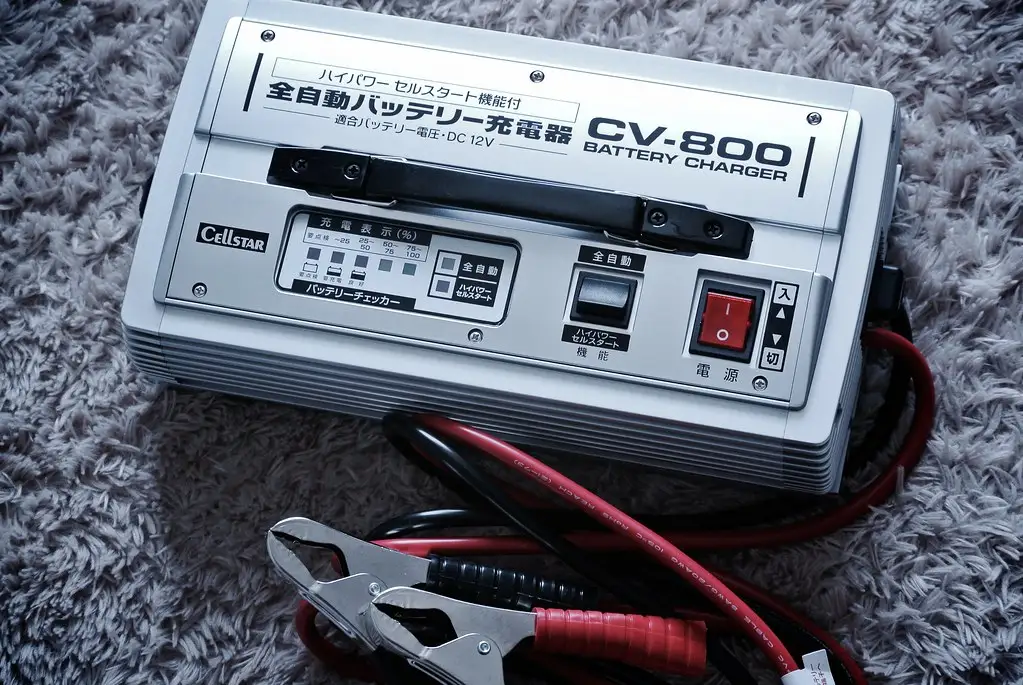
The main difference is not only how they start the car. It is the whole workflow: a charger needs wall power and time, while a jump starter is ready in the trunk and buys minutes, not hours. That makes one a home tool and the other an emergency tool.
Charge time vs start time
Charging can take from a few hours to 24+ hours, depending on how low the battery is and how much current the charger can supply. Fast chargers can deliver 10–20 amps, which helps, but they are still working toward recovery rather than a quick start. A jump starter is the fast answer when the clock is the problem.
AC outlet required vs trunk-ready portability
A charger generally needs an AC outlet, so it is most useful in a garage, a driveway with power, or another maintenance setup. A jump starter is portable and does not need external power, which makes it the better fit for winter roadside use, apartment parking, or a travel kit.
Peak amps, CCA, and what those numbers mean in cold weather
Jump starters often list peak amps, and some also reference CCA. Peak amps is the burst number, while CCA matters because cold weather raises the demand on the starting system. The key is not chasing the biggest number on the box; it is matching the jump starter to the vehicle and the temperature you expect to face.
Can a jump starter be used as a battery charger?
No. A jump starter can start a vehicle, but it does not recharge the battery. After a successful jump, the battery may still be weak, which means the alternator has to recharge it while you drive or a charger has to do the recovery work later.
Why a jump starter only gives a short burst
The pack is built for a brief, high-current event. That is enough to crank the engine, but not enough to refill a 12-volt lead-acid battery the way a charger does. If the battery was low enough to need a jump, it probably needs a proper charge afterward.
When a charger still has to do the recovery work
If the car starts but the battery was cold-soaked, deeply discharged, or repeatedly low, put it on a smart charger after the trip. That is the step many drivers skip, then wonder why the car needs another jump a few mornings later. The jump got the engine running; the charger fixes the battery.
Battery charger types: smart charger, trickle charger, and fast charger
Not all chargers behave the same way. The right one for winter and storage is usually a smart charger, because it adjusts automatically and uses multi-stage charging rather than dumping current into the battery blindly. The wrong one can maintain poorly or overcharge if left unattended.
Smart charger features to look for
A smart charger is microprocessor-controlled, with automatic adjustment, and often includes bulk, absorption, and float stages. For daily use, that is the safest and most practical setup. Reverse polarity protection matters too, because frozen fingers make mistakes more likely.
Trickle charger use for stored vehicles
A trickle charger delivers very low current, about 0.5–2 amps, so it suits long-term storage and low-demand maintenance. It is not a rapid recovery tool. Left unattended in the wrong setup, it can overcharge, which is why modern smart chargers are usually safer for most drivers.
Why unattended charging matters
Winter storage often means the car sits longer and the battery self-discharges more than people expect. A maintenance or float stage keeps the battery from sitting empty for weeks, which is exactly when cold weather turns a weak battery into a dead one. For that job, charger choice matters more than peak current.
Winter dead-battery decision chart
This chart turns the winter choice into a simple call. Start with battery state, then match the tool to the time you have. If the battery keeps failing after charging, stop treating it as a one-time problem and look at replacement or charging-system faults.
| Scenario | What you are seeing | Use this tool | Typical recovery time | Replace the battery when… |
|---|---|---|---|---|
| Low battery | Slow crank, dim lights, car was parked in the cold | Battery charger | Hours to overnight | It keeps coming back weak after a full charge |
| Dead battery | No crank, no time, need the car now | Jump starter | Minutes to start the engine | The car needs repeated jumps or will not hold charge later |
| Repeated no-start | Battery dies again after short trips or a night outside | Charger first, then test battery and charging system | One to two charge cycles, then diagnosis | It fails again after charging or tests show weak capacity |
| Long-term storage | Seasonal vehicle, weekend car, garage storage | Smart charger or maintainer | Continuous float/maintenance stage | The battery self-discharges quickly or will not stabilize |
When to replace the battery instead of charging again
Replace the battery when charging no longer buys reliable starts. If it keeps needing jumps, will not hold a charge, or acts weak right after a full charge, the battery may be worn out or sulfated. Cold weather exposes that weakness faster because there is less margin to crank the engine.
Signs the battery will not hold a charge
Common warning signs include repeated no-starts, a battery that drops off quickly after charging, and a car that starts only after a jump despite having been driven. If that pattern repeats, a charger is no longer a cure. It is time to test the battery itself.
How age, cold, and sulfation change the call
Aged batteries lose capacity, and winter makes that loss obvious. Sulfation also reduces how well the battery accepts a charge. When both are present, the battery may appear to recover for a day and then fail again the next cold morning.
When alternator trouble looks like a battery problem
If the battery seems fine after a full charge but goes low again after driving, the charging system may be the real issue. A weak alternator can mimic a bad battery. Replacing the battery without checking the alternator can waste money and leave the same winter problem in place.
Choose battery charger if…
Choose a battery charger if the vehicle sits at home, the battery is weak rather than instantly dead, or you want to prevent the next cold-morning failure. It is the better tool for garage-only use, storage maintenance, recovery after cold soaking, and any case where the battery needs real repair time.
Choose jump starter if…
Choose a jump starter if you need the car moving now, especially in a parking lot, at work, or on a subzero morning with no outlet nearby. It is the better trunk-kit tool, the better apartment-parking tool, and the better answer when the battery is dead but you still need to leave immediately.
Frequently asked questions
battery charger vs jump starter
A battery charger restores a weak 12-volt lead-acid battery over time. A jump starter gives a short burst to start the engine now. If you want prevention and recovery, choose the charger. If you want the vehicle running this morning, choose the jump starter.
car battery charger vs jump starter
The car battery charger is for home recovery and maintenance, usually from an AC outlet. The jump starter is for emergencies and portability. In winter, a charger fixes the battery after the fact, while the jump starter gets you out of a cold parking space quickly.
battery charger maintainer vs jump starter
A maintainer is the low-output side of charging, often using a float stage to keep a stored battery ready. A jump starter does not maintain anything; it only starts the car. For seasonal vehicles or garage storage, the maintainer is the better tool.
can a jump starter be used as a battery charger
No. A jump starter can start a vehicle, but it does not recharge the battery. After the engine starts, the battery still needs a charger or a healthy alternator to restore its charge. If the battery keeps failing, the underlying problem still needs diagnosis.
is a battery charger the same as a jump starter
No. They solve different problems. A charger uses AC power and controlled current to replenish the battery, while a jump starter is a portable lithium-ion pack that gives a quick start. Treating them as the same tool leads to winter headaches.
portable battery charger vs jump starter
Portable battery charger usually means a small charger, but it still needs power and time to refill the battery. A jump starter is the truly portable emergency tool because it carries its own power source. For roadside use, the jump starter is the more useful carry item.
battery charger vs jump box
A jump box is another name for a jump starter. It does the same thing: provide a short high-current burst to start the vehicle. A battery charger works differently, so if the battery is weak rather than dead, the charger is the better long-term answer.
Products related to this article
Sponsored / affiliate links. As an Amazon Associate I earn from qualifying purchases. I may earn additional commission from eligible campaigns.