Car Care vs Car Maintenance
Car care helps keep paint, trim, glass, and the cabin looking good and protected from surface damage, while car maintenance helps the vehicle keep running, stopping, cooling, and charging as it should. Ignore either one and you risk cosmetic damage, breakdowns, lower resale value, and avoidable repair bills. This guide separates appearance tasks, failure-prevention tasks, and non-negotiable safety checks so you can budget and prioritize.
| Decision factor | Car Care | Car Maintenance | Winner |
|---|---|---|---|
| Main purpose | Protects paint, trim, glass, and cabin appearance. | Protects reliability, drivability, and safety. | Car Maintenance |
| Risk if skipped | Fading, staining, surface wear, and lower resale value. | Overheating, uneven tire wear, weak braking, fluid-related failures, and starting trouble. | Car Maintenance |
| Typical tasks | Washing, waxing, vacuuming, interior cleaning, paint protection, seat and trim care. | Oil changes, fluid checks, filter replacement, tire rotation, brake inspection, scheduled service. | Tie |
| Safety impact | Low, unless dirt or haze blocks lights or visibility. | High, because it includes wear-item and safety checks. | Car Maintenance |
| Resale impact | Strong, because cosmetic condition changes buyer perception fast. | Strong, because service records and condition reduce buyer risk. | Tie |
Car care vs car maintenance at a glance
Car care covers the tasks that keep the vehicle clean and protected from surface wear. Car maintenance covers the work that keeps it operating safely and dependably. If budget forces a choice, maintenance comes first whenever safety, reliability, or factory service requirements are on the line.
What each one protects
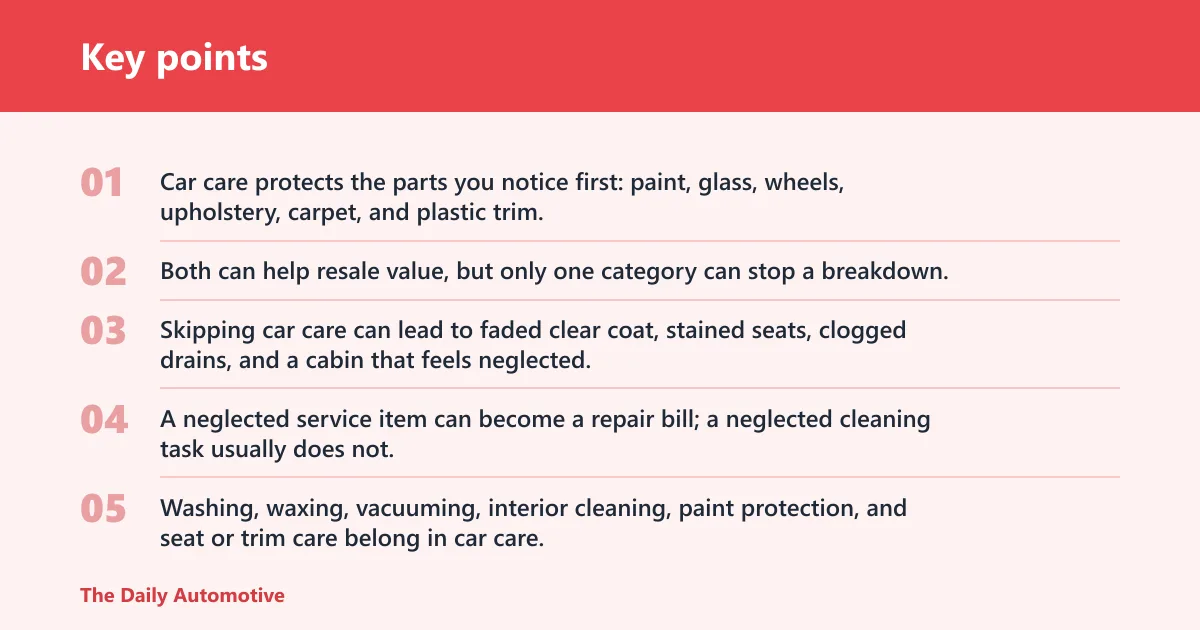
Car care protects the parts you notice first: paint, glass, wheels, upholstery, carpet, and plastic trim. Car maintenance protects the systems that fail when ignored: engine lubrication, cooling, braking, tire wear, and battery health. Both can help resale value, but only one category can stop a breakdown.
What skipping it can cost
Skipping car care can lead to faded clear coat, stained seats, clogged drains, and a cabin that feels neglected. Skipping maintenance can lead to overheating, poor fuel economy, shorter component life, and safety problems such as weak brakes or low tread depth. A neglected service item can become a repair bill; a neglected cleaning task usually does not.
Common examples of each
Washing, waxing, vacuuming, interior cleaning, paint protection, and seat or trim care belong in car care. Oil changes, fluid checks, filter replacement, tire rotation, brake inspection, and scheduled intervals belong in car maintenance. The owner’s manual decides the interval, the fluid spec, and the tire pressure.
What counts as car care?
Car care is the appearance-focused side of ownership. It includes washing, waxing, interior cleaning, paint protection, and seat and trim care. These tasks do not stop an engine failure, but they do slow cosmetic wear and help the vehicle hold its appearance and value.
Washing and waxing
Washing removes road film, salt, tar, and grime that can stain paint and trim. Waxing or another paint protectant adds a layer between the finish and the weather. That layer helps the exterior stay cleaner longer, but it does not replace mechanical service or inspection.
Interior cleaning and trim care
Vacuuming carpet, wiping touch points, cleaning glass, and conditioning appropriate materials keep the cabin presentable. Seat and trim care matters because UV exposure, spills, and dirt can harden surfaces or stain fabrics. This is upkeep, not failure prevention.
Paint protection and appearance upkeep
Paint protection, trim dressing, and regular detailing preserve finish quality. They matter most if you plan to keep the vehicle looking newer for longer or want stronger resale appeal. They are optional when the issue is purely cosmetic.
What counts as car maintenance?
Car maintenance is the mechanical work that keeps the vehicle dependable and safe. It includes routine service items, preventive checks, and wear-item replacement. If the owner’s manual lists a task at a time or mileage interval, that task belongs here, not in the “maybe later” pile.
Routine service items
Oil changes, fluid checks, filter replacement, tire rotation, and brake inspection are the core routine items most owners know. The manual usually tells you which engine oil grade to use, which coolant or transmission fluid spec applies, and how often service should happen. Time-based intervals matter even when mileage is low.
Preventive checks that avoid breakdowns
Preventive maintenance is about failure prevention. It includes looking for leaks, low fluid levels, weak battery condition, cracked belts, soft hoses, thin brake pads, and uneven tire wear before those issues become roadside problems. It costs less to replace a part before it strands you.
Wear items and consumables
Consumables include engine oil, coolant, brake fluid, transmission fluid, air filters, and cabin air filters. Wear items include brake pads, tires, battery, wiper blades, and spark plugs. These parts do not last forever, and ignoring them often creates a second problem on top of the first.
When should you do maintenance instead of just cleaning?
Do maintenance instead of cleaning when the symptom points to a mechanical issue, not a surface problem. A dirty car can wait; a warning light, weak brake feel, noisy belt, or low tire tread cannot. Short-trip driving and severe-service schedules also move maintenance up, even if the vehicle looks fine.
Warning signs that point to upkeep, not appearance work
If lights are dim, wipers streak, the battery cranks slowly, the steering wheel shakes, or the brake pedal feels different, the next step is inspection and service. Cleaning might improve the look, but it will not fix worn pads, weak battery output, or a fluid problem. The same applies to coolant loss, oil leaks, and visible belt cracking.
Say your oil life is still decent on the dash, but the coolant reservoir keeps dropping over two weeks. That is a maintenance problem, not a washing problem. A top-off may be part of the response, but finding the leak and checking the system matters more than making the engine bay look clean.
Short-trip and severe-service clues
Short trips, stop-and-go traffic, extreme heat, extreme cold, towing, dusty roads, and repeated idling count as severe service in many manuals. Those conditions age oil, batteries, brakes, and fluids faster than easy highway driving. If most trips are about five miles or less, the service schedule may need to follow the severe-service column.
That is why time-based intervals matter as much as mileage-based ones. A vehicle driven sparingly still needs oil changes, brake fluid attention, and inspections on schedule if the calendar says so. Low mileage does not cancel age.
Manual intervals that overrule guesswork
The owner’s manual is the rulebook. It tells you the factory intervals, fluid specs, tire pressure, and warranty-related service requirements. If the manual calls for a service by time or mileage, that interval wins over habit, guesswork, or a clean-looking vehicle.
-
Check the manual first.
Use the factory schedule to confirm what is due by mileage or time. Look for severe-service notes if your driving is mostly short trips, towing, or stop-and-go traffic. -
Inspect the safety items.
Look at lights, wipers, belts, hoses, battery condition, and tire tread depth before deciding the problem is cosmetic. If any of those items are weak, the job shifts from care to maintenance. -
Service the fluid or wear item.
Replace the needed consumable or wear item with the correct spec from the manual. That keeps the vehicle within factory expectations and reduces the chance of a second failure.
How the owner’s manual sets the rules
The owner’s manual is the source for factory intervals, fluid specs, tire pressure, and warranty requirements. It separates what the manufacturer expects from what an owner thinks is “probably fine.” If the manual says a service is due, that service belongs in the maintenance column even if the car still looks clean.
Factory intervals and mileage timing
Many manuals use mileage, time, or both. Oil changes, filters, brake fluid, coolant, plugs, and inspections may all have different timing. That schedule exists because parts age differently, and some age from time alone.
Fluid specs and tire pressure
Use the specified engine oil viscosity, coolant type, brake fluid rating, and transmission fluid spec. Tire pressure should also come from the manual or the placard on the vehicle, not from a guess based on tire sidewall text. Wrong fluid or pressure can create wear, noise, or damage even if the car looks spotless.
Warranty-related service requirements
Some service intervals tie directly to warranty compliance. Missing a required service can complicate a claim if a related part fails later. Keep receipts and dates for oil changes, fluid service, and any scheduled maintenance the manual calls for.
Car care matrix
This matrix turns the choice into a simple rule: cosmetic tasks protect appearance, maintenance tasks protect function, and repair tasks fix something already broken. If you are deciding what to do now, use the consequence of skipping the task as the filter. Safety and reliability win over appearance every time.
| Task | Category | Consequence of skipping it |
|---|---|---|
| Wash exterior | Car care | Dirt and salt can stain paint and trim. |
| Wax or apply paint protection | Car care | Paint loses protection and may age faster. |
| Vacuum interior and clean surfaces | Car care | Cabin looks worn and can hold stains or odors. |
| Oil change | Car maintenance | Oil degrades, increasing wear and heat-related damage. |
| Fluid check | Car maintenance | Low or dirty fluid can lead to overheating or component failure. |
| Filter replacement | Car maintenance | Restricted airflow or dirty cabin filtration hurts performance and comfort. |
| Tire rotation | Car maintenance | Tires can wear unevenly and lose usable life sooner. |
| Brake inspection | Car maintenance | Worn pads or hardware can reduce stopping ability. |
| Replace broken wiper blade | Car maintenance | Visibility drops in rain or snow. |
| Replace cracked hose | Repair | Leak or failure can cause overheating or a tow. |
Low-mileage budget priorities
- Follow the calendar-based items in the manual even if mileage is low.
- Prioritize engine oil, battery condition, tire pressure, and wiper blades.
- Keep washing and interior cleaning on a simple routine if resale matters to you.
Medium-mileage budget priorities
- Keep oil changes, fluid checks, tire rotation, and brake inspection on schedule.
- Watch tread depth, battery health, and filter condition before they become failures.
- Add car care only after the maintenance list is current.
High-mileage budget priorities
- Put wear items first: tires, brake pads, battery, spark plugs, wiper blades, and any overdue filters.
- Watch coolant, transmission fluid, and brake fluid closely because aging parts can fail faster.
- Use appearance work to preserve value, but do not let it delay needed service.
Choose Car Care if… / Choose Car Maintenance if…
Choose Car Care if the vehicle is mechanically sound, all safety checks pass, and your main goal is to protect appearance and resale value. Choose Car Maintenance if the manual calls for service, a warning sign has appeared, or a wear item is nearing the end of its life. If both apply, do Car Maintenance first.
Choose Car Care if…
Choose Car Care if the paint is dirty, the cabin needs attention, the trim is fading, or you want to slow cosmetic aging before a sale or long-term storage period. It is the right call when the vehicle is running normally and the task affects appearance more than function.
Choose Car Maintenance if…
Choose Car Maintenance if you see a warning light, weak brakes, low tread, uneven wear, dim lights, cracked belts, a weak battery, or a service interval due by time or mileage. It is also the right call for short-trip drivers under a severe-service schedule. If a safety check fails, maintenance outranks cleaning.
Frequently asked questions
Car service vs car maintenance
Car service is often used as a broad term for scheduled work, while car maintenance is the ongoing upkeep that prevents failure. In practice, most owners should treat service as the set of maintenance tasks the manual asks for at a given time or mileage. If a task prevents wear or breakdown, it belongs in maintenance.
What does car maintenance cover?
Car maintenance covers oil changes, fluid checks, filter replacement, tire rotation, brake inspection, and the replacement of wear items such as brake pads, tires, batteries, wiper blades, and spark plugs. It also includes checking lights, belts, hoses, tread depth, and battery condition before a small issue becomes a roadside problem.
What car maintenance is really necessary
The necessary items are the ones tied to safety, reliability, or the factory schedule: oil changes, fluid service, filters, tire rotation, brake inspection, battery checks, and worn parts such as tires or brake pads. Short-trip and severe-service driving can make those items due sooner than a low-mileage driver expects.
Is car care the same as car maintenance?
No. Car care is appearance-focused upkeep such as washing, waxing, and interior cleaning. Car maintenance is the mechanical work that prevents failures and protects safety. Both matter, but they do different jobs and should not be budgeted as if they were interchangeable.
How often should basic car maintenance be done?
Basic maintenance should follow the owner’s manual, not a single universal schedule. Some items are mileage-based, others are time-based, and severe-service driving can shorten the interval. If you mainly drive short trips, use the severe-service schedule when the manual provides one.
Products related to this article
Sponsored / affiliate links. As an Amazon Associate I earn from qualifying purchases. I may earn additional commission from eligible campaigns.