Car Charger Cost Explained: What You’ll Actually Pay
A Level 1 EV charger can cost about $150 to $500, a Level 2 unit about $300 to $800, and installation often adds about $500 to $2,500, while home electricity typically runs about $0.03 to $0.06 per mile. Split those costs, and you avoid buying the wrong hardware, underbudgeting wiring, or missing monthly charging costs by hundreds. This guide breaks out charger price, installation, and charging electricity so you can estimate the real total before you buy.
What affects your charger’s total cost
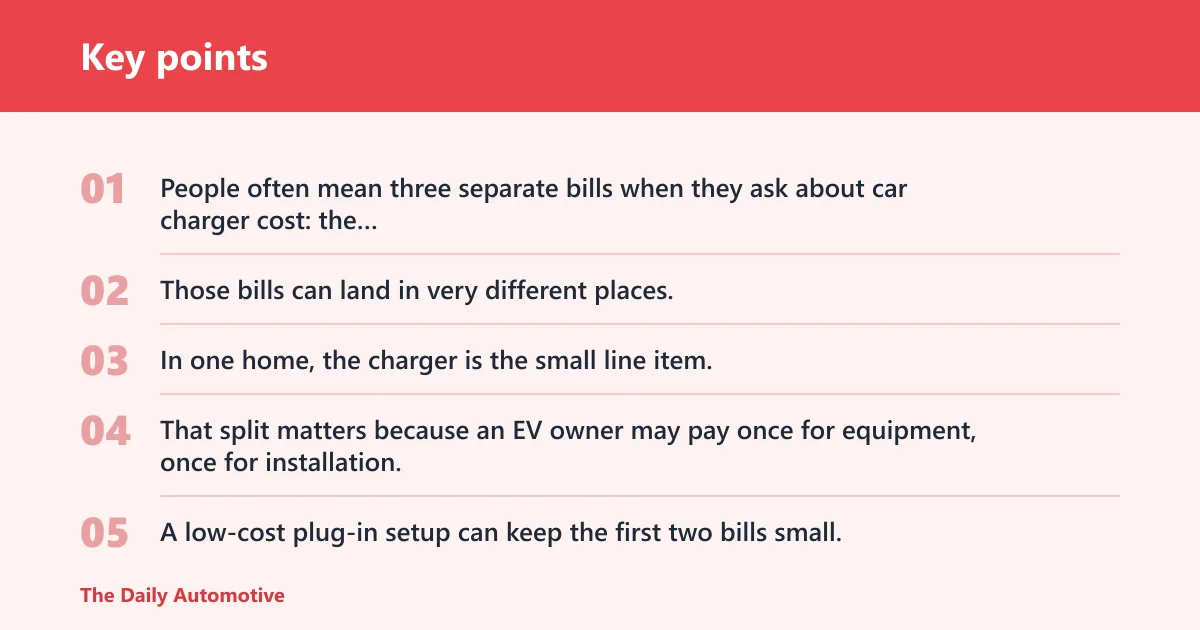


People often mean three separate bills when they ask about car charger cost: the hardware, the electrician’s work, and the electricity used to charge the vehicle. Those bills can land in very different places. In one home, the charger is the small line item. In another, the panel work is the big one.
That split matters because an EV owner may pay once for equipment, once for installation, and then pay for charging every month. A low-cost plug-in setup can keep the first two bills small. A detached garage, long cable run, or panel upgrade can move the project into a much higher bracket.
Equipment price
Home EV charger equipment typically costs extra beyond installation and varies by brand, smart features, and whether you choose a wallbox or a hardwired unit. A basic unit can be modest; connected models with app control, scheduling, and load management usually cost more. For a car battery charger, the price point is different again, because that phrase can mean a 12-volt battery maintainer rather than an EV charger.
Installation price
Installation is the bill that changes fastest with the home. A standard job often includes labor, wiring, conduit, breaker, testing, and warranty. If the electrician has to extend cable far from the panel, add a sub-panel, cut through finished surfaces, or upgrade the main service, the quote can rise quickly.
Charging electricity
Electricity is the recurring cost. It depends on the battery size in kWh, the vehicle’s efficiency, and the tariff you pay. Standard residential electricity in the U.S. was 17.45 cents per kWh in April 2025. An off-peak EV tariff can be far lower than a daytime rate, so the same car can cost much less to fill at night than in the afternoon.
How much does a car charger cost?
For a home EV, the charger itself usually sits in the hundreds, not the thousands. A Level 1 charger is the lowest-cost option, a Level 2 unit is the common home choice, and a DC fast charger is a very different category that is usually not a home purchase at all. The hardware price alone rarely tells the full story.
Level 1 charger price
A Level 1 EV charger uses a 120-volt outlet, charges slowly, and is often included with the vehicle. It is best for low-mileage drivers who can leave the car plugged in for long periods. The hardware cost may be low or already covered, but the tradeoff is speed.
Level 2 charger price
A Level 2 EV charger uses a 240-volt outlet and is the typical home charging setup. A NEMA 14-50 outlet is described as a 240-volt outlet for plug-in Level 2 chargers. Chargerpedia says home EV charger prices start from $700 to $2,000 for individual use, while the proof range above shows many consumer units in the $300 to $800 band depending on features.
DC fast charger cost
A DC fast charger, also called a Level 3 charger, is much more powerful than Level 2 and is usually a public-only option. The same source says commercial charging stations can cost $10,000 to $20,000, and setup can run much higher once electrical work and site construction are included. These stations are built for rapid top-ups, not home parking.
How much does installation cost?
Home EV charger installation typically ranges from $800 to $3,000 before equipment. That number can climb if the electrical panel is tight on capacity, the run is long, or the site needs trenching. Permits may add more. The easy installs are routine; the hard ones are where the quote changes sharply.
Easy home install
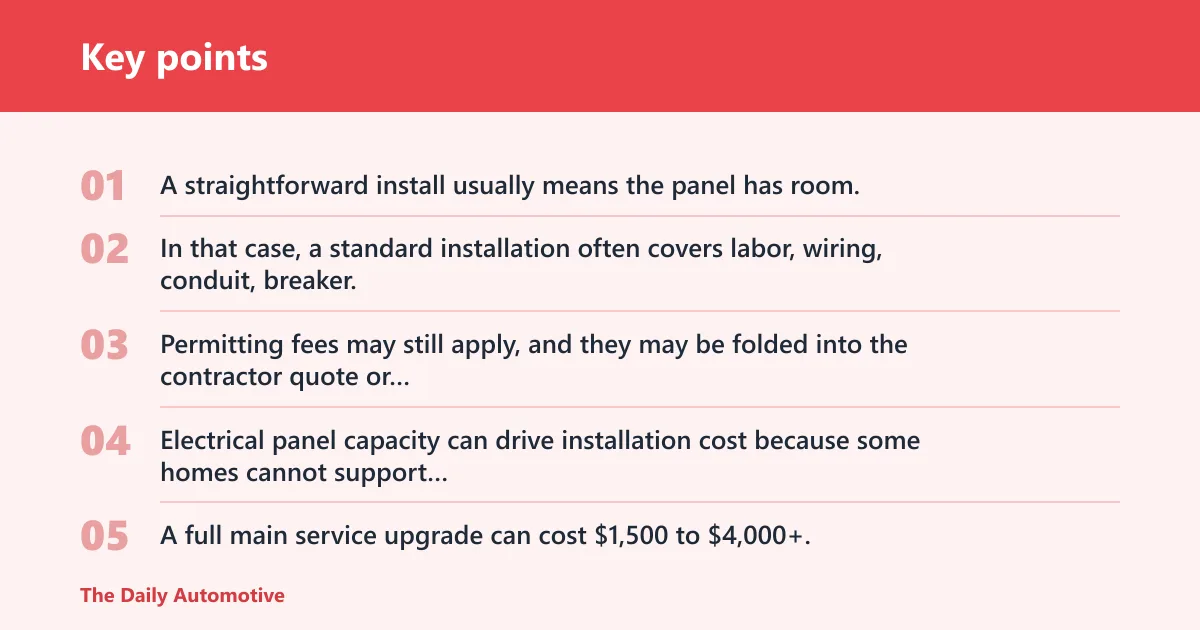
A straightforward install usually means the panel has room, the charger mounts close to the electrical source, and the route is simple. In that case, a standard installation often covers labor, wiring, conduit, breaker, testing, and warranty. Permitting fees may still apply, and they may be folded into the contractor quote or billed separately.
Panel upgrades and sub-panels
Electrical panel capacity can drive installation cost because some homes cannot support an EV charger without changes. A full main service upgrade can cost $1,500 to $4,000+. Older homes, especially ones with smaller service capacity, are common candidates for a sub-panel or a full upgrade when the electrician runs the numbers.
Permits, wire runs, and trenching
Permitting fees may run from $50 to $800 depending on jurisdiction. Long wire runs, a detached garage, or trenching across a driveway can push the job well past a basic quote. These are the expensive edge cases that many online averages skip. They are also the reason one home may see a modest bill while another sees a much larger one.
Say your panel is in the garage and the charger mounts on the same wall. The bill may stay near the low end. Change one variable, and the quote shifts. Put the charger in a detached garage 60 feet away, and the electrician may need trenching or a longer conduit run, which can push installation cost up fast.
How much does charging cost at home?
Home charging cost comes from electricity use, not the charger hardware. The bill depends on battery size, how empty the battery is, the car’s efficiency, and your tariff. For many drivers, off-peak charging is the key difference between a cheap routine and a noticeably higher monthly bill.
Electricity rate and off-peak pricing
Utility pricing matters as much as charger speed. Cord EV reports that standard home tariff charging can be around 26p/kWh, while off-peak EV tariff charging can drop to around 7p/kWh. That gap is large enough to change the economics of home charging. Many owners save by scheduling charging overnight.
Battery size and cost to fill
Battery size in kWh sets the basic fill cost. A 63-kWh EV battery at 15.38 cents per kWh costs $9.69 for a full charge. Bigger batteries cost more to fill, even if the per-kWh price stays the same. A vehicle with a larger pack will usually cost more per session than a smaller one.
Cost per mile estimate
A simple way to estimate charging cost is: battery size × electricity rate = full-charge cost, then divide by range for a rough cost per mile. The Hyundai Ioniq 5 base battery example has a 245-mile range, which gives a useful yardstick for planning. At home, many drivers land in the low cents per mile range, especially on off-peak rates.
Suppose a driver charges a 63-kWh EV overnight at an off-peak rate. The same battery costs far less than it would on a standard daytime tariff. The charger did not change. The bill did, because the tariff changed.
Car charger cost matrix
| Scenario | What is included | What is excluded | Likely cost driver |
|---|---|---|---|
| Basic home setup | Level 1 or simple Level 2 equipment, short run, standard labor, breaker, testing | Panel upgrade, trenching, detached garage work, major permit issues | Equipment price is usually the smaller bill; electricity is the recurring cost |
| Harder home install | Level 2 unit, electrician labor, longer wiring, conduit, possible sub-panel | Public charging fees, vehicle purchase, separate utility tariff changes | Electrical panel capacity, long wire runs, trenching, and permits |
| Public charging only | No home equipment, pay-per-use charging at rapid or ultra-rapid sites | Home installation, panel work, private wallbox costs | Charging speed, network type, and location; rapid charging is usually pricier per kWh |
| Battery charger vs EV charger confusion | 12-volt battery charger or maintainer, or a true EV charger depending on the product | Assumption that a small battery charger will charge an EV traction battery quickly | Product type; the phrase “car charger” can mean very different hardware |
Which cost drives the bill?
Equipment matters most when the install is simple and the charger has extra features. Installation matters most when the home needs panel work, a long cable run, or trenching. Electricity matters most over time, especially for high-mileage drivers or anyone on an expensive daytime tariff. The biggest bill depends on which part of the setup is hardest.
When equipment matters most
If the home already has an easy path to power, hardware choice becomes more visible. A basic plug-in model costs less than a smart charger with scheduling, load management, and app control. For low-mileage drivers, a Level 1 or simple Level 2 unit can be enough.
When installation matters most
Installation becomes the main cost when the home electrical setup is the constraint. Older homes can have limited panel capacity, and that is where the quote can shift from modest to costly. A panel upgrade, sub-panel, or trenching job can outweigh the charger price by a wide margin.
When electricity matters most
Electricity dominates for drivers who charge often, drive more miles, or rely on public fast charging. RAC says home charging is usually cheaper than filling up with petrol or diesel, but that advantage grows or shrinks with tariff choice. Off-peak rates help. Rapid charging can reduce convenience costs, but the per-kWh price is much higher.
What changes the quote?
Three things change the quote most often: electrical panel capacity, charging location, and local permitting rules. Site prices can also shift with utility rates, network fees, and the speed of the charger you choose. The cheapest advertised setup is not always the cheapest installed setup.
Electrical panel capacity
Panel capacity can determine whether the job is a minor add-on or a larger electrical project. If the panel has spare room and the service is adequate, installation tends to be simpler. If not, the electrician may recommend load management, a sub-panel, or a full service upgrade.
Charging location
Home charging and public charging do not cost the same, and rapid or ultra-rapid charging usually costs more per kWh than home electricity. The same source says public rapid charging can cost 65 to 89p/kWh. That makes it useful for travel and quick top-ups, but expensive as a daily routine.
Permitting and utility rates
Permitting fees may be part of the quote or added later, depending on the jurisdiction. Utility rates also matter because standard home tariff pricing and off-peak EV tariff pricing can differ sharply. A charger that is cheap to buy can still produce a high bill if the local rate is steep and the vehicle charges during peak hours.
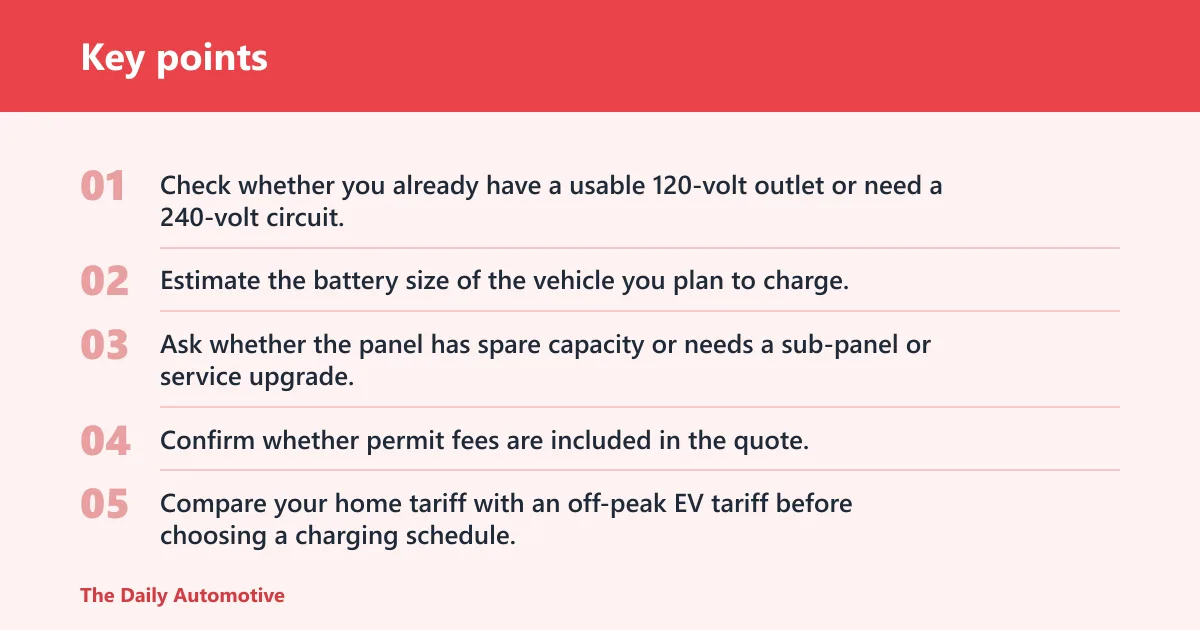
- Check whether you already have a usable 120-volt outlet or need a 240-volt circuit.
- Estimate the battery size of the vehicle you plan to charge.
- Ask whether the panel has spare capacity or needs a sub-panel or service upgrade.
- Confirm whether permit fees are included in the quote.
- Compare your home tariff with an off-peak EV tariff before choosing a charging schedule.
Frequently asked questions
How much does it cost to install a car charger?
Home EV charger installation typically ranges from $800 to $3,000 before equipment. A standard job may be simple, but a long wire run, detached garage, permit cost, or panel upgrade can push the total higher. If the main service needs work, the bill can rise into the several-thousand-dollar range.
How much does charging a car cost at home?
At home, the cost depends on your electricity rate, battery size, and how much energy the car needs. A 63-kWh battery at 15.38 cents per kWh costs $9.69 for a full charge. Off-peak tariffs can lower that further, while a higher standard rate raises the bill.
How much is a car battery charger?
That phrase can mean a 12-volt battery maintainer or a true EV charger. A small battery charger is usually much cheaper than a Level 2 EV unit. If you are shopping for an electric car, make sure the product is meant for the traction battery, not the small auxiliary battery.
How much electric car charger cost
Some home EV charger products are listed higher when they include smart features or app control. Installation is separate and can easily exceed the hardware price if the home needs electrical upgrades.
How much does it cost to charge an electric car?
Home charging is usually the cheapest option, while public rapid charging costs more per kWh. The exact amount depends on battery size, tariff, and charging location. Standard home rates can be much lower than rapid public rates, so the same car can cost very different amounts depending on where you plug in.
Products related to this article
Sponsored / affiliate links. As an Amazon Associate I earn from qualifying purchases. I may earn additional commission from eligible campaigns.