Car Door Sill Plates vs. Door Sill Guards
Choose Car Door Sill Plates if you want a factory-style finished look; choose Door Sill Guards if your priority is scuff protection and easy replacement after heavy foot traffic. Pick the wrong part, and you will see shoe marks, worn paint, or trim that looks out of place. This guide compares materials, coverage, fit, and daily use so you can match the part to how you enter, exit, and load the car.
| Decision factor | Car Door Sill Plates | Door Sill Guards | Winner |
|---|---|---|---|
| Primary purpose | Decorative trim with an OEM-style finish | Protection-first scuff and kick control | Door Sill Guards |
| Appearance | Usually more polished, etched, or logo-driven | Usually simpler, with appearance secondary to coverage | Car Door Sill Plates |
| Replacement ease | Often used as a trim piece that should match the vehicle closely | Often easier to swap when the surface gets marked or worn | Door Sill Guards |
| Best fit use case | Restoration, show trim, and interior finish upgrades | Daily use, family traffic, and loading wear | Tie |
| Coverage focus | Door opening edge and visible sill area | Door opening edge, front or rear entries, and some boot sill areas | Door Sill Guards |
What is a door sill plate?
A door sill plate is a decorative or OEM-style trim plate fitted across the door opening. It leans toward appearance first, with protection as a useful side effect. Many are model-specific, and they are often sold as pairs or multi-piece sets for a closer match to the vehicle’s interior finish.
Decorative trim and OEM-style finishes
Door sill plates are the better choice when you want the opening to look finished rather than padded or rugged. They often use stainless steel, aluminum, zinc, etched finishes, vinyl, acrylic, or light-up styling. On a classic car, that visual match matters more than a plain protective strip.
Common materials and how they are sold
Some sellers package sill plates as front-door pairs only; others offer multi-piece sets for more coverage. SNJ Parts lists 28-31 coupe aluminum sill plates at $14.00, while Cadillac Parts Ltd lists 1954 Cadillac Coupe and Convertible Door Sill Plates at $788.50. That spread shows how much value depends on fitment, finish, and the vehicle they are made for.
What is a door sill guard?
A door sill guard is a protective scuff plate or kick plate meant to reduce daily wear from shoes, heels, and loading edges. It is usually the better pick when the sill gets stepped on often. The job is simple: take the abrasion, limit paint damage, and make replacement less painful later.
Protection-first scuff control
These parts are sold to prevent sill damage from daily use. That includes shoe scuffs, heel marks, and contact from bags, tools, or cargo being dragged in and out. They do not make the sill area damage-proof, but they can slow down the wear that shows up first.
Front, rear, and boot sill coverage
Fitment matters here. JK Auto Styling says its door sills are offered for both front and rear doors, and it also notes that 3-door cars can use sets of 2 for the front doors. Some aftermarket collections also cover the boot sill or trunk sill, which is a separate cargo-entry area and not the same as a door sill.
Materials and finishes
Material choice changes the look and the job. Stainless steel usually sits higher on the price ladder, black plastic keeps cost down, and decorative options like vinyl, acrylic, or LED styles lean toward appearance. The right pick depends on whether you want a visible accent or a wear layer.
Stainless steel and aluminum
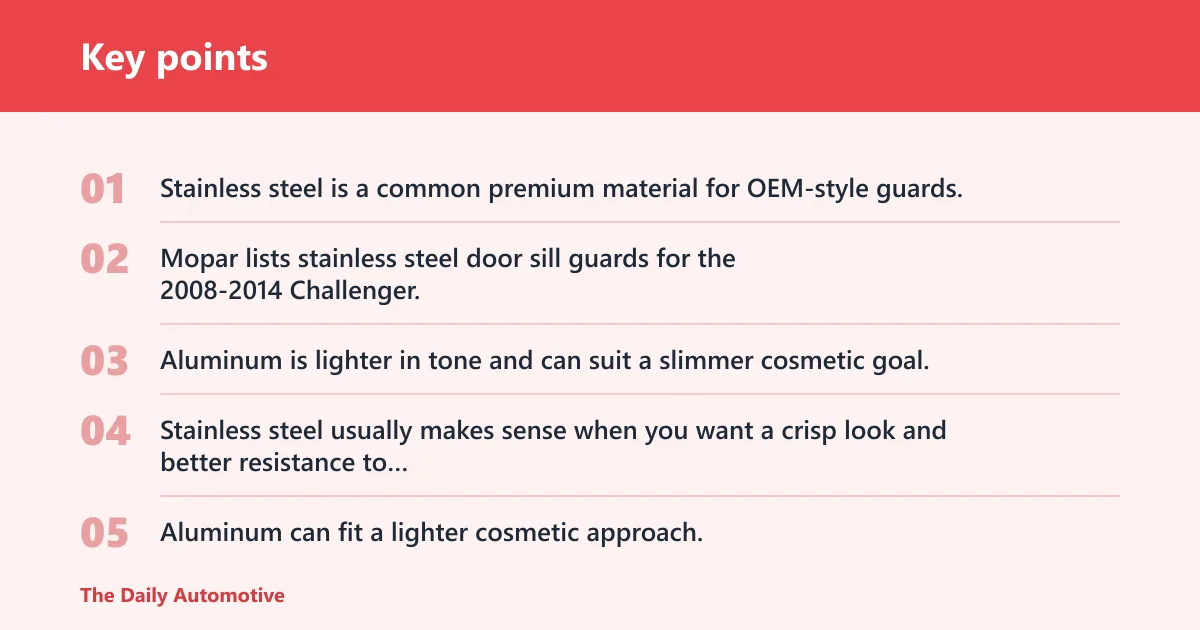
Stainless steel is a common premium material for OEM-style guards, including Mopar and aftermarket collections. Mopar lists stainless steel door sill guards for the 2008-2014 Challenger, with an in-cart price of $127.65. Aluminum is lighter in tone and can suit a slimmer cosmetic goal; SNJ Parts lists aluminum sill plates at the lower end of the price range.
Stainless steel usually makes sense when you want a crisp look and better resistance to repeated shoe contact. Aluminum can fit a lighter cosmetic approach, especially on classic or coupe applications where the finish is part of the cabin styling.
Black plastic, vinyl, acrylic, and LED styles
Black plastic is the lower-cost guard material and is used in Mopar Jeep examples, where protection comes before appearance. The same source lists black plastic sill guards for the 2 Door Wrangler JL at $63.25. Vinyl, acrylic, and custom LED versions are more style-led, with JK Auto Styling saying its door sill collection includes stainless steel, vinyl and acrylic led light up plates.
Custom LED door sill protectors are usually more about visual effect than heavy-duty abrasion control. The same source lists a custom wireless LED colour change set at £59.95 and custom LED door sill protector strips at £70.80. If you want a light-up entry point, that category makes sense; if the goal is kick resistance, a plain guard is usually the more direct buy.
Fitment and coverage
Model-specific fitment matters more than generic sizing. A plate that misses the door opening by a few millimeters will stand out fast, and a guard that does not follow the sill line can leave the most worn area exposed. Check the vehicle generation, door count, and whether the set covers front, rear, or boot sill areas.
Front-only versus front and rear
Some sets cover only the front doors, while others cover both front and rear openings. That matters on family vehicles, because rear-seat passengers often scuff the threshold as they climb in. A front-only set can be enough for a 3-door car or a coupe, but it is not enough for every use case.
Say your family SUV gets stepped into every day by children wearing chunky trainers. A front-only plate may leave the rear sill untouched, which means the visible wear shifts to the part of the car that gets used most often by passengers.
3-door cars and boot sill options
The same source says 3-door cars can use sets of 2 for the front doors. That is a practical reminder that the number of doors changes the kit you should buy. Some aftermarket collections also add boot sill coverage for cargo loading, which helps when suitcases, crates, or prams slide across the rear edge.
Picture a sporty coupe with a low opening and a narrow rear cargo lip. A boot sill guard can make more sense than a decorative plate there, because the load edge is what gets hit first, not the visible door trim.
How do you install door sill protectors?
Most adhesive-backed sill parts install with basic prep, but the process is not risk-free. The same source says its scuff plates come with pre-applied 3M adhesive tape, and it also says to clean and dry the surface before installation. That matters for bond strength, alignment, and later removal.
3M adhesive tape and prep steps
- Check the vehicle listing for exact fitment by make, model, year, and door count.
- Clean the sill area thoroughly and dry it fully before fitting.
- Test the alignment without removing the backing tape.
- Peel the adhesive backing and press the part into place.
- Hold firm pressure along the full edge so the tape bonds evenly.
3M adhesive tape makes DIY fitting simpler because the part arrives ready to mount. The trade-off is that surface contamination, moisture, or poor alignment can leave residue or weaken the bond. That is why prep is not optional.
Replacement fitment versus overlay fitment
Replacement-fit parts are meant to sit as the main visible trim piece, while overlay-fit parts sit on top of the existing surface. Overlay fitment can be easier for DIY installation, but it can also add thickness and change how the edge looks when the door closes. Replacement fitment usually looks cleaner if the part is made for the exact vehicle.
Removal, residue, and paint-safety concerns
Adhesive-backed parts can leave residue when removed, and older paint or previously repaired surfaces need extra care. A common first-timer mistake is sticking a guard over dust or wax, then pulling it off later and finding patchy adhesive left behind. A careful removal plan matters as much as the install.
Sill plates decision table
This table maps common use cases to the material, fitment area, install method, and wear resistance you should expect. The point is not to rank every product line. It is to match the part type to the way the vehicle is used.
| Use case | Best material | Fitment area | Install method | Expected wear resistance |
|---|---|---|---|---|
| Daily driver | Black plastic or stainless steel | Front doors, and rear doors if passengers step there often | Pre-applied 3M adhesive tape on many aftermarket sets | Good for shoe scuffs and repeated entry wear |
| Family SUV | Stainless steel or black plastic | Front and rear doors | Overlay fitment with clean, dry surface prep | Good for heel marks and passenger traffic |
| Classic car restoration | Aluminum, zinc, or etched finish | Model-specific front opening or full set | Replacement-fit or exact-matched adhesive fit | Moderate, with appearance taking priority |
| Sporty coupe | Stainless steel or etched finish | Front doors only on many 2-door cars | Model-specific adhesive-backed fitment | Good at protecting the visible entry edge |
| Custom LED styling | Vinyl, acrylic, or LED light-up style | Front doors, rear doors, or both depending on the kit | Usually adhesive-backed; check power and mounting details | Lower than a plain metal guard for abrasion control |
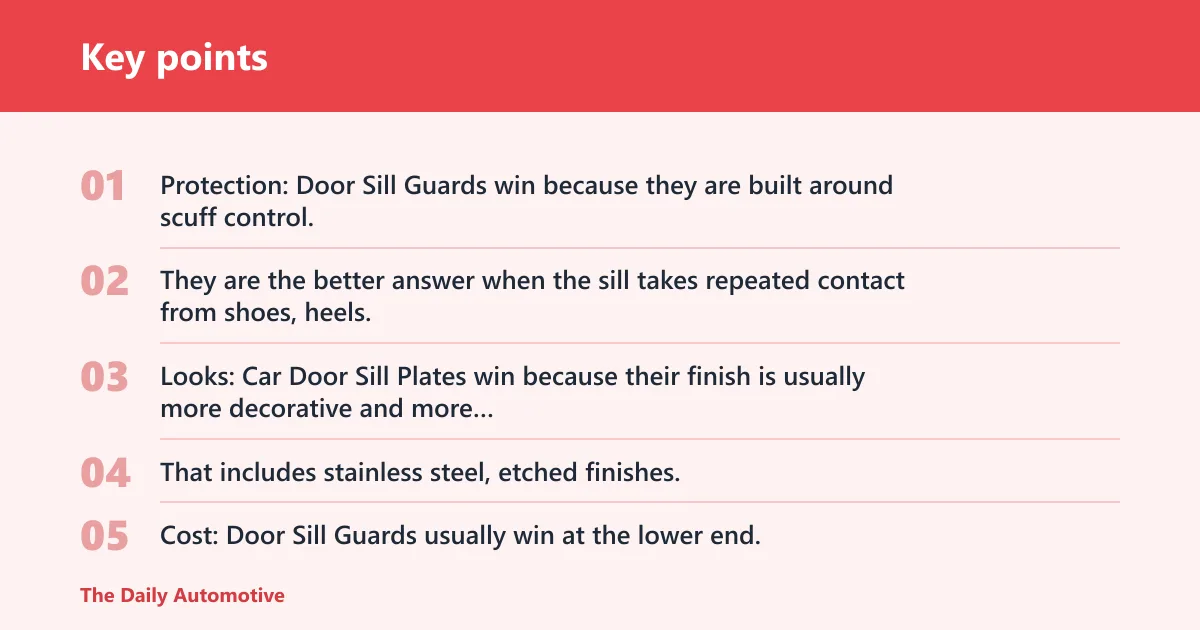
Protection: Door Sill Guards win because they are built around scuff control, not just appearance. They are the better answer when the sill takes repeated contact from shoes, heels, or cargo edges.
Looks: Car Door Sill Plates win because their finish is usually more decorative and more likely to match an OEM-style cabin. That includes stainless steel, etched finishes, and light-up styling when visual effect matters most.
Cost: Door Sill Guards usually win at the lower end, especially black plastic examples like the Mopar Jeep part at $63.25. Car Door Sill Plates can be cheap on some coupes, but restoration and branded fitment can climb sharply, as the Cadillac example shows.
DIY difficulty: Door Sill Guards usually have the edge because many arrive with pre-applied 3M adhesive tape. The install is still only as good as the surface prep, but the basic process is simple for a careful owner.
Choose Car Door Sill Plates if… / Choose Door Sill Guards if…
Choose Car Door Sill Plates if you want a cleaner factory-style look, you are restoring a classic, you care more about trim match than heavy scuff control, or you want etched, aluminum, or light-up styling at the door opening.
Choose Door Sill Guards if your vehicle sees frequent entry and exit, passengers kick the sill area often, you want front and rear coverage, or you need a part that is easier to replace after wear.
If the car is a daily driver or family SUV, guards usually make the better use-case choice. If the car is a coupe, show build, or restoration project, plates usually make more sense because the finish matters as much as the function.


Frequently asked questions
What is a car door sill?
The car door sill is the threshold area you step over when entering or leaving the vehicle. It is one of the first places to show shoe marks, heel wear, and scratches from cargo or bags. That is why both decorative plates and protective guards are sold for it.
Are car door sill protectors worth it?
They are worth it when the sill area gets regular contact from shoes, children, tools, or cargo. They are less useful if the opening rarely gets stepped on and you only want a cosmetic upgrade. The right answer depends on how the vehicle is used, not on the accessory alone.
How do you install a car door sill protector?
Most adhesive-backed protectors install by cleaning and drying the surface, checking alignment, peeling the backing, and pressing the part into place. The same source says some scuff plates come with pre-applied 3M adhesive tape and that the surface should be clean and dry before installation. That prep is what keeps the bond stable.
Do door sill guards prevent scratches?
They help reduce scratches, scuffs, and kick marks, especially in the high-contact entry zone. They do not make the sill damage-proof, and they will not stop every scrape from heavy cargo or a sharp object. Their job is to absorb common wear before the painted sill does.
Can door sill plates fit front and rear doors?
Yes, some sets fit both front and rear doors, but many do not. The same source says it offers door sills for both front and rear doors, and it also notes that 3-door cars can use sets of 2 for the front doors. Check the listing for your body style before buying.
Products related to this article
Sponsored / affiliate links. As an Amazon Associate I earn from qualifying purchases. I may earn additional commission from eligible campaigns.